A Rinnai flashing LC0 is not broken. It is keeping a tally. Somewhere inside the control board a counter has been adding up every hour the burner has fired, and once that total crosses a maintenance threshold, on many models around 500 burn hours, it puts LC0 on the screen to tell you scale is building in the heat exchanger and a flush is due. The unit keeps making hot water the whole time, which is exactly why people let it slide. LC0 is the lowest rung on a ladder that climbs to LC9, and the earlier you deal with it the cheaper and easier the fix stays.
What LC0 is actually telling you
Rinnai groups plain LC and LC0 through LC9 into one family: scale build-up in the heat exchanger. The number is not an error severity in the usual sense, it is a count. The board tracks cumulative burner-on hours, and when it reaches the service interval it starts at LC0. Keep running the unit without addressing the scale and the count ticks up, LC0 to LC1 to LC2, on toward LC9, each step marking more burn hours logged since the reminder first appeared. So LC0 is the friendliest version of the warning. It means you caught it early. LC9 means the unit has been begging for a flush for a long time.
First, confirm it is a soft lockout
The LC codes are unique in Rinnai's list because the unit keeps operating with them showing. The display alternates between the LC code and your set temperature, and hot water still flows. Run through these before you do anything else so you know what you are dealing with.
- Look at the display: LC0 should alternate with your temperature setpoint, not sit as a solid fault.
- Confirm you still get hot water at the tap. If you do, it is the soft scale reminder, not a hard lockout.
- Check whether the unit has isolation service valves on the hot and cold lines. You need them to flush.
- Think about your water: hard water, no softener, and a unit a year or more past its last flush all fit.
- Note the exact code. LC0 is early; LC7, LC8, LC9 mean the scale has been ignored much longer.
- Do not just silence it and walk away. A soft lockout that is never fixed eventually hard-locks the unit.
Reading the situation before you flush
The code points at scale, but the right response depends on what you find. This is the order to think through it, from the quick temporary fix to the permanent one to the cases that need a pro.
Buy time with the 5-press temporary run
If you need hot water right now and cannot flush yet, press the On/Off button on the controller five times in a row. The code clears and the unit runs for about 70 hours, then locks out again with another LC code. This is a reprieve, not a repair. It does not touch the scale or reset the real counter.
Descale the heat exchanger
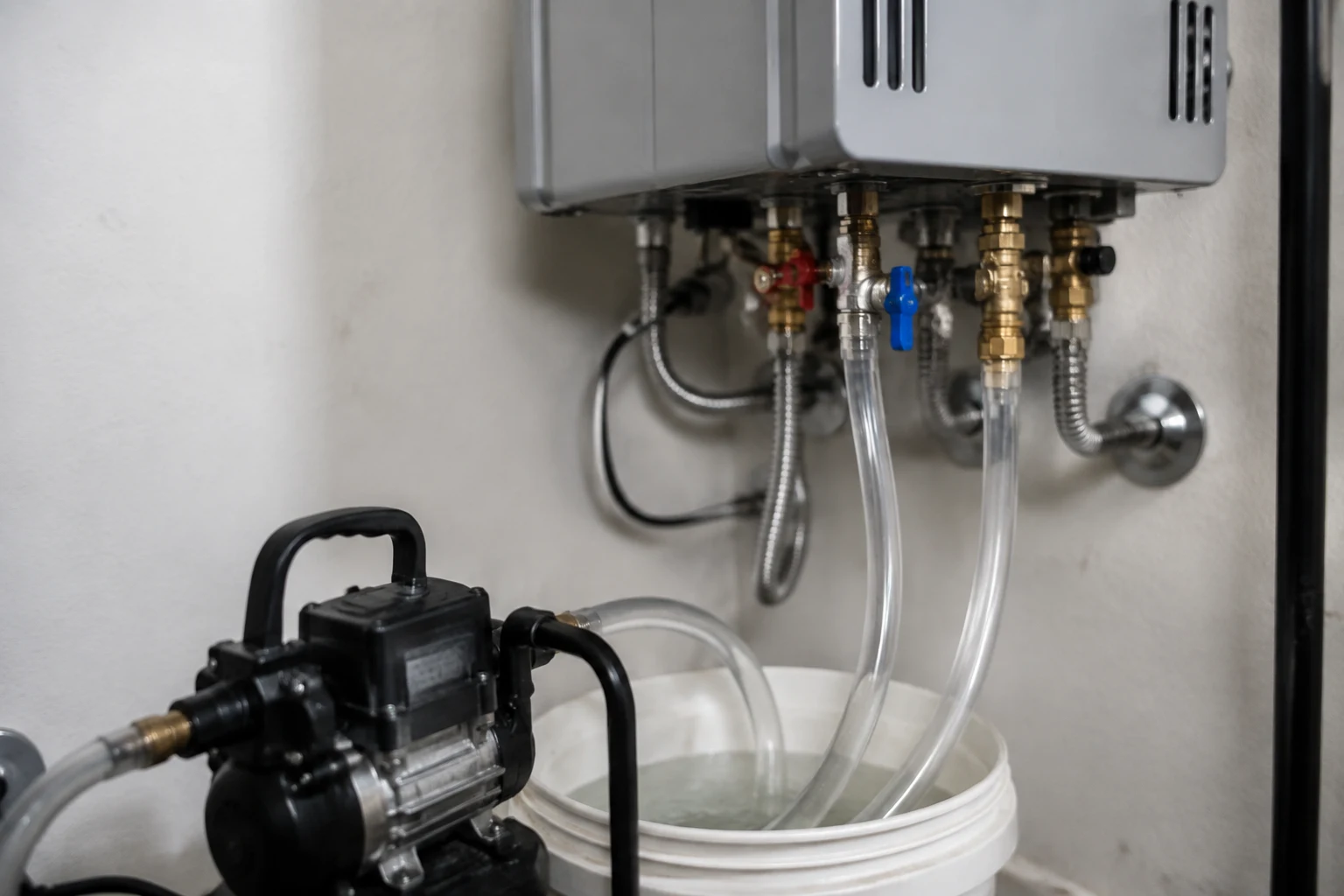
This is the actual fix. Close the isolation valves, connect a submersible pump and two hoses into a closed loop through the exchanger, and circulate food-grade white vinegar or a Rinnai-approved descaler for 45 to 90 minutes. Run the full time if an LC code triggered the flush, since a quick pass leaves scale behind. Rinse with clean water afterward.
Reset the maintenance counter
After the flush you must zero the count or the display keeps showing LC. Sources differ by model: some units clear by cutting power and turning it back on, others need the A and B switches on the PC board held together for about five seconds, which returns the LC number to 0. Use the sequence for your model.
Treat the water if LC0 returns fast
A code that comes back within weeks means hard water is scaling the exchanger faster than an annual flush can manage. The durable fix is a water softener or a scale-inhibiting filter on the cold inlet. Flushing more often helps, but you are fighting the water chemistry, not the unit.
Call a tech for a stubborn or damaged unit
If LC0 persists after a proper flush and reset, the flow sensor wiring can be misreading, or the exchanger is scaled badly enough to need replacing. Both are worth a licensed tech with the model service sheet, especially if you have been ignoring the code long enough to climb into the high LC numbers.
The short version
Key takeaways
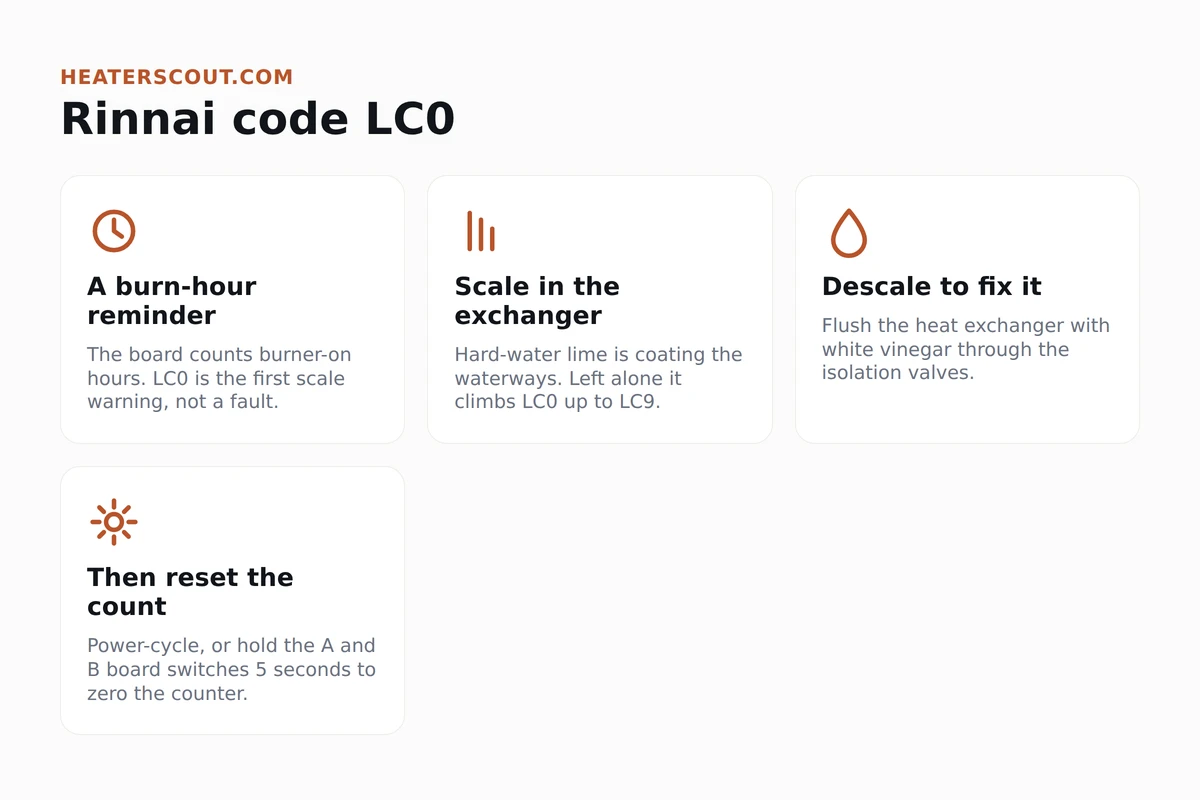
- LC0 is the first scale-accumulation reminder in Rinnai's LC0-LC9 series, driven by cumulative burn hours.
- It is a soft lockout: the unit keeps heating and the display alternates the code with your temperature.
- Pressing On/Off five times gives about 70 hours of temporary run, it is not a real reset.
- The permanent fix is a heat-exchanger descale flush with white vinegar through the isolation valves.
- After flushing you must reset the counter, by power cycle or by holding the A and B board switches 5 seconds.
- If LC0 keeps returning, hard water is the culprit; add a softener or an inlet scale filter.
Doing the flush yourself
If your Rinnai has isolation service valves, this is a job a careful homeowner can do in about an hour. Nothing here touches gas or combustion, the whole procedure is on the water side. You need a small submersible pump, two hoses, a five-gallon bucket, and about four gallons of food-grade white vinegar. Kill power to the unit before you start.
Keeping LC0 from coming back
The counter that trips LC0 is doing its job, so the goal is not to silence it but to reach the threshold less often and clean the exchanger before scale gets a grip. Flush the unit once a year as a baseline, more often if you are on a well or known hard water. The real leverage is upstream: a water softener or a scale-inhibiting filter on the cold inlet slows mineral deposition dramatically, which stretches the interval between flushes and protects the exchanger from the thermal stress that cracks it. If your LC0 came back within a couple of months of a proper flush and reset, that is your water telling you an annual flush alone will not keep up. Treat the water and the code goes back to being the once-a-year reminder it was meant to be.
Frequently asked
What does Rinnai error code LC0 mean?
LC0 is the first entry in Rinnai's LC scale-accumulation series, LC0 through LC9. It is not a breakdown. The control board keeps a running count of how many hours the burner has fired, and when that total crosses a preset maintenance threshold, roughly 500 burn hours on many models, it starts flashing LC0 to warn you that mineral scale is building up inside the heat exchanger and a descale flush is due. LC0 is the gentlest level of that warning. If you ignore it and keep running the unit, the count climbs to LC1, LC2, on up to LC9 as more burn hours accumulate, and each step is telling you the scale problem is getting worse.
Does LC0 shut my Rinnai down or does it keep running?
It keeps running. The LC codes are the only Rinnai codes that let the unit continue to operate, which is why they are called a soft lockout. With LC0 showing, the display alternates between the LC code and your temperature setting, and you still get hot water. That is the catch: because nothing stops working, people ignore it for months. A soft lockout does not clear itself. If the underlying scale is never addressed the count keeps rising and the unit will eventually hard-lock and refuse to fire, and by then the heat exchanger has been running scaled for a long time. Treat LC0 as an early appointment reminder, not a false alarm.
How do I clear the LC0 code on my Rinnai?
There are two things people mean by clearing it, and they are not the same. Pressing the On/Off button on the controller five times in a row makes the code disappear and buys you about 70 hours of run time, then it locks out with another LC code. That is a temporary reprieve so you can finish a shower or wait for the weekend, not a reset. The real reset comes after you descale. Sources differ on the exact key sequence by model: some units clear by simply cutting power to the heater and turning it back on, while others require pressing the A and B switches on the PC board together for about five seconds, which returns the LC number to zero. Check the procedure sheet for your model. Do the flush first, then reset, or the count just returns.
Will descaling clear the LC0 code?
Descaling is the fix, but the flush alone does not always clear the code. You have to descale and then reset the maintenance counter. The LC series exists specifically to prompt a heat-exchanger flush, so running descaling solution or white vinegar through the exchanger addresses the actual cause. After the flush you reset the count, either by power-cycling the unit or by holding the A and B board switches for five seconds depending on model, and the LC number returns to zero. If you skip the reset the display keeps showing LC even though the exchanger is now clean. If you reset without flushing, you have only silenced the reminder and the scale keeps building until the count trips again.
How much does it cost to fix a Rinnai LC0 code?
If you do the flush yourself, the cost is a one-time kit and a few gallons of vinegar. A DIY Rinnai descale kit, a small submersible pump rated around 1,200 gallons per hour, two hoses, and a five-gallon bucket, runs roughly $130 to $200 and you reuse it every year. Four gallons of food-grade white vinegar is about $12. That assumes your unit already has isolation service valves; if it does not, add a plumber's visit or a valve kit to install them. Having a pro come out to flush the unit typically runs about $150 to $300 depending on your area. The expensive outcome only shows up if you ignored LC0 for years and scale ruined the heat exchanger, which is a several-hundred-dollar part plus labor. That is exactly what the code is trying to prevent.
Why does my Rinnai LC0 keep coming back after flushing?
A few reasons. The most common is that you flushed but never reset the counter, so the display keeps showing the code even though the exchanger is clean. Do the model-correct reset after the flush. If you did reset and LC0 returns quickly, the flush may not have removed enough scale, run the descale for the full 45 to 90 minutes rather than a quick pass, and use fresh solution. Recurring codes at short intervals usually mean hard water is packing the exchanger faster than an annual flush can keep up, and the long-term answer is a water softener or a scale-inhibiting filter on the cold inlet. In stubborn cases the flow sensor wiring can read wrong, or the exchanger is scaled badly enough that it needs replacing, both of which are worth a tech's eyes.
Is the Rinnai LC0 code dangerous?
The code itself is not dangerous, it is a maintenance warning working exactly as designed. The risk is what happens if you ignore it. Scale is an insulator. As it coats the heat exchanger, the burner has to fire harder and longer to push heat through the mineral layer, which drives up your gas use and overheats the metal locally. Over time that thermal stress can crack the exchanger, the single most expensive part in the unit. So LC0 is low urgency on the day it appears and high consequence if left for a year of showers. There is no gas or combustion hazard in dealing with it, the whole job is on the water side, which keeps it a reasonable DIY task if your unit has service valves.