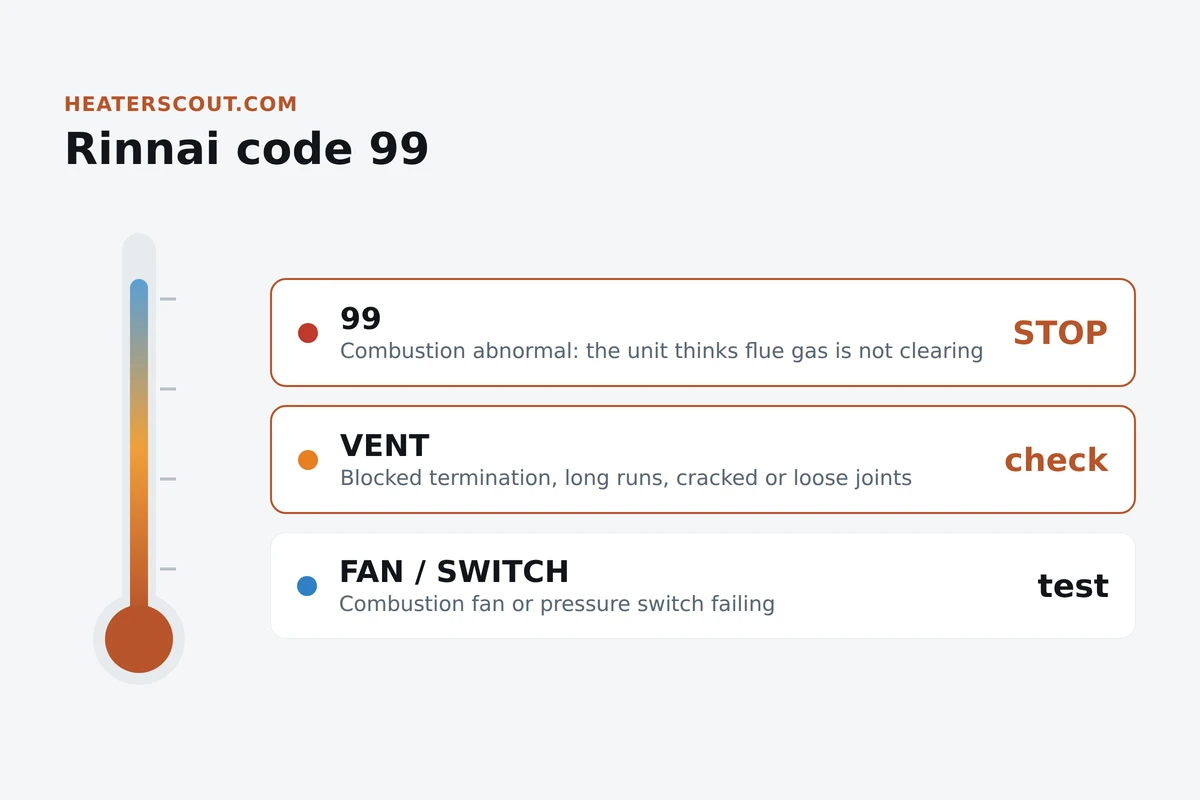
A Rinnai flashing 99 is not complaining about water temperature or a failed ignition. It is telling you it does not believe its own exhaust is getting out of the building. The control board watches the combustion air and vent path, and the instant it cannot confirm that flue gas is clearing, it shuts the burner off and shows 99. That is a carbon monoxide safety lockout, which is why this code sits in a different category from the sensor faults you can chase with a screwdriver and a meter.
One code, two model families
Before you order a part, get the meaning straight, because Rinnai does not use 99 on every unit. Sources and manuals agree on the idea but split on the display. On EnergySaver direct-vent wall furnaces and some heaters, the combustion-abnormal or flue-blockage fault prints as 99. On modern condensing tankless water heaters, the equivalent air-supply and exhaust blockage fault usually shows up as code 10 instead. So if your tankless unit is throwing 99 and a guide only lists 10, you are not reading the wrong guide, you are reading a different model line. The fix logic is the same either way. What differs is the number on the display, and you confirm that against the diagnostic code table for your exact model rather than assuming.
What 99 actually means
- The board cannot confirm exhaust is clearing the flue.
- It locks out the burner to avoid burning while it cannot vent.
- The trigger is combustion air and exhaust, not water or ignition.
- Unvented combustion gas is carbon monoxide, so this is a safety stop.
What 99 does not mean
- Not a scale or flow problem, so descaling will not touch it.
- Not a temperature sensor fault you can ohm out and swap.
- Not always a real blockage: a bad pressure switch fakes it.
- Not a code to bypass or jumper so the unit will run.
Why the board is so strict about venting
A gas tankless heater or wall furnace burns fuel and produces exhaust that has to leave the building through the flue. If that exhaust cannot get out, the combustion products, including carbon monoxide, back up into the space you are trying to heat. To catch that, Rinnai uses a combustion fan that moves air through the burner and a pressure switch that confirms the fan is actually creating the airflow it should. When the switch does not see the pressure it expects, the board assumes the vent is blocked or the fan is not moving air, and it refuses to fire. That refusal is 99. The system is deliberately conservative: it would rather false-alarm on a marginal reading than let the unit run one cycle while it cannot prove the flue is open. That is also why a perfectly clear vent can still throw 99 when the switch itself has failed.
Rinnai code 99
A combustion or venting abnormality. The control board cannot confirm that the unit is clearing its exhaust, so it locks out the burner rather than risk running while combustion gas backs up. Causes range from a physically blocked flue or vent termination, to venting that is too long or wrongly installed, to a weak combustion fan, to a pressure switch that reports a blockage that is not there. On EnergySaver furnaces and some heaters this prints as 99; on condensing tankless water heaters the same air and exhaust blockage fault often shows as code 10.
What a homeowner can safely check
There is a short, safe list you can work before calling anyone, and it clears a fair share of 99 faults. Everything on it is outside the combustion path. The moment the checks below do not clear the code, stop and bring in a technician, because the next steps involve testing airflow and the pressure switch on a live combustion appliance.
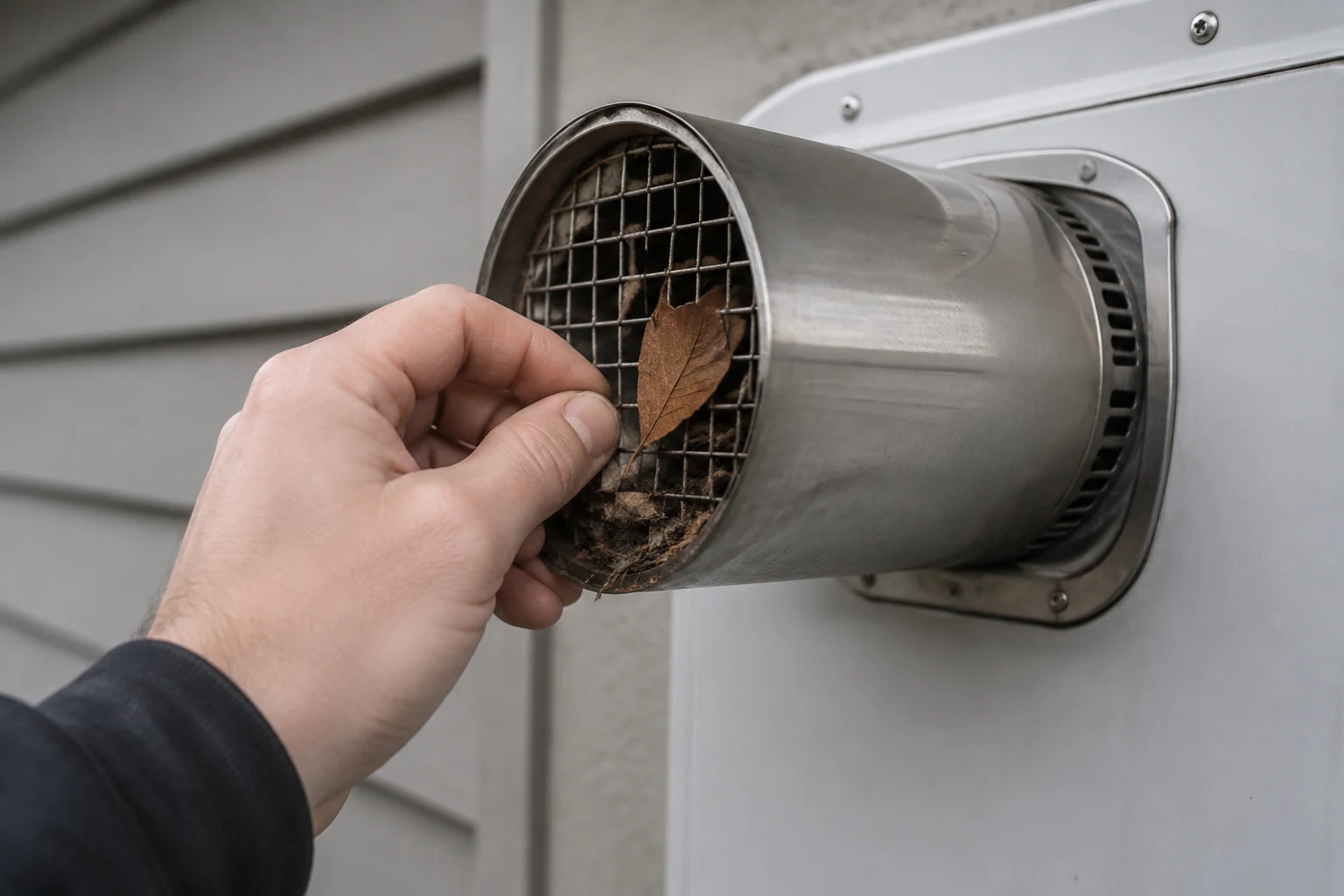
- Go outside and inspect the vent termination for a nest, snow, leaves, lint, or any obstruction, and clear it.
- Confirm the termination is not blocked by a wall, soffit, screen, or a nearby vent that lets exhaust recirculate.
- Check the gas is turned on at the unit and the meter, and on propane confirm the tank is not empty.
- Look at the visible vent pipe for a cracked, loose, or disconnected joint, and for sagging that traps condensate.
- Make sure the intake and exhaust are not iced over in cold weather or covered by drifting snow.
- Power cycle the unit for about 30 seconds to clear the latch, then watch whether 99 returns.
- If 99 comes back after the outside vent is confirmed clear, stop and call a licensed technician.
Where the pro picks it up
Past the outside checks, diagnosing 99 means proving whether the blockage is real or the switch is lying. A technician runs the unit and watches the combustion fan: is it spinning and actually moving air out the exhaust? If the fan is weak, dirty, or failing, it cannot build the pressure the switch needs, and the board reads that as a blockage. If the fan is clearly moving air and the flue tests clear, the pressure switch is the prime suspect. That switch connects to the board with a hose and a plug, and a failed one reports a blockage that is not there. The tech also checks vent length and configuration against the model's limits, because a run with too many elbows or too long a path can push the unit over the edge into 99 even when nothing is technically broken. This is manometer-and-service-sheet work, not a guess-and-swap job, which is why the honest answer for 99 is call a pro.
Keeping 99 from coming back
Most repeat 99 faults trace to venting and neglect, and both are preventable. Keep the outside termination clear: a quick look each season for nests, snow, and debris beats a no-hot-water morning. If the unit sits where snow drifts or ice builds, watch the intake and exhaust in a hard freeze. Get the annual service done, because the same visit that flushes the heat exchanger is when a tech can eyeball the combustion fan, check the pressure switch, and confirm the vent joints are tight. If the heater has thrown 99 before, it is worth having the venting checked against the model's allowed length and layout, since a marginal install will keep nudging the unit into a lockout on the coldest, windiest days when you need it most.
Frequently asked
What does Rinnai error code 99 mean?
Code 99 is a combustion or venting fault. The control board watches whether the unit is actually pushing its combustion byproducts out through the flue, and when it decides that is not happening it shuts the burner down and shows 99. In plain terms the heater believes exhaust is not clearing, which is a carbon monoxide risk, so it refuses to keep firing. On Rinnai the 99 display shows up most often on EnergySaver direct-vent wall furnaces and some heaters. On modern condensing tankless water heaters the same air-supply or exhaust blockage problem usually prints as code 10 instead. Sources differ on exactly which number a given model uses, so match the code table for your unit. Either way, the meaning is the same: the combustion air and exhaust path is not doing its job, and that is a safety lockout, not a nuisance.
Is Rinnai code 99 dangerous?
Treat it as the one code you do not ignore. The whole point of 99 is that the unit suspects it cannot vent its exhaust, and unvented combustion gas is carbon monoxide. The lockout is the safety system working: the heater would rather stop and show a code than keep burning while it cannot prove the flue is clear. Do not bypass, jumper, or tape over the pressure switch or any vent sensor to force it to run. If you ever smell exhaust indoors, feel lightheaded, or your CO alarm sounds, get out and call for help before you touch the heater. Because a real venting fault involves combustion products, the diagnosis past checking the outside vent belongs to a licensed technician.
Can I reset Rinnai error code 99 myself?
You can clear the latched code, but clearing is not the same as fixing it. Turn the unit off at the controller, cut power at the breaker or unplug it for about 30 seconds, then restore power. That drops the current fault so you can see whether it comes right back. Before you do, walk outside and look at the vent termination: a bird nest, a wasp nest, packed snow, leaves, or lint over the cap can trigger 99, and clearing that obstruction is a fix a homeowner can safely do. Also confirm the gas is on and, on propane, that the tank is not empty. If the code returns after a power cycle and the outside vent is clear, stop. The unit needs combustion testing and likely a part, not another reset.
Why does Rinnai code 99 keep coming back?
A code that returns means the venting fault is still live. The usual repeat causes, roughly in order: a vent termination that is partly blocked or too close to a wall, soffit, or another vent so exhaust recirculates back into the intake; a vent run that is too long or has too many elbows for the model; a cracked or loose joint in the vent pipe leaking or drawing wrong; a combustion fan that is weak, dirty, or failing so it cannot move enough air; or a pressure switch that has gone bad and reports a blockage that is not there. That last one is common: the flue tests clear and the fan runs, but the switch will not close, so the board throws 99. Chasing which of these is the real cause is exactly why 99 needs a technician with a manometer and the model service sheet.
How much does it cost to fix Rinnai code 99?
It depends on where the fault lands. If it is a blocked vent cap or a nest at the termination, the fix is free beyond your time to clear it and reset. If a pressure switch is bad, the part itself is inexpensive, often in the $15 to $80 range, but you are paying a technician to diagnose and confirm it, so a real combustion service visit commonly runs about $150 to $400 once you count the diagnostic fee and labor. A combustion fan or blower motor is the pricier part, frequently a few hundred dollars plus labor. Repairs that involve reworking undersized or non-compliant venting cost more because it is pipe and labor, not a plug-in part. Get the diagnosis before you buy anything; a false-blockage pressure switch and an actual blocked flue look identical to the homeowner but cost very different amounts to fix.
Will descaling clear Rinnai code 99?
No. Descaling flushes vinegar or a descaling solution through the heat exchanger to strip mineral scale off the waterways, and it is worth doing on schedule. But 99 is a combustion and venting fault, not a water or scale problem. The vent path, the combustion fan, and the pressure switch do not care whether the exchanger is scaled. A descale will not clear a blocked flue, a false-reading switch, or a weak fan. Do the annual flush because it keeps the unit healthy, just do not expect it to touch 99.
Is Rinnai code 99 the same as code 10?
They describe the same family of trouble from opposite ends of Rinnai's lineup. Code 10 on condensing tankless water heaters means the unit detected a blockage in its air supply or exhaust, from a clogged or frozen condensate line, a dirty intake filter, blocked or wrong vent piping, debris in the vent, a restricted fan, or a termination too close to a wall. Code 99 on EnergySaver furnaces and some heaters is the combustion-abnormal or flue-blockage version of that idea. Both mean the combustion air and exhaust path is not proving itself to the board. Which number your unit shows depends on the model, so read it off the code table for your exact heater rather than assuming.