A Rinnai flashing 92 is not a broken part. It is a clock. Condensing tankless heaters wring so much heat out of the exhaust that they condense acidic water inside the heat exchanger, and a small capsule of media neutralizes that acid before it hits your drain. The control board counts the hours that media has run. Code 92 is the moment the counter says the media is getting old, roughly 1,100 hours in. Your water still gets hot. What you have is a service reminder with a deadline, and the fix is a $30 refill and a menu reset, not a repair bill.
The verdict
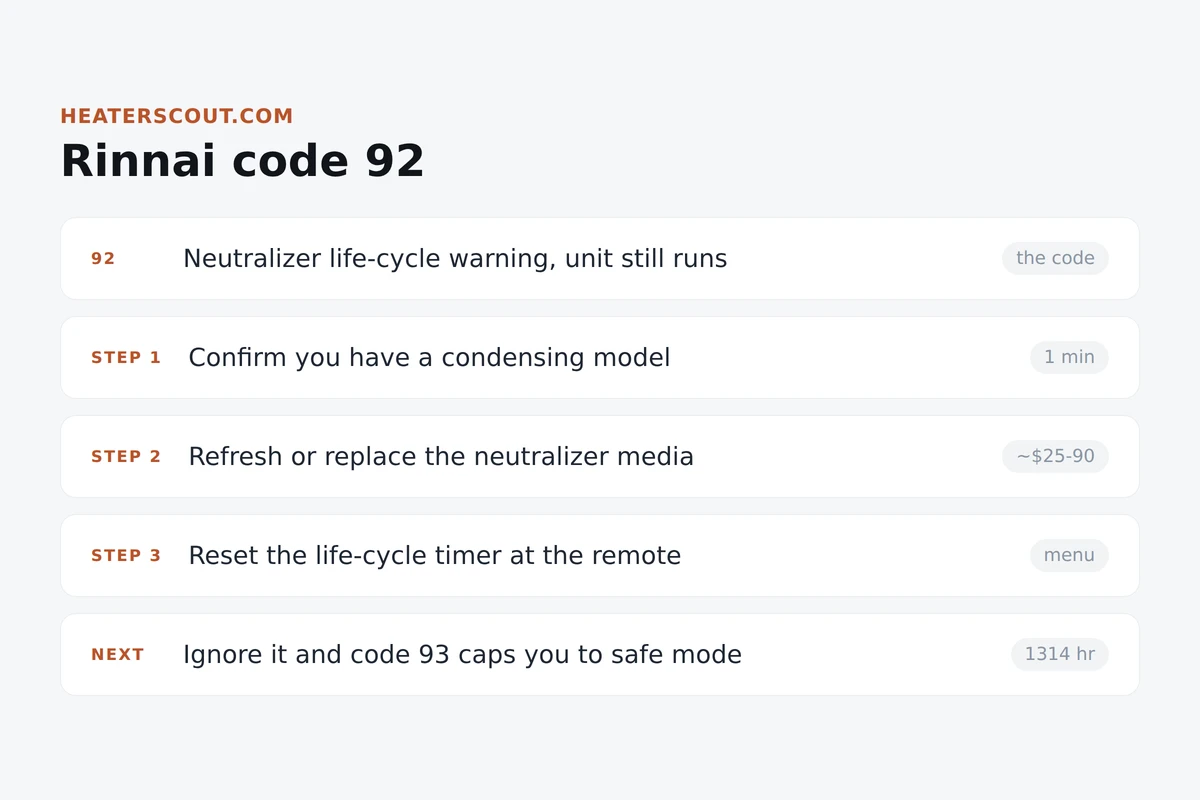
Code 92 is an early warning that the condensate neutralizer media is near the end of its rated hours, and the heater keeps running normally. Refresh or replace the neutralizer media, then reset the life-cycle timer through the controller. A power cycle and a descale both do nothing here, because 92 is an hour counter, not a fault. Ignore it and the unit throttles to about 2.6 GPM, then rolls to code 93 and safe mode.
The water still gets hot at 92. It is the last cheap window before the heater starts protecting itself and your options get worse.
Why a heater needs to neutralize its own drain water
This code makes sense once you know what a condensing unit does differently. A non-condensing tankless heater sends its exhaust up the flue still hot. A condensing model adds a second heat exchanger that pulls that leftover heat back out, which is how it hits 95 percent efficiency. The catch is thermodynamic: cooling the exhaust that far drops it below its dew point, so water vapor in the flue gas condenses into liquid. That liquid is not clean. Combustion byproducts make it acidic, typically pH 3 to 4, in the range of vinegar. Send that straight into a metal drain line and it corrodes it, which is why the plumbing code requires a neutralizer on these units. The neutralizer is a chamber of media, usually crushed marble or a magnesium mix, that the acidic condensate trickles through on its way out. The media reacts with the acid and raises the pH toward neutral. Like any consumable, it gets used up, and the board tracks that with an hour counter rather than by measuring pH directly.
The three-stage sequence behind 92
Rinnai and Noritz condensing controls do not just throw the code and forget it. The life-cycle counter steps through documented thresholds, and knowing them tells you exactly how much runway you have. Work the stages in order and you never reach the unpleasant one.
Around 1,114 hours: code 92 appears
The counter crosses its first mark and the remote shows 92. This is the early warning. The heater still fires and delivers full hot water. Nothing is limited yet. This is your window to service the neutralizer on your own schedule instead of on the heater's.
Around 1,214 hours: flow gets capped
If 92 is ignored, the control throttles maximum flow to roughly 2.6 gallons per minute. A single low fixture still feels fine, but a full shower or two taps at once goes weak. This is the heater nudging you harder because the media is now well past its rating.
Around 1,314 hours: code 93 and safe mode
The counter reaches end of life, the code rolls over to 93, and the unit drops into a restricted safe mode. Now you have lost normal operation, not just a warning light. Everything short of this point was avoidable by handling 92 when it first showed.
Service the neutralizer, then reset
The cure at any stage is the same: refresh or replace the neutralizer media, then reset the life-cycle timer through the controller menu. Resetting without servicing the media just silences the warning while acidic condensate keeps hitting your drain unbuffered.
Code 92 versus code 93 at a glance
People mix these up because they are the same system. The difference is simply where you are on the counter and what the heater does about it.
| Code 92 | Code 93 | |
|---|---|---|
| What it means | Neutralizer media near end of life | Neutralizer media at end of life |
| Roughly when | About 1,114 run hours | About 1,314 run hours |
| Does the unit run | Yes, normal hot water | Restricted safe mode only |
| Flow limit | None yet (2.6 GPM cap at ~1,214 hrs) | Limited operation |
| Urgency | Service on your schedule | Service now to restore full output |
| The fix | Refresh media, reset timer | Refresh media, reset timer |
Can I just reset the timer and skip replacing the media?
You can, and the code will disappear, but you should not. The counter is a proxy for how spent the media is. Reset it without refilling and the board now believes you have a fresh neutralizer while acidic condensate keeps passing through exhausted media. That acid then goes down your drain with little buffering, corroding drain lines and, in most jurisdictions, putting you out of code. Reset the timer only after the media is actually fresh. The reset is the last step of the job, not a shortcut around it.
How the fix actually goes
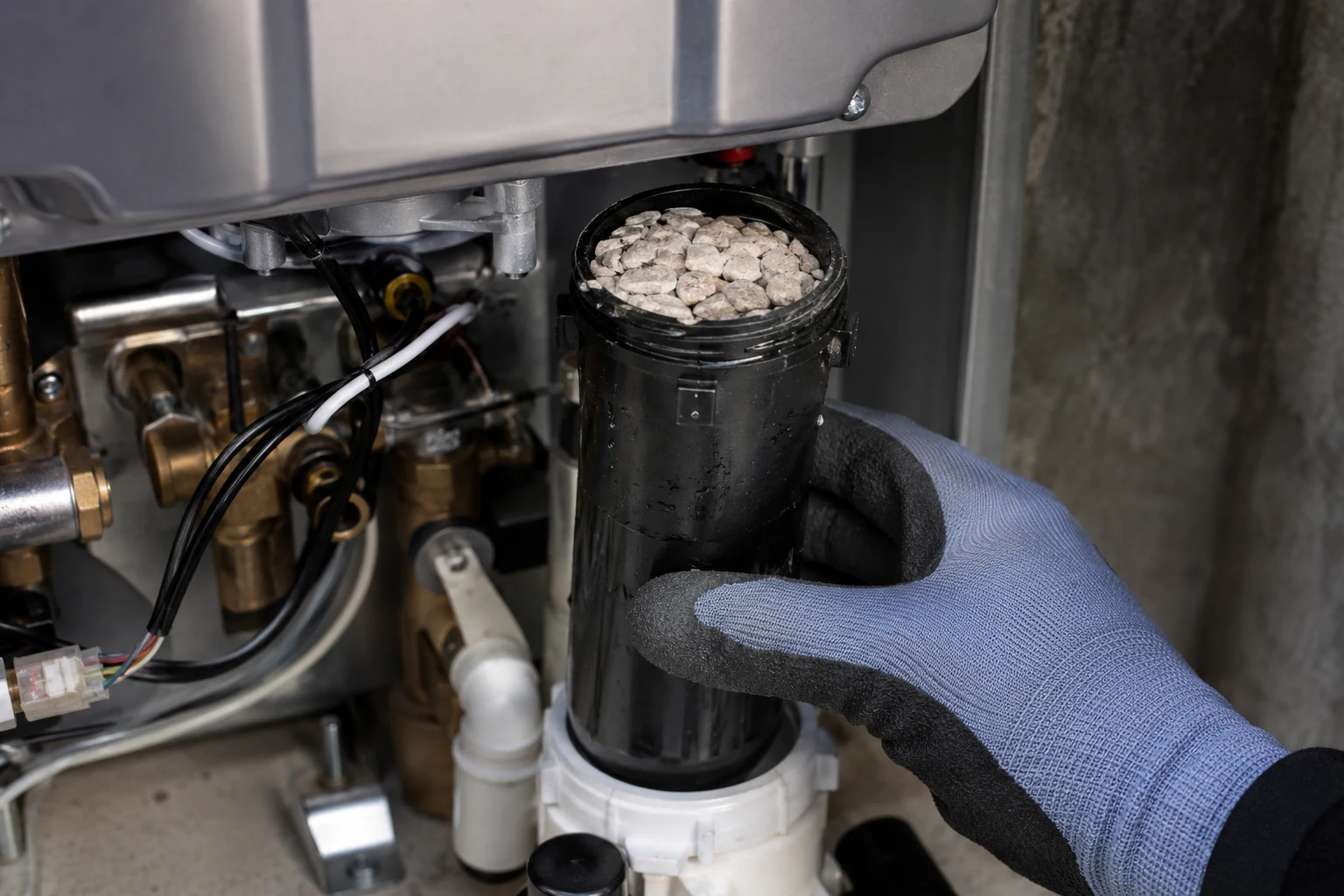
Rinnai's neutralizer is built to be serviced, not thrown away. The capsule uncaps at one end. You empty the depleted media, refill with fresh neutralizing media, recap, and you are done on the hardware side. Rinnai's own kit, part 804000074, is a reusable design with a clear chamber so you can eyeball the media at an annual check. A media refill is the cheap path; a full kit swap is for when the capsule itself is aged or cracked. After the media is fresh, go into the controller's maintenance menu and reset the life-cycle timer. That reset is what clears 92. The exact button sequence differs between Rinnai model lines, so read the tech sheet taped inside the front cover for yours. On the Noritz-built condensing equivalents the replacement neutralizer carries part number SKD7466 and the procedure is the same idea: replace, then reset.
Where the homeowner line sits
Refreshing neutralizer media and resetting a timer is well inside what a careful homeowner can do. Nothing here touches the gas train, the burner, or combustion tuning, which is what keeps 92 on the DIY-friendly side. You turn off the appliance, close the condensate path, uncap the capsule over a bucket because the spent media and any trapped condensate are acidic, refill it, and recap. Wear gloves and rinse anything the old media touches. The only place people trip is the reset menu, and that is a matter of finding the right sequence on your model's sheet, not a skill problem. If your unit is hard-plumbed into an awkward spot, or you would rather not handle acidic media, a plumber does the whole thing in one short visit.
Keeping 92 from surprising you
The neutralizer is a consumable, so the goal is not to prevent 92 forever but to meet it on your terms. Roughly 1,100 run hours is a lot of showers, often a year or two of typical household use, so put neutralizer service on the same annual visit as your descale. While the cover is off, look at the media through the clear chamber; if it is packed down, discolored, or dissolved away, refresh it early rather than waiting for the code. Check that the condensate line drains freely and has not backed up into the capsule. A neutralizer that is inspected once a year almost never gets to throw 93, and the whole thing stays a $30 chore instead of a safe-mode scramble on a cold morning.
Frequently asked
What does Rinnai error code 92 mean?
On a condensing Rinnai tankless heater, code 92 is a neutralizer life-cycle warning. The unit burns gas so efficiently that it pulls extra heat out of the exhaust, and doing that condenses acidic water vapor inside the heat exchanger. That condensate is corrosive, around pH 3 to 4, so the heater runs it through a small neutralizer capsule packed with media that raises the pH close to neutral before it goes down the drain. The control board counts the hours that media has been in service. When the counter crosses its first threshold, roughly 1,114 hours of run time, the remote shows 92 to tell you the media is near the end of its life. It is a heads-up, not a breakdown. The water still gets hot.
Will my Rinnai still work with error code 92 showing?
Yes. Code 92 is a warning, not a lockout. The heater keeps firing and delivering hot water normally when 92 first appears. That is the whole point of the early warning: it gives you time to service the neutralizer before anything actually limits you. If you ignore it, the counter keeps climbing. Around 1,214 hours the control throttles your maximum flow to about 2.6 gallons per minute, so a big shower or two fixtures at once will feel weak. Around 1,314 hours the code rolls over to 93 and the unit drops into a restricted safe mode. So 92 is your free window. Handle it then and you never feel the throttle.
How do I reset Rinnai code 92?
You do not clear 92 with a power cycle, and you do not clear it by descaling. It is not a fault that a restart resets, it is an hour counter tied to the neutralizer. The counter only clears when you reset the life-cycle timer through the controller menu, and you are only supposed to reset it after you have actually refreshed or replaced the neutralizer media. Cutting the breaker and turning it back on will not touch the count. The reset lives in the maintenance or diagnostic menu on the remote; the exact keypress varies by model, so check the tech sheet inside your unit's cover. Resetting the timer without servicing the neutralizer just hides a warning while acidic condensate keeps hitting your drain.
What is the difference between Rinnai code 92 and code 93?
They are the same system at two stages. Code 92 is the early warning that the neutralizer media is near the end of its life, and the heater still runs normally. Code 93 is end of life: the media is spent and the unit switches to a restricted safe mode. In the documented hour sequence, 92 shows around 1,114 hours, the flow gets capped near 1,214 hours, and 93 arrives around 1,314 hours. Think of 92 as the low-fuel light and 93 as the engine actually pulling power to protect itself. Both are fixed the same way: service the neutralizer and reset the timer. The only reason to ever see 93 is having driven past 92 without acting.
How much does it cost to fix Rinnai code 92?
This is one of the cheaper Rinnai codes to clear. Rinnai's neutralizer is a reusable capsule: you uncap it, dump the spent media, refill it with fresh neutralizing media, and recap. A media refill runs roughly $25 to $50. A complete replacement neutralizer kit, part 804000074, is commonly in the $60 to $110 range if the capsule itself is old or cracked. There is no expensive board or sensor involved. If you do it yourself the cost is just the media. A plumber's visit to service the neutralizer and reset the timer typically lands around $120 to $250 with the trip and labor. Compared with a heat exchanger or PCB fault, 92 is a small bill.
Does descaling clear Rinnai code 92?
No. Descaling flushes the heat exchanger to remove mineral scale from the water side, and it is worth doing on schedule, but it does nothing for the neutralizer. Code 92 is driven by an hour counter on the condensate neutralizer media, not by scale in the waterways. You can run a perfect vinegar flush and the code will still be there, because the media is still counted as aged and the timer has not been reset. The two jobs are separate: descale the exchanger for flow and efficiency, service the neutralizer for the condensate. Since you often have the unit open for one, it is a sensible time to do the other, but do not expect a descale to make 92 go away.
Is Rinnai error code 92 dangerous?
The code itself is not a safety hazard. It does not mean gas, venting, or combustion trouble. What it protects is your plumbing and, indirectly, the environment. Condensing units make acidic condensate, and a spent neutralizer means that acidic water goes down your drain with less buffering. Over time that can corrode metal drain lines and, in many jurisdictions, it violates the plumbing code that required the neutralizer in the first place. So 92 is a low-urgency, do-not-ignore item: nobody is in danger tonight, but leaving it for months lets acidic condensate eat at your drain and eventually forces the unit into safe mode at code 93.
Only condensing Rinnai models show code 92, right?
Correct. A neutralizer only exists on condensing tankless heaters, the high-efficiency ones that produce condensate, so code 92 only appears on those models. A non-condensing Rinnai has no neutralizer and will never throw this code. One caution: across the broader tankless world, a few Noritz-built control lines use the number 92 for a fan or combustion-air fault instead. On Rinnai and Noritz condensing units the neutralizer meaning is the documented one, but if your unit is non-condensing and shows 92, stop and match the number against the code table on your specific tech sheet before you assume it is the neutralizer.