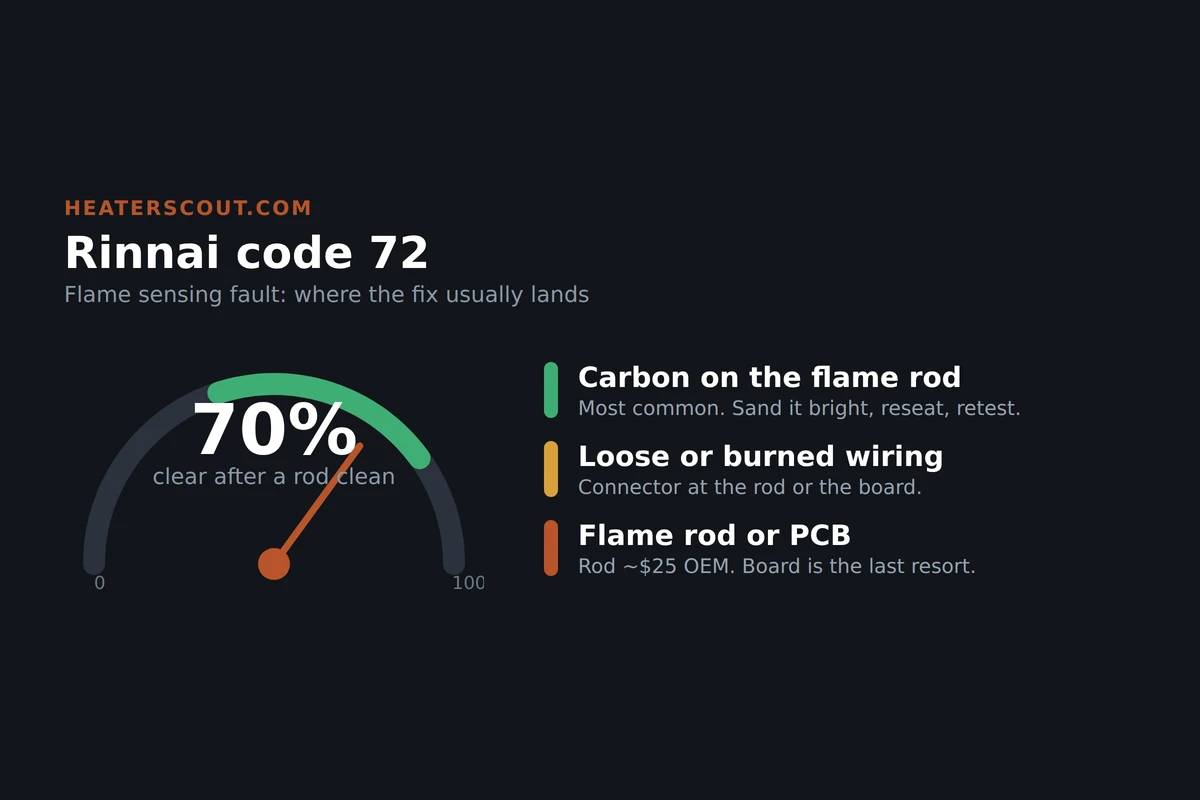
A Rinnai that flashes 72 on the controller is not telling you the fire went out. It is telling you it cannot trust what its flame sensor is reporting. The board fires the burner, then waits for a tiny current, measured in millionths of an amp, to confirm real flame is present. When that signal reads wrong, missing, or present when it should not be, the unit throws code 72 and shuts down on purpose. Nine times out of ten the villain is a film of carbon on a metal rod the size of a toothpick, and the fix is a sheet of sandpaper.
Rinnai code 72
A flame sensing device fault. The control board is not getting a valid signal from the flame rod. That covers a rod it cannot read, a signal that makes no sense, or flame reported when the board expects none. It is the sensing circuit that is at fault, not necessarily the fire itself. This is distinct from code 12, which is a flame failure where the burner never proved a stable flame at all.
How the flame rod actually works
Understanding the code makes the fix obvious. A flame rod is a single metal electrode that sits at the edge of the burner flame. Flame conducts electricity, barely, and it conducts in one direction better than the other. The board pushes a small AC voltage down the rod and looks for a rectified DC current coming back through the flame to ground. On a healthy Rinnai burner that current sits around one to two microamps at first light and climbs to roughly four to eight microamps once the burner is at full fire, depending on gas type and firing rate. The board wants to see at least one microamp to call the flame proven. Carbon, scale, or a poor ground kills that current, and the board reads it as no valid flame signal. Hence code 72.
Before you touch the burner
Kill the power and the gas before you open anything. This is a sealed combustion unit with live spark voltage and gas at the burner. Turn the unit off at the controller, switch off the breaker, and close the gas shutoff valve. Give the heat exchanger a few minutes to cool before you reach in.
The fix, in order
Work cheap to expensive. Do not order a control board because a code that mentions the board scared you. Start with the rod, because that is where the money is not.
Diagnostic order when a clean does not hold
If 72 survives a good rod clean and a wiring reseat, stop swapping parts and start measuring. The flame current tells you the truth.
Measure the flame current
Put a meter in microamp DC mode in series with the flame rod lead and fire the burner. You want to see at least one microamp with flame present, ideally climbing toward four to eight at full fire. Below one microamp with a clean rod means the sensing side is genuinely weak.
Check the burner flame quality
A rod that re-fouls quickly points at a rich or lifting flame, which is a gas pressure or combustion air problem, not a rod problem. Soot on the rod within days is a symptom, not the disease. Verify gas supply pressure and look for a clean blue burner.
Confirm the ground path
The flame current returns to ground through the burner. A poor ground at the burner assembly or a loose chassis ground starves the signal. Reseat grounds and check continuity back to the board.
Replace the flame rod
If the rod is pitted, cracked, or its ceramic insulator is chipped, or the current stays weak after cleaning, fit a genuine Rinnai flame-rod or electrode kit. This is the honest fix for a worn sensor.
Suspect the PC board last
Only after the rod, the wiring, the ground, and the flame current all check out do you consider the board. A board misreading a good signal is real but rare, and it is the most expensive part in the unit.
| Code meaning | Flame sensing device (flame rod) fault |
| Related code | Code 12, flame failure / ignition loss |
| Most likely cause | Carbon or scale on the flame rod |
| Reset method | On/Off button on controller, or 30-sec breaker cycle |
| Healthy flame current | About 1-2 microamps at light, 4-8 at full fire |
| Minimum to prove flame | Roughly 1 microamp with flame present |
| Clean the rod with | Fine sandpaper (220 grit or finer) or steel wool |
| OEM flame-rod kit | About $21 to $29 for common R / RL series |
| Pro repair range | About $150 to $350 diagnose and rod swap |
| Board (worst case) | About $300 to $600 for the part alone |
| Difficulty | DIY-friendly clean, gas tech for pressure or board |
Where the homeowner line sits
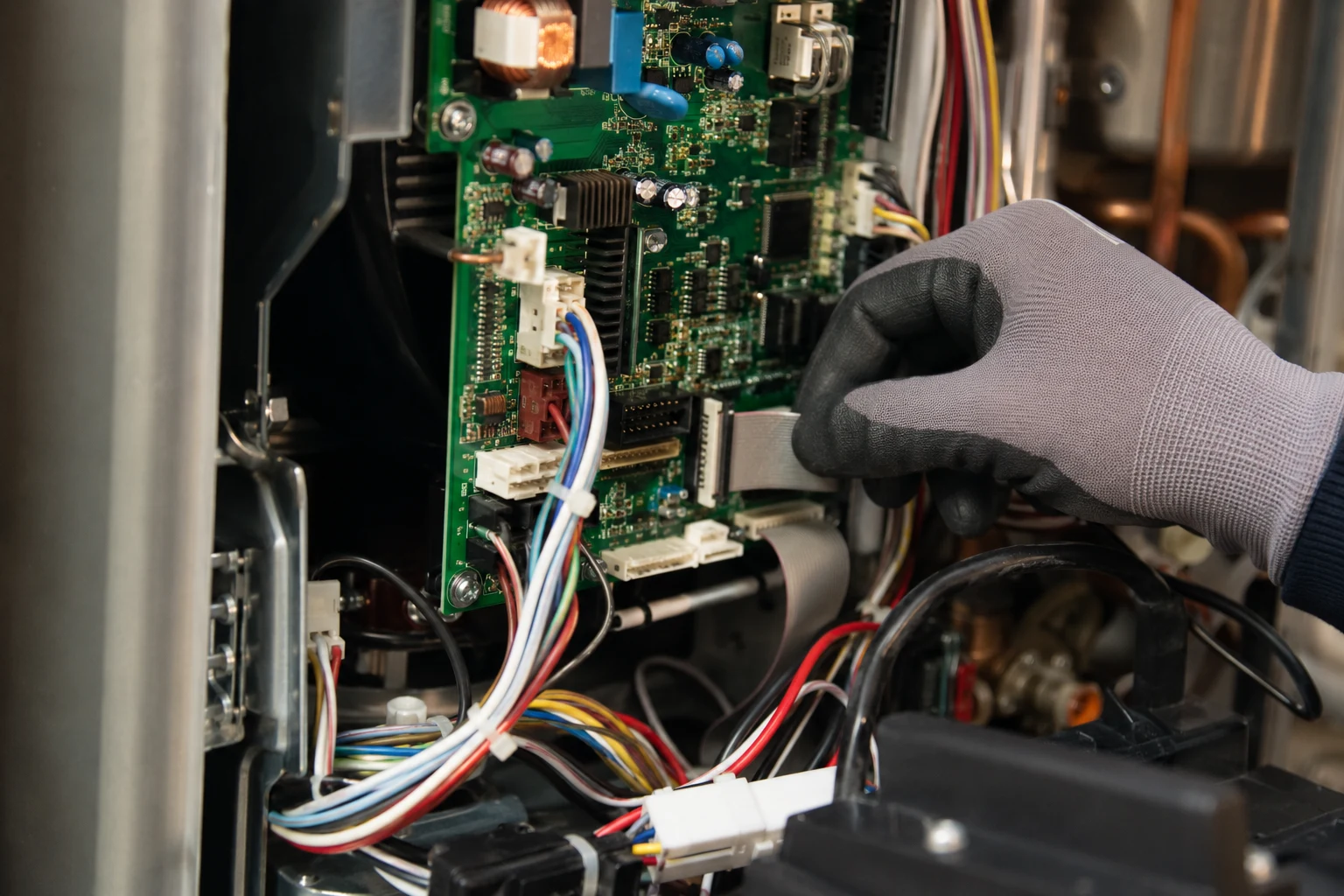
Cleaning the rod and reseating wiring is fair game for a careful homeowner who is comfortable shutting off gas and opening a sealed unit. It is a screwdriver, a sheet of sandpaper, and patience. The line you do not cross is the gas side. If the rod cleans up but 72 keeps returning because the burner is running rich, that is a manifold pressure or combustion problem, and setting gas pressure is a licensed tech's job with a manometer. Same story if you are staring at a flame current below one microamp on a brand new rod, or a board that misreads a signal that checks out on the meter. Never jumper or defeat the flame-sensing circuit to force the heater to run. That circuit exists so the unit does not keep feeding gas to a flame it cannot confirm.
Keeping 72 from coming back
A flame rod fouls because combustion is dirty or because the unit has not been serviced. Descaling on schedule keeps the water side healthy, but it does nothing for the rod, so add a combustion check to your annual service. Have the tech pull the flame rod, inspect it, and read the flame current while the burner runs at full fire. Keep the intake and exhaust clear so the burner gets clean air, because a starved or recirculating burner sooties the rod fast. If you live with hard water or run the unit hard, a yearly look at the rod is cheap insurance against a code that always seems to appear on the coldest morning of the year.
Frequently asked
Can I reset Rinnai code 72 myself?
You can clear it, but clearing is not fixing. On a Rinnai tankless the controller has no dedicated red reset button. The On/Off button on the temperature controller doubles as the error clear. Press it to turn the unit off, wait a few seconds, then press it again to power back on and the code drops. If you have no controller handy, flip the breaker for the water heater off for about 30 seconds and back on. That power cycle keeps your temperature settings and clears the latched fault. The catch is that 72 is a flame-sensing fault, so if the flame rod is fouled or a wire is loose, the code comes right back the next time the burner tries to fire and prove flame. The reset gets you one more firing cycle to watch what happens, not a permanent fix.
What is the difference between Rinnai code 72 and code 12?
They both live in the flame-detection world, and Rinnai's own tech sheets overlap them, but they point at different parts of the same job. Code 12 is flame failure: the burner tried to light and the board never saw a stable flame, so it locked out. That leans toward gas supply, ignition, and the burner. Code 72 is a flame-sensing device fault: the problem is the flame rod circuit itself, either a signal that makes no sense, flame reported when there should be none, or a rod the board cannot read cleanly. In plain terms, 12 usually means no fire, and 72 usually means fire is there but the sensor is not talking straight. On some model lines the line between them blurs, so if you chase 72 and find the burner is not lighting at all, treat the gas and ignition side like a 12 as well.
How do I clean the flame rod on a Rinnai tankless?
Kill power and gas first. This is a sealed combustion unit, so you remove the front cover, then get to the burner assembly where the flame rod sits at the edge of the flame path, usually next to the igniter. Unclip the wire, unthread the two screws holding the rod, and pull it out. The metal rod should be bright. If it is gray, sooty, or scaled, that film blocks the tiny current the board reads. Clean it with fine sandpaper, 220 grit or finer, or a bit of steel wool, until the metal shines again. Do not bend the rod or change its spacing. Reinstall with the same gasket if it is intact, reseat the wire firmly, and put the cover back before you restore gas. Cleaning fixes a large share of 72 faults because carbon is the usual culprit.
How much does it cost to fix Rinnai code 72?
If it is carbon on the rod, the fix costs you nothing but a sheet of sandpaper and half an hour. If the rod is pitted, cracked, or the ceramic insulator is chipped, a genuine Rinnai flame-rod or electrode kit runs about $21 to $29 online for the common R and RL series, sometimes packaged with the igniter electrode. A plumber's visit to diagnose and swap the rod usually lands in the $150 to $350 range once you count the trip and labor, more in high-cost metros. The expensive path is a PC board, which can run $300 to $600 for the part alone on many models. That is exactly why you rule out the cheap causes first. A board almost never fails before a dirty rod or a bad connector does.
Will descaling clear code 72?
No, and this is a common mix-up. Descaling flushes vinegar or a descaling solution through the heat exchanger to strip scale off the waterways. It does nothing for the flame rod, which lives on the combustion side, dry, in the path of the flame. Code 72 is about the sensor reading the fire, not about water flow or scale. Descaling is still worth doing on schedule for the health of the unit, and a heater that has been neglected on maintenance is often neglected on combustion too, but do not expect a flush to touch this code. The rod clean and the wiring check are the moves that clear 72.
Why does Rinnai code 72 keep coming back?
A code that returns after a clean is telling you the real cause is still there. The usual repeat offenders: the rod was cleaned but the connector at the rod or the board is corroded or loose, so the signal drops intermittently. Or the burner is running rich and re-coating the rod with soot faster than you can clean it, which points at a gas pressure or air problem, not the rod. Or the rod is physically out of position, sitting just outside the flame, so it never gets a steady reading. Or the micro-amp signal is genuinely weak because the rod is worn out. Measure the flame current with a meter while the burner runs. If it sits below about 1 microamp with flame present, the sensing side is failing and a new rod is the honest fix.
Is Rinnai code 72 dangerous?
The code itself is a safety feature doing its job. Flame sensing is how the unit confirms it actually lit before it keeps gas flowing, so a 72 fault causes the heater to shut down or refuse to run rather than dump unburned gas. That lockout is protective. The danger is not the code, it is ignoring it or bypassing it. Never jumper or defeat a flame-sensing circuit to force the unit to run. If the board reports flame when there is none, or cannot verify a real flame, that is precisely the condition you do not want overridden. If the rod cleans up and reseats and the code still returns, or if you smell gas at any point, shut the unit down and get a licensed gas tech on it.