A Rinnai tankless that flashes 70 and quits is not asking you to reset a sensor or flush scale. Code 70 is the unit reporting a problem with its own brain, the printed circuit board that runs everything from the gas valve to the flame monitor. That makes it one of the few Rinnai codes where the honest first step is figuring out whether you should touch it at all.
What Rinnai code 70 is telling you
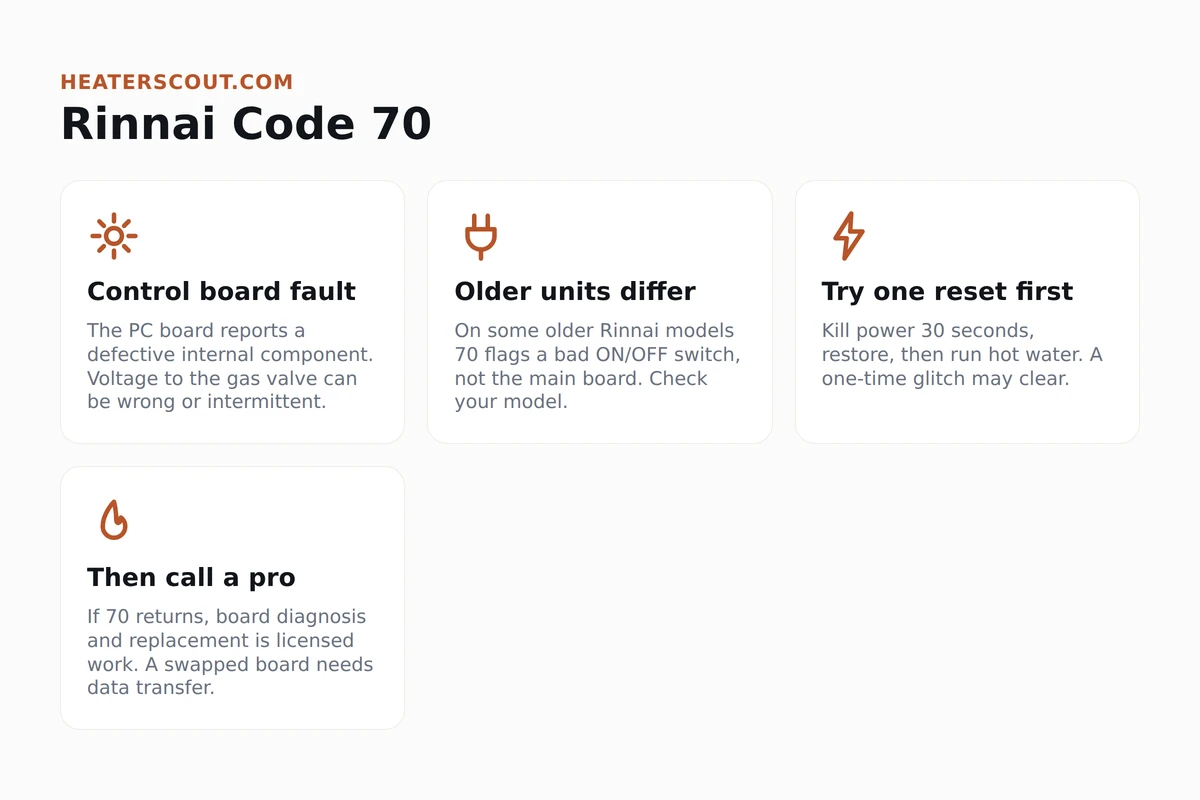
On Rinnai's current condensing tankless line, error 70 is a control board fault. The board detects that one of its own components is not behaving. Rinnai's technical notes describe the specific failure mode as the voltage output to the gas valve being incorrect or intermittent because a component on the PC board is defective. When the board cannot trust its own output to the gas valve, it locks the unit out rather than fire the burner on bad signals. That lockout is the safe response, and it is why you lose hot water the moment 70 appears.
There is a wrinkle worth knowing before you spend a dime. On some older Rinnai units, the same 70 code means a faulty ON/OFF switch, not the main board. Repair forums and Rinnai's older service literature both list that alternate meaning. So the code number is the same, the fix is not. Always match 70 to your specific model and its service sheet before assuming the worst.
| Code | What it points at | Who fixes it |
|---|---|---|
| 70 | PC board / control board fault (older units: ON/OFF switch) | Licensed tech |
| 11 | No ignition, often gas supply or igniter | DIY checks, then tech |
| 12 | Flame failure during operation | DIY checks, then tech |
| 10 | Air supply or exhaust blockage | DIY-friendly |
| LC | Scale buildup, needs descale | DIY-friendly |
The point of that table is simple. If your display shows 10, 11, 12, or an LC maintenance code, you have real homeowner steps to run first. Code 70 sits in a different bucket. It is a hardware fault inside the electronics, and the safe DIY portion of the job is short.
The one reset that is worth trying
Before you call anyone, run a single clean power cycle. Sometimes a voltage spike, a brownout, or a one-time glitch trips the board and a full reboot clears it. If 70 was a fluke, this brings the unit back. If 70 is a failing part, this test tells you that too, because the code returns fast.
PC board (control board)
The main circuit board inside the Rinnai. It reads the flame sensor, flow sensor, and thermistors, then drives the igniter, fan, and gas solenoid valves. When it faults, the unit has no safe way to control combustion, so it stops.
Where the fault usually lives, most likely first
Not every 70 is a dead board. A technician works the cheap and common causes before ordering a 300 dollar part. Here is the order most Rinnai service work follows.
Loose or corroded wiring harness
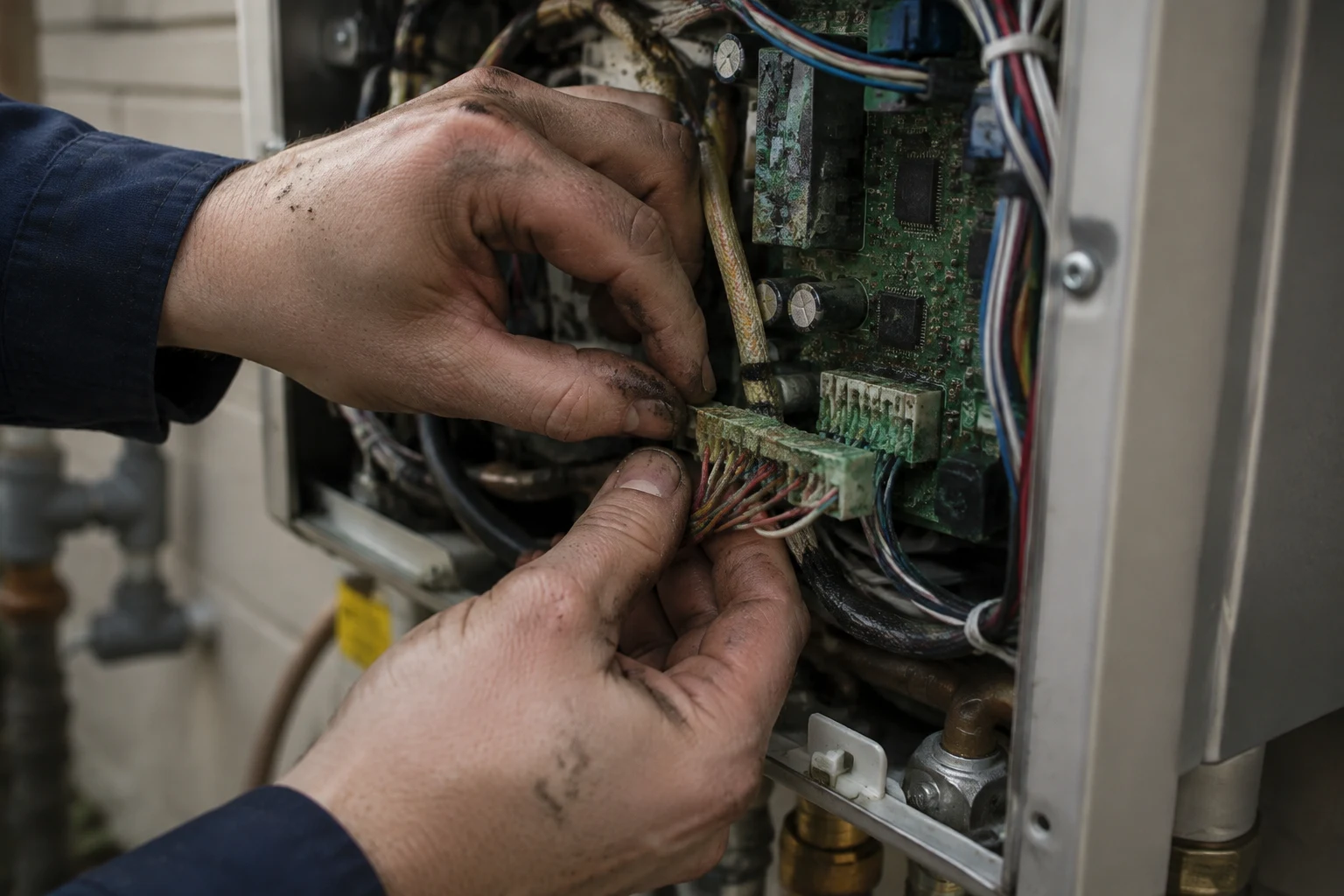
The first thing to check. A connector that backed out, or pins with corrosion from humidity, can throw a 70 that looks exactly like a dead board. Disconnecting and firmly reseating every harness on the unit and the board fixes a real share of these.
Moisture or condensation on the board
Condensing units make water. A cracked drain, a weeping fitting, or heavy condensation can wet the board and short a trace. The board is inspected for water tracks and corrosion before anything is replaced.
Shorted or open component driving the gas valve
This is the classic true 70. A defective part on the board makes the voltage to the gas solenoid valves wrong or intermittent. The tech checks the gas valve circuit for shorts and opens, on the board and at the valves themselves.
The PC board itself
When the harnesses are clean, the board is dry, and the fault still stands, the board is replaced. On newer Rinnai units a new board is not plug and play. A data transfer process has to be completed so the board knows the model and settings, or the unit will not run right.
The reset worked, but 70 came back a week later. Now what?
That pattern almost always means an intermittent hardware fault. A hairline crack in a solder joint or a component that fails when it warms up can pass a cold reboot and then trip again under load. Log the dates it happens and hand that to your technician. Intermittent boards are real, and a good tech will reseat harnesses and check for shorts before condemning the whole board.
DIY-safe versus licensed-tech work
Draw the line clearly, because 70 is one code where crossing it is a bad idea. What you can safely do at home is the power cycle above, plus a visual check for obvious water pooling near the unit and a look at whether the vent and condensate drain are clear. That is the extent of the homeowner side.
Everything past that involves opening the sealed combustion cabinet, probing live circuits, testing gas solenoid valves for shorts, and handling the board. That is licensed technician work for a reason. You are inside a gas appliance with mains voltage and a controller that governs combustion. A board swap also demands the data transfer step on newer units, and getting that wrong leaves you with a unit that lights but runs badly. If your Rinnai is still under warranty, do not open it yourself at all. Call Rinnai or your installer, since self-service can void coverage on a part they might replace for free.
Real parts and cost in the US
The part in question is the PC board, sometimes listed as the control board or PCB assembly for your specific model. For a residential Rinnai tankless, the board itself commonly runs 250 to 500 dollars depending on the series. A service call with diagnosis and installation adds roughly 150 to 400 dollars in labor. Bundled jobs tend to land in the 400 to 900 dollar range. Prices vary by region and by whether the tech has to source a board or has one on the truck.
Two things move that number. First, warranty. Rinnai's heat exchanger and parts warranties can cover the board on units that are not that old, which turns a 700 dollar job into a labor-only bill. Dig out your model and serial and check the coverage before you authorize a paid board. Second, age. If the unit is well past a decade and out of warranty, a homeowner sometimes weighs a board replacement against a new tankless, because a board plus labor can be a meaningful fraction of a fresh install.
One more note on sourcing. The board is model specific, so a tech needs your exact model number to order the right part. A generic or cross-shipped board that does not match the unit will not accept the correct settings during the data transfer step, and you end up back at square one. If you get a quote over the phone, confirm the technician has matched the board to your serial before parts get ordered.
Keeping 70 from coming back
You cannot prevent a random component failure, but you can remove the things that push boards toward an early death. Most of them come down to water and connections.
Keep the unit dry. Make sure the condensate drain runs clear and does not back up near the electronics, and fix any small leak at a fitting before it wicks toward the board. Keep the electrical supply clean, since brownouts and spikes stress the board over time, and a surge protector on the circuit is cheap insurance. Have the unit serviced on a normal schedule so a technician catches a corroding harness or a damp cabinet before it turns into a lockout. Annual descaling will not stop a 70, but the same service visit is when a good tech spots the early warning signs on the electronics side.
Code 70 is the rare Rinnai fault where the smartest move is to do less, not more. One clean reset tells you whether it was a glitch. After that, the unit is telling you it needs a set of eyes and a meter, not another reboot.
Frequently asked
Can I reset Rinnai error code 70 myself?
Yes, you can try one reset safely. Shut the unit off at the breaker or unplug it for 30 seconds, restore power, then open a hot tap. On units with a controller, turning off all hot taps and pressing ON/OFF twice also clears the display. If 70 comes right back, the reset did its job as a test and the fault is real hardware.
What does error code 70 actually mean on a Rinnai?
On current condensing tankless units it means the PC board, the unit's main circuit board, has a defective component. Rinnai's own notes describe the voltage output to the gas valve as incorrect or intermittent. On some older Rinnai models the same 70 points to a faulty ON/OFF switch instead, so the meaning depends on your exact model.
How much does it cost to fix Rinnai code 70?
A replacement PC board for a residential Rinnai tankless usually runs about 250 to 500 dollars for the part, and a service call with diagnosis and install typically adds 150 to 400 dollars in labor. Total real-world jobs land near 400 to 900 dollars. If the unit is under Rinnai's warranty, the board may be covered and you pay only labor.
Will descaling clear error code 70?
No. Descaling fixes scale-related faults and flow problems, not an electronic board failure. Code 70 is an internal electrical fault, so a vinegar or descaler flush will not touch it. Keep descaling on your annual list for the health of the heat exchanger, just do not expect it to clear a 70.
Is Rinnai error code 70 dangerous?
It is not a gas leak or a carbon monoxide alarm. The unit locks out and stops firing when it detects the board fault, which is the safe behavior. The risk is loss of hot water, not a hazard in the room. Still, do not bypass the lockout or force the unit to run, since the board controls the gas valve.
Why does code 70 keep coming back after a reset?
Because the underlying part is failing. A reset clears the display, but a cracked solder joint, moisture on the board, a shorted component, or a bad connector is still there. Repeated 70 lockouts after a power cycle are the clearest sign that the board or a wiring harness needs to be serviced rather than reset again.
Can moisture cause a Rinnai code 70?
Yes. Condensation or a small leak reaching the board, corroded pins, or a loose wiring harness can all produce the fault or a false 70. A technician will reseat every harness and inspect for shorts and corrosion before condemning the board, because a connector fix is far cheaper than a new board.