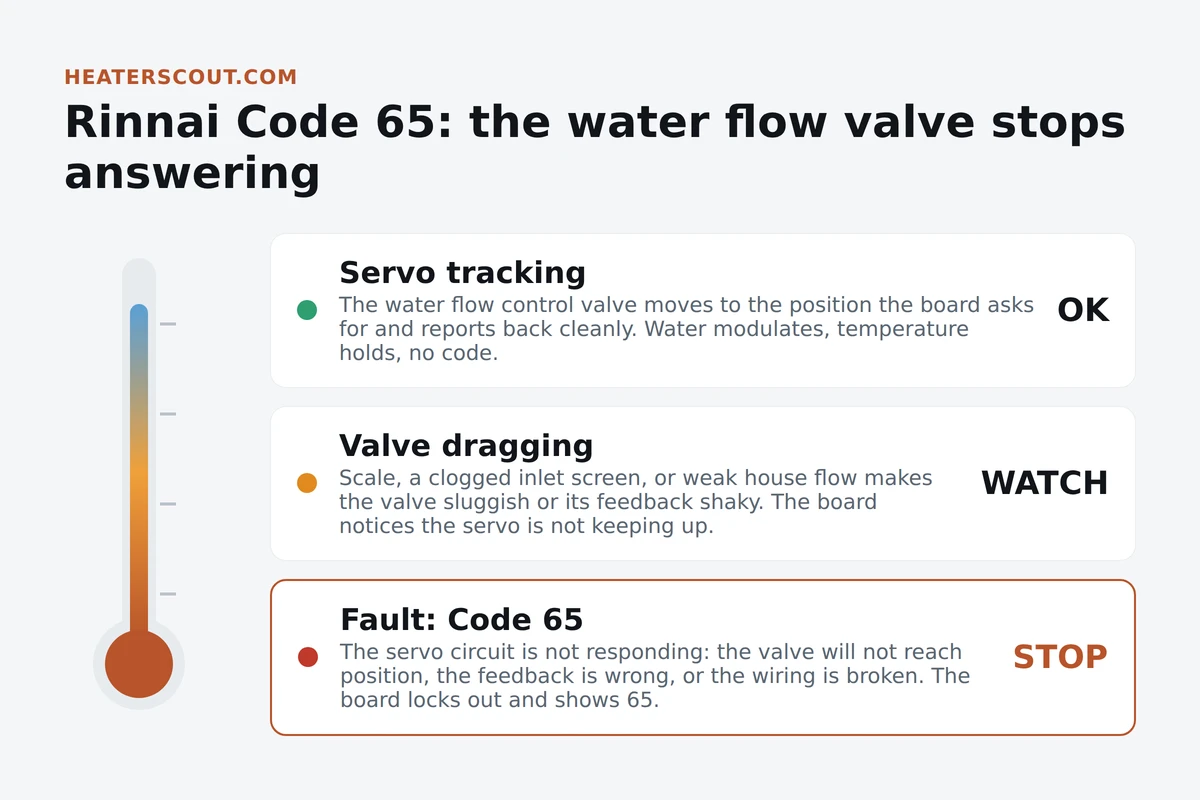
Rinnai code 65 shows up when the unit stops being able to control its own water flow. Inside every Rinnai tankless heater is a small motor-driven valve, the water flow servo, that opens and closes to regulate how much water passes through the heat exchanger. That is how the heater holds your set temperature when the incoming flow shifts. Code 65 means the board told that valve to move and did not get the answer it expected. Before you assume the valve failed, know this: scale and a clogged inlet screen cause far more 65s than a dead servo does, and both are fixable without a new part.
Two things it usually is, and one it usually is not
Almost every code 65 traces to a water flow problem the servo cannot overcome, or to a fault in the servo circuit itself. Those two feel different once you start working the problem, and telling them apart keeps you from buying a valve you did not need. Match your situation to one side before you open anything up.
A flow or scale problem (start here)
- The unit is a few years old, in a hard-water area, and has not been descaled on schedule.
- Code 65 came back within a day or two of cleaning the inlet screen, which points at scale the screen never touches.
- Hot water flow is weak or surges at a single fixture, so the valve is fighting an unstable supply.
- Fix path: clean the inlet screen, confirm steady flow, then descale the unit. This clears a large share of 65s with no parts.
A servo circuit fault
- The code appeared suddenly, often right after service, a move, or work near the unit.
- A power cycle does not clear it and it returns instantly, with no change from descaling or cleaning the screen.
- You find a loose connector, a corroded terminal, or chafed wiring on the run between the servo and the control board.
- Fix path: reseat and inspect the servo wiring first, per Rinnai's own procedure, then test or replace the valve if the wiring checks good.
Do this in order
Rinnai's published troubleshooting for code 65 starts with the wiring, not the valve. Check the harness to the water flow servo for loose, broken, or damaged connections all the way back to the PC board, then cycle power to see whether 65 clears. Only after the wiring checks out and the descale is done does the servo assembly itself become the suspect. Kill power and gas before you open the cabinet.
How the causes stack up
Not every cause is equally likely, and the order matters because it maps to how much the fix costs. Here is the same list a tech works through, ranked by how often it turns out to be the answer, along with what each one takes to clear.
| Cause | How likely | Who fixes it | Rough cost |
|---|---|---|---|
| Scale on the water flow valve | Very common on older/hard-water units | Homeowner or plumber (descale) | $40 to $70 kit, or $150 to $350 for a pro flush |
| Clogged inlet filter screen | Common | Homeowner | Free to $20 |
| Low or unstable house-side flow | Common | Homeowner, sometimes plumber | Varies; often free to diagnose |
| Loose or damaged servo wiring/connector | Occasional | Handy homeowner or tech | Free to a service-call fee |
| Failed water flow servo valve assembly | Least common, but real | Licensed tech | $75 to $150 part, $300 to $600 installed |
What the water flow servo actually does
It helps to know what the board is asking of the valve, because that is what code 65 is really about: a request the servo could not answer. Once you picture the job it does, the fix order makes sense.
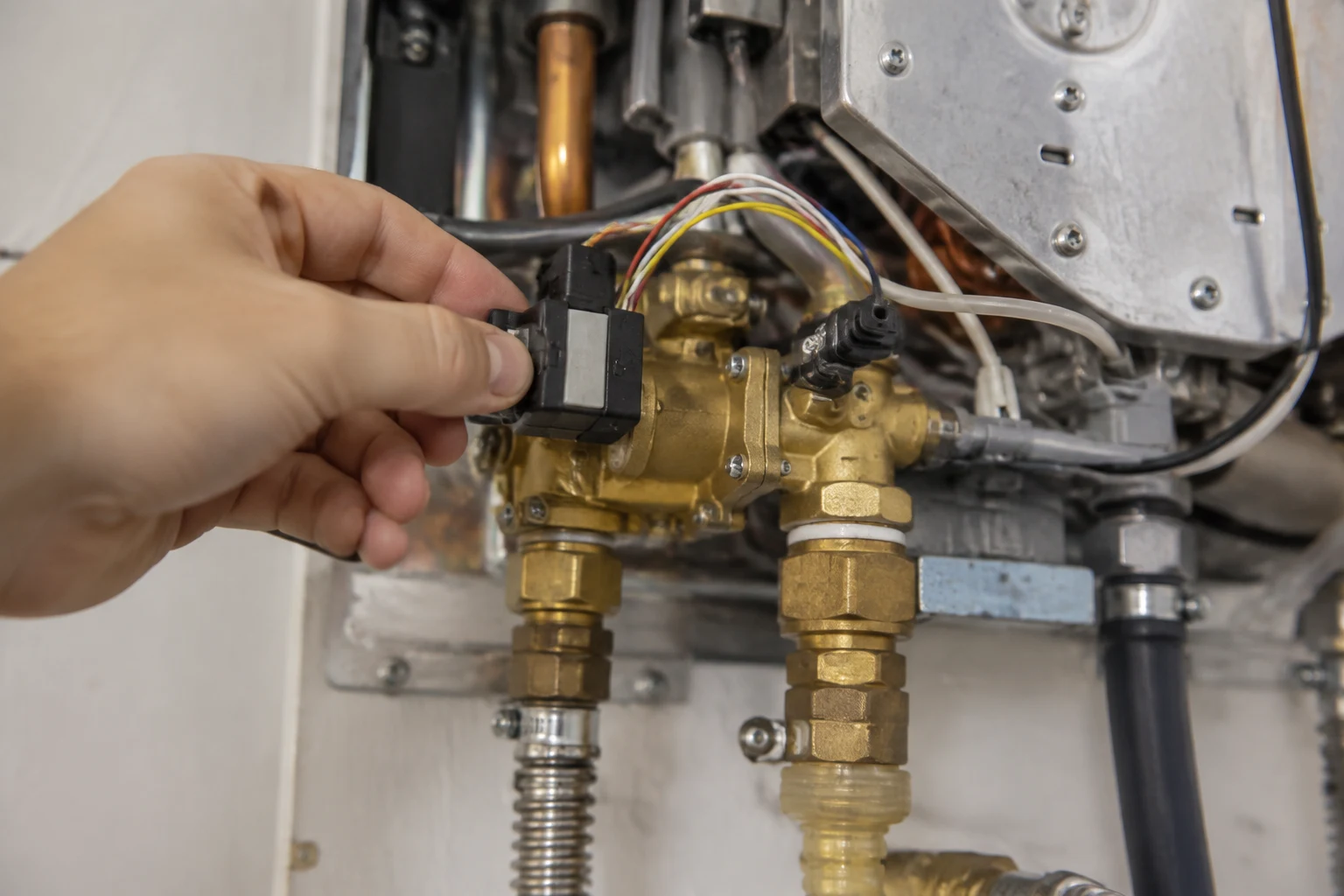
Water flow servo (water flow control valve / bypass servo)
A small motor-driven valve inside the Rinnai unit that meters how much water passes through the heat exchanger versus how much bypasses it. By moving to a commanded position, it lets the control board hold your set temperature as the incoming flow and temperature change through the day. The board sends a position command and expects the servo to get there and report back correctly. When the valve cannot move freely because scale is dragging it, when weak flow makes its job impossible, or when the wiring between it and the board is broken, the board stops getting a sensible answer and throws code 65. The valve is a modest part on its own; the value is in the control it gives the board, which is why a servo that will not track shuts the whole unit down.
Work the fix in order
The water side of a 65 is short and cheap to chase, so go from the most likely, lowest-cost fault down to the valve. Cut power and gas before opening the cabinet. If you are not comfortable inside the unit, do the screen cleaning and the power-cycle test, then hand the descale and any wiring or valve work to a licensed tech. Run this list top to bottom and stop when the code clears.
- Power cycle once. Off at the controller or unplug it, wait about a minute, power back up, and run hot water. If 65 clears and stays gone, it was a glitch. If it returns immediately, keep going.
- Clean the inlet filter screen. Find the screen at the cold water inlet above the isolation and drain valves, unscrew the plug, pull the screen, rinse out sediment and scale, and reinstall it. A clogged screen is a classic 65.
- Confirm steady flow. Run hot water at one fixture and watch that the flow is strong and stable. Weak or surging supply makes the servo fight a moving target, so fix low house pressure or a partly closed valve first.
- Descale the unit. If it is hard water and the heater has skipped maintenance, run a descaling flush through the heat exchanger and valve for the recommended time. This frees a scaled servo and clears a large share of 65s.
- Inspect the servo wiring. With power and gas off, follow the harness from the water flow servo to the control board. Reseat the connector, and look for corrosion, chafing, or pinched wire. Wiggle-test it and watch for the code to change.
- Check the connector at the board. A half-seated plug left after a service call reads exactly like a failing valve. Confirm both ends of the servo run are clean and tight before you condemn any part.
- Test or replace the servo valve. If the screen is clean, flow is steady, the descale is done, and the wiring checks good but 65 persists, the servo assembly is the remaining suspect. That is a tech job with the service manual and the right OEM kit for your model.
- Note the conflicting labels. If an online chart calls 65 an inlet solenoid fault, do not chase a different part. Rinnai's documentation ties 65 to the water flow servo, and the repair path above is the same regardless of the wording.
Keeping 65 from coming back
The single best thing you can do for a Rinnai on hard water is descale it on schedule, once a year in most areas and more often where the water is very hard. A yearly flush keeps scale off the water flow valve, which is the number one reason 65 returns. Pair that with cleaning the inlet screen at the same visit, and you have removed the two most common causes before they ever trip the code. If your water is hard enough that you are flushing every few months, a whole-house softener or a scale-inhibiting filter ahead of the heater pays for itself in fewer service calls and a valve that keeps moving the way the board expects.
Frequently asked
What does Rinnai error code 65 mean?
Code 65 is a water flow control valve fault. Inside a Rinnai tankless heater there is a small motor-driven valve, called the water flow servo or bypass servo, that opens and closes to control how much water passes through the heat exchanger. That is how the unit holds your set temperature when the incoming flow or temperature changes. Code 65 means the control board commanded that valve to move and did not get the response it expected. The valve is not reaching its position, its feedback is off, or the wiring between the servo and the board is broken. One thing worth flagging: a few generic error-code lists online describe 65 as an inlet solenoid valve problem. Rinnai's own service documentation frames it as the water flow servo, sometimes labeled the water flow control valve. It is the same assembly and the same repair path either way, so do not let the wording throw you.
Can I reset Rinnai code 65 myself?
Yes, and it is the first thing to try. Turn the unit off at the controller or unplug it, wait about a minute, then power it back up and run hot water at one fixture. If 65 was a one-time glitch, it may clear and stay gone. But here is the honest part: if the valve is scaled, the inlet screen is clogged, or the servo wiring is bad, code 65 comes right back the next time the unit calls for hot water, because the fault is mechanical or electrical, not a stuck display. Rinnai's own troubleshooting for 65 says the same thing in reverse: check the servo wiring first, then cycle power to see whether it clears. A code that returns immediately after a reset is telling you to stop resetting and start inspecting.
What is the most common cause of Rinnai code 65?
On a unit that has run for a few years, scale is the usual culprit, especially in hard-water areas where the heater has not been descaled on schedule. Mineral buildup makes the water flow valve sluggish or keeps it from moving to the position the board wants, and the board reads that as a fault. Right behind scale is a clogged inlet water filter screen, which is the little screen at the cold water inlet that catches sediment and debris. When it plugs up, flow gets weak and unstable and the servo cannot regulate against it. After those two come the electrical causes: a loose or corroded connector at the servo, or damaged wiring back to the control board. A failed servo valve assembly itself is real but it is usually the last suspect, not the first.
How much does it cost to fix Rinnai code 65?
It depends entirely on where the fault lands. If it is a clogged inlet screen or a servo that just needed a descale, your cost is a vinegar-and-pump flush kit, roughly $40 to $70, or nothing if you already own the gear. If a plumber does a diagnostic and descale, expect somewhere in the $150 to $350 range for the visit and the flush. If the water flow servo valve assembly actually failed and needs replacing, the OEM part is commonly $75 to $150 depending on your model, and installed by a licensed tech you are usually looking at $300 to $600 all in, since the job means opening the cabinet, swapping the valve, and confirming the servo tracks correctly afterward. The reason a good tech descales and checks the screen before condemning the valve is that the cheap fix clears a large share of these.
Is Rinnai code 65 dangerous?
The code itself is the safe response, not a hazard. Unlike the combustion or venting codes, 65 is on the water side of the unit, so it is not about gas, exhaust, or carbon monoxide. What the lockout is protecting against is the unit running without proper control of water flow, which could let temperature swing or the heat exchanger see conditions it should not. Shutting down and showing 65 is the board refusing to run blind. The thing you should not do is try to defeat it or force the unit past the code. If the valve cannot be controlled, the heater cannot reliably hold your temperature, and that is worth fixing rather than bypassing. Find the cause, clear it, and let the servo track the way it is supposed to.
Why does Rinnai code 65 keep coming back?
Because the underlying restriction or fault is still there. This is the most common frustration with 65: someone cleans the inlet screen, the code clears for a day, then it returns. On older or hard-water installs, that almost always means scale on the valve that a screen cleaning did not touch. The screen catches debris at the inlet, but it does nothing about mineral buildup coating the servo inside the unit. If 65 keeps returning after you have cleaned the screen and confirmed steady flow, the next step is a full descale of the heat exchanger and valve, not another screen cleaning. If it still comes back after a proper descale, the servo assembly or its wiring is the remaining suspect, and that is where a tech takes over with the service manual.
Will descaling clear Rinnai code 65?
Often, yes, and that is exactly why it is worth doing before you buy any parts. Code 65 is a water flow control problem, and scale is one of the top reasons the valve stops moving freely. A proper descale runs a descaling solution through the heat exchanger and valve for the recommended time, which can free a sluggish servo and clear the code without touching a single component. This is the opposite of a code like a burner sensor fault, where a flush does nothing. Here the flush is aimed right at the likely cause. Do the inlet screen first, then descale, then run the unit. If 65 is gone, you found it. If it survives a good descale with clean flow, you have ruled out the cheap fixes and the valve or wiring is next.