A Rinnai flashing 61 has not overheated and has not lost water. It has lost confidence in its own fan. Before the burner ever lights, the control board spins the combustion blower up to a target speed and watches a feedback signal to confirm it got there. When the measured RPM comes up short, or the signal drops out, the board refuses to fire and posts code 61. The cause is usually cheaper than the number on the display makes people fear: a wheel packed with dust, a loose connector, or a motor whose bearings have gone tired, not the control board that ends up quoted first.
How the board watches the fan
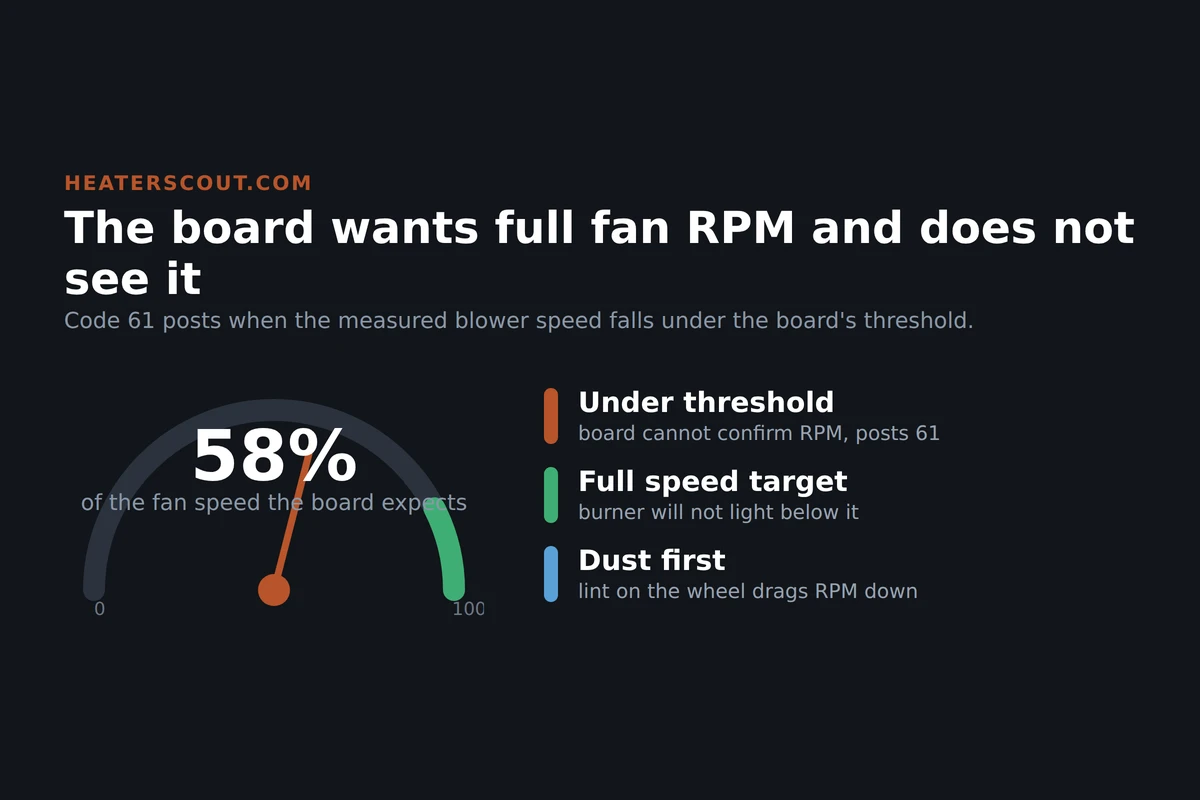
The combustion fan is the lung of a tankless heater. It pulls fresh air in for the burner and pushes exhaust out the vent, and it has to move a specific amount of air for the gas to burn cleanly. So the board does not just switch the fan on and hope. It commands the DC blower motor to a target RPM during startup, reads a speed feedback signal back from the motor, and only lights the burner once it sees the fan holding the speed it asked for. It keeps that watch the whole time the unit fires. The moment the real speed falls under the threshold, the board shuts down and shows 61 rather than burn with the wrong airflow.
Dust and lint on the blower wheel
The most common and cheapest cause. Fine debris builds up on the fan blades and inside the housing over years, throwing the wheel out of balance and dragging its RPM below the board's threshold. A can of air or a soft brush and a rag, with the power off, often clears a 61 outright. Check this before you spend a cent on parts.
Loose connector or chafed harness
The fan reports its speed through a wiring harness back to the board. A backed-out pin, green corrosion on a connector, or a wire chafed against an edge makes the feedback signal drop in and out. That reads to the board as a fan that is not spinning, so it posts 61. Reseat every connector and follow the harness for damage where it flexes.
Tired or seized fan motor
Bearings wear, the motor draws more current, and top RPM falls off until it slips under the threshold. A wheel that grinds, sticks, or will not coast freely when you spin it by hand is a failing motor. This is the classic intermittent 61: works for a few hours after a reset, then trips once the cold motor drags on the next startup.
Restricted or blocked venting
If the intake or exhaust is partly blocked, by a nest, screen debris, ice, or a run that is too long, the fan has to fight extra back-pressure and cannot hit its commanded speed. The motor may be fine but the load is wrong. Clear the vent terminals and confirm the run matches Rinnai's spec before condemning the motor.
Control board misreading a good fan
The last and most expensive suspect. If the wheel is clean, the wiring is tight, the motor windings ohm out correctly, and 61 still returns, the reading circuit on the PCB is what remains. It is real but uncommon, and it is why you rule out everything upstream before anyone orders a board.
The odds behind the code
Numbers help set expectations before you open the cover. Code 61 lands on the mechanical side of the heater far more often than the electronic one, and the fixes cluster around the fan itself.
What to check first
Work the free causes before you price a part. Most 61 faults are dust or a connector, not the board. Cut power and gas at the unit before the cover comes off, and give a hot exchanger time to cool.
- Switch off the breaker or unplug the unit, shut the gas, then remove the front cover.
- Find the combustion fan, spin the blower wheel by hand and feel for drag, grinding, or a wheel that sticks.
- Clean dust and lint off the fan blades and out of the housing with a soft brush or a can of air.
- Unplug and inspect the fan connectors for green corrosion, backed-out pins, or a burnt terminal.
- Follow the fan harness for chafes, pinches, or a break where it flexes against an edge.
- Check the intake and exhaust terminals outside for nests, screens, or debris that loads the fan.
- Reseat every connector, close up, restore power, and watch whether 61 comes back on startup.
When cleaning does not hold
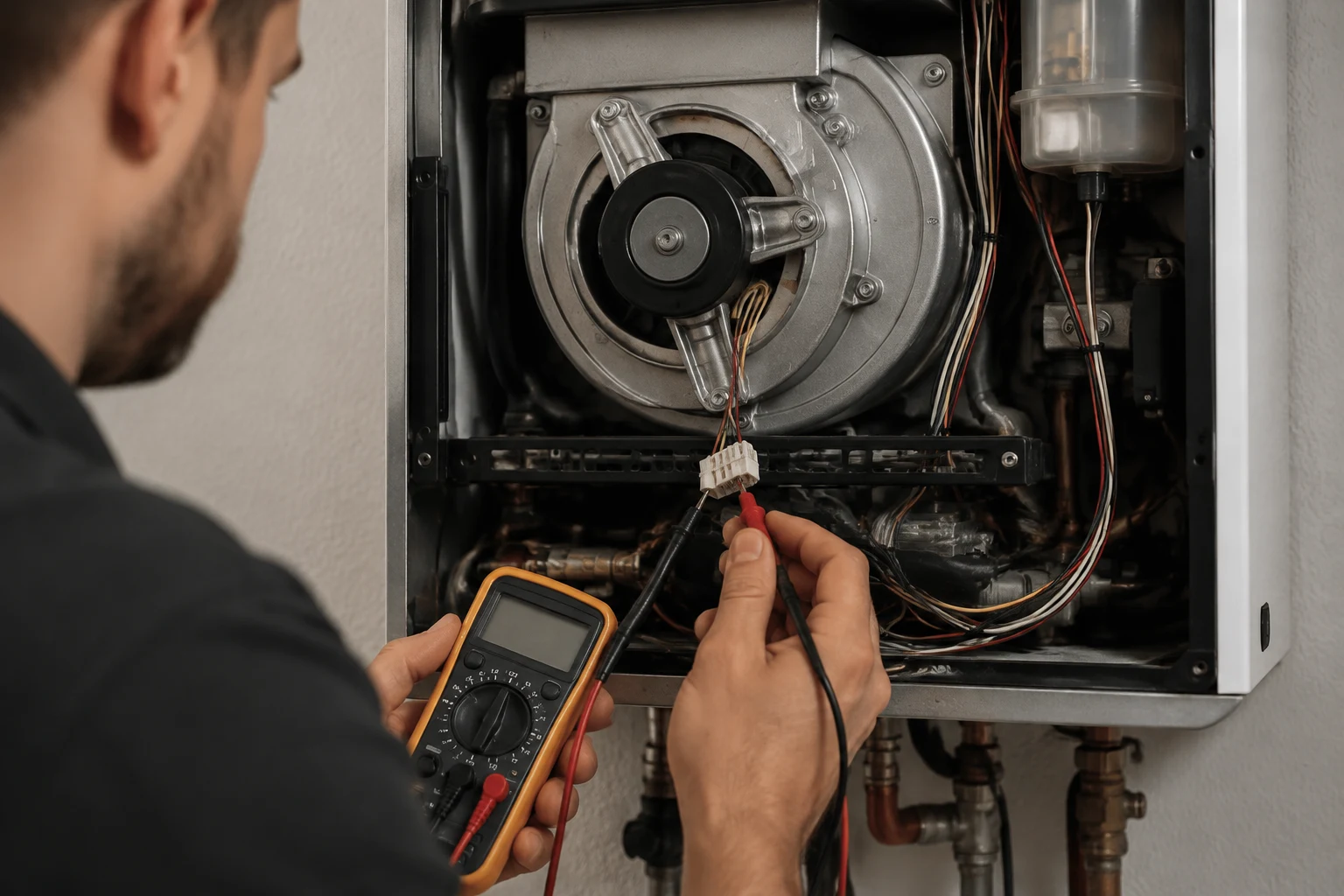
If 61 survives a clean wheel and reseated connectors, stop guessing and put a meter on the motor. Measure the winding resistance across the motor leads with power off. An open winding is a dead motor and a clear answer. Some technicians also confirm the board is driving the fan by checking for roughly 49 VDC at the motor leads during a heat cycle. If the windings read good and the board is delivering voltage but the fan still cannot hold speed, you are looking at a worn motor under load or a board that misreads the feedback. That split, a confirmed-bad fan versus a bad board, is where the repair gets expensive, so prove it before you buy the part.
The verdict
Code 61 is a combustion fan fault: the board commands the DC blower to a target RPM, reads a feedback signal, and locks out when the fan cannot reach or hold that speed. Rule out dust on the wheel and a loose fan connector first, both free. Then check the venting and ohm the motor windings. The fan motor is the usual paid fix at roughly $300 to $600; the control board is the last and most expensive suspect at $500 to $900. Reset by pulling power for about three minutes, but treat that as a test of your repair, not the repair itself.
Where the homeowner line sits
Cleaning the fan wheel, reseating connectors, checking the harness, clearing the vent terminals, and ohming the motor windings are all fair game for a careful owner with a screwdriver and a multimeter. None of that touches the gas train or combustion tuning, which keeps the first round of 61 work on the DIY-friendly side. The place to hand it off is the motor swap on models where the fan is buried, and the control board. Diagnosing a PCB against Rinnai's service sheet, and setting up combustion after a fan or board change, is a licensed tech's job. Never jumper or bypass the fan circuit to force the unit to run. That fan check is what keeps the burner from firing with the wrong airflow and venting exhaust the way it should.
Keeping 61 from coming back
A combustion fan fails from three slow things: dust load, worn bearings, and a connector that works loose over years of heat cycling. You cannot stop bearings from aging, but you can keep the wheel clean. Pull the cover at your annual service and brush the dust off the blades and out of the housing before it unbalances the fan. While you are in there, reseat the fan connectors and look for the first green hint of corrosion, because catching a loose pin early beats chasing an intermittent 61 on a cold morning when the motor drags worst. Keep the intake and exhaust terminals clear of nests and debris so the fan never fights extra back-pressure. A unit that gets a yearly look rarely surprises you with a fan code out of nowhere.
Frequently asked
Can I reset Rinnai error code 61 myself?
Yes, but reset it the way Rinnai means it. There is no red button for 61. You clear the latched code by pulling power: switch the unit off at its breaker or unplug it, leave it dead for about three minutes, then restore power. Ten seconds is not always enough; the board and its capacitors want the full down time to fully reset. When power comes back the unit runs its startup and spins the fan to check it. If the fan reaches speed, 61 clears. If it does not, the code returns the moment the board looks for the fan again. So the reset is a test, not a repair. A unit that runs for a few hours after a reset and then throws 61 is telling you the fan or its circuit is marginal, not fixed.
What does Rinnai code 61 actually mean?
It means the control board could not confirm the combustion fan is spinning at the speed it expects. Before the burner lights, the board commands the DC blower to reach a target RPM and reads a feedback signal from the motor to verify it. It keeps watching that speed while the unit fires. If the fan never reaches the threshold, stalls, or the feedback signal drops out, the board shuts everything down and displays 61 rather than fire with the wrong airflow. The fan pushes combustion air and pulls exhaust out the vent, so running without a healthy fan would burn dirty and vent poorly. Code 61 is that protection doing its job.
How do I test the combustion fan on a Rinnai?
Kill power and gas first, then pull the front cover. Rinnai's own procedure is straightforward: check the wiring and connectors from the fan back to the board for looseness, corrosion, or a chafed harness, spin the blower wheel by hand to confirm it turns freely with no drag or grinding, and clear any dust or debris from the wheel and housing. With a multimeter you can measure the fan motor winding resistance; an open winding means a dead motor. Some techs also check for roughly 49 VDC at the motor leads during a heat cycle to confirm the board is driving it. If the wiring is tight, the wheel spins clean and free, and the motor windings read good but 61 stays, the fault has moved toward the board.
How much does it cost to fix Rinnai code 61?
If it is dust or a loose connector, the fix costs nothing beyond your time with a cover off and a rag. When the fan motor itself is worn or seized, a replacement combustion fan motor plus labor typically runs about $300 to $600 depending on model and your local rates. The expensive outcome is the control board, which can land in the $500 to $900 range once you count the part and the visit. Most 61 repairs fall in the fan-motor band, not the board band, which is exactly why you clean and check the fan before anyone orders a PCB. The board is the last suspect for a reason.
Will descaling clear Rinnai code 61?
No. Descaling flushes mineral scale out of the heat exchanger waterways, and it is worth doing on schedule, but 61 is an air-side fault, not a water-side one. The combustion fan and its feedback signal have nothing to do with scale in the exchanger. A descale will not clean dust off the blower wheel, tighten a loose fan connector, or wake up a seized motor. That said, if you already have the unit open for a 61, it is a fair time to look at overall service, because a heater that has gone years without a flush has usually gone years without anyone clearing dust off the fan either. Just do not expect vinegar to touch this code.
Why does Rinnai code 61 keep coming back?
A repeat 61 means the fan or its circuit is still marginal. The classic pattern owners report is a unit that runs fine for a few hours after a reset, then flashes 61 once it sits idle and cools. That points at a tired motor whose bearings drag when cold, dust that keeps loading the wheel out of balance, or a feedback signal that flickers at a corroded connector. It can also be the control board misreading a healthy fan, which is uncommon but real and costs the most to prove. Clean the wheel and housing, reseat every fan connector, ohm the windings, and if a good fan still throws 61 the board is the remaining suspect.
Is Rinnai error code 61 dangerous?
The code itself is a safety lockout, so the appliance is protecting you by refusing to fire. The fan moves combustion air in and pushes exhaust, including carbon monoxide, out the vent. If the board cannot trust the fan speed, firing anyway could mean incomplete combustion and poor venting, so it shuts down instead. The lockout is the safe outcome. What is not safe is trying to bypass or jumper the fan circuit to force the unit to run. That defeats the airflow check that keeps combustion clean. Dealing with 61 is low risk since your part of the work is dust, connectors, and a meter, but if you ever smell gas or see scorched wiring while you are in there, stop and get a licensed tech on it.