A Rinnai tankless unit throws code 35 when its control board reads a temperature sensor and gets a number it refuses to trust. The board would rather lock the burner out than fire on a reading it cannot verify, so hot water stops and 35 shows on the controller. The frustrating part is that 35 is not one single failure. It belongs to a family of thermistor and sensor faults, and the exact sensor it points at shifts between model lines. That is why one search result blames a burner thermocouple and the next blames a water sensor. Before you buy anything, you want to know which sensor your specific model ties to the number 35, and you want to rule out the cheap, common problems first.
What the board is really telling you
Rinnai groups its faults into families. The 30-series codes, which include 30, 33, 34, 35, and 38, are all thermistor and temperature-sensor problems. A thermistor is just a resistor whose resistance changes with temperature, and the board reads that changing resistance to know how hot something is. Feed it a value that falls outside the range a working sensor could produce, or break the wire so it reads open, and the board flags the circuit. Code 35 is that flag on one particular sensing loop.
Which loop depends on the unit. On non-Sensei units the number lands on a combustion or water thermistor. On the RH180 hybrid tank-tankless, Rinnai's sheet ties the same area to a tank temperature sensor. The two side-by-side notes below show why you should never fix a Rinnai code by the number alone.
What stays the same
- It is a temperature-sensor circuit fault, part of the 30-series family.
- The board is rejecting a reading, not measuring a real over-temperature.
- The first suspect is always the wiring harness, not the sensor.
- A meter that reads 20K ohms is the tool that settles it.
What varies by model
- The exact sensor: water thermistor, combustion thermistor, or tank sensor.
- Whether Sensei or non-Sensei procedure applies to your unit.
- How far the gas-side checks go before you replace the part.
- The part number and price of the replacement thermistor.
How code 35 compares to its neighbors
Because 35 shares a family with the codes on either side of it, it helps to see them together. If your controller has cycled through more than one 30-series number, the pattern narrows down which sensor is acting up. This is pulled from Rinnai's diagnostic sheet and the way each code's procedure reads.
| Code | Circuit it watches | First thing to check |
|---|---|---|
| 30 | Temperature sensor fault, sensor family | Harness and connector at the sensor |
| 33 | Water thermistor circuit | Reseat and meter the water thermistor |
| 34 | Combustion thermistor, gas-type sensitive | Harness, gas type, manifold pressure |
| 35 | Temperature-sensor circuit, model dependent | Harness first, then meter the thermistor |
| 38 | Exhaust gas temperature sensor | Exhaust sensor harness and resistance |
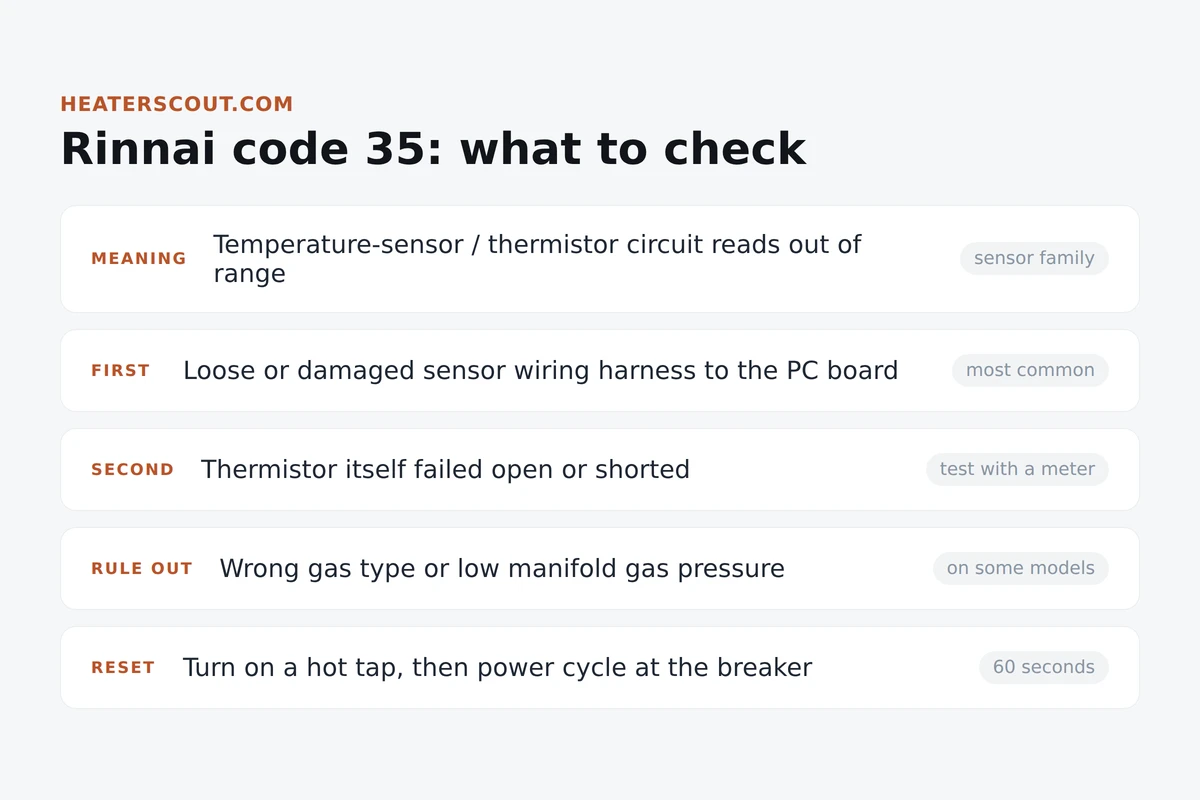
The plain-English definition
Rinnai code 35
A thermistor or temperature-sensor circuit is reporting a value the control board will not accept: out of range, open, or short. It sits in Rinnai's 30-series sensor-fault family. The specific sensor depends on the model, which is why the meaning reads differently across sources. The board locks the burner out until the circuit reads sane again. Fixes run from reseating a loose connector, to replacing a drifted thermistor, to the gas-side checks Rinnai lists for stubborn cases: correct gas type, manifold pressure, and a clean burner.
That last sentence is where the old "gas or combustion" reputation of code 35 comes from. Rinnai's 30-series procedure does not stop at the sensor. If a good sensor keeps flagging, the sheet walks you into gas territory: confirm the gas type, check for a past propane conversion done wrong, and verify manifold pressure with a manometer. So the hint that 35 is gas related is not wrong, it is incomplete. The code starts at a sensor and reaches gas only when the sensor checks out clean.
Pick your path by what you are seeing
Not every code 35 needs the full treatment. Match your situation to one of these before you start pulling connectors, because the right first move is different for a one-time flash than for a code that will not clear.
It flashed once and cleared
A single 35 after a power blip or a cold snap is often a transient read. Clear it with a power cycle, run hot water, and watch. If it does not return over a few days, you had a glitch, not a broken sensor. No parts needed.
It comes back after every reset
A code that returns within minutes means the fault is live. Open the front cover with the power off and reseat every connector in the sensor circuit. A backed-out or corroded pin is the single most common real cause.
Connectors look fine
If the harness is solid, the thermistor itself is next. Pull it and check resistance cold and warm against Rinnai's chart. A sensor that does not track temperature has drifted and needs replacing.
Sensor tests good but 35 stays
When a verified-good sensor keeps flagging, Rinnai's procedure moves to gas type, manifold pressure, and a scaled burner. Those are licensed-tech checks. Do not open the sealed combustion path yourself.
The homeowner-safe checklist
Here is what you can safely do before a service call, with the power off and the front cover removed. Stop at the gas-side steps and hand those to a tech. Everything on this list is inspection and reseating, not gas work.
- Power cycle first: open a hot tap so the unit tries to fire, then flip the breaker off for a full minute and back on. See if 35 returns.
- Kill power at the breaker before you open anything. Confirm the controller is dark.
- Trace the sensor harness from the thermistor back to the PC board and look for chafed, pinched, or backed-out wires.
- Reseat every connector in that circuit. Unclip, look for green corrosion or a bent pin, push it home until it clicks.
- Check for moisture. A condensate drip or a damp install spot can wet a connector and throw the reading off.
- Look at the install location. A sensor reading wildly cold in a freezing garage can flag on a marginal unit.
- Note your model number and pull its diagnostic sheet so you know which sensor 35 means on your unit.
- If the code clears and holds, you are done. If it returns, write down what you checked and call a tech.
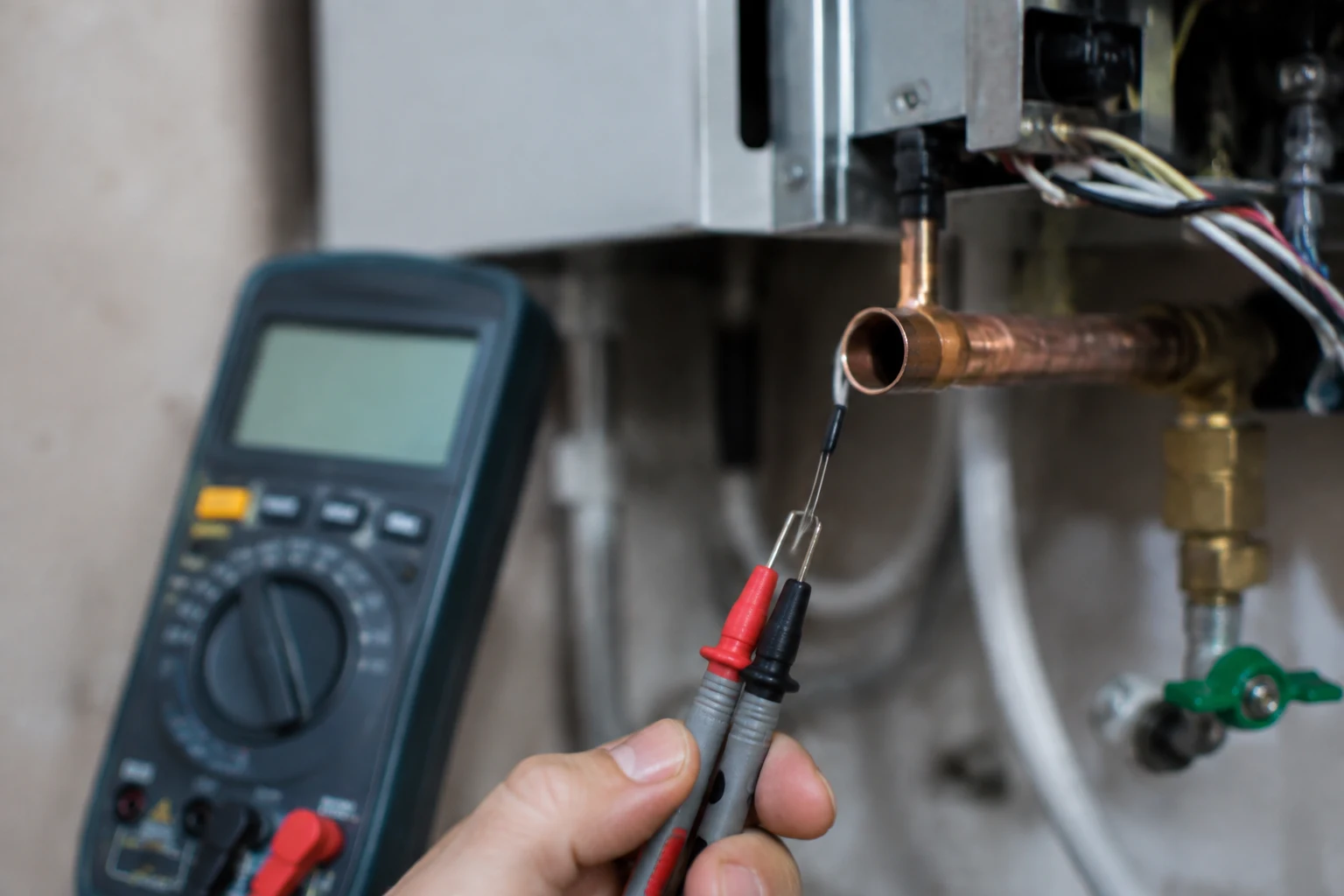
Testing the thermistor with a meter
If the harness checks out and 35 keeps coming, the sensor is next. A thermistor is easy to test if you have a multimeter that reads up to 20K ohms. Rinnai isolates the water supply and pulls the sensor, then reads resistance across the plug. The number should fall as the sensor warms and rise as it cools, and it should land inside a published band at each temperature.
Rinnai's own reference values give you the target. Around 59 degrees the sensor should read roughly 11.4 to 14K ohms. At 86 degrees it drops to about 6.4 to 7.7K ohms. By 113 degrees you are near 3.6 to 4.5K ohms, and at 140 degrees it falls to about 2.2 to 2.7K ohms. A quick field trick is to warm the sensor bulb between your fingers and watch the resistance drop, or hold ice to it and watch it climb. A sensor that does not move, or that sits well outside those bands at a known temperature, has failed and needs replacing. Re-fit any water sensor with its small O-ring intact and a dab of lubricant so you do not tear it going back in.
Where the gas-side checks come in
Say you have reseated everything and the thermistor meters perfectly. Rinnai's 30-series procedure does not just declare the board bad and move on. It walks into the gas system, and this part needs a licensed tech. First, confirm the unit is set for the gas it is actually burning. A heater plumbed for natural gas but converted to propane, or converted without the correct procedure and DIP switch settings, can run a flame that pushes a combustion thermistor into readings the board rejects.
Next comes manifold gas pressure. A tech uses a manometer to read the force low-fire and high-fire manifold pressures against the technical data sheet inside the front cover. Pressure that is too low starves the flame and skews the temperature the sensor sees. While the cover is off, the same procedure has you inspect the burner assembly and heat-exchanger fins for scale and confirm the venting is within Rinnai's clearance and length specs. A blocked or overlong vent changes how the unit burns, and that shows up at the sensor. None of these are homeowner steps.
Keeping code 35 from coming back
Most repeat 35 faults trace back to two things you can get ahead of. The first is scale. Hard water leaves mineral on the heat exchanger, the exchanger runs hotter and less evenly, and sensors start reading numbers the board dislikes. An annual descale, more often on very hard water, keeps the exchanger clean and the sensors honest. If your unit has an inline sediment filter or an isolation-valve service kit, that is where you flush.
The second is the connections. Vibration, heat cycling, and time work connectors loose, and a marginal pin that reads fine today flags 35 next winter. When a tech has the cover off for a descale, it costs nothing to reseat the sensor harnesses and check for early corrosion. Keep the install spot dry, keep condensate draining where it should, and keep the vent clear, and you remove most of what makes a sensor lie. A Rinnai flushed once a year rarely shows 35 twice.
Frequently asked
What does Rinnai error code 35 actually mean?
Code 35 lives in Rinnai's 30-series family of thermistor and temperature-sensor faults, alongside 30, 33, 34, and 38. In plain terms the control board is watching a temperature sensor and getting a reading it does not trust: out of range, open, or shorted. That sensor might be a water thermistor, a combustion thermistor, or on a hybrid tank-tankless unit like the RH180 the tank temperature sensor. The exact sensor tied to 35 depends on your model line, which is why two websites tell you two different things. What does not change is the category. A temperature-sensing circuit is not reporting a sane value, and the board shuts the burner down rather than fire blind. Look up your model in its diagnostic sheet before you buy a part, because 35 on a non-Sensei unit and 35 on a hybrid can point at different hardware.
Can I reset Rinnai code 35 myself?
You can clear it, but clearing is not the same as fixing it. On a unit with a controller, open a hot tap so the heater tries to fire, then press the on/off button or cycle the breaker feeding the water heater. Leave it off for about a minute so the board fully powers down, then restore power and run hot water again. If the sensor and its wiring are fine and the code was a one-time glitch, it stays clear. If a harness is loose or a thermistor has drifted out of spec, 35 comes right back the next time the board reads that circuit. A reset that holds tells you the fault was transient. A reset that fails within a minute or two tells you there is a real hardware problem to chase down.
Is Rinnai code 35 dangerous?
The code itself is a safety response, not a hazard. The board saw a temperature reading it could not verify and locked out the burner instead of running without reliable feedback. That is the system working. The risk lives in what you do next. Rinnai's 30-series procedure has you check manifold gas pressure and confirm the correct gas type, and those are steps for someone qualified to work on gas systems. Opening the sealed combustion chamber without that training is where people get hurt. So the code is protecting you. Hand the gas-side checks to a licensed tech.
How much does it cost to fix Rinnai code 35?
If the fault is a loose connector at the sensor or the PC board, the fix is free once someone reseats it. A replacement thermistor is a modest part, usually 30 to 90 dollars depending on which sensor your model uses, and the labor to remove, test, and swap it runs a service call plus an hour, so figure 150 to 350 dollars all in for a straightforward sensor job. If the trail leads past the sensor into a gas-pressure problem, a failed control board, or a scaled heat exchanger, the number climbs, and a PC board alone can run several hundred dollars. Get the sensor ruled in or out first, because it is the cheapest and most common answer, and do not let anyone sell you a board before the thermistor has been tested with a meter.
Will descaling clear code 35?
Not directly, because 35 is a sensor-circuit fault, not a flow or scale code. But scale is not innocent here. A heat exchanger caked with hard-water mineral runs hotter and unevenly, and Rinnai's 30-series steps have you inspect the burner and copper fins for buildup. Heavy scale can push a combustion thermistor into readings the board rejects, so on a unit that has never been flushed, a descale is worth doing as part of the workup, and it keeps sensors reading true long term. Just do not expect the descaler to be the whole answer if a harness is loose or a thermistor has actually failed.
Why does Rinnai code 35 keep coming back?
A code that returns within minutes of every reset is telling you the fault is live, not transient. The usual repeat offenders, in order: a connector that looks seated but has a corroded or backed-out pin, a thermistor that has drifted out of its resistance band with age, chafed harness wire, or moisture in a connector from a condensate leak. Less often it is a control board that misreads a good sensor. Work it in that order. Reseat and inspect every connector, then meter the thermistor cold and warm to see if its resistance tracks, then look for physical damage to the wire. Boards are last because they are expensive and rarely the actual cause.
Should I call a pro for Rinnai code 35 or handle it myself?
Split it. A homeowner can safely power cycle to clear the code and reseat an accessible sensor connector if they are comfortable opening the front cover with the power off. Where you stop is the gas side. Testing manifold pressure with a manometer, verifying the unit matches your gas type, checking a prior propane conversion, and pulling a combustion thermistor all sit with a licensed tech, because they involve the sealed combustion path and live gas. If a reset holds and the code was a fluke, you are done. If 35 returns, or if the trail points at gas pressure or the board, that is a service call.