Code 34 on a Rinnai tankless is not about water or scale. It is the combustion air temperature sensor, the little probe on the intake side that tells the control board how warm the incoming air is. When the board reads a value it cannot trust from that sensor, out of range, jumping, or gone, it refuses to fire the burner and posts 34. So the whole diagnosis happens on the air side of the cabinet, not down in the heat exchanger. That single fact saves a lot of people from descaling a unit that never needed it.
Air side, not water side
Most Rinnai error codes people run into, the overheat trips and the ignition faults, lead you toward the burner, the exchanger, or the gas train. Code 34 is different. It is one of the combustion-air sensors, and the fastest way to waste an afternoon is to treat it like a flow or scale problem. Before you open anything, it helps to know clearly which side of the machine you are working on, because the fix and the tools are different.
What code 34 is
- A combustion air temperature sensor fault. The board cannot trust the air-temperature reading it is getting.
- An air-side issue: sensor, its wiring and connector, and the airflow feeding it at the intake and blower.
- A safety lockout. The unit will not fire until the reading is trustworthy again.
- Fixed with a meter, a screwdriver, and clean connections, not with a flush kit.
What code 34 is not
- Not an overheat trip. That is a different code tied to the high-limit on the heat exchanger.
- Not a scale or flow problem in the water path, so a descale is rarely the cure.
- Not an ignition or gas-supply fault, though a blocked intake can overlap with venting issues.
- Not a clear-on-a-button code. Power-cycling hides it; it does not fix a bad sensor reading.
Code 34 at a glance
The short version, so you know what you are dealing with before you decide whether to grab a meter or the phone. One detail worth checking against your own unit: Rinnai lists 34 on the indoor non-condensing models, with the R98LSi called out as an exception, so pull your model's tech sheet if you are unsure the code even applies the same way.
| What it means | The combustion air temperature sensor is reporting a value the control board cannot trust, so the board locks out rather than fire the burner blind. |
| Where it lives | The air side of the unit, at the intake and blower, not in the heat exchanger or water path. |
| Clears on a button reset? | Only cosmetically. A power cycle drops it from the display, but a real sensor or wiring fault brings it right back. |
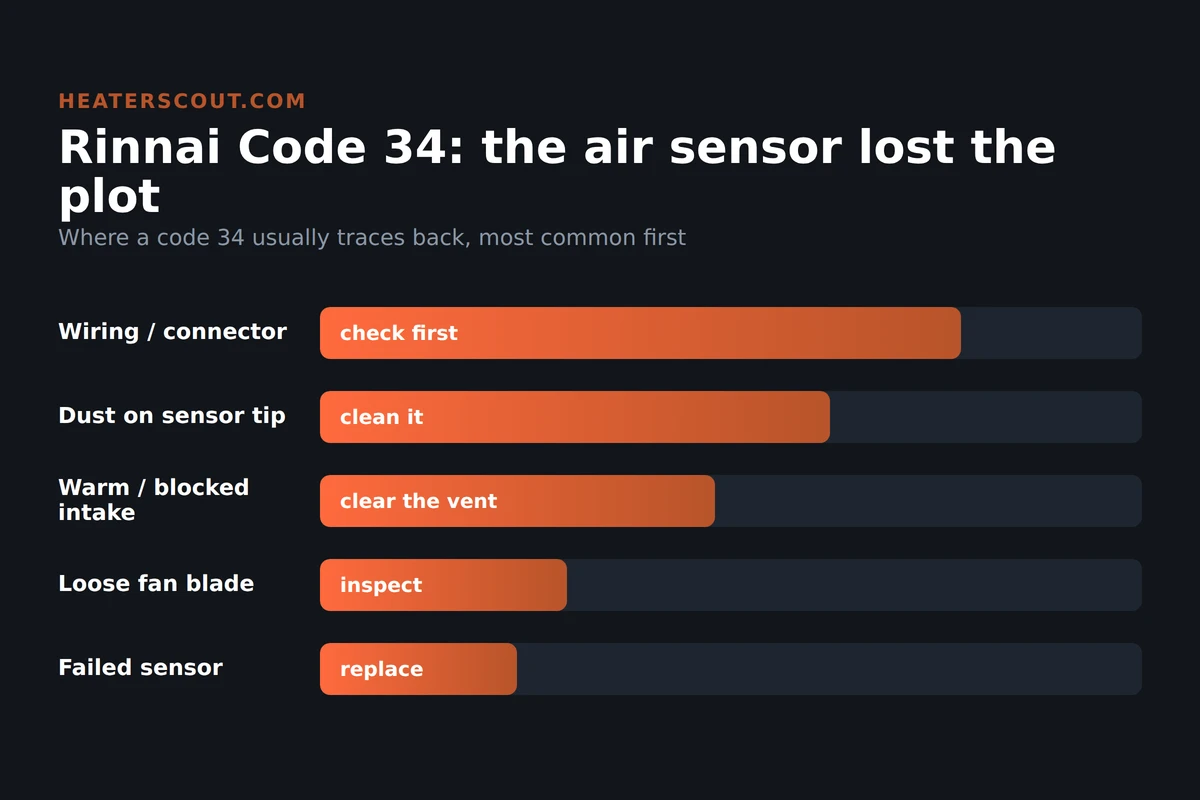
| Most likely cause | A loose, corroded, or damaged connection at the sensor, followed by scale or dust on the sensor tip. |
| Other causes | A restricted or warm intake, a partly blocked vent terminal, a loose fan blade upsetting airflow, or a failed sensor reading out of range. |
| Model note | Listed on indoor non-condensing units, with the R98LSi as a documented exception. Confirm against your model's tech sheet. |
| DIY-safe steps | Reseat and clean the sensor connector, clean the sensor tip, and clear any obstruction at the intake and vent terminal. |
| Call-a-pro steps | Measuring sensor resistance against spec, testing the blower and fan, and replacing the sensor. |
| Prevention | Keep the intake and vent terminal clear, make sure the intake draws cool air, and check connectors during annual service. |
How to read the fault
The point of these first checks is to separate a bad connection from a bad sensor from a airflow problem, because the fix is different for each. Work them in order. Most 34s are solved somewhere in the first two steps, long before anyone needs to buy a part.
Confirm it is not a one-time glitch
Cut power to the unit for a full minute, restore it, and demand hot water. If 34 stays gone, it may have been a momentary hiccup and you are done. If it returns on the next burn, the sensor reading is genuinely wrong and you move on. Do not keep cycling past this; you have your answer.
Inspect the sensor connector and wiring
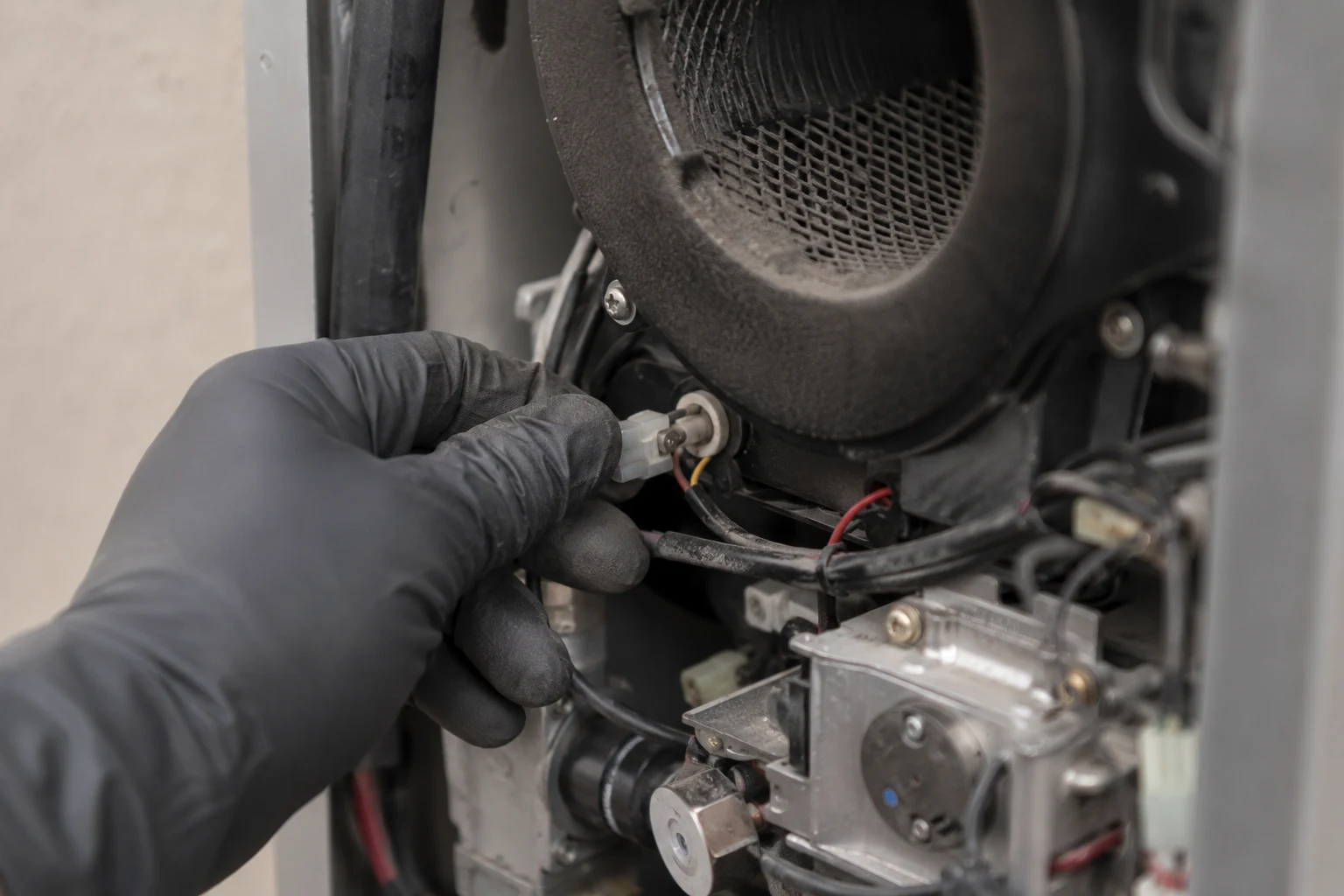
This is where most 34s hide. Find the combustion air temperature sensor on the intake side, unplug its connector, and look at the pins. Corrosion, a bent pin, a connector that was never fully seated, or a wire chafed against a warm surface all read like a bad sensor. Reseat it firmly, and follow the harness for damage. A marginal connection that drifts as the unit heats is the classic cause of a 34 that comes and goes.
Clean the sensor tip
A sensor coated in dust or a thin film reports a temperature that is off from reality. With power off, gently clean the sensing tip. Do not sand it or bend it. If the tip was fouled, cleaning it can bring the reading back into range without a new part.
Check the airflow at the intake
The sensor reads the air the unit is pulling in, so restricted or warm intake air can make its reading look wrong even when the sensor is fine. Clear the vent terminal outside of lint, nests, snow, or a packed screen, and make sure the intake is drawing cool air and not sitting in a hot, closed enclosure. On concentric venting, confirm the intake is not recirculating its own exhaust.
Look at the fan and blower
A loose fan blade or a blower that spins unevenly disturbs the airflow the sensor is measuring, which shows up as an unstable reading. With power off, check that the fan blade is tight on its shaft and turns freely without wobble or drag. A blower fault is less common than a wiring problem but worth ruling out before you condemn the sensor.
Measure the sensor resistance
If the connection is clean, the tip is clean, and the airflow is right, put a meter on the sensor. It is a thermistor, so its resistance should track with temperature and match the values in Rinnai's tech sheet for your model. A reading that is open, shorted, or far off spec confirms the sensor has failed and needs replacing. This is the step where a lot of homeowners hand off to a tech, and that is a reasonable place to draw the line.
Working the fix in order
Once you know whether you are chasing a connection, the airflow, or the sensor itself, the repair is straightforward. The order matters: do the free checks before you buy anything, and do not replace the sensor until you have proven the reading is wrong at the part and not at the plug or in the air feeding it.
Frequently asked
Can I reset Rinnai code 34 myself?
You can clear the display, but that is not the same as fixing it. Cut power to the unit for a minute and restore it, and the code will drop off the panel. If the sensor is still reading a temperature the board does not trust, code 34 comes right back the next time the burner tries to fire. Rinnai treats 34 as a lockout for a reason: the control board is refusing to run on a bad combustion-air reading. So a power cycle is worth one try to confirm it was not a one-time glitch, but if it returns, stop cycling and start checking the sensor, its wiring, and the airflow around the intake. The reset addresses the symptom on the screen, not the fault behind it.
What does Rinnai code 34 actually mean?
It is the combustion air temperature sensor. That sensor sits on the air side of the unit, near the intake and blower, and tells the control board how warm the incoming combustion air is so the board can trim the burner correctly. When the board gets a reading that is out of range, jumps around, or drops out entirely, it cannot set the air-fuel mix safely, so it shuts down and posts 34. On most model lines the display shows a 34; on some it flashes 3 then 4. It is worth noting that on Rinnai's list, code 34 shows up on the indoor non-condensing units, with the R98LSi as the documented exception, so check your specific model's tech sheet.
Is Rinnai code 34 dangerous?
The shutdown is the safe response, not the danger. A gas burner needs to know the air side to hold a clean, complete flame, and the board would rather stop than guess with a sensor it cannot trust. So the code itself is protecting you. The thing to avoid is forcing the unit to run past it by jumping the sensor connector or repeatedly power-cycling to sneak a burn through. Beyond the sensor, one of the causes behind 34 is a restricted or warm intake, and a genuinely blocked vent on a gas appliance is its own hazard. Treat the code as a stop, find out why the air reading is wrong, and let the protection go back to doing its job.
Will descaling clear code 34?
Usually not, because code 34 lives on the air side of the unit, not the water side. Descaling flushes mineral scale out of the heat exchanger and the water passages, which is the fix for overheat and flow codes, but the combustion air temperature sensor is not in that water path. There is one indirect connection worth mentioning: a sensor tip coated in dust or a thin film can read wrong, and cleaning that buildup off the sensor itself can help. That is not a descale, though. It is wiping or gently cleaning the sensor. If your unit is also overdue for a descale, do it for the sake of the exchanger, but do not expect it to be the cure for a 34.
How much does it cost to fix Rinnai code 34?
If it turns out to be a loose or corroded connector, the fix is free beyond your time; you reseat the plug and clean the contacts. Cleaning a fouled sensor is likewise a no-parts job. The combustion air temperature sensor itself is not an expensive part, commonly in the $30 to $80 range depending on model, but getting a licensed tech out to diagnose and replace it, and to confirm the airflow and fan are right, typically runs a service call into the $200 to $400 bracket. If the real problem is a loose fan blade or a blower issue feeding the sensor a bad reading, add that part and labor, which can push the total toward $400 or more.
Why does Rinnai code 34 keep coming back?
Because the underlying reading is still wrong. The most common repeat offender is a marginal connection at the sensor, a connector that looks seated but has a corroded pin or a wire chafed against a hot surface. It reads fine when cold, then drifts as the unit heats and vibrates, so 34 returns intermittently and looks random. The next suspect is intake air that is warmer or more restricted than it should be, from a partly blocked terminal or an intake drawing from a hot enclosure. And a fan blade that is loose or a blower spinning oddly can feed the sensor unstable air. Chase the connection first, then the airflow, then swap the sensor if the reading is still out of spec.
Can I keep using hot water with a code 34 showing?
No. Code 34 is a lockout, so the unit will not fire the burner while the code is active. You get no hot water until it clears, and it will not clear for good until the air-temperature reading is trustworthy again. A power cycle might buy you one shower if the fault was momentary, but a real sensor or wiring problem will lock it out again quickly. This is not a code to nurse along. Because it sits on the combustion air side, work through the wiring and airflow checks or get a tech in sooner rather than later, since every failed ignition attempt is the board confirming it still cannot trust the reading.