Error 32 on a Rinnai tankless is the unit telling you it no longer trusts the thermometer at its own hot-water outlet. The outgoing water temperature thermistor, the sensor that reads how hot the water is as it leaves the heater, has gone open, shorted, or drifted outside the resistance window the control board expects. The board reacts the only safe way it can: it shuts the burner off and posts 32 rather than push out water at a temperature it cannot verify. Most of the time the sensor is not dead. It is buried under a layer of hard-water scale that insulates the tip and throws the reading off, which is why a descale and a cleaning fix a large share of these before any part gets ordered.
What the board is actually reporting
The outgoing thermistor is a small temperature sensor whose resistance changes with temperature. The board sends it a reference and reads the resistance back, then converts that to a water temperature. For any given temperature Rinnai expects the resistance to fall in a defined band. When the value goes to infinity the circuit is open, meaning a broken wire or a disconnected sensor. When it drops toward zero the circuit is shorted. When it simply sits outside the band, the sensor is fouled or failing. Any of those three lands as code 32. One point worth nailing down before you buy anything: 32 is the outlet water thermistor, and 33 is a separate sensor, the heat-exchanger outgoing thermistor that sits upstream of the final outlet. The troubleshooting is nearly identical but the physical part is different, so read the display exactly.
1. Confirm the code and its history
Read the number on the controller as it displays, 32, and note whether it fires the instant you draw hot water or only after the unit has run for a while. A code that appears immediately points at an open or shorted circuit, a wire or connector problem. A code that shows up only once the unit is hot points at a thermistor drifting out of range as it heats, or scale that reads slow. Check the unit's error history through the controller if your model stores it, so you know if 32 is a repeat offender.
2. Clear it and see if it holds
Run a hot tap so the unit tries to fire, then press On/Off on the temperature controller twice to cycle it and drop the stored code. No controller wired in, cut power at the breaker for about 30 seconds and restore it. Draw hot water again. If 32 stays gone, the trigger was transient and you are done watching. If it returns within a minute, the sensor circuit is genuinely out of range and you keep going.
3. Inspect the harness and connector
With power and gas off and the unit cool, open the cabinet and find the outgoing thermistor on the hot-water outlet line. Follow its two wires back to the control board. Look for a connector backed half out, a wire chafed against metal, or green corrosion on the pins. Heat and vibration work connectors loose over years. Reseat the connector firmly, straighten any pinched wire, and cycle the unit again. A surprising share of intermittent 32s are nothing more than a loose plug.
4. Descale, then clean the sensor tip
If the connection is solid, scale is the prime suspect. Flush the unit with a descaling solution through the service valves per Rinnai's procedure. Then, with the thermistor out, wipe the mineral crust off the sensor tip so it reads the water and not the scale. Reinstall it, restore water, and check for leaks at the fitting before you power up. On a hard-water install this step alone clears the code more often than any other.
5. Measure the thermistor, then replace if it fails spec
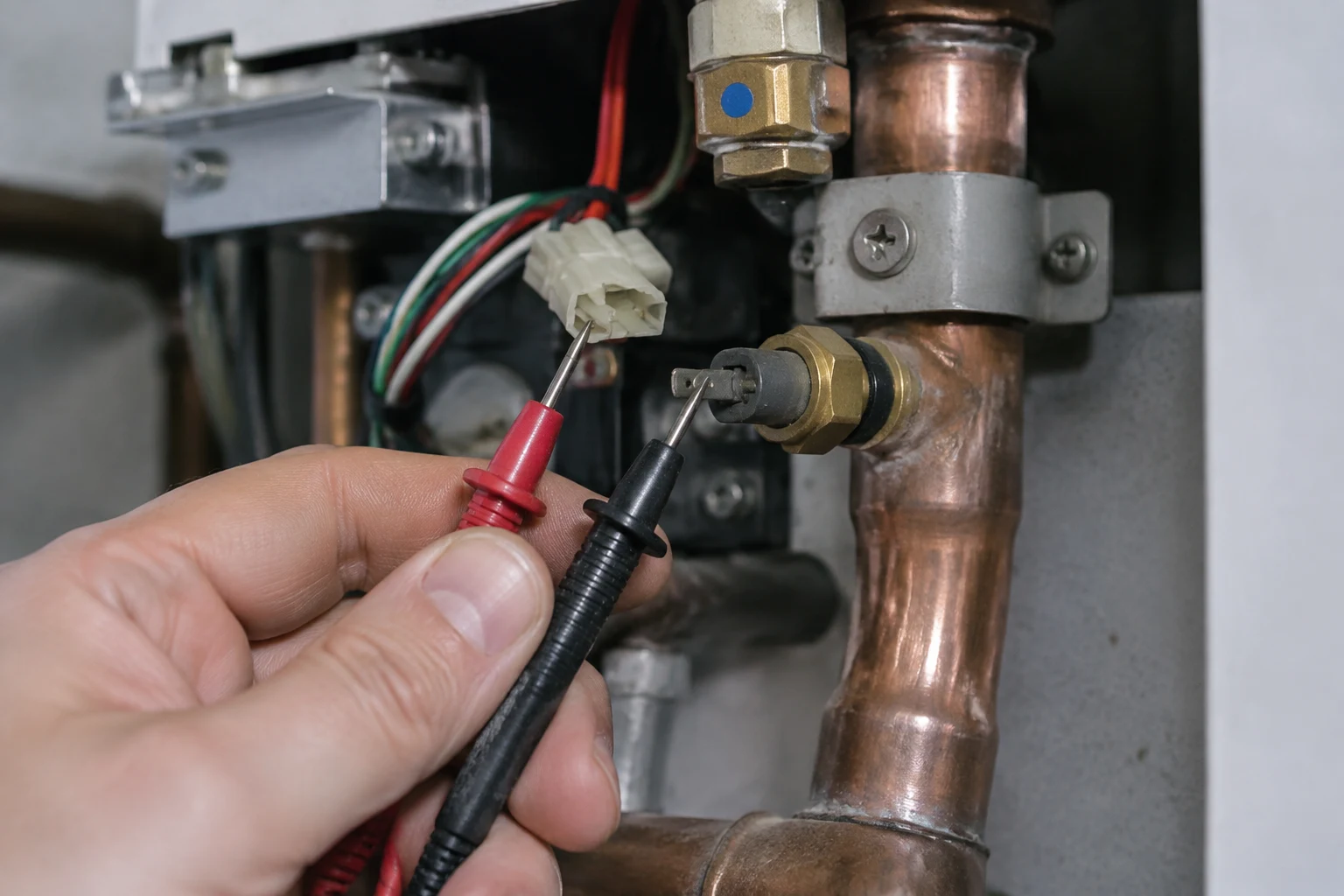
Still throwing 32 after a clean sensor and a solid connection means measuring the thermistor's resistance with a meter and comparing it against Rinnai's temperature-to-resistance table for the model. If it reads open, shorted, or outside the band at a known temperature, the sensor is bad and gets replaced. If a known-good thermistor still posts 32, the fault has moved to the control board, and that is a tech's call rather than a parts swap.
Power and gas off, and never bypass the sensor
Cut the power and the gas before you open the cabinet, and give the unit time to cool. The outgoing thermistor threads into a line that carries scalding water, and it sits in a cabinet with gas piping and 120-volt wiring a few inches away. Just as important: never jumper or bypass the thermistor to force the unit to keep running. That reading is the safety input the board uses to keep outlet water in a safe range, and defeating it is exactly what code 32 exists to prevent.
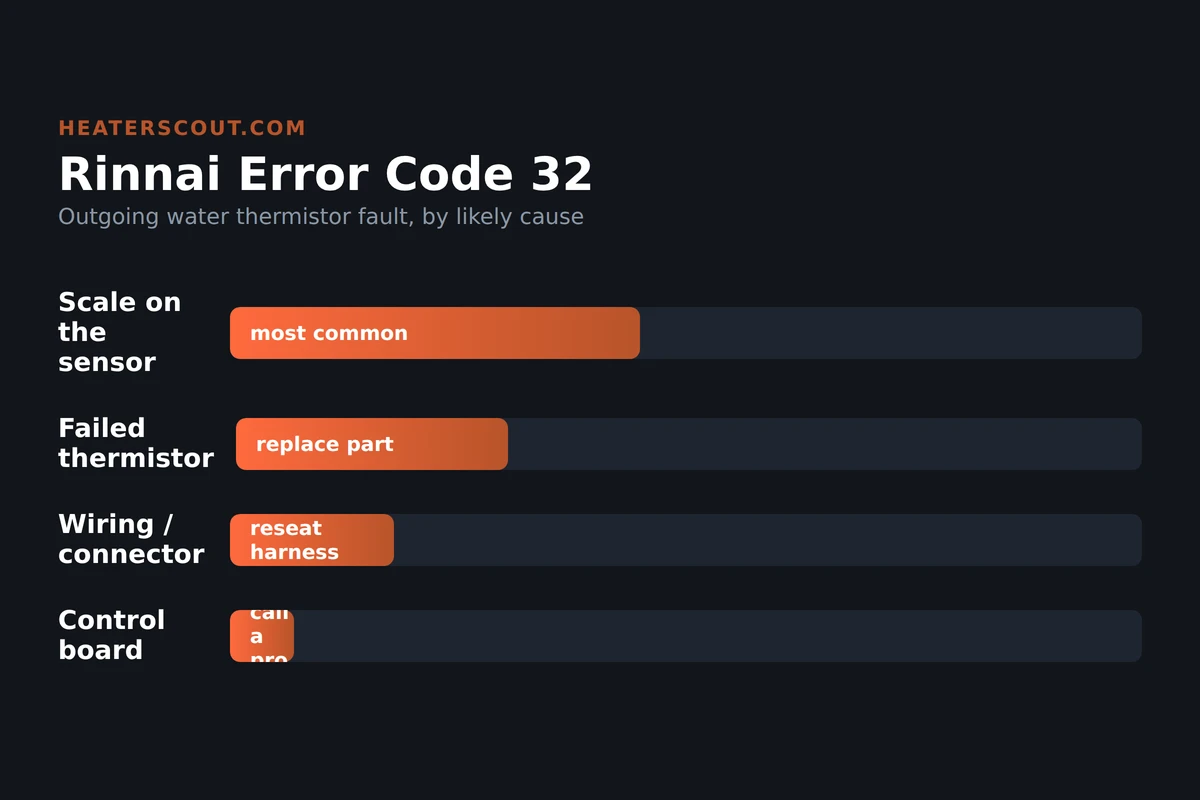
Sort the fix by what actually caused it
Two of the four causes are within reach of a confident owner and two are not. The dividing line is whether the job is cleaning and reseating, which is careful but low-stakes, or diagnosing and replacing a part inside a live gas appliance. Read the split below and be honest about where you land before you start pulling a sensor out of a hot-water line.
You can likely handle this
- Clearing the code: run a hot tap, press On/Off twice, or power-cycle at the breaker for 30 seconds.
- Descaling the unit through the service valves with a proper descaling solution on the annual schedule.
- Cleaning scale off the thermistor tip once the unit is cool, drained, and depressurized.
- Reseating a loose sensor connector and inspecting the wire for chafing or corrosion.
- Checking your water: if it is hard and the unit has no softener ahead of it, that is why scale keeps returning.
Call a licensed tech for this
- Measuring the thermistor's resistance against Rinnai's spec table if you are not set up to test it.
- Replacing the outgoing thermistor if opening a gas appliance is outside your comfort or local code.
- A code that returns after a confirmed-good sensor, which points at the control board.
- Any sign of gas smell, water leaking inside the cabinet, or scorching around the burner.
- Warranty work, since a DIY part swap can void coverage on some Rinnai units.
What to have on hand before you open it
The parts list for a code 32 job is short, but a tankless sits high on a wall with the sensor tucked behind the front cover, so fumbling for a tool halfway in is how the water still on the line finds the floor. Lay it out first. The thermistor is model-specific, so match the part to your unit rather than buying a generic sensor.
- The correct OEM outgoing thermistor for your exact Rinnai model, roughly $17 to $30, if the measured sensor fails spec.
- A digital multimeter that reads into the 20K-ohm range to check the thermistor's resistance against Rinnai's table.
- A descaling kit: a pump, hoses, and a food-grade descaling solution or white vinegar, to flush through the service valves.
- The service (isolation) valves on the unit, so you can flush without disconnecting the water lines.
- A bucket and rags for the water that follows the thermistor out of the hot-water line when you pull it.
- A small flashlight, because the sensor and its connector sit in shadow behind the front cover.
- Your model's manual or spec sheet for the temperature-to-resistance table and the descaling procedure.
- A soft cloth or plastic pad to clean scale off the sensor tip without scratching or bending it.
Keeping code 32 from coming back
Almost every repeat 32 traces to water chemistry. Hard water reforms scale on the sensor within months of a cleaning, so a descale that holds depends on getting ahead of the mineral load. Flush the unit once a year, twice if your water is very hard, and treat the flush as the routine that keeps the thermistor reading true rather than a repair you only do when the code hits. If your water tests hard, a softener or a scale-inhibiting cartridge ahead of the heater slows the buildup on every internal surface, the thermistor included. The sensor is a consumable in that sense: protect it from scale and it reads accurately for years, starve it of maintenance and it fouls and posts 32 on a schedule you did not choose.
Frequently asked
Can I reset Rinnai code 32 myself?
You can clear it, and clearing it is the right first move to see whether the fault is live or a leftover from a past event. On a Rinnai unit with the standard MC-91 or MCC controller, run a hot tap so the unit tries to fire, then press the On/Off button on the temperature controller twice. That cycles the unit and drops the stored code. If your install has no controller wired in, kill power at the breaker for 30 seconds and restore it. Here is the catch: if the outgoing thermistor is actually faulty or buried in scale, the code comes right back the next time you draw hot water. A reset that sticks means the trigger was transient. A reset that fails within a minute means the sensor circuit is genuinely out of range and you move on to the real fix.
What does code 32 actually mean on a Rinnai tankless?
It is the outgoing water temperature thermistor reporting a fault. That thermistor sits at the hot-water outlet and tells the control board the temperature of the water leaving the unit. The board reads it as a resistance value. If that resistance goes open, shorts out, or drifts outside the window Rinnai expects for a given water temperature, the board cannot trust the reading, shuts the burner down for safety, and posts 32. Do not confuse it with code 33, which is a different sensor: 33 is the heat-exchanger outgoing thermistor, upstream of the final outlet. Same troubleshooting logic, different physical part, so read the code exactly before you order anything.
How much does it cost to fix Rinnai error code 32?
The part itself is cheap. An OEM outlet thermistor for a Rinnai tankless runs roughly $17 to $30 depending on the model and whether it ships as a bare sensor or a kit. If you do the swap yourself, that is the whole bill. If you call a licensed tech, expect a service call plus labor, so a diagnosed-and-replaced thermistor typically lands somewhere around $150 to $300 all in. The number climbs if the real cause turns out to be a scaled-up unit that needs a full descale, or in the rare case that the control board is the fault rather than the sensor. Get the code confirmed before you pay for a board.
Will descaling clear code 32?
Often, yes, because scale is the single most common trigger. Hard water leaves a mineral crust on the outgoing thermistor, and that crust insulates the sensor tip so it reads slow and wrong, which the board flags as an out-of-range fault. Flushing the unit with a descaling solution through the service valves, and physically cleaning the deposit off the sensor when you have it out, restores an accurate reading and the code stays gone. If the thermistor is genuinely dead, though, no amount of descaling brings it back. Think of descaling as both the fix for the common case and the test that tells you whether you are dealing with fouling or a failed part.
Why does Rinnai code 32 keep coming back?
A code that returns within seconds of a reset is telling you the sensor circuit is still out of range, not that the unit had a one-off hiccup. Three things drive repeats. First, scale you cleaned off is reforming fast because the water is hard and the unit has no softener ahead of it. Second, the thermistor is failing intermittently, reading fine cold and drifting once it heats up. Third, a wiring connector at the sensor or the board is loose or corroded, so the reading cuts in and out with vibration or heat. Work them in that order: descale and clean, then reseat and inspect the harness, then measure the thermistor's resistance, then replace it. If it still returns after a known-good thermistor, the board is the suspect.
Is code 32 dangerous?
The code is a safety response, not a hazard by itself. When the board loses a trustworthy outlet-temperature reading, it stops the burner rather than risk delivering water at an uncontrolled temperature, so the unit fails safe and simply stops making hot water. The risk to watch is not the code, it is what you do next. The outgoing thermistor sits on a line that carries scalding water and, on some models, inside a cabinet with gas and 120-volt wiring. Cut power and gas and let the unit cool before you open it. Never bypass or jumper the thermistor to force the unit to run, because that defeats the exact protection the code exists to provide.
Do I need a plumber, or can this be a DIY fix?
It splits by cause. Descaling the unit and reseating a loose sensor connector are within reach for a handy owner who is comfortable shutting off gas, water, and power and working the isolation valves. Swapping the thermistor is a small part but it means opening a gas appliance, so know your comfort level and your local code. Where you should stop and call a licensed tech: if resetting and descaling do not hold, if the resistance reading is off but you are not set up to measure it, or if the fault points at the control board. Rinnai's own troubleshooting has you confirm the thermistor's resistance against spec before condemning it, and getting that measurement right is where a pro earns the call.