A condensing Rinnai makes water while it runs. It pulls so much heat out of the exhaust that vapor condenses inside the cabinet, and that acidic condensate has to drain out a small line at the bottom of the unit. Code 29 means it is not getting out. Something in the condensate path is blocked, water is backing up, and the control board shut the burner down before it could flood. Nine times out of ten the culprit is a plugged drain line, which is good news, because that is a job most owners can handle.
Before you open anything
Run this list first. It sorts the clear-the-line cases from the ones that need re-piping or a tech, and it keeps you from chasing a sensor when the real problem is a garden slug in the end of a drain tube. Most of these you can check in a few minutes without tools.
- Where does the condensate drain line run, and can you follow it end to end? You need to see the whole path.
- Is the small drain line at the bottom of the unit clear, or does it feel plugged or hold water when you pull it?
- Does the line slope downhill the whole way, or is there a low belly that holds water or a spot that runs uphill?
- Is there an extra trap in the line? Rinnai units have a trap inside, so a second external one blocks the flow.
- Does the line run outside to a spot that can freeze? A frozen end backs the whole path up in winter.
- When was the neutralizer last checked? Spent or packed media chokes the drain even with a clear line.
- Is there water pooling or staining under the unit? That is condensate that already overflowed, and a clue.
- Is this a brand-new install throwing 29 out of the box? Check for a shipping plug left in the condensate trap.
Rinnai code 29
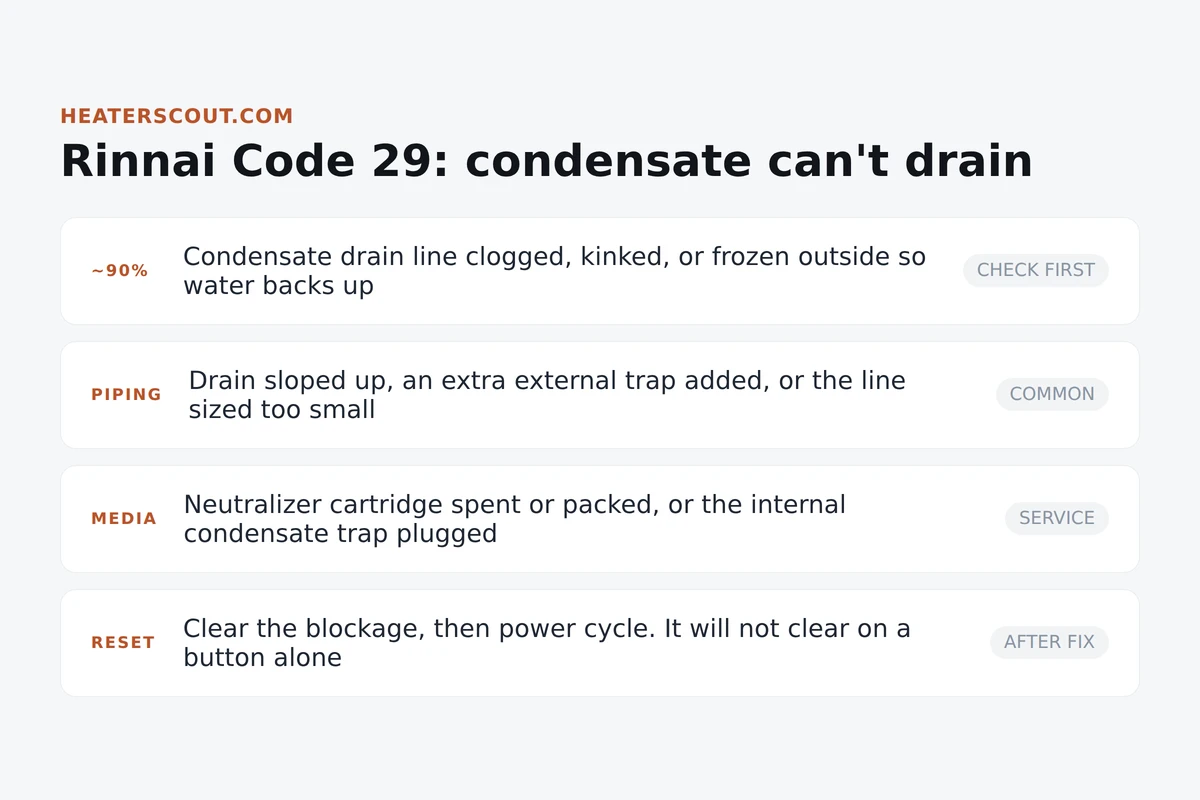
A condensate drainage fault on a condensing Rinnai. The control board monitors the condensate path, the internal trap, the neutralizer, and the drain line. When condensate cannot get out, it backs up toward the burner, so the board shuts the unit down and shows 29 to keep the burner from flooding. It is an exhaust-side problem, not a water-flow or scale problem, which is why descaling does nothing for it.
What the board is actually watching
A non-condensing tankless vents hot exhaust and never makes much water. A condensing unit does the opposite: it wrings the last heat out of the exhaust, and pulling the flue gas below its dew point condenses water inside the heater. That water is acidic, so Rinnai routes it through an internal trap and usually a neutralizer before it leaves through a small drain line. The trap keeps exhaust from pushing back, and the neutralizer raises the pH so the condensate does not eat your drain. Code 29 fires when that path stops flowing and condensate has nowhere to go but up, toward the burner.
One caveat worth stating plainly. The meaning above is Rinnai's own for condensing tankless units, and it matches what techs see. On Rinnai's E-series boilers, service docs tie a 29 more to how the condensation collar was installed and to venting, and a handful of third-party code lists online wrongly label 29 as an outlet-thermistor fault. If your unit is a boiler, or if the drainage checks all pass, pull the diagnostic table for your exact model rather than trusting a generic chart.
Which situation are you in
Code 29 walks in a few different ways, and the pattern tells you where to look. Here are the ones that show up most, and what each means for the repair.
The line clogged over time
The unit ran fine for a year or two, then started throwing 29. The condensate drain line has filled with slime and sediment or dropped into a low spot that holds water. Pull the line, clear it, flush it, and confirm it drains freely before you power back up.
It only happens in winter
The heater is fine most of the year but throws 29 when it gets cold. The condensate line runs outside and freezes, backing water up into the unit. Clearing it works until the next freeze. The real fix is to reroute the line somewhere warm or protect it from freezing.
Brand-new install, immediate 29
A freshly installed or replaced unit shows 29 before it ever really worked. Suspect the piping or a shipping plug. Check for an extra external trap, an uphill run, or a plug left in the condensate trap out of the box. This is an install error, not a worn part.
You cleared it and it came back
You blew the line out, it worked for a day, and 29 returned. The blockage is upstream, in a packed neutralizer or a plugged internal trap, or the piping itself is wrong. Service the neutralizer and trap, and fix the slope or the extra trap so it drains for good.
Clear the condensate path in order
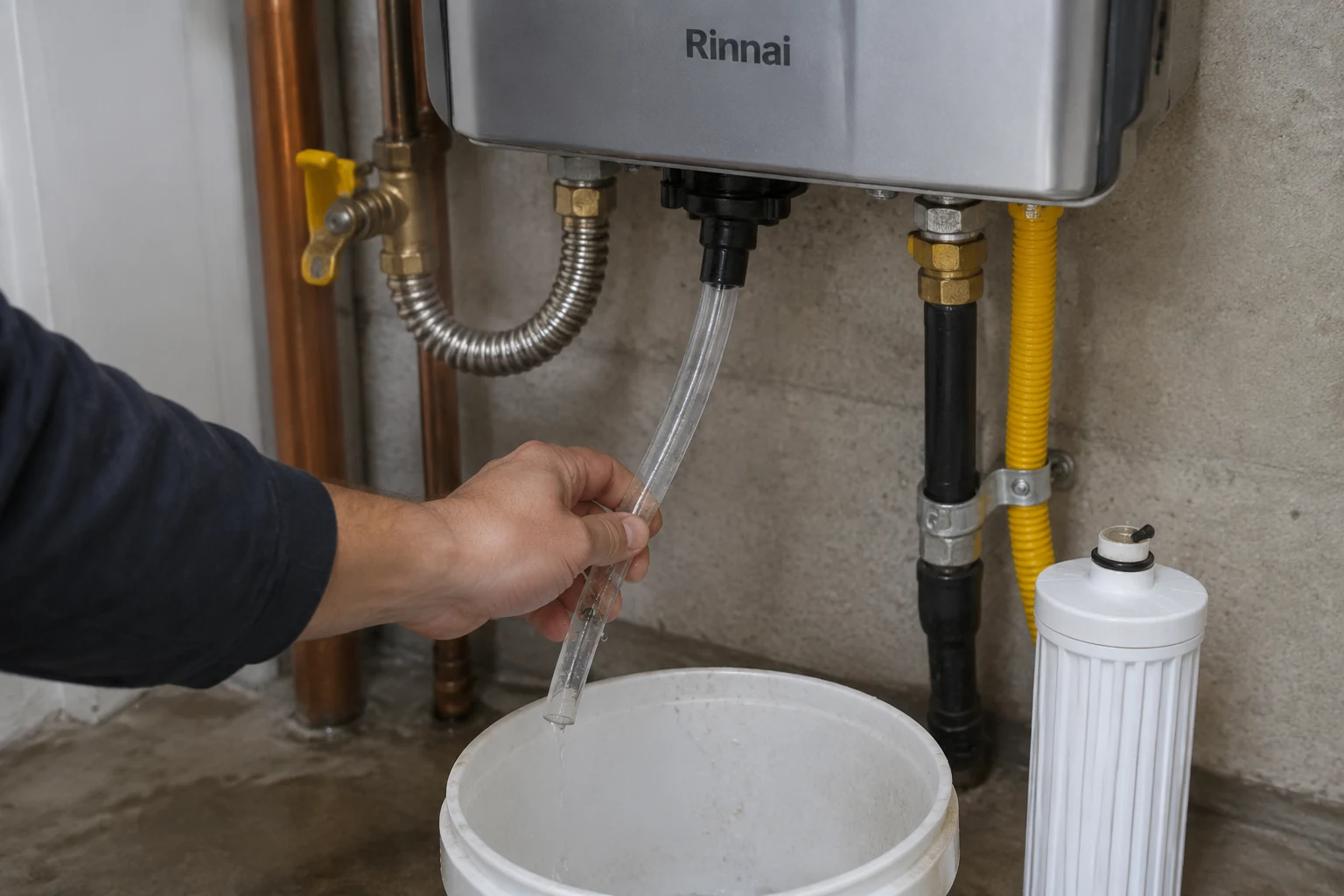
Work from the easy, most-likely fix outward. The drain line first, because that is the usual answer, then the piping, then the neutralizer and the internal trap. If you are not comfortable opening the cabinet, stop at the drain line and piping checks, which are the DIY-safe part, and hand the internal trap and any gas or electrical work to a licensed tech.
Code 29 at a glance
The quick facts, so you know whether you are reaching for a bucket and a length of tubing or the phone.
| What it means | A condensate drainage fault on a condensing Rinnai. Condensate cannot get out, so the unit shuts down before the burner floods. |
| Which side of the unit | The exhaust side, not the water side. It is about condensate leaving the heater, so descaling does nothing for it. |
| Most likely cause | A clogged condensate drain line. Techs put it around nine out of ten. Sediment, a low belly holding water, or a frozen outdoor end. |
| Other causes | Bad drain piping (uphill run, extra external trap, undersized), a frozen line, a spent or packed neutralizer, a plugged internal condensate trap. |
| Clears on a button reset? | Not by itself. Clear the blockage first, then power off, wait, and power back on. Cycling power alone brings 29 right back. |
| DIY-safe steps | Inspecting and flushing the drain line, correcting slope, removing an extra external trap, thawing a frozen line, refilling the neutralizer. |
| Call-a-pro steps | Clearing a plugged internal condensate trap, re-piping a bad drain, adding a condensate pump, and any work inside the cabinet. |
| Parts and rough cost | Neutralizer refill about $20 to $30, a neutralizer kit about $40 to $70. A pro clearing and re-piping the condensate path runs $150 to $350. |
| Prevention | Flush the condensate drain and check the neutralizer once a year, keep the line sloped and unfrozen, and never add a second trap. |
Frequently asked
Can I reset Rinnai code 29 myself?
You can clear it, but not by tapping a button and walking away. Code 29 is Rinnai telling you condensate is not draining, and the board will keep throwing it until the water has somewhere to go. The reset is really two steps. First you fix the drainage: pull the small condensate drain line off the bottom of the unit, check it for a clog, a kink, or ice, and blow it clear or flush it with warm water. Then you power the unit off at the switch or breaker, wait a minute, and power it back on. If the path is actually clear, 29 stays gone. If you cycle power without clearing the blockage, the code comes right back the moment the burner runs and starts making condensate again. So the button is the last step, not the fix.
What is the most common cause of Rinnai code 29?
A clogged condensate drain line, by a wide margin. Repair techs put it around nine out of ten. A condensing tankless pulls so much heat out of the exhaust that water forms inside it, and that acidic condensate has to run out a small drain line at the bottom of the cabinet. Sediment, slime, and mineral gunk build up in that line over time, or it dips into a low spot and holds water, or an insect or debris plugs the end. Once it stops flowing, condensate backs up inside the unit and the board shows 29. The next causes down the list are bad drain piping that never drained right to begin with, a frozen outdoor line in winter, a spent neutralizer cartridge, and a plugged internal condensate trap.
Does code 29 mean the same thing on every Rinnai?
Mostly, but not perfectly, so it is worth checking your own model's manual. On Rinnai condensing tankless heaters, 29 is the condensate drainage fault: the condensate path is blocked and the unit shuts down before the burner floods. That is the meaning that matches the manufacturer's tankless troubleshooting sheet and what techs see in the field. On Rinnai's E-series boilers, some service documents connect a 29 to how the condensation collar was installed and to venting, so the wording shifts a little on that product line. A few third-party code lists online also muddle 29 with an outlet-thermistor fault, which does not match Rinnai's own tankless documentation. When in doubt, read the diagnostic table for your exact model rather than a generic list.
Will descaling clear code 29?
No, and it is a common mix-up. Descaling flushes mineral scale out of the heat exchanger on the water side, which fixes overheating and flow codes. Code 29 is on the exhaust side: it is about condensate leaving the unit, not water moving through the coil. A descale does nothing for a plugged condensate drain line or a spent neutralizer. The right maintenance for 29 is to clear and flush the condensate drain, inspect the trap, and check the neutralizer media. Keep the two jobs separate in your head. Descale for scale codes, service the condensate path for a 29.
Is Rinnai code 29 dangerous?
The shutdown is the safe part. By stopping the unit when condensate cannot drain, the board keeps water from backing up and flooding the burner, which protects the heater. The condensate itself is mildly acidic, so if it has been overflowing you may see staining or a little corrosion around the base or wherever it puddled, and that is worth cleaning up and drying out. The bigger risk is ignoring the code and letting the unit sit with water backed up inside it, or trying to defeat the safety. Clear the drain and let the protection do its job. If you see water pooling under the unit or a persistent overflow you cannot trace, get a tech in before the standing condensate does damage.
How much does it cost to fix Rinnai code 29?
Often nothing but your time. If the fix is clearing a clogged condensate drain line, a homeowner does it with a bucket, warm water, and maybe a piece of tubing to blow the line out. If the neutralizer media is spent, a refill runs roughly $20 to $30, and a full neutralizer kit is about $40 to $70. Where it gets more expensive is labor. A plumber or Rinnai tech clearing the condensate path, servicing the trap, and correcting bad drain piping typically charges $150 to $350 depending on how the line is routed. Re-piping a drain that was installed wrong, or adding a condensate pump because there is no gravity drain nearby, pushes it higher. The cheap end is the common end here, because most 29s are just a plugged line.
Why does Rinnai code 29 keep coming back?
Because the drainage problem was cleared for a moment, not actually fixed. If you blew the line out but it slopes uphill, holds water in a belly, or ties into an extra trap it should not have, it clogs again and the code returns. If the outdoor end freezes every cold snap, 29 comes back every winter until you reroute or protect it. And if the neutralizer media is packed or the internal condensate trap is plugged, clearing the outside line does nothing, because the blockage is upstream of it. Recurring 29 is a piping and maintenance story: fix the slope, kill the extra trap, protect against freezing, and service the neutralizer.