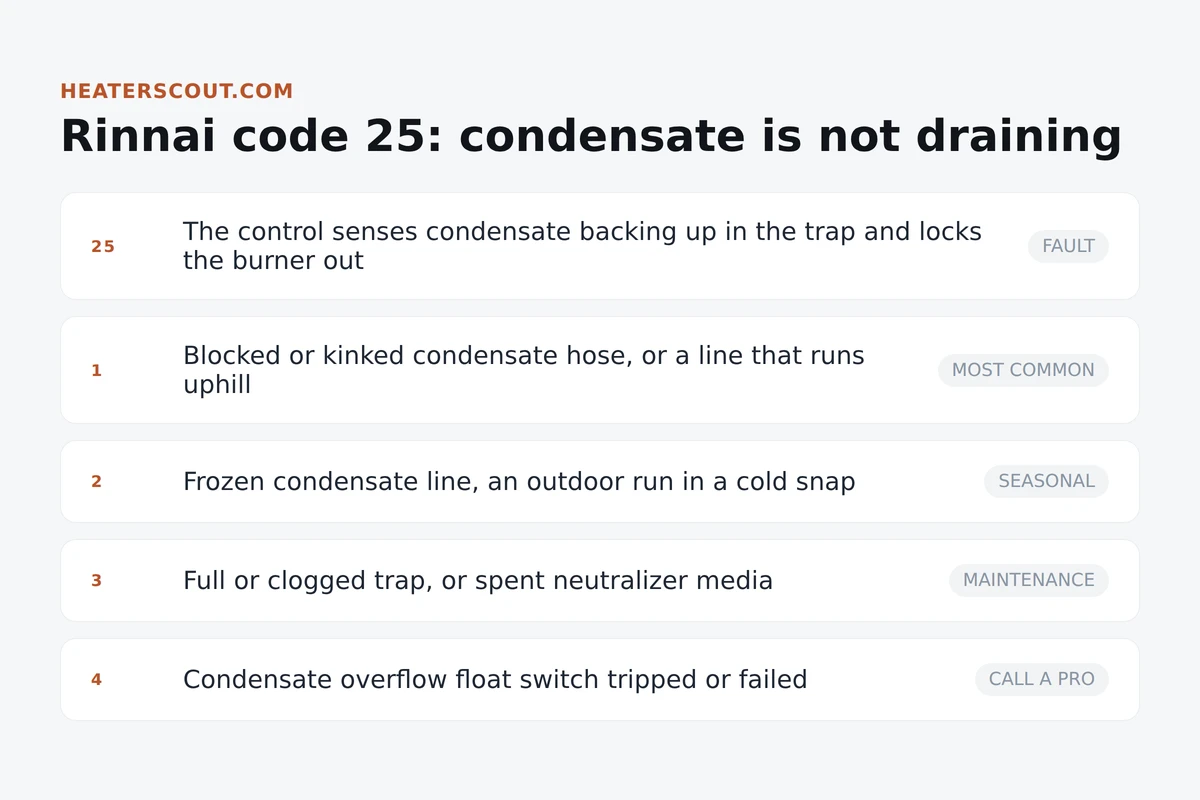
Rinnai code 25 is not a gas fault or a sensor glitch, it is a plumbing problem wearing an electronic costume. On a condensing tankless unit the burner pulls so much heat out of the exhaust that water vapor condenses back to liquid inside the heat exchanger, and that liquid has to drain out by gravity through a trap and a hose. When the control senses that condensate is backing up instead of leaving, it locks the burner out and posts 25. Nine times out of ten the water is stuck on a blocked, kinked, or frozen drain line, and you can clear it yourself with a bucket and ten minutes.
Acidic and quick to freeze
The condensate you are chasing is acidic, roughly pH 3 to 5, because it carries dissolved combustion gases. That is acidic enough to corrode a copper drain, cast iron, and the heat exchanger itself if it sits and pools. It is also why cold climates see a wave of code 25 calls every winter: the trickle freezes from the outdoor end backward until the pipe is plugged solid. Thaw a frozen line with warm towels or a hair dryer on low heat only. Never put an open flame near the unit, the line, or the cabinet.
Trace the condensate path before you clear anything
Code 25 tells you where the trouble is, not what it is. The control watches the level in the condensate trap, and it trips when that level climbs instead of draining away. So the whole job is following the water from the unit's trap to wherever it is supposed to end up, and finding the one spot where it stalls. Work the list in order. The early items are free and cover most cases; the later ones need the cabinet open and usually a tech.
1. Check the drain hose for kinks, sags, and uphill runs
Follow the clear or black condensate hose from the bottom of the unit to the drain. It must fall the whole way, no uphill sections and no low sag that holds a puddle. A hose crushed behind the unit, pinched by a zip tie, or looped up over a joist will dam the flow and throw 25. Re-route it so it runs continuously downhill to a floor drain, a standpipe, or a condensate pump, and replace any length that is kinked past straightening.
2. Look for ice if it is cold out
If the fault showed up in a freeze and part of the line runs outdoors or through an unheated wall, suspect ice first. The condensate freezes from the outlet backward, so the plug is usually at the cold end. Warm the exposed run with towels soaked in hot water or a hair dryer on low until it flows again. This is the single most common seasonal cause, so do not skip it just because the hose looks clear near the unit.
3. Empty and rinse the condensate trap
The trap at the base of the unit catches condensate and holds a small water seal. Grit, scale, and biofilm settle there and can choke the outlet. With the unit powered down, pull the trap per the manual, dump it, and rinse it with warm water until the passage is clear. A partially clogged trap raises the level enough to trip the switch even when the downstream hose is fine.
4. Inspect the neutralizer media
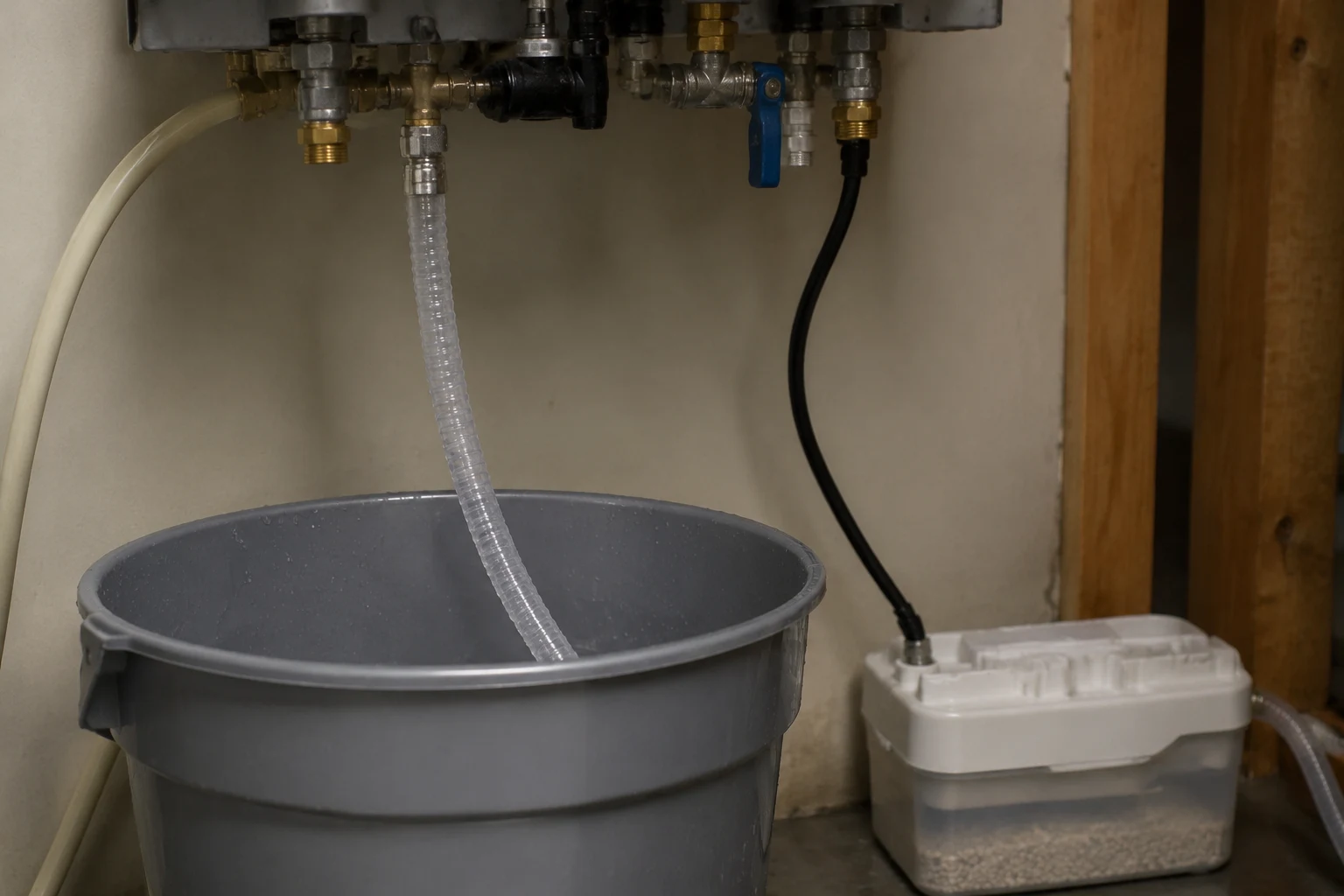
If your install has a condensate neutralizer, open it and look at the media. Fresh chips are loose and rattle; spent media caks into a dense, gray plug that condensate cannot flow through, and that plug backs water up just like a clogged hose. Scoop out the caked media, rinse the chamber, and refill with fresh neutralizer media. Rinnai's kit uses a clear body specifically so you can see this without disassembly.
5. Suspect the overflow float switch or trap assembly
If the line is clear and sloped, the trap is clean, and the media is fresh, but 25 still returns, the fault is inside the unit. A condensate overflow float switch that has tripped and stuck, or an internal trap or level sensor that has failed, will report a backup that is not there. This is the point to stop and call a licensed tech; it means opening the cabinet and testing or swapping a Rinnai-specific part, not something to guess at with the burner exposed.
The reason this order works is that the cheap, external causes account for the large majority of code 25 calls. A blocked or frozen line and a full trap are all outside the sealed cabinet, all reachable with hand tools, and all safe for a homeowner to touch. Only when the whole external path is proven clear does it make sense to open the unit and look at the float switch, and by then you have already ruled out everything that does not require pulling the cover.
Match your situation to the fix
Three patterns cover almost every code 25 an owner runs into, and each points at a different part of the drain path. Read the one that matches what you are seeing and start there instead of tearing the whole system apart at once.
Frozen condensate line
Code 25 appears during or after a hard freeze on a unit that ran fine the day before, and part of the drain runs outdoors or through an unheated space. The trickle froze from the outlet backward and plugged the pipe. Thaw the exposed run with warm towels or a hair dryer on low, confirm it flows, then clear the code. Prevent the repeat with insulation over the exposed section, or heat-trace cable in a genuinely cold climate.
Clogged or full trap
The fault creeps in over weeks with no cold snap involved, often after a year or more with no service. Grit, scale, and biofilm have choked the trap so it drains slower than the unit makes condensate, and the level climbs to the switch. Power down, pull and rinse the trap until the passage runs clear, and check the hose for a sag while you are in there. This is routine maintenance the unit was quietly waiting for.
Spent neutralizer media
You cleared the line and rinsed the trap, but 25 comes back, and the install has a neutralizer in the drain path. The alkaline media has been consumed and caked into a hard plug that condensate cannot pass. Scoop out the gray caked media, rinse the clear chamber, and refill with fresh neutralizer media. Then put an annual media check on the calendar so it does not silently clog again.
The question that trips people up
Owners almost always ask whether they can just bypass the condensate switch to make the code go away, especially in winter when the line keeps freezing. It is worth answering directly, because the shortcut does real damage.
Can I just bypass the condensate overflow switch to stop code 25?
No, and here is what happens if you do. The switch is the only thing telling the unit that condensate is backing up. Defeat it and the burner keeps firing while acidic condensate, pH 3 to 5, fills the trap, backs into the heat exchanger, and eventually overflows the cabinet onto your floor or into the wall. You trade a harmless lockout for slow corrosion of the exchanger and a water leak you will not notice until there is a stain. The switch is doing its job. The fix is to give the condensate a clear, sloped, unfrozen path out, not to silence the part that warns you it has none. If the line freezes every winter, solve the freeze with insulation or heat trace, do not solve it by cutting the switch out of the circuit.
The condensate system on a condensing tankless unit
A standard tankless heater sends hot exhaust straight out the vent. A condensing unit adds a second heat exchanger that pulls so much more heat out of that exhaust that the water vapor in it drops below its dew point and condenses back to liquid inside the unit. That extra recovered heat is what pushes efficiency past 90 percent, but it leaves you with several gallons a day of liquid that has to go somewhere. The condensate system is the path it takes: a trap at the base of the unit that catches the water and holds a small seal, a drain hose that must fall continuously to a floor drain or condensate pump, and on most installs a neutralizer that raises the acidic pH before discharge. Because that whole path drains by gravity, any dam, a kink, a freeze, a clogged trap, or caked neutralizer media, backs water up to the level switch and produces code 25. It is a drainage system bolted onto a water heater, and it fails the way drains fail.
Keep it from coming back
Once you have cleared a code 25, the same three habits keep it gone. Give the condensate line a continuous downhill run with no outdoor low spots, protect any exposed section against freezing before the first hard night of the year, and put the trap and neutralizer on an annual check right alongside your descale. The trap rinse takes five minutes and the neutralizer media swap takes ten, and together they head off the two slow-building causes before the control ever locks out. The one thing not to do is treat 25 as a nuisance to clear and forget, because every repeat means acidic water sat where it should not have.
Frequently asked
Can I reset Rinnai error code 25 myself?
You can clear the code, but clearing it does not fix what caused it. On most Rinnai condensing units you press and hold the On/Off button on the controller to power the unit down, wait about thirty seconds, then power back up, or you cycle the breaker. The 25 will drop off the display. The problem is that the control set the code because condensate was backing up in the trap, and a power cycle does not move that water. If the line is still blocked, kinked, frozen, or the trap is still full, the fault comes right back the next time the burner runs long enough to make condensate. Fix the drainage first, then clear the code and run a hot tap for a few minutes to confirm it stays gone.
Why does Rinnai code 25 keep coming back?
Because the water still has nowhere to go. Code 25 is a plumbing symptom, not an electronics glitch, so it repeats until the condensate path actually drains by gravity. The usual repeat offenders are a hose with a low sag that holds a slug of water, a section of line that runs uphill instead of downhill, a trap packed with grit and biofilm, or neutralizer media that has caked into a hard plug. Seasonal repeats in winter are almost always a frozen outdoor run. Trace the whole path from the unit's trap to the drain, look for the spot where water pools, and correct the slope or clear the clog. If it still returns with a clean, sloped, unfrozen line, suspect the overflow float switch or the trap assembly itself.
Is Rinnai error code 25 dangerous?
The lockout itself is a safety response, so the unit shutting down is the safe outcome, not the hazard. What you do not want is to defeat the switch and keep running the burner while acidic condensate backs up inside the heat exchanger and cabinet. That condensate carries a pH around 3 to 5, acidic enough to corrode the exchanger, the burner tray, and anything it drips onto over time. Standing condensate can also leak out of the cabinet onto the floor or into the wall. So 25 is not an emergency, but ignoring it and clearing it over and over lets an acidic drip work on metal it was never meant to touch. Restore the drain path rather than muting the alarm.
How much does it cost to fix Rinnai code 25?
If it is a blocked or frozen line, the fix is free beyond your time, plus a couple of dollars for a length of hose if the old one is kinked past saving. A trap cleanout is a rag and warm water. Replacement neutralizer media runs about $15 to $30, and a full Rinnai neutralizer kit is roughly $40 to $70. Where it climbs is the parts a tech has to open the cabinet for: a condensate overflow float switch or trap assembly runs $30 to $90 in parts, and a service call with diagnosis and labor usually lands between $150 and $350 depending on your area and how buried the part is.
Will descaling clear Rinnai code 25?
No. Descaling flushes the water side, the heat exchanger passages that scale up from hard water, and it does nothing for the condensate drain, which is a separate path on the exhaust side of the unit. Code 25 lives entirely in the condensate system: the trap, the drain hose, the neutralizer, and the overflow switch. You could run a perfect vinegar flush and still throw 25 the next minute if the drain line is frozen. Keep the two tasks separate in your head. Annual descaling is real maintenance and worth doing, but the cure for 25 is clearing and sloping the condensate drain, cleaning the trap, and refreshing the neutralizer media.
How do I keep a Rinnai condensate line from freezing?
Keep as much of the run indoors and warm as you can, and give the outdoor section the shortest, most sloped path to daylight or a drain. Any part exposed to outdoor air in a hard freeze is at risk because the trickle of condensate freezes from the outlet backward until the pipe is plugged. Pipe insulation over the exposed run helps in a mild climate. In a real cold climate, self-regulating heat-trace cable along the exposed line, then insulation over it, is the reliable fix. Avoid long horizontal outdoor runs and any low spot where water can sit and freeze. If you already have ice, thaw it with warm towels or a hair dryer on low, never an open flame, and clear the plug before you clear the code.
What is a condensate neutralizer and does mine need one?
A neutralizer is a small chamber of alkaline media, usually limestone or magnesium chips, that the acidic condensate flows through on its way to the drain. It raises the pH from the corrosive 3 to 5 range toward neutral so the discharge does not eat copper drain lines, cast iron, or a septic system. Rinnai sells one as a kit, part 804000074, with a clear body so you can eyeball the media. Whether yours is required depends on local code and what the condensate drains into; many jurisdictions and most metal or septic drains call for one. The catch is that the media gets used up and can cake into a plug, which backs up the condensate and throws code 25, so it needs a check and refresh about once a year.