Rinnai code 14 is not an ignition hiccup you can clear by cycling power. It is a safety lockout: the overheat protection inside the unit saw the heat exchanger run too hot and shut the burner down. Two different devices can throw it, and one of them does not reset at all. That is why pressing the power button over and over gets you nowhere. The board is telling you the unit got dangerously hot, and it will not run again until the reason is gone.
What code 14 actually reports
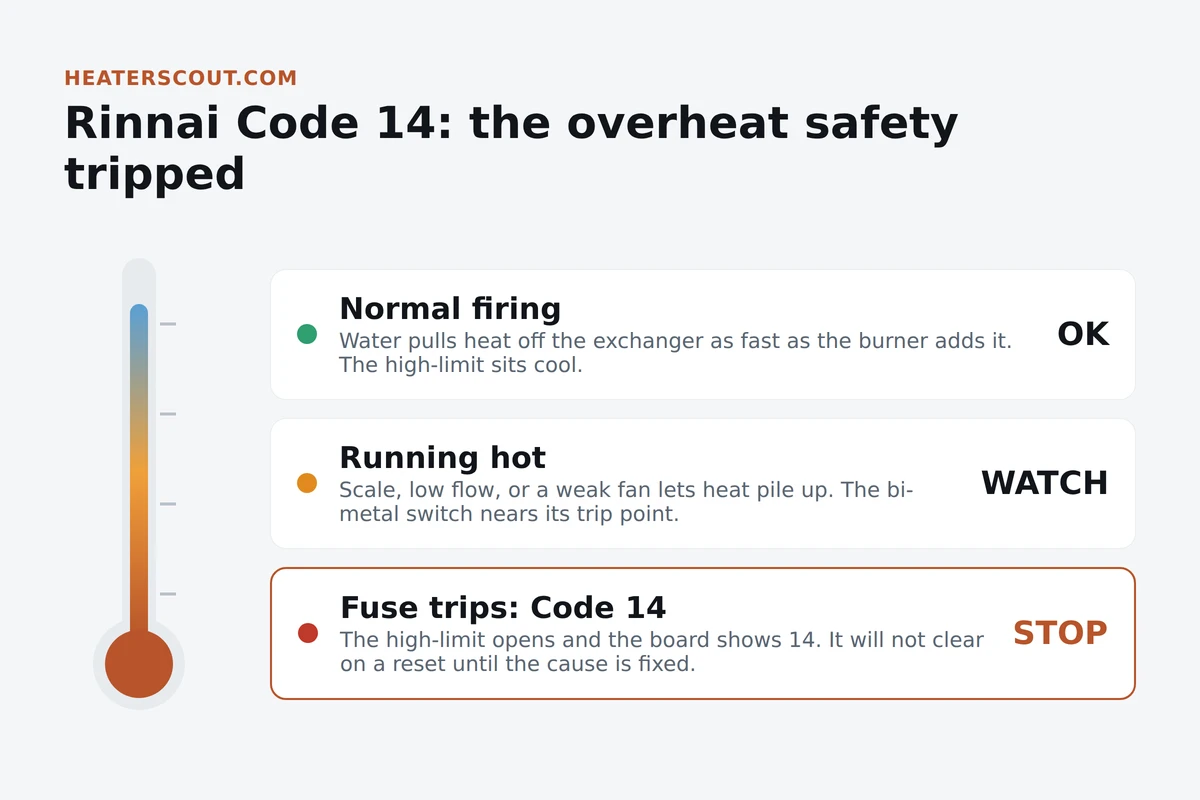
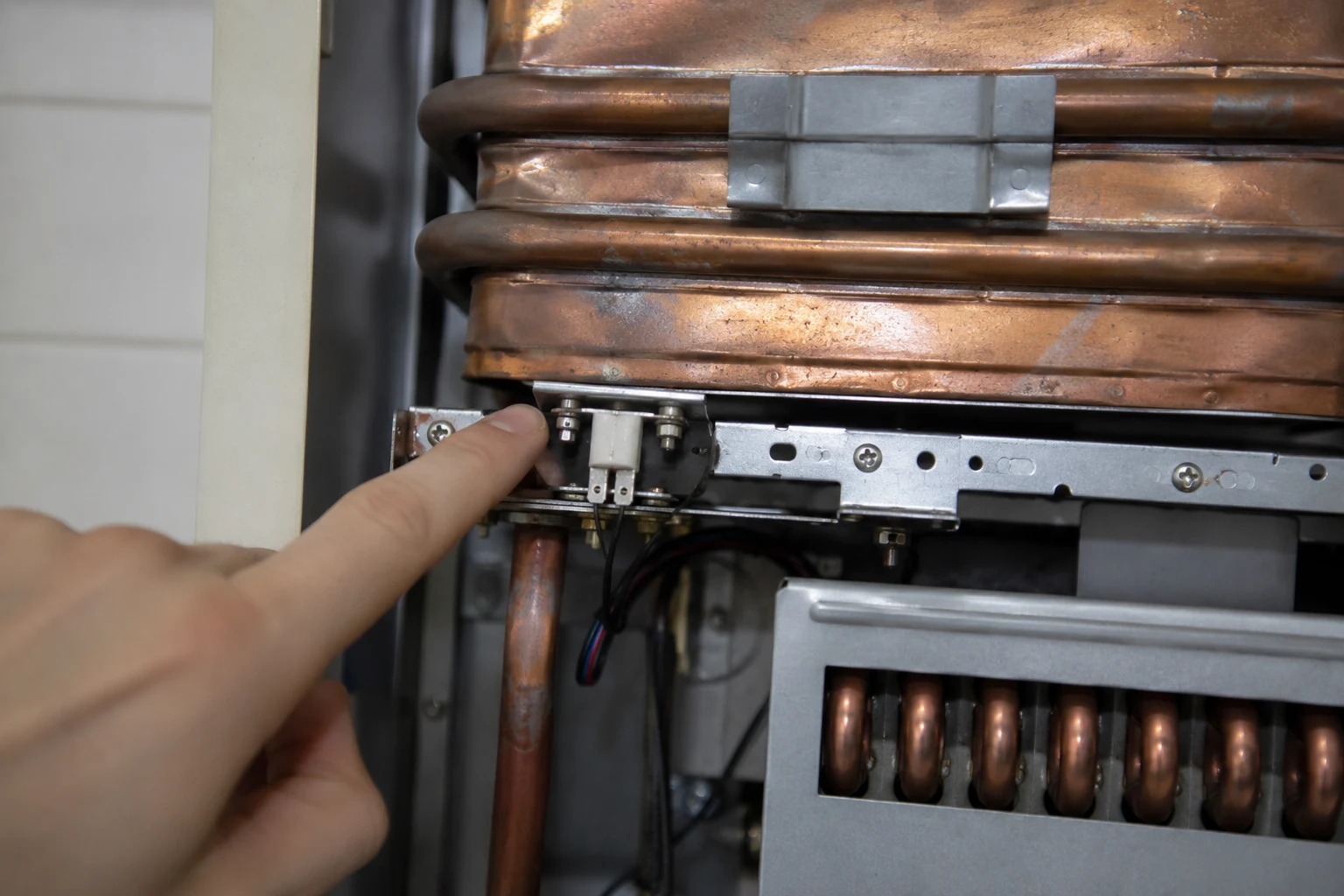
Rinnai uses code 14 for the overheat, or high-limit, safety on the heat exchanger. Two separate parts can set it, and knowing which one changes the whole repair. The first is a bi-metal high-limit switch mounted on the heat exchanger, usually near the top front on one side. It snaps open when the metal gets too hot and, in most cases, resets itself once it cools. The second is a thermo-fuse, wrapped around the heat exchanger. A thermo-fuse is a one-shot device: once it blows, it is done and has to be replaced before the unit will fire again.
That split explains the two ways owners see the code. On some units, 14 shows up, the heater cools, the bi-metal switch resets, and the code clears on its own, only to return the next time the burner runs long. On others, 14 locks in hard and nothing brings it back, because the thermo-fuse has blown. Rinnai is explicit that code 14 will not clear with a button reset, so in both cases you diagnose the cause, not the display.
Work the fix in order
The overheat trip is downstream of whatever let heat build up, so you chase the cause from the most common down. Scale first, because it is the usual culprit and the easiest thing to rule out. Then flow, then combustion air. Do not replace a thermo-fuse until you know why it blew, or the new one blows too. If you are not comfortable inside the cabinet or working with the gas train, stop at the descale and the flow checks and hand the rest to a licensed tech.
Before you open the cabinet
Half of a code 14 diagnosis is ruling out the easy things so you do not tear into the unit for a clog at the inlet screen. Run this list first. It sorts the descale-and-done cases from the ones that need a tech, and it keeps you from replacing a good part.
- How long since the last descale? If it is over a year, or you have never done it, descale before anything else.
- Is your water hard? Hard water scales the exchanger fast and makes code 14 a recurring visitor.
- Is the cold-inlet water filter screen clean? A clogged screen starves the flow and overheats a clean exchanger.
- Is every valve in the water path fully open, isolation valves included? A half-closed valve reads like low flow.
- Does the code clear on its own after the unit sits, then return? That points to the self-resetting bi-metal switch and an uncorrected cause.
- Does the code lock in hard and never clear? That points to a blown one-shot thermo-fuse.
- Is the outside vent terminal clear of nests, snow, lint, and debris? A blocked vent traps heat.
- Does the combustion fan sound healthy, or does it whine or spin down slowly? A weak fan overheats the exchanger.
Scale trip vs. flow trip: telling them apart
The two most common paths to a code 14 both end at the same overheated exchanger, but they get there differently. Scale is a slow build that insulates and clogs; a flow problem is often sudden and traces to one restriction. Reading which one you have saves you from descaling a unit whose real issue is a half-closed valve, or vice versa.
Scale in the exchanger
- Comes on gradually over months as hard water lays down mineral deposits inside the coils.
- The unit may run cooler than set or cycle oddly before it finally trips 14.
- Descale flush runs gray and gritty; that debris is the proof.
- Fix: circulate descaler about 45 minutes, flush clean, then descale annually to keep it away.
Restricted or low flow
- Often shows up suddenly, after a filter clogs, a valve gets bumped, or a pump starts failing.
- The exchanger can be clean and still overheat, because less water is carrying the heat away.
- Common sources: a clogged inlet screen, a partly closed valve, a kinked line, a weak recirc pump.
- Fix: clean the inlet screen, open every valve fully, and clear the restriction before you blame the unit.
Which situation are you in
Code 14 lands differently depending on the unit's history and how the code behaves. These are the patterns that walk in most often, and what each one means for the repair.
Never been descaled
A unit that is a few years old, in a hard-water area, and has never had a flush. Scale is choking the exchanger. Start with a full descale; it clears the code in most of these cases, and then put it on an annual schedule.
The code comes and goes
It trips, the unit sits and cools, the code clears, then it comes back on the next long shower. That is the self-resetting bi-metal switch reacting to a cause that is still there. Descale, then check flow and the fan; do not just keep clearing it.
Nothing clears it
The 14 will not go away no matter how long the unit sits or how many times you cycle power. A one-shot thermo-fuse has blown. It has to be replaced, but only after you fix whatever overheated the exchanger in the first place.
Descaled and it still trips
You did a proper flush and 14 came back. Scale was not the whole story. Move to flow, then venting, then the combustion fan. A weak fan or a bad thermistor is often hiding here; get a tech with a combustion analyzer if it keeps tripping.
Code 14 at a glance
The quick facts, so you know what you are dealing with before you decide whether to grab the flush kit or the phone.
| What it means | The overheat, or high-limit, safety on the heat exchanger tripped. The unit ran too hot and shut down. |
| Two possible parts | A bi-metal high-limit switch on the exchanger that self-resets when it cools, or a thermo-fuse wrapped on the exchanger that is one-shot and must be replaced. |
| Clears on a button reset? | No. Code 14 is a safety lockout. Cycling power does not clear it; the cause must be corrected first. |
| Most likely cause | Scale in the heat exchanger from skipped descaling, which insulates the metal and restricts flow. |
| Other causes | Low or restricted water flow, a partially blocked exhaust or intake, a failing combustion fan, a faulty high-limit thermistor. |
| DIY-safe steps | Descaling, cleaning the inlet water filter, opening valves fully, and clearing the vent terminal. |
| Call-a-pro steps | Testing the high-limit and thermistor, replacing a blown thermo-fuse, servicing the combustion fan, and combustion analysis. |
| Prevention | Descale yearly, more often on hard water. Keep the inlet screen clean and the vent clear. |
Frequently asked
Can I reset Rinnai code 14 myself?
Not with a button. Code 14 is a safety lockout, and Rinnai designs it so it will not clear by pressing the power button the way a startup or ignition code does. The overheat device has to see the unit cool down, and the fault that overheated it has to be gone, before the heater runs again. If the tripped part is the bi-metal high-limit switch, it resets itself once it cools, so the code can vanish after the unit sits, but it comes right back the next time the burner runs long because nothing was fixed. If the tripped part is a thermo-fuse, it does not reset at all and has to be replaced. Either way, cycling power does not address why the unit got hot. Find the cause first.
What is the most common cause of Rinnai code 14?
Scale in the heat exchanger, by a wide margin. Hard water leaves mineral deposits inside the coils, and that scale does two things at once. It insulates the water from the flame so the metal runs hotter, and it narrows the passages so less water moves through to carry heat away. Both push the exchanger temperature up until the overheat device trips and throws 14. If the unit has not been descaled in a year or two, or ever, in a hard-water area, assume scale until proven otherwise. The next causes down the list are restricted or low water flow, a partially blocked exhaust or intake, a combustion fan that cannot move enough air, and, less often, a high-limit thermistor that is reading wrong.
Will descaling clear code 14?
Often, yes, if scale was the reason it overheated and the tripped part was the self-resetting bi-metal switch rather than a blown one-shot thermo-fuse. Descaling removes the mineral layer that was insulating the exchanger and choking the flow, so the unit runs at a normal temperature again and the high-limit stops tripping. Circulate white vinegar or a Rinnai-approved descaler through the isolation valves for about 45 minutes, then flush with clean water. If 14 stays gone after the descale, scale was your problem. If it comes back, the overheat device is either still tripping from another cause, or a thermo-fuse blew and has to be replaced. Descaling never hurts, but it is not always the whole fix.
Is Rinnai code 14 dangerous?
The code itself is the safe outcome. It means the overheat protection did its job and shut the burner down before the unit could damage itself or overheat the water. What you should not do is defeat it. Do not jumper across the high-limit switch, tape the display, or keep power-cycling to force the unit past a code 14. The exchanger is being told it got too hot for a reason, and running past that risks scalding water at the tap, thermal damage to the exchanger, and, on a gas appliance, the conditions that let heat pile up can point at a venting or combustion problem that is its own hazard. Treat 14 as a stop sign, find the cause, and let the safety go back to guarding.
How much does it cost to fix Rinnai code 14?
It ranges a lot depending on what actually tripped it. If the fix is a descale, a homeowner with the flush kit spends only the price of vinegar and an hour of time; a plumber charges roughly $150 to $300 for a professional descale. If a one-shot thermo-fuse blew, the part is usually under $50, but the labor to access it and the required diagnosis of why it blew push a pro visit into the $250 to $450 range. A failing combustion fan or a bad high-limit thermistor adds that part plus labor, commonly $300 to $600 installed. The expensive end is a heat exchanger scaled so badly it is damaged, which on an older unit starts to rival the cost of replacing the heater.
Why does Rinnai code 14 keep coming back?
Because the reset addressed the symptom, not the cause. A bi-metal high-limit switch cools off and resets itself, so the code disappears and the unit runs, right up until the burner fires long enough to overheat again, and then 14 returns. That loop tells you the real fault is still there: scale still choking the exchanger, flow still too low, a vent still partly blocked, or a fan still weak. The fix is to find which one it is and correct it, not to keep clearing the code. If you have already descaled and it still recurs, move down the list to flow, then venting, then the fan, then the thermistor, and get a tech with a combustion analyzer involved.
Can low water flow cause a Rinnai code 14?
Yes. A tankless heater relies on water moving through the exchanger to carry heat away from the flame. When flow drops too low, the same heat goes into less water, the metal runs hotter, and the overheat device can trip even with a clean exchanger. Low flow comes from a clogged inlet water filter, a partially closed valve, a kinked line, a failing recirculation pump, or heavy scale narrowing the passages. Clean the cold-inlet screen, confirm every valve in the water path is fully open, and make sure nothing is throttling the flow before you assume the problem is deeper in the unit.