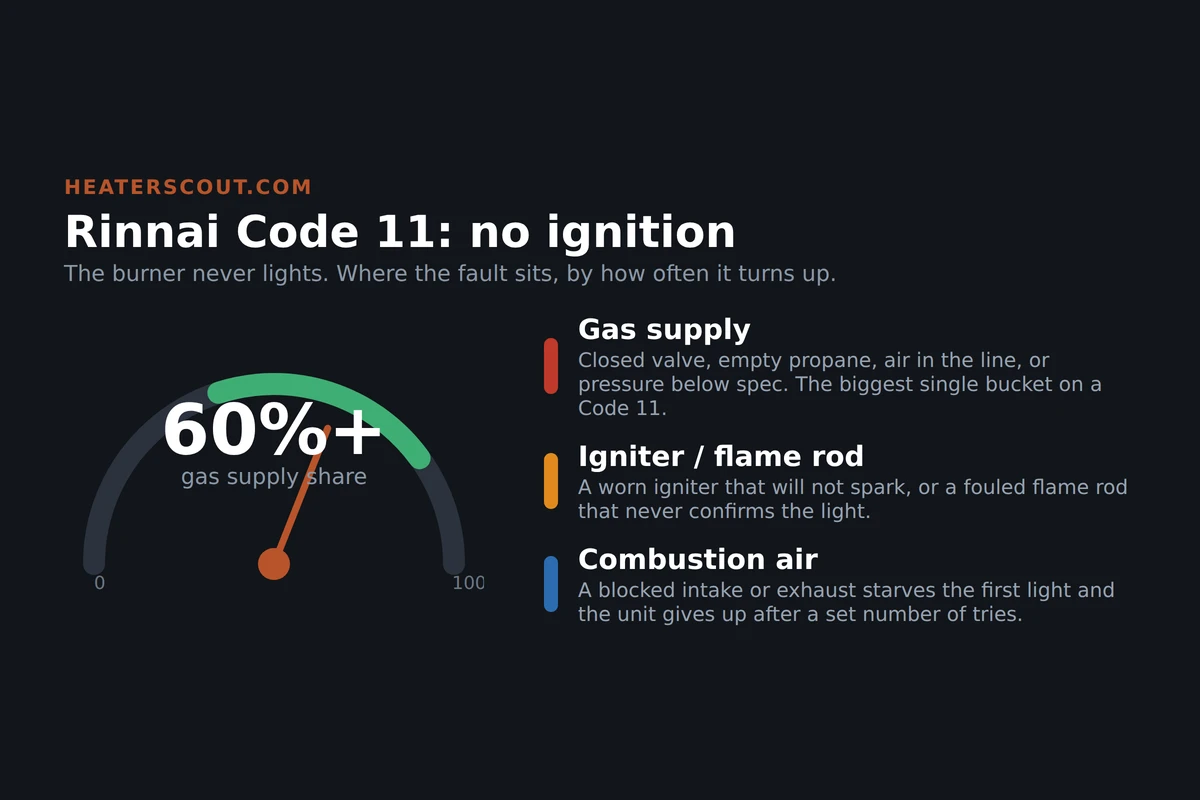
Code 11 on a Rinnai tankless heater means the burner never lit. You open a hot tap, the unit tries to spark, and after a few attempts it gives up and locks out with 11 on the display. That is different from a flame that lights and then drops. The controller counted its ignition tries, saw no flame, and shut the gas valve to stay safe. More than half the time the reason is dull and free to fix: a valve that got bumped closed, a propane tank run low, or air still sitting in a gas line that has never fired. Start there before you touch a single part.
Code 11 versus code 12: know which one you have
People mix these two up, and chasing the wrong one wastes a morning. The split is simple. Code 11 is a no-ignition fault: the burner never caught. Code 12 is a flame-loss fault: the burner lit and then the unit could not hold or confirm the flame. Listen at startup. If you hear the igniter click and no burner roar at all before the display flips to 11, that is a true no-ignition. The table below lines up what each code is telling you and which checks actually apply, so you are not running flame-loss diagnostics on an ignition fault.
| Code 11 (no ignition) | Code 12 (flame loss) | Gas-supply check that applies | |
|---|---|---|---|
| What happened | Burner never lit at all | Burner lit, then flame dropped or was not confirmed | Both need gas at the right volume and pressure |
| Startup sound | Igniter clicks, no burner roar | Igniter clicks, brief roar, then silence | Run a stove burner: does it light clean and blue? |
| First suspect | Closed valve, empty LP, air in a fresh line | Marginal gas volume, dirty flame rod | Manual gas valve fully open, not half-turned |
| Free homeowner check | Purge air, confirm valve open, check LP level | Clear vents, confirm other appliances burn | Propane tank level above about a quarter |
| When it needs a pro | Igniter, flame rod, or low gas pressure | Manifold pressure, flame rod, undersized line | A manometer reading of inlet and manifold pressure |
First things to verify, in order
None of this needs tools, and this list clears the majority of Code 11 calls before a technician ever loads a van. Work it top to bottom. The order is deliberate: the cheapest and most common causes sit first. Do not skip to the igniter because that is the part you have heard of.
- Confirm the manual gas valve at the heater is fully open. The handle should run in line with the pipe, not crosswise. A valve bumped half-closed feeds enough gas to spark but not enough to light.
- Run another gas appliance in the house, a stove burner or the furnace. If it will not light or burns weak and yellow, the gas problem is house-wide, not the heater, and Code 11 is just the first symptom.
- On propane, check the tank gauge. A tank near empty drops pressure and starves the burner. A tank that ran fully dry needs bleeding and often a licensed LP tech to purge and relight per gas-company rules.
- If this is a brand-new install or a first fire after an LP refill, suspect air in the gas line. Running a nearby gas appliance for a minute or two often pulls the trapped air through so the heater can light.
- Walk outside and look at the intake and exhaust terminations. A wasp nest, snow drift, leaves, or lint over the cap starves the first light of combustion air and trips Code 11 after the set number of tries.
- Check that nothing tripped the breaker or unplugged the unit mid-cycle. A power interruption during an ignition attempt can leave the code set even after the real cause is gone.
- Only after all of the above: reset the unit (power off thirty seconds, back on) and run a hot tap. If Code 11 clears and stays gone, a temporary supply hiccup caused it and you are done.
Related questions owners ask
A few things come up on almost every Code 11 that the checklist above does not spell out. These are the ones worth reading before you decide whether to keep going or call someone.
Why does the unit spark but never roar?
That click without a follow-up roar is the signature of Code 11. The igniter is firing, so power and the control board are working. What is missing is fuel reaching the burner at the right pressure, or a flame rod that will not confirm the light. Gas that is off, low, or full of air gives you exactly this pattern: spark, no light, lockout. Chase the gas before you suspect the board, because the board just proved itself by making the igniter click.
It lit fine yesterday. Why Code 11 this morning?
A unit that ran fine and then codes 11 overnight almost always changed on the supply side, not inside. A propane tank that dipped below a quarter, a hard freeze that slowed LP vaporization, a regulator icing over, or the furnace and heater both calling at once and sagging the gas pressure. Note the exact conditions when it fails: cold morning, heavy demand, low tank. That pattern tells a technician whether to bring a manometer or a part.
Can I clean the flame rod myself?
On many Rinnai models the flame rod is a serviceable part, and a light oxide film can be cleaned off the tip with fine abrasive. But it lives inside a cabinet with line-voltage wiring and a live gas valve, so the gas and power must be off before any cover comes off. If you are not set up to work safely around both, this is the point to hand it to a licensed tech rather than push further into the unit.
Three ways Code 11 usually shows up
The same code, three different back stories, and the fix is not the same for each. Match your situation to the closest card. The tells are the timing (new versus existing), the fuel (natural gas versus propane), and whether the unit ever lit at all before it started coding.
Air trapped in a fresh gas line
The unit is new, or a gas line was just run to it, and it codes 11 on the very first hot-water call. The valve opens and the igniter sparks, but only air reaches the burner for the first seconds, so it never lights. Purge, or bleed, the air out. Running a nearby gas appliance for a minute or two often pulls the air through on natural gas. On propane the installer usually bleeds the line at the unit. This is a startup gremlin, not a defect, and it clears once real gas reaches the burner.
The LP tank ran low or dry
On propane, a tank that drops near empty loses pressure and the burner starves, so Code 11 shows up long before the tank reads zero. If the tank ran fully dry, refilling is not the end of it. Air gets into the line, and gas-company rules usually require a licensed LP tech to purge the system, check for leaks, and relight appliances. Check the tank gauge first on any propane Code 11, because this is the cheapest cause and the easiest one to miss.
Igniter or flame rod is failing
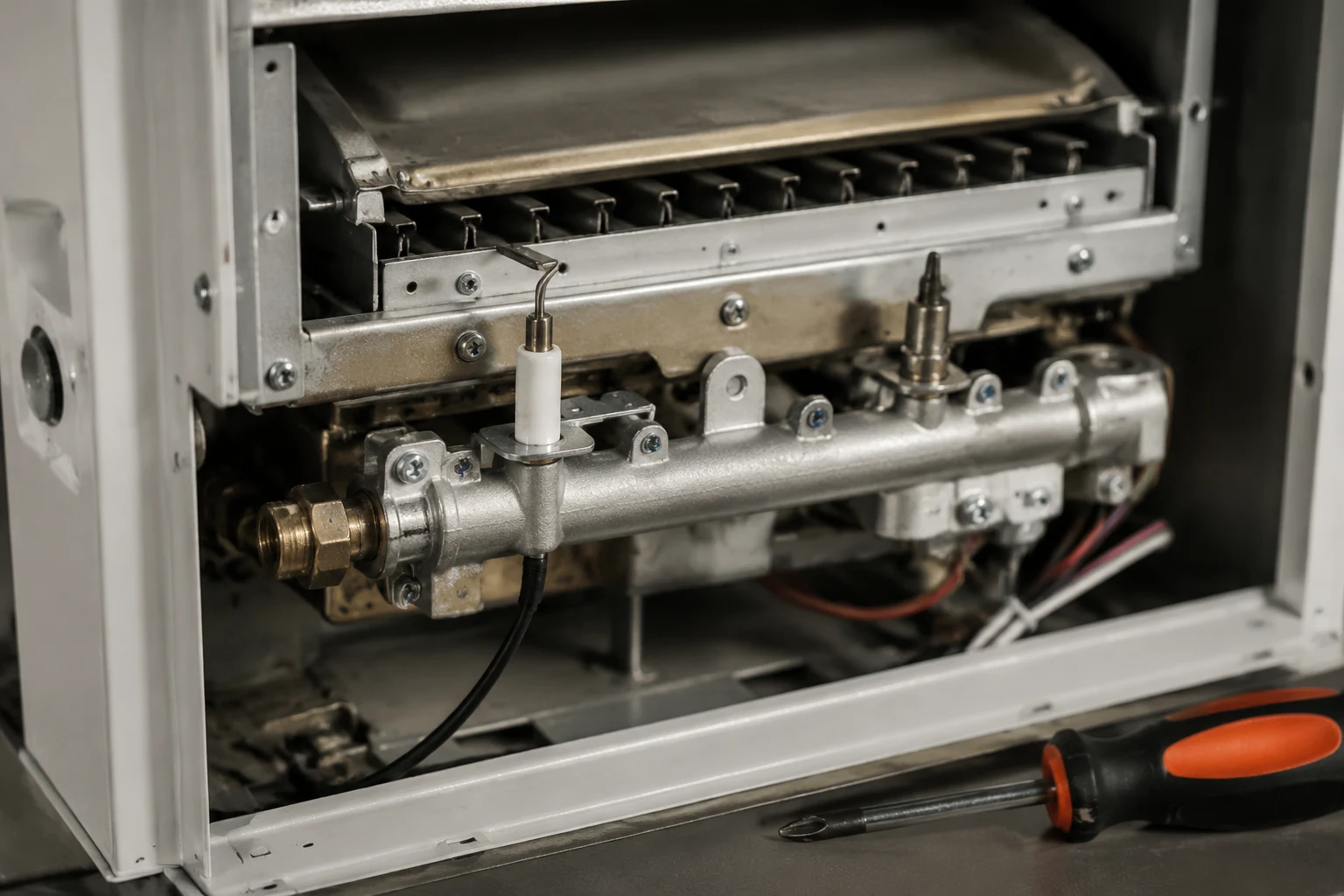
The gas valve is open, other appliances burn clean, the tank has fuel, the vents are clear, and it still codes 11. Now the fault is inside. A worn igniter no longer sparks reliably, or a fouled flame rod cannot confirm the light even when the burner catches. Both are replaceable, but they need the gas and power off and, for a pressure check, a manometer. This is where a homeowner hands it to a licensed technician.
Gas pressure: the number a homeowner cannot take
When the free checks pass and Code 11 keeps returning, gas pressure is the usual quiet culprit. A Rinnai burner wants natural gas roughly in the 5 to 10.5 inches of water column range, and propane closer to 9 to 13 inches, measured at the unit while it is trying to fire. An undersized line, a weak regulator, or a meter sized for the old tank heater can leave the pressure sagging just as the burner asks for full fire, especially when the furnace and the water heater call at once. A tankless unit can draw 120,000 to 199,000 BTU wide open, several times what a tank heater pulls, so a supply that was fine for years can choke this one. Reading that pressure takes a manometer teed into the gas line and a tech who knows the target numbers. It is the one measurement that separates a real supply fault from a guess, and it is not a homeowner job.
What Code 11 is not
It is not a scale or water-flow fault. Those live under different codes and want a descale, not an ignition check. Running a descale kit because the display reads 11 clears no fault. Code 11 is strictly the combustion side: fuel, air, spark, and flame confirmation. Work that order and skip the water side entirely. If your panel is actually showing a different number, the cause and the fix change, so read the exact code off the display before you spend a dollar on parts.
Before you call a technician
Have these answers ready and the visit goes faster. Is this a new install or a first fire after an LP refill, or an existing unit that just started coding? Natural gas or propane, and if propane, how full is the tank? Does the igniter click with no burner roar, or is there no attempt at all? Do other gas appliances burn clean and blue? Are the outdoor intake and exhaust caps clear? A tech who hears "existing propane unit, tank near a quarter, clicks but never lights, other appliances fine" already knows to check the LP level and gas pressure before pulling a part.
Frequently asked
What does error code 11 mean on a Rinnai tankless water heater?
Code 11 is an ignition failure, also called a no-ignition fault. The heater tried to light the burner, could not confirm a flame after a set number of tries, and locked out to stay safe. It is different from Code 12: Code 11 means the burner never lit at all, while Code 12 means it lit and then lost the flame. The most common reason for Code 11 is a gas supply problem, so that is where you start. Confirm the manual gas valve at the heater is fully open, check that other gas appliances in the house run, and on propane check that the tank is not low. If the unit is on its very first fire after install or after the LP tank ran dry, there is often air in the gas line that has to be purged before it will light.
How do I clear and reset Rinnai code 11?
Fix the cause first, then reset. Resetting a heater that still has a closed gas valve or an empty propane tank just gives you Code 11 again on the next hot-water call. Once you have checked the gas, turn the unit off at its power switch or trip its breaker, wait about thirty seconds, then power it back on. On a unit with a controller, the code clears when you cycle the on/off button. Then open a hot tap and watch the startup. If it lights and runs, the reset held. If Code 11 comes right back after gas is confirmed on and the tank has fuel, the fault is deeper, usually the igniter, the flame rod, or gas pressure, and that is a technician's call.
Can air in the gas line cause Rinnai code 11?
Yes, and it is one of the most common causes on a first fire. When a new gas line is installed, or a propane tank runs empty and gets refilled, air gets trapped in the line ahead of the gas. The heater opens its gas valve and sparks, but only air reaches the burner for the first few seconds, so it never lights and throws Code 11. The fix is to purge the air out. On natural gas, running another gas appliance nearby for a minute or two often pulls the air through. On propane after a refill, the line may need bleeding at the unit, and a tank that ran fully dry may require a licensed LP tech to purge and relight per gas-company rules.
How much does it cost to fix Rinnai code 11?
It depends on the cause. A closed valve, a low propane tank, or air in the line costs nothing or the price of a fill. A service call to diagnose a stubborn Code 11 usually runs about $100 to $200 for the visit. A flame rod or igniter, the parts most often replaced when gas checks out, tends to land around $150 to $400 installed depending on model and local labor. A gas pressure problem can be cheap (a partly closed valve upstream) or expensive (an undersized line or meter that has to be upsized), so confirm the free checks before you authorize parts.
Is Rinnai code 11 dangerous?
The code itself is the safety system doing its job. When the heater cannot confirm a flame, it shuts the gas valve and locks out instead of dumping raw gas at an unlit burner. That lockout is the safe outcome. The underlying cause is what deserves respect. A blocked exhaust or a gas leak is a real hazard. If you smell gas, stop, leave, and call the gas company. Do not keep resetting a heater that will not light without figuring out why.
Why does Rinnai code 11 keep coming back?
A Code 11 that returns after you have confirmed the gas is on, the tank has fuel, and the vents are clear usually means one of three things. The igniter is worn and no longer sparks reliably. The flame rod is fouled or failing and cannot confirm the light even when the burner catches. Or the gas pressure at the unit is below spec, from an undersized line, a weak regulator, or a meter sized for the old tank heater. All three need a technician with a manometer. A recurring Code 11 is the signal to stop resetting and get a pressure reading, the one measurement a homeowner cannot safely take.
Will descaling fix Rinnai code 11?
No. Descaling clears scale out of the heat exchanger and helps with flow and temperature faults, but Code 11 is an ignition problem on the combustion side, not a water-flow problem. Running a descale kit when the display reads 11 wastes an afternoon. Fix the ignition side instead: gas supply first, then combustion air, then the igniter and flame rod. Keep descaling as annual maintenance, not a Code 11 cure.