A Richmond water heater has a shortcut most homeowners miss: it is a Rheem. Richmond is one of Rheem's badges, sold through Menards and hardware channels, and the tanks roll off the same lines as Rheem and Ruud. That means the diagnostics are identical, the status-light blink codes read the same, the serial decodes the same, and every part cross-references to a Rheem number. So the first move on a dead Richmond is not the pilot or the breaker. It is knowing that whatever the label says, you are troubleshooting a Rheem, and that decides where the codes and the parts come from.
| Type | How to spot it | First thing to check |
|---|---|---|
| Gas atmospheric | Standing pilot, draft hood on top, status light on the gas valve | Status-light flash count, then pilot / thermopile |
| Electric | Two access panels on the side, no burner, 240 V breaker | Red ECO reset on the upper thermostat, breaker off |
| Power Vent / Encore | A blower on top, PVC vent, power cord to the blower | Vent for blockage, pressure-switch tube, then the code |
One flash every three seconds is the heater telling you it is fine. Two or more flashes is it handing you a fault code. Everything on a gas Richmond starts by counting that light.The single habit that shortcuts most gas calls
The verdict
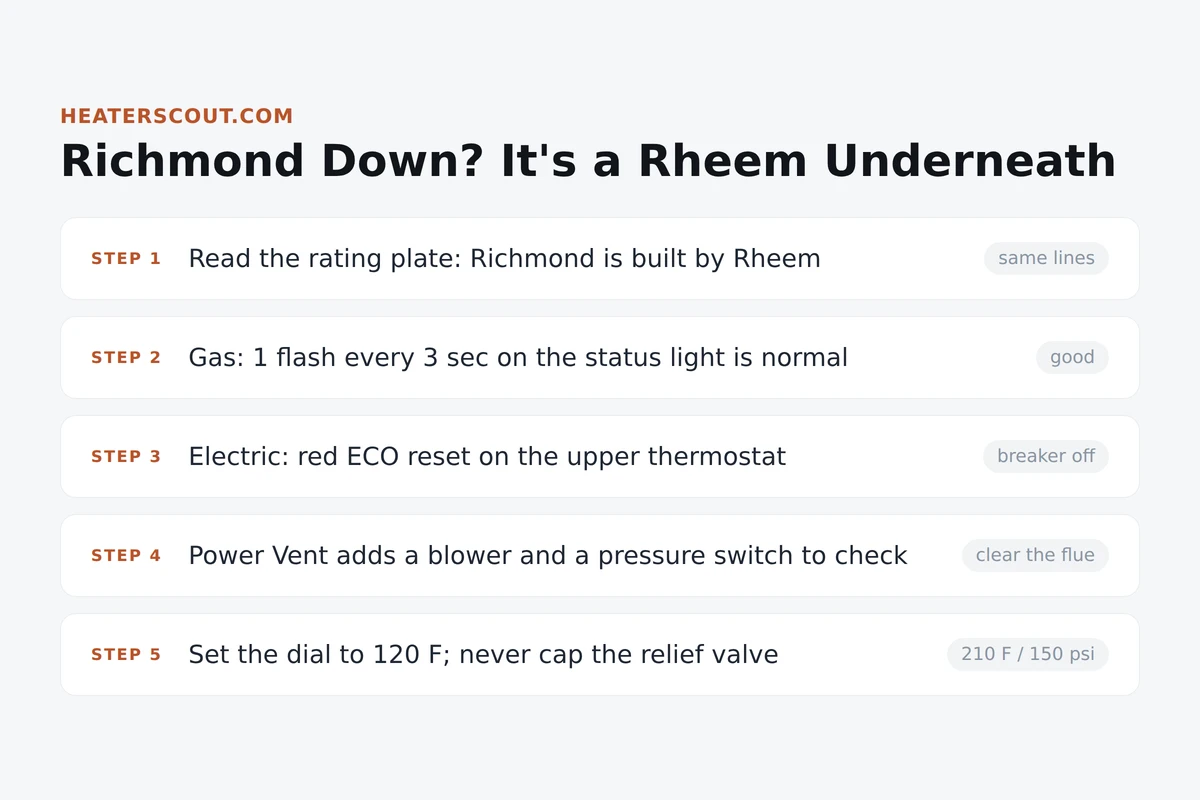
Read the rating plate and treat it as a Rheem. On gas, count the status light: one flash per three seconds is normal, two or more is a code you match to the legend on your valve. On electric, the red ECO reset is on the upper thermostat, breaker off first, reset once. Power Vent adds a blower and pressure switch to the list. Set it to 120, never cap the relief valve, and order parts by the Rheem number.
Quick answer
Find the rating plate on the upper third of the tank and confirm the fuel type. On a gas Richmond, read the status light on the gas valve: one flash every three seconds is normal, and a repeating count of two or more is a fault you match to the printed legend. On an electric one, kill the 240 V breaker and press the red ECO reset on the upper thermostat once. On a Power Vent, clear the flue and check the pressure-switch tube first. Parts cross-reference to Rheem.
Step zero: read the plate, then treat it as a Rheem
Before you touch anything, find the rating plate on the upper third of the tank and read three things: the model number, the serial, and the fuel type. Richmond is a Rheem brand, so none of the diagnostics or parts are Richmond-specific. The serial carries the age in a Rheem-style date code, with the week and year encoded in the digits right after the first block of the serial number, which matters because most repair-or-replace calls come down to how old the tank is. Photograph the plate. Model, serial, gas or electric, gallons, and vent type drive every code lookup and every parts search from here, and every one of them resolves to a Rheem cross-reference.
The Richmond / Rheem relationship
Richmond is not a separate factory. It is one of Rheem's labels, built alongside Rheem and Ruud on shared lines and sold mainly through Menards and independent hardware stores. Practically, that means a Richmond behaves exactly like a Rheem of the same size and vent type: same status-light codes, same WWYY-style serial date code, same gas valves and elements. When you order a part or look up a code, you use the Rheem information for your model, because there is no meaningfully different 'Richmond' version behind the badge.
No hot water: read the light, then the reset
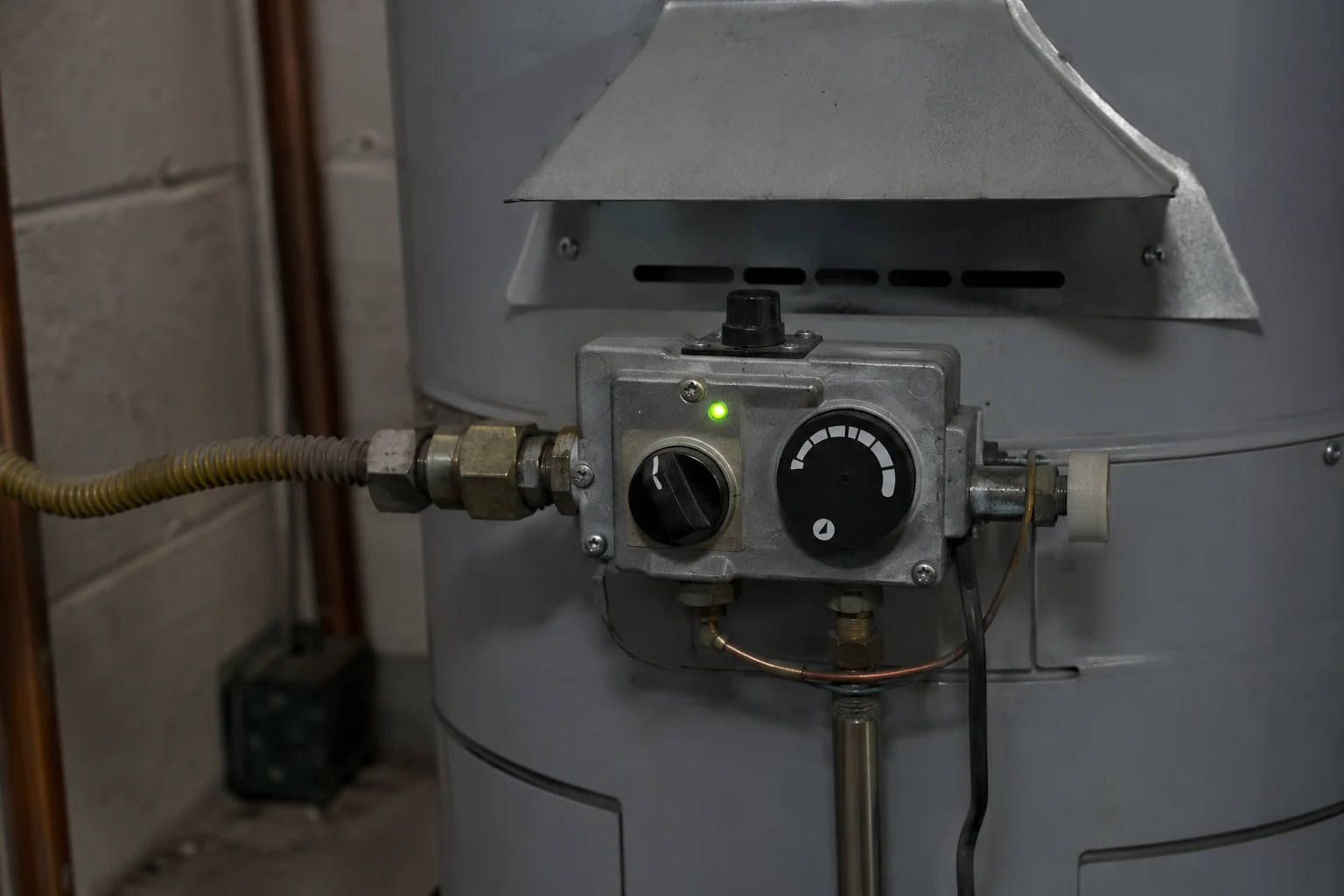
No hot water is the call that starts most Richmond troubleshooting. Split it by fuel type right away. On a gas Richmond, look at the status light on the gas control valve at the base of the tank. One flash every three seconds means it is healthy, pilot lit and control fine. A repeating pattern of two or more flashes is a fault code. Two flashes is flame failure or low thermopile voltage, usually a weak or dirty pilot. Three flashes points at over-temperature or an air-supply and flue lockout. Four flashes is high water temperature. Seven flashes is a gas control valve fault, and a six-then-three pattern is a recycle limit with the flame dropping out of sequence. Match your count to the legend printed by the valve, because model to model the map shifts a little.
On an electric Richmond with no hot water, the usual culprit is the ECO, the red high-temperature reset on the upper thermostat. Before you go near it, kill the breaker, because the panel you are opening sits on 240 volts. With power off, remove the upper access panel, fold back the insulation, press the red button until it clicks, then button everything up before restoring power. The ECO opens around 180 degrees, so it only trips when the water really overheated. If the reset holds, you are done. If it trips again within a day, you have an element shorted to the tank or a stuck thermostat, not a nuisance trip, and that is where you stop resetting. A tripped ECO cuts both elements, so it usually leaves no hot water at all. Lukewarm water instead points at a single dead element, most often the lower one.
- Gas: count the status light. One flash per three seconds is normal; two or more is a code you match to the legend on the valve.
- Two flashes: clean the pilot and relight. If it dies on release, the thermopile is weak.
- Electric: kill the 240 V breaker, then press the red ECO reset on the upper thermostat once.
- ECO trips again within a day: stop resetting, find the overheating cause (shorted element or stuck thermostat).
- Power Vent: confirm the blower spins and the vent is clear before chasing a burner fault.
The pilot and thermopile problem
A two-flash code, or a pilot that lights and then dies the second you release the gas knob, is almost always the thermopile. It is the sensor bundle the pilot flame heats, and its small voltage is what holds the main gas valve open. If the pilot flame is weak, off-color, or does not fully wrap the sensor, the voltage sags and the valve closes. To relight, turn the knob to OFF and wait about five minutes so any gas clears, then turn it to PILOT, press it fully in and hold, and click the igniter until the pilot catches. Keep the knob pressed roughly a minute after it lights so the thermopile warms. If the pilot holds and you get one flash every three seconds, you are done. If a meter reads the thermopile below about 400 millivolts, when a healthy one sits around 650 to 850 open-circuit, replace it. It is a cheap part under the Rheem number.
Safety: the relief valve
Never cap or plug the temperature and pressure relief valve. It opens near 210 degrees or 150 psi and is the tank's last defense against rupture. A drip during a heating cycle is often thermal expansion; open a hot faucet, and if the drip stops, the house wants an expansion tank. A valve that drips steadily otherwise gets replaced, not blocked.
Not enough hot water, or it runs out fast
Running out is a different problem from no hot water, and the difference points at the cause. On an electric Richmond, a burst of hot that turns lukewarm halfway through a shower is the classic sign of a dead lower heating element. The upper element heats the top of the tank for the first few gallons, then the lower element carries the rest, and when it fails you get a short run of hot followed by cold. On a gas Richmond the same short-supply feeling usually traces to a low temperature setting, a partly clogged burner, or a thick sediment layer insulating the flame from the water. Check the dial first, because it is free.
Sediment is the quiet thief here. Mineral scale on the tank floor steals usable volume and burner efficiency, so a 40 gallon Richmond starts behaving like a 30, and it drives the popping and rumble you hear as trapped water flashes to steam under the layer. A yearly drain and flush is both fix and prevention, though on a unit well past ten years the capacity loss can be permanent once the scale bakes hard onto the steel.
Power Vent and Encore: the blower changes the game
A Richmond Power Vent or Encore adds a blower and a pressure switch on top of the standard gas controls, and those extra parts add failure modes an atmospheric tank does not have. On these units a three-flash type fault usually means the control cannot prove airflow before it will fire the burner. The first suspects are a blocked intake or exhaust, a kinked or water-filled pressure-switch tube, or a tired blower. Clear the PVC vent runs, check the small clear tube going to the pressure switch for water or a kink, and confirm the blower actually spins up on a call for heat. If the blower runs and the burner still never lights and the unit locks out, the control is not seeing the pressure switch close. A flammable-vapor sensor lockout is a separate and more serious code that means the unit detected combustible fumes near the floor. Remove any gasoline or solvent, ventilate the space, and if the lockout will not clear, that one is a tech's call, not a reset you keep pressing.
Leaks, temperature, and the stop-and-call-a-pro line
Where a Richmond leaks decides whether it is a cheap fix or a new heater. A drip from the relief valve during a heating cycle can be normal thermal expansion, cured with an expansion tank on the cold inlet. A relief valve that drips steadily otherwise is worn or fouled and gets replaced, never capped. A leak at a fitting or union up top can often be resealed. The one leak nobody fixes is water weeping from the body or bottom of the tank, which means the steel corroded through, and on an aging unit that is a replacement. On temperature, leave the dial at 120, the factory scald-safe point. Water that runs scalding means turn the dial down before blaming a part, and on electric both thermostats have to be set the same with the breaker off.
Plenty of Richmond work is a careful homeowner's afternoon with the breaker off and the burner-door legend open: relighting a pilot, resetting an ECO once, flushing sediment, turning the dial down. The stop-and-call line is where a fault keeps coming back or the failure is the tank itself. A repeated over-temp code or an electric ECO that trips a second time both mean the water is genuinely overheating, and chasing that with repeated resets wears out a safety device while ignoring a real hazard. A seven-flash gas valve fault, a flammable-vapor lockout that will not clear, any gas smell, and a weeping tank body are hard stops. Everything below that line is where a licensed plumber or gas tech earns the call, because the failure mode is a burn, a flood, or a combustion problem. The tie-breaker is always the legend on your specific valve and the Rheem cross-reference for your model. Read both before you turn a screw or place a parts order.
Frequently asked
Who actually makes Richmond water heaters, and can I use Rheem parts?
Richmond is a Rheem brand. The tanks come off the same production lines as Rheem and Ruud, so a Richmond, a Rheem, and a Ruud of the same size and vent type are essentially the same heater under different labels. That is good news for repair. The gas control valve, thermopile, heating element, thermostat, anode, and relief valve all cross-reference to Rheem part numbers, and any plumbing supplier that stocks Rheem can pull the part off your model and serial. When you search for a replacement, note the model number and serial off the rating plate on the upper third of the tank, then look up the Rheem equivalent. You are not stuck hunting for a rare 'Richmond' part, because there really is not one.
What do the blinks on my Richmond gas water heater status light mean?
The status light sits on the gas control valve at the bottom front of the tank and blinks a diagnostic code. One flash about every three seconds is the healthy signal: pilot lit, control fine, nothing to do. Trouble is a repeating pattern of two or more. On the common Rheem-built Richmond control, two flashes is flame failure or low thermopile voltage, usually a weak or dirty pilot. Three flashes points at over-temperature or an air-supply and flue lockout. Four flashes is high water temperature. Seven flashes is a gas control valve fault. A six-then-three pattern is a recycle limit, the flame dropping out of sequence. The exact chart is printed on a label near the valve, so match your count to that legend rather than a number off the internet.
Where is the reset button on a Richmond electric water heater and can I press it?
It is the red button on the upper thermostat, the ECO or high-temperature cutoff, hidden behind the upper access panel and a layer of insulation. One rule matters more than its location: shut the breaker off first, because those terminals carry 240 volts and the ECO sits right next to them. With power off, remove the panel and fold back the insulation, press the red button until it clicks, put everything back, then restore power. The ECO opens when tank water climbs past about 180 degrees, so it only trips because the water genuinely overheated. A reset that holds is fine. A reset that trips again within a day means a real fault, usually an element shorted to the tank or a stuck thermostat, and that is where you stop resetting and diagnose.
How do I relight the pilot on a Richmond gas water heater?
Turn the gas control knob to OFF and leave it there about five minutes so any gas in the burner chamber clears. Then turn the knob to PILOT, press it fully in and hold, and click the piezo igniter until the pilot catches. Keep the knob held down for roughly sixty seconds after it lights so the thermopile warms up and builds voltage, then release. If the pilot stays lit and the status light settles to one flash every three seconds, you are done. If the pilot dies the moment you release the knob, or you get a two-flash code, the thermopile is weak or the pilot flame is dirty and not wrapping the sensor. Clean the pilot and try once more before replacing the thermopile.
My Richmond Power Vent throws a code and the blower runs, what now?
A Power Vent or Encore adds a blower and a pressure switch on top of the standard gas controls, so it has failure modes an atmospheric tank does not. A three-flash type fault on these units usually means the blower cannot prove airflow: a blocked intake or exhaust, a kinked or water-filled pressure-switch tube, or a failing blower. Start by clearing the vent and checking the small clear tube to the pressure switch for water or kinks. If the blower spins up but the burner never lights and it locks out, that is the control not seeing the switch close. A flammable-vapor sensor lockout is a separate, more serious code that means the unit smelled combustible fumes near the floor. Clear any gasoline or solvent, ventilate, and if it will not clear, get a tech.
Is it worth repairing a Richmond water heater or replacing it?
Age plus the failure type. A residential tank typically lasts 8 to 12 years, and you can read the age off the serial: Richmond uses the same date code as Rheem, with the week and year in the digits after the first block of the serial number. Small parts are worth doing on a tank with life left. A thermopile, thermocouple, gas valve, single element, thermostat, or worn relief valve are all normal repairs, bought under the Rheem cross-reference. The replace-it signs are clear. Water weeping from the body or bottom of the tank means the steel corroded through and no patch holds. Rusty hot water that stays rusty after a full flush, a repeated over-temp code or ECO trip on a ten-year-old tank, and a failed gas valve on an aging unit all point toward a new heater with a fresh warranty rather than more money into an old one.