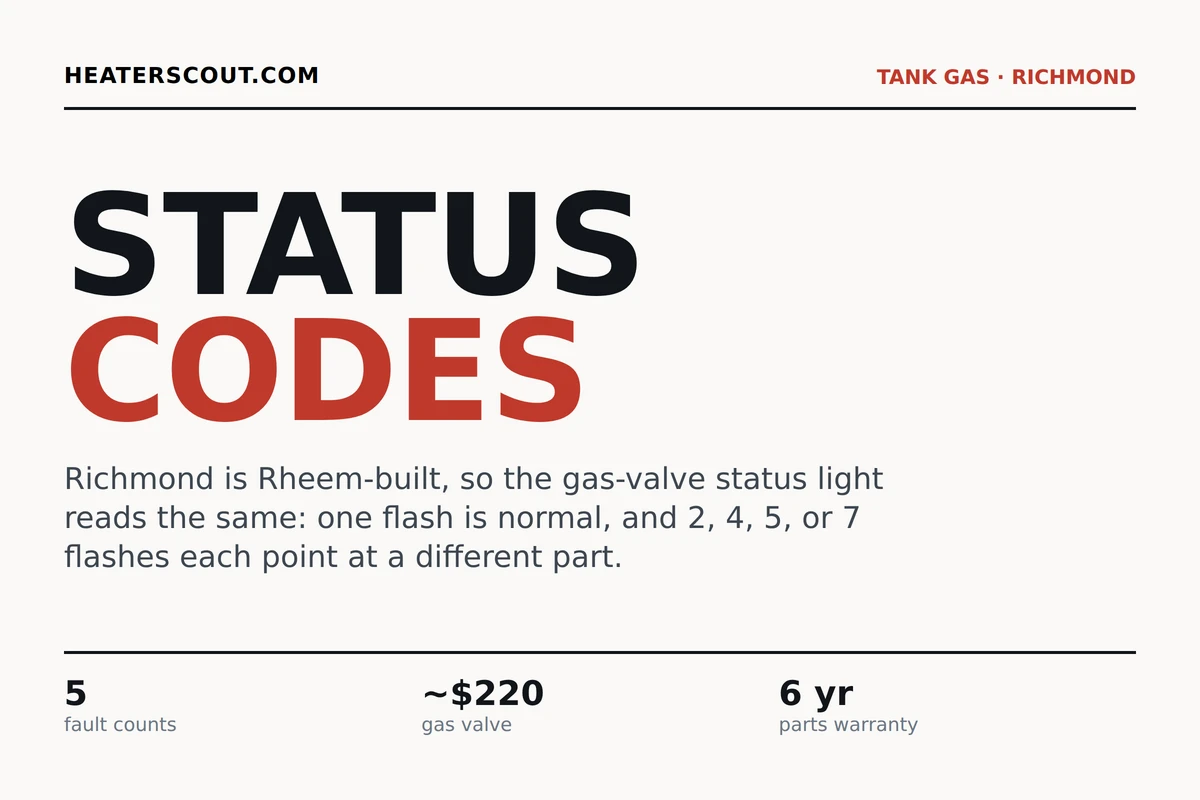
Richmond water heaters carry the same gas control valve as Rheem, because Richmond is a division of Rheem Manufacturing, so the little status light near the base of the tank speaks the identical language. One slow flash every three seconds is the heater telling you everything is fine. The trouble starts when that light throws bursts of two, four, five, or seven quick flashes with a pause in between. Each count is a specific message from the valve, and knowing the difference between the normal one-flash heartbeat and a fault burst is the single most useful thing you can learn about this heater. This page maps every count, shows how to count without getting fooled, walks the gas-knob reset, and routes each code to the part behind it.
Key takeaways
- One flash every three seconds is normal on a Richmond gas heater. It means the pilot is lit and the thermopile is healthy, not that something is wrong.
- Faults are bursts of two or more quick flashes: 2 = low thermopile voltage, 4 = high-temperature shutdown, 5 = temperature-sensor failure, 7 = gas control valve fault.
- Richmond is Rheem-built, so the chart matches Rheem, Ruud, and GE. The legend on your own burner door is the final word for your exact model.
- Reset is the ON/OFF switch on the gas control knob, not a red button. Off, wait five minutes, relight the pilot, back to your setting. Reset once, not repeatedly.
- Check the rating label for model and serial before buying parts. The gas valve is usually a covered part on Richmond's warranty for six years or more.
How to read the flashes without miscounting
Miscounting is the most common way owners end up buying the wrong part. The flashes come fast and the pause is long, so it is easy to count a pause as a flash or to lose your place across cycles. The status light sits low on the gas control valve near the base of the tank, and on some Richmond models it glows green for the diagnostic track. Work it slowly and confirm the count before you touch anything.
The Richmond flash-code chart
This is the core of the page. The counts read the same as the Rheem gas control valve chart because the valve is the same hardware. Any count above one is a fault. The table below pairs each count with what the valve is actually reporting, the part it points at, and whether it is homeowner work or a call to a licensed plumber.
Benign to diagnose
- 1 flash / 3 sec: normal. Pilot lit, thermopile healthy, no fault. Nothing to reset.
- 2 flashes: low thermopile voltage. Weak pilot flame, sooted or worn thermopile, or a loose lead. Cheap, DIY-friendly, part usually under $50.
- 4 flashes: high-temperature (ECO) shutdown. Often a high setpoint or sediment trapping heat over the burner. Start free: back the dial to 120 F and flush the tank.
Points at the valve
- 5 flashes: temperature-sensor failure. On modern Richmond gas heaters the sensor is built into the valve, so this usually ends in a valve job.
- 7 flashes: gas control valve failure. Internal fault, replace the valve assembly. Rarely clears with a reset. Check warranty first.
- Flammable-vapor lockout: the FV sensor tripped on fumes near the heater. Ventilate and remove the source before you reset, this is a hazard, not a valve fault.
A word on the higher and less-common counts you may see on some Richmond sheets, like a three-flash or an eight-flash. Their meaning varies by model line and Richmond does not publish them consistently across every manual. On power-vent models a three-flash often relates to the vent pressure switch or blower proving, while an eight can appear on flame-sense or lockout states. If your unit throws a count outside the core five, read it off that heater's own burner-door legend rather than assuming a cause, and treat a hard lockout as a stop-and-diagnose, not a reset-and-hope.
What each fault count actually is
Two flashes is low thermopile voltage. The thermopile is the little bundle of thermocouples that the pilot flame heats to generate the small DC voltage that powers the gas valve. When the pilot flame is weak, sooty, or not wrapping the thermopile tip, or when the thermopile itself is worn, the voltage sags below the valve's holding threshold and the burner will not fire. It is the friendliest code on the list. Check that the pilot burns a strong steady blue and envelops the thermopile, clean and reseat the leads at the valve, and if a meter reads low under load, swap the thermopile. That is squarely homeowner work.
Four flashes is a high-temperature shutdown, the gas equivalent of an ECO tripping. The valve sensed the water climbing past its high limit and cut the burner. The causes stack from free to expensive: a setpoint dialed toward the HOT end, sediment on the tank bottom acting like an insulating blanket over the burner and overheating the water above it, a temperature sensor reading high, or a valve that is not shutting the burner off cleanly. Back the dial to about 120 degrees and flush the tank before you suspect the valve. If four flashes returns on a clean tank at a sane setting, then you are into sensor or valve territory and it is time for a pro.
Five flashes is a temperature-sensor failure: the valve no longer trusts its own reading of the water. On modern Richmond gas heaters that sensor is integral to the gas control valve, so a genuine five-flash usually ends in a valve replacement rather than a separate sensor swap. Seven flashes is the valve itself reporting an internal fault, and it almost always means replacing the gas control valve assembly. Both of those are the codes where the warranty matters most, because the valve is a covered part on most Richmond gas heaters for years, and the difference between a covered and an out-of-warranty valve is the difference between a labor-only bill and a full part-plus-labor job.
The reset, and where the DIY line sits
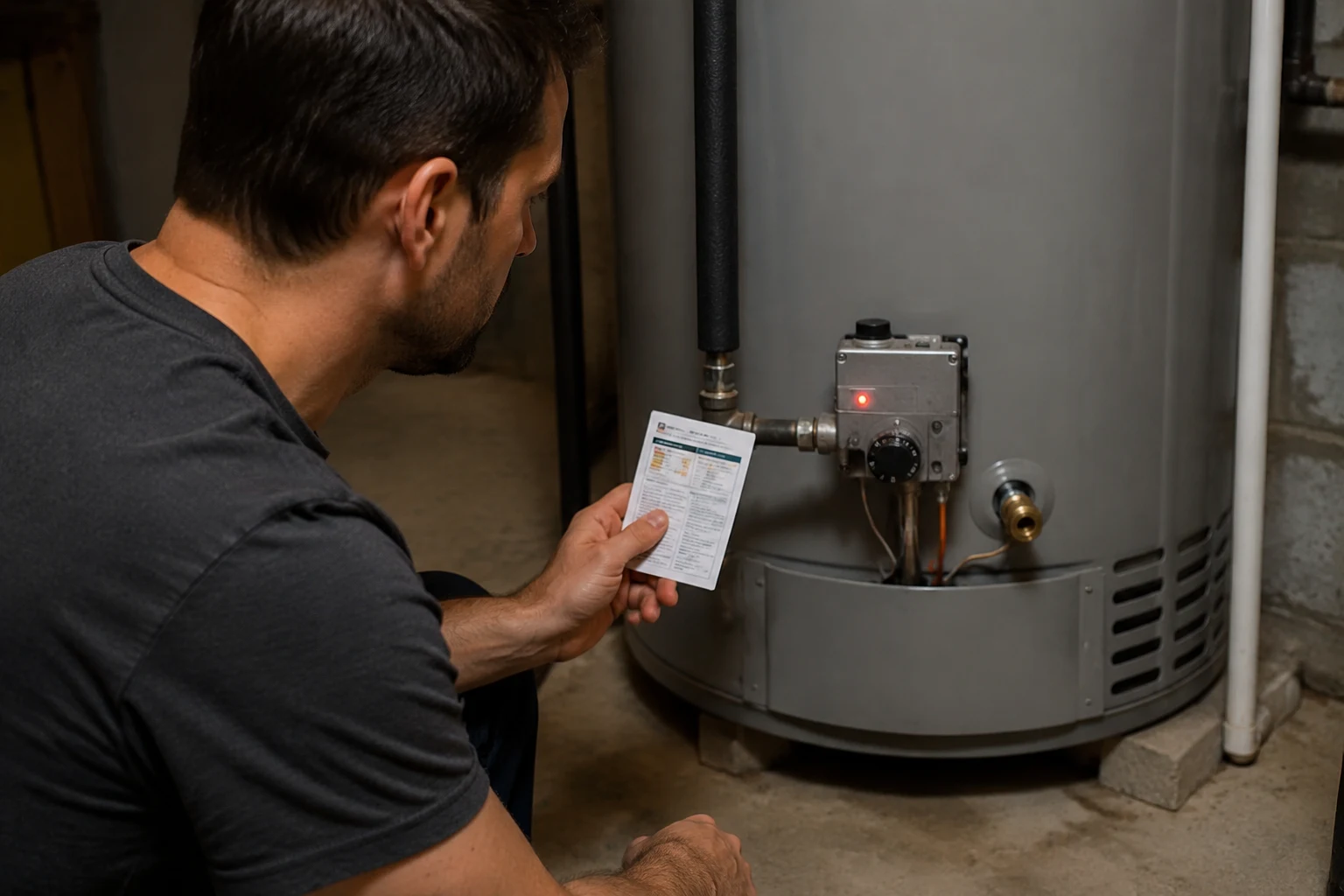
The soft reset is the same for most of these codes and it is worth doing exactly once before you spend money. On a gas Richmond, turn the ON/OFF switch on the gas control knob to OFF, wait about five minutes for the valve and water to settle, then relight the pilot following the lighting instructions on the burner door and return the knob to your temperature setting. On a power-vent or electronic model, cutting power at the switch or breaker for the same few minutes does the same thing. People go looking for a red reset button and get confused when a gas Richmond does not have one. On gas models the high-temperature sensor is built into the valve, so the knob cycle is your reset. The physical red ECO button lives on electric models, behind the upper access panel.
Where you stop depends on the count. The two-flash thermopile job is homeowner work: a screwdriver, a wrench, a multimeter, and a cheap part. The four-flash code starts as homeowner work, backing off the temperature and flushing sediment, and only becomes a pro job if it returns on a clean tank at a sane setting. Five and seven flashes are the valve, and replacing a gas control valve means draining the tank and breaking the gas connection, which is where most people bring in a licensed plumber. Before any valve purchase, read the complete model and serial off the rating label and check coverage, because a covered valve turns a part-plus-labor bill into labor only.
Richmond-specific notes: label, warranty, and where you bought it
A few things are worth knowing that are particular to the Richmond brand rather than the generic Rheem chart. Richmond gas tank heaters are sold mainly through Menards under the Essential and Encore lines and through independent plumbing supply houses, not the big-box chains that carry Rheem's own badge. That means when you go for a part, you are matching to a Richmond model number, which on gas tanks usually starts with a 6G prefix, like 6G40-36F for a 40-gallon 36,000 BTU unit. The rating label on the side of the tank carries the full model, the serial number, and its own flash legend, and that on-appliance legend is the authority for your exact build year.
Warranty is the other Richmond-specific piece. The Menards Essential line commonly ships with a six-year tank and parts warranty plus a two-year labor warranty, while premium Richmond lines can run longer, up to twelve years or a lifetime tank on some models. Because Richmond is a Rheem division and shares manufacturing and warranty terms with Ruud, GE, and Sure Comfort, the parts coverage on the gas control valve is the same generous window you would get on the Rheem badge. To claim it you need the complete model number, the complete serial number, and the installation date, and Richmond's customer service line at 800.621.5622 can look up coverage from the serial. So a seven-flash valve fault on a three-year-old Richmond is not the wallet hit it looks like, since the valve itself is almost certainly covered and you are paying only for a plumber's hour to swap it.
One last habit that saves grief. Because Richmond, Rheem, Ruud, and GE gas tanks share the valve, generic online charts and forum threads will apply to your unit, but the wording and the uncommon higher counts drift between brands and production years. Count the flashes, match them to the core five, and then confirm the meaning against the legend on your own burner door before you order a part. If the door label and a generic table ever disagree, the appliance in front of you wins. From there, follow your count to the fix: two flashes to the thermopile, four to the setpoint and a flush, five and seven to the valve.
Frequently asked
What do the flashing lights on my Richmond water heater mean?
The small status light low on the gas control valve is a diagnostic readout, and the number of quick flashes in each burst is the code. One flash every three seconds is normal: the pilot is lit and the valve is healthy, so that steady single blink is not a fault no matter how much it looks like a warning. Bursts of more than one flash are faults. Two flashes is low thermopile voltage, four is a high-temperature shutdown, five is a temperature-sensor failure, and seven is a gas control valve fault. Because Richmond heaters are built by Rheem and use the same valve, that chart is the same one Rheem, Ruud, and GE-branded units use. Count the flashes in one burst, wait for the roughly three-second pause, confirm the same count on the next burst, and match it to the legend printed on your burner door.
Are Richmond flash codes the same as Rheem?
Yes, for the practical codes. Richmond Water Heaters is a division of Rheem Manufacturing, and the Richmond gas heaters sold at Menards and through independent supply houses use the same gas control valve as their Rheem and Ruud cousins. Same valve means the same status-light logic: one flash normal, two thermopile, four high-temp, five sensor, seven gas valve. What can differ between a Richmond and a Rheem is the wording on the rating label, the model prefix (Richmond gas tanks often start with a 6G code), and the exact behavior of the uncommon higher counts. When in doubt, read the flash legend printed on that specific heater's burner door rather than assuming, since the label on the appliance in front of you is the authority for that model year.
How do I reset a Richmond water heater?
On a gas Richmond, the reset is the gas control knob, not a red button. Turn the ON/OFF switch on the gas control valve to OFF, wait about five minutes so the valve and water can settle, then relight the pilot following the lighting instructions on the burner door and turn the knob back to its temperature setting. On a power-vent or electronic model you can also cut power at the switch or breaker for the same few minutes. That clears a one-time fault. It does not fix a cause. If the same flash count comes right back after a clean reset, the fault is real and repeating, and repeatedly resetting a four-flash high-temp code or a seven-flash valve code is the wrong move because those are safety conditions.
What does 7 flashes mean on a Richmond water heater?
Seven flashes is a gas control valve fault. The valve is reporting an internal failure and that it can no longer run the burner safely. Unlike the two-flash thermopile code, seven flashes rarely clears with a reset or a cheap part, and it almost always ends in replacing the gas control valve assembly. Before you buy one, pull the complete model and serial number off the rating label and check the warranty, because the gas control valve is a covered part on most Richmond gas heaters for several years. On the Menards Essential line that is typically six years on parts, which can turn a two-hundred-dollar valve into a labor-only job. Richmond's Customer Service line, 800.621.5622, can confirm coverage from the serial number.
How much does it cost to fix a Richmond gas valve code?
It depends entirely on the count. A two-flash thermopile fix is cheap: the thermopile part usually runs under fifty dollars and it is homeowner work with a screwdriver and a wrench. A four-flash high-temp code often costs nothing to clear if it is just a high setpoint or sediment, though a flush might mean a plumber's visit. Five and seven flashes are the gas control valve, and the valve assembly runs roughly one hundred fifty to two hundred fifty dollars for the part, plus one to two hours of labor to drain the tank and swap it, so a professional valve replacement commonly lands in the three hundred to five hundred dollar range. If the heater is still under Richmond's parts warranty, you pay labor only.
Is a blinking status light on my Richmond dangerous?
The blinking is the safety system reporting, not the hazard. Some codes are harmless to diagnose, like the two-flash thermopile code, which just means the burner will not light until you restore voltage. Others are genuine safety trips. Four flashes is a high-temperature shutdown, the valve cutting the burner because the water climbed past its limit, and that is not a code to keep resetting past. On flammable-vapor models a lockout means the FV sensor detected combustible fumes near the heater, gasoline or solvents stored too close, which you clear by ventilating and removing the source, not by forcing a reset. The dangerous move is never the light itself. It is bypassing or jumpering a safety to run the burner through a warning.
Why does my Richmond water heater keep flashing the same code?
A code that returns after a clean reset means the underlying cause is still there. A stubborn two-flash means the pilot is still weak or the thermopile is genuinely worn, so it needs cleaning or replacement, not another reset. A repeating four-flash on a tank that is at 120 degrees and freshly flushed points at a drifting temperature sensor or a valve that is not shutting the burner off cleanly. A seven-flash that will not clear is the valve telling you it is done. Resetting only silences the readout for one cycle. If the same count keeps coming back, stop resetting, note the number and your model and serial, and chase the actual part the count points to.
Where is the model and serial number on a Richmond water heater?
On the rating label, a printed plate usually stuck to the side of the tank near the top or on the front above the burner door. It lists the complete model number (Richmond gas tanks often begin with a 6G prefix, like 6G40-36F), the complete serial number, gas type, and BTU rating. Write down both the full model and the full serial before you call for parts or warranty, because Richmond and Rheem parts are keyed to the exact model, and the serial number encodes the build date that decides whether you are still inside the warranty window. Having installation date handy helps too when you call the Richmond customer service line.