A Rheem tank that stops making hot water is rarely the mystery it feels like at 6 a.m. in a cold shower. On the gas models a small status light on the control valve is already blinking a code at you, and on the electric ones a single red button behind a panel explains most dead units. The trick is sorting the handful of things a homeowner can safely check, the temperature dial, the reset button, the pilot, the flash count, from the two or three failures where the right move is to stop and call a licensed tech. This page walks the real symptoms in the order people actually hit them.
Does any of this apply to a Rheem tankless or hybrid heat pump unit?
Some of it. The temperature, leak, smell, and EcoNet notes carry over, but tankless and hybrid heat pump units use different controls and error codes than a standard gas or electric tank, and their faults are not read the same way. This hub is about residential storage tanks, gas and electric. If you have a tankless or a hybrid, use its own display code and manual.
No hot water: read the light, then the reset
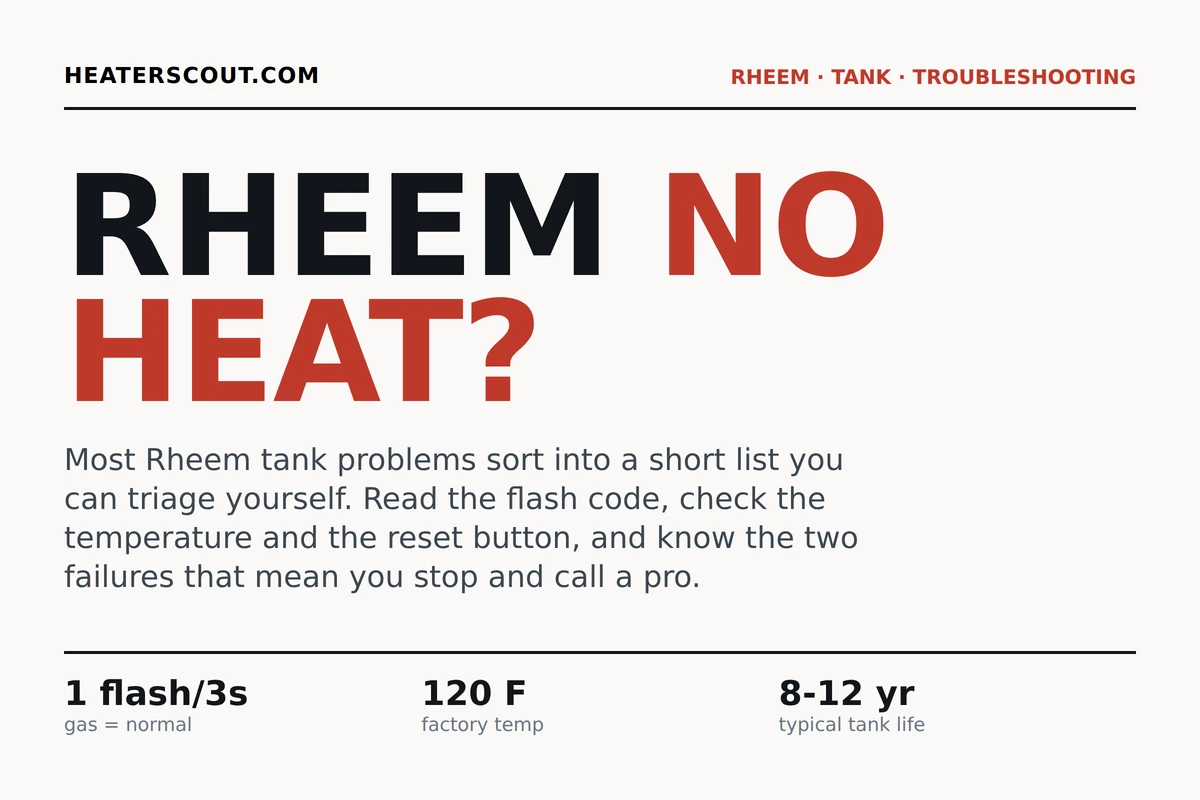
No hot water is the call that starts most of these. Split it by fuel type right away. On a gas Rheem, look at the status light on the gas control valve at the bottom of the tank. One flash roughly every three seconds is the heater telling you it is fine, pilot lit and control healthy. A repeating pattern of two or more flashes is a fault code, and the exact count is printed on the label on the front of your heater. Two flashes is low thermopile voltage, three is a pilot that has gone out, four is a high-limit trip meaning the water overheated, six is the flammable-vapor lockout, and seven is a gas valve failure. Match the count to your label rather than a number you read online, because the map can shift by model.
On an electric Rheem with no hot water, the usual culprit is the ECO, the red high-temperature reset button on the upper thermostat. Before you go anywhere near it, kill the breaker. The panel you are opening sits on 240 volts. With the power off, fold back the insulation, press the red button until it clicks, and button everything back up before restoring power. If that reset holds, you are done. If it trips again within a day, the water is genuinely overheating and you have a failed thermostat or a shorted element, not a nuisance trip. That is where you stop resetting and get it diagnosed.
ECO (Energy Cut-Off)
A one-shot safety switch that cuts the heat if tank water climbs past a safe limit, around 170 to 180 degrees Fahrenheit. On electric Rheem units it is the red reset button on the upper thermostat; on gas units the same job shows up as a four-flash high-limit code. It exists to stop a runaway from turning the tank into a pressure vessel. Because it only trips when the water really did overheat, a repeat trip is a symptom of another failure, never something to just keep resetting.
Not enough hot water, or it runs out fast
This one is different from no hot water, and the difference points at the cause. If you get hot water but it turns lukewarm halfway through a shower on an electric tank, the classic reason is a dead lower heating element. The upper element heats the top of the tank for the first few gallons, then the lower element is supposed to carry the rest. When the lower element fails, you get a short burst of hot followed by cold. On a gas unit the same short-supply feeling usually comes from a low temperature setting, a partly clogged burner, or a thick layer of sediment insulating the flame from the water. Check the dial first, it is free.
Sediment is the quiet thief here. Years of mineral scale settle on the tank floor and steal usable volume and burner efficiency, so a 40 gallon tank starts acting like a 30. A yearly flush is the fix and the prevention. If the tank has never been drained and it is pushing ten years old, a flush may buy time but the capacity loss can be permanent once the scale has cooked hard.
| No hot water, gas, 3 flashes | Pilot out or bad thermocouple. Relight per the label; if it will not hold, replace the thermopile. |
| No hot water, gas, 2 flashes | Low thermopile voltage, usually a weak or dirty pilot. Clean pilot, retest; below ~400 mV under load, replace. |
| No hot water, gas, 4 flashes | High-limit (ECO) trip, water overheated. Call a pro; do not keep relighting. |
| No hot water, electric | Tripped ECO on the upper thermostat, or a failed element or thermostat. Reset once, breaker off; repeat trip means diagnose. |
| Runs out fast, electric | Dead lower heating element, or heavy sediment cutting usable volume. |
| Runs out fast, gas | Low temp setting, sediment insulating the burner, or a partly clogged burner. |
| Water too hot / scalding | Temperature set above 120 F, or a failed thermostat sticking the heat on. |
| Leak at T&P valve | Thermal expansion or a worn valve. Replace the valve, add an expansion tank if it recurs. Never cap it. |
| Leak at tank base | Tank corroded through. Not repairable. Replace the unit. |
| Rumbling / popping | Sediment on the tank floor. Drain and flush. |
| Rotten-egg smell (hot side) | Hydrogen sulfide from bacteria reacting with the magnesium anode. Swap to aluminum-zinc or powered anode, chlorine-flush. |
| EcoNet won't connect | 2.4 GHz band mismatch, weak signal, or cloud outage. Not a heating fault; the tank still runs on its thermostats. |
The stop-and-call-a-pro line
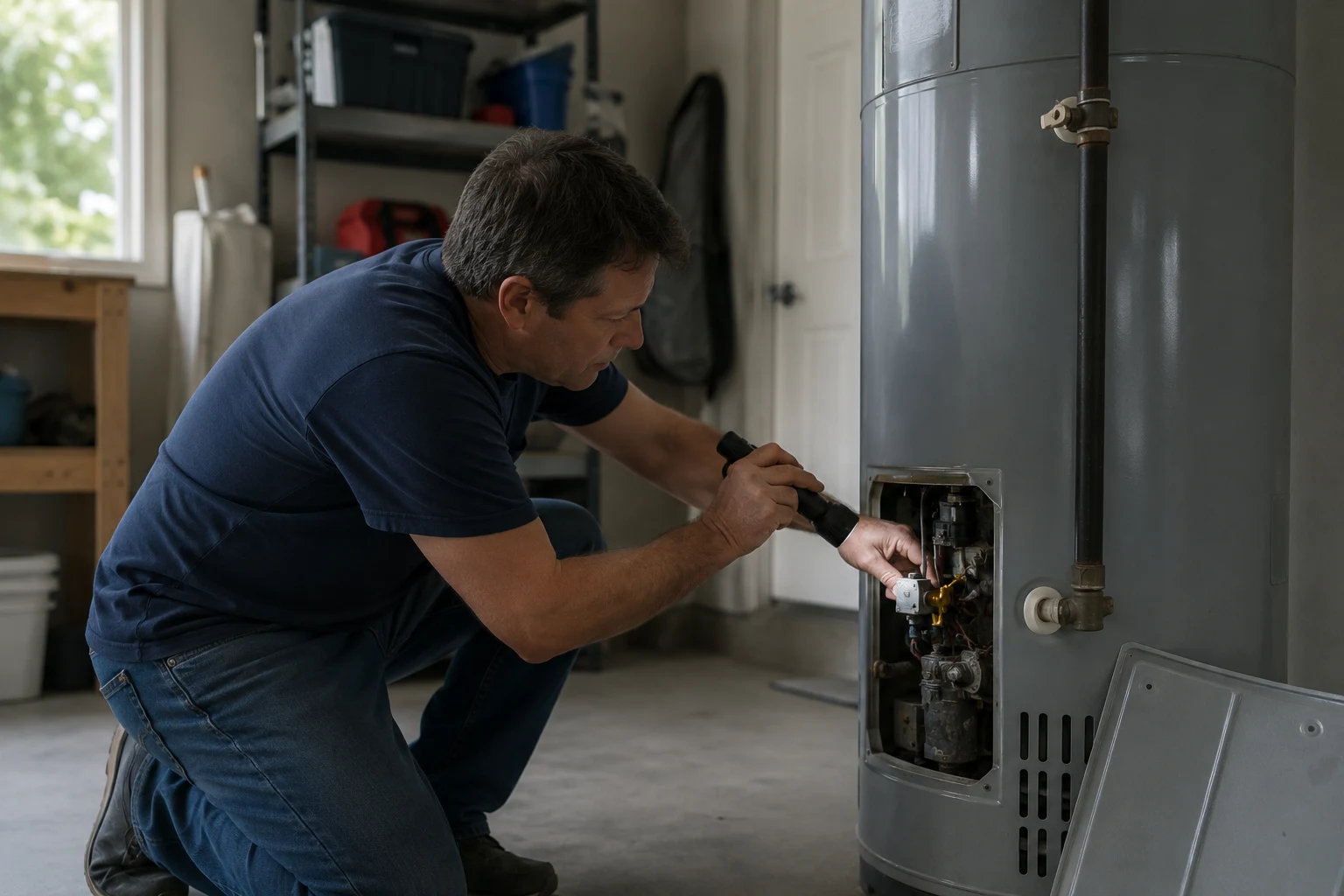
Plenty of this is homeowner work: relighting a pilot, resetting an ECO once, turning the dial down from scalding, flushing sediment, swapping an anode rod. The line worth respecting is where a fault keeps coming back or where the failure is the tank itself. A four-flash high-limit or an electric ECO that trips a second time both mean the water is genuinely overheating, and chasing that with repeated resets is how a safety device gets worn out and a real hazard gets ignored. A six-flash flammable-vapor lockout, a seven-flash gas valve fault, and any gas smell are hard stops. So is water seeping from the body of the tank. None of those are dial-and-reset problems.
- Gas leak or a smell of gas near the heater, leave and call the gas utility, do not flip switches.
- Four-flash high-limit code, or an electric ECO that trips a second time within a day.
- Six-flash flammable-vapor lockout or a seven-flash gas control valve fault.
- Water weeping from the bottom or the body of the tank, not just a fitting.
- T&P valve that keeps dripping after a new valve and an added expansion tank.
- Rusty or metallic hot water that stays rusty after a full flush, on a tank past 10 years.
- 240 volt electrical work beyond pressing the reset button with the breaker off.
Everything above the pro line is a reasonable afternoon for a careful homeowner with the breaker off and the manual open. Everything below it is where a licensed plumber or gas tech earns the call, because the failure mode is a burn, a flood, or a combustion problem, not an inconvenience. When in doubt on a gas unit, the label on the front of your specific Rheem is the tie-breaker, and the flash count on it beats any generic chart. Read yours before you turn a single screw.
Frequently asked
Why does my Rheem gas water heater have no hot water and a blinking status light?
Start by counting the blinks, because on a Rheem gas unit the little status light on the gas control valve is telling you exactly what it sees. A single flash roughly every three seconds is normal, it means the pilot is lit and the control is healthy. Trouble shows up as a repeating pattern of two or more flashes. Two flashes points at low thermopile voltage, which usually means a weak or dirty pilot flame. Three flashes points at a pilot outage or a bad thermocouple, so the pilot has actually gone out. Four flashes is a high-limit trip, meaning the water got too hot. Six flashes is the flammable-vapor lockout, and seven is a gas control valve failure. The flash count is printed on the label on the front of the heater for your exact model, so read yours rather than trusting a number off the internet. Relighting the pilot per that same label fixes many two and three flash cases. A repeat four, six, or seven flash is a call-a-pro fault.
Where is the reset button on a Rheem electric water heater?
It is the red button on the upper thermostat, called the ECO or high-temperature cutoff, and you reach it behind the upper access panel with the insulation folded back. The rule that matters more than its location: turn the breaker off before you touch anything in there. Those terminals carry 240 volts. With the power off, press the red button firmly until you feel or hear it click, then put the insulation and panel back before you restore power. Here is the part people skip. The ECO only trips because the water actually got too hot, so a reset that holds is fine, but a reset that trips again within a day means a real fault is cooking the water, usually a thermostat set too high, a failed thermostat, or a heating element shorted to the tank. Do not sit there resetting it over and over. Once it trips a second time, leave it off and get the cause found.
What temperature should I set my Rheem water heater to?
Rheem ships them preset at 120 degrees Fahrenheit, and 120 is the number most households should leave it at. It is hot enough for showers and dishes and low enough that a slip of the hand at the tap does not scald instantly. The dial goes higher, up around 140 to 150 on most models, but every degree past 120 cuts the time it takes to burn skin, which is why the higher end is a real hazard with kids or older adults in the house. If your water comes out scalding, check the setting first. On a gas unit the temperature dial is on the control valve and each mark is roughly a ten degree step. On an electric unit there are two thermostats behind the upper and lower panels, and both have to be set to the same point with a small flat screwdriver, breaker off. Water that runs hotter than the dial says, or that will not turn down, is a failing thermostat, not a setting problem.
My Rheem water heater is leaking, is it dangerous and can I fix it?
Where it leaks decides everything. A little water dripping from the temperature and pressure relief valve during a heating cycle can be normal thermal expansion, but a valve that drips steadily or runs is telling you the pressure is too high or the valve is worn, and that is worth attention because the T and P valve is the tank's last-line safety device against rupture. Never plug or cap it. Replace it, and if the drip returns on a new valve, the house likely needs a thermal expansion tank. A leak at a threaded fitting or a union at the top can often be tightened or resealed. The one leak you cannot fix is water weeping from the bottom of the tank itself. That means the steel tank has corroded through, and no patch holds. On a tank that old the answer is replacement. Keep a drip pan with a drain under the heater so a slow leak goes somewhere safe instead of into the floor.
Why does my Rheem hot water smell like rotten eggs?
That sulfur, rotten-egg smell is hydrogen sulfide gas, and it comes from a reaction between sulfate-reducing bacteria in the water and the magnesium anode rod inside the tank. The anode is a sacrificial rod that corrodes on purpose to protect the steel tank, and magnesium happens to feed the smell. It is not usually a health emergency, but it is unpleasant and it tells you the tank chemistry is off. The common fixes are to swap the magnesium anode for an aluminum-zinc or a powered anode rod, which do not feed the bacteria, and to disinfect the tank with a chlorine flush to kill off what is in there. Running the tank at 140 degrees will also knock the bacteria back, though that raises the scald risk so it is a tradeoff. If the smell is in the cold water too, it is coming in with your supply, not from the heater, and that is a water-treatment problem rather than a Rheem problem.
Why won't my Rheem EcoNet water heater connect to Wi-Fi?
Nine times out of ten it is the 2.4 gigahertz band. The Rheem EcoNet Wi-Fi module only talks on 2.4 GHz, and a lot of modern routers push new devices onto 5 GHz by default, so the module never sees a network it can join. Make sure your phone is on the 2.4 GHz network while you pair, and if your router hides both bands behind one name, split them or temporarily favor 2.4 GHz. Beyond that, weak signal at the heater, an outdated app, or a Rheem cloud outage can all block the connection. To reset the module, hold its button for about 10 to 15 seconds until the light blinks to show it is ready to pair, or pull power to the heater for 30 seconds and let it come back. One thing to keep straight: an EcoNet connection problem is a network issue, not a water-heating fault. The heater still makes hot water on its own thermostats whether or not the app can see it.
How do I know when a Rheem water heater needs replacing instead of repairing?
Age plus the type of failure. A residential tank typically lasts 8 to 12 years, and past that window the math tilts toward replacement. The clearest replace-it sign is water weeping from the body of the tank, which means the steel has rusted through and cannot be sealed. Persistent rusty or metallic hot water after a full flush, a spent anode rod eaten down to its core wire, and heavy sediment that keeps causing rumble and overheating on an old unit all point the same way. Repairs make sense on a younger tank: a bad thermostat, a single shorted element, a worn T and P valve, a weak thermopile, or a pilot that will not stay lit are all normal parts jobs on a heater with years of life left. The judgment call is a repeatedly tripping ECO or a four-flash high-limit on a ten year old tank, where you are often better off putting the repair money toward a new unit.