A single slow blink every three seconds on a Rheem gas water heater is not a problem, it is the heartbeat that says everything is fine. The trouble starts when that light throws bursts of two, four, five, or seven quick flashes with a pause between them. Each count is a specific message from the gas control valve, and the difference between the normal one-flash rhythm and a fault burst is the single most useful thing to learn about this heater. This page maps every flash count, shows how to count them without getting fooled, and routes each code to the part most likely behind it, from a cheap thermopile up to a full gas-valve replacement.
Normal versus a fault: read the rhythm first
The status light sits low on the gas control valve near the base of the tank. It has exactly two modes worth knowing. Normal is one flash, a long pause, one flash, a long pause, steady and unhurried, roughly one blink every three seconds. A fault is a rapid burst of two or more flashes, then a roughly three-second pause, then the identical burst again. If you find yourself counting and it is always one, the heater is telling you it is fine and your no-hot-water problem is somewhere else. Only when you count two or more per burst do you have a code to chase.
One flash every three seconds is the heartbeat, not a warning. Two or more quick flashes in a burst is the actual code.Rheem gas control status-light chart
How to count the flashes correctly
Miscounting is the most common way people end up replacing the wrong part. The flashes are quick and the pause is long, so it is easy to count a pause as a flash or to lose track across cycles. Work it slowly and confirm the number before you touch the reset.
The full Rheem flash-code map
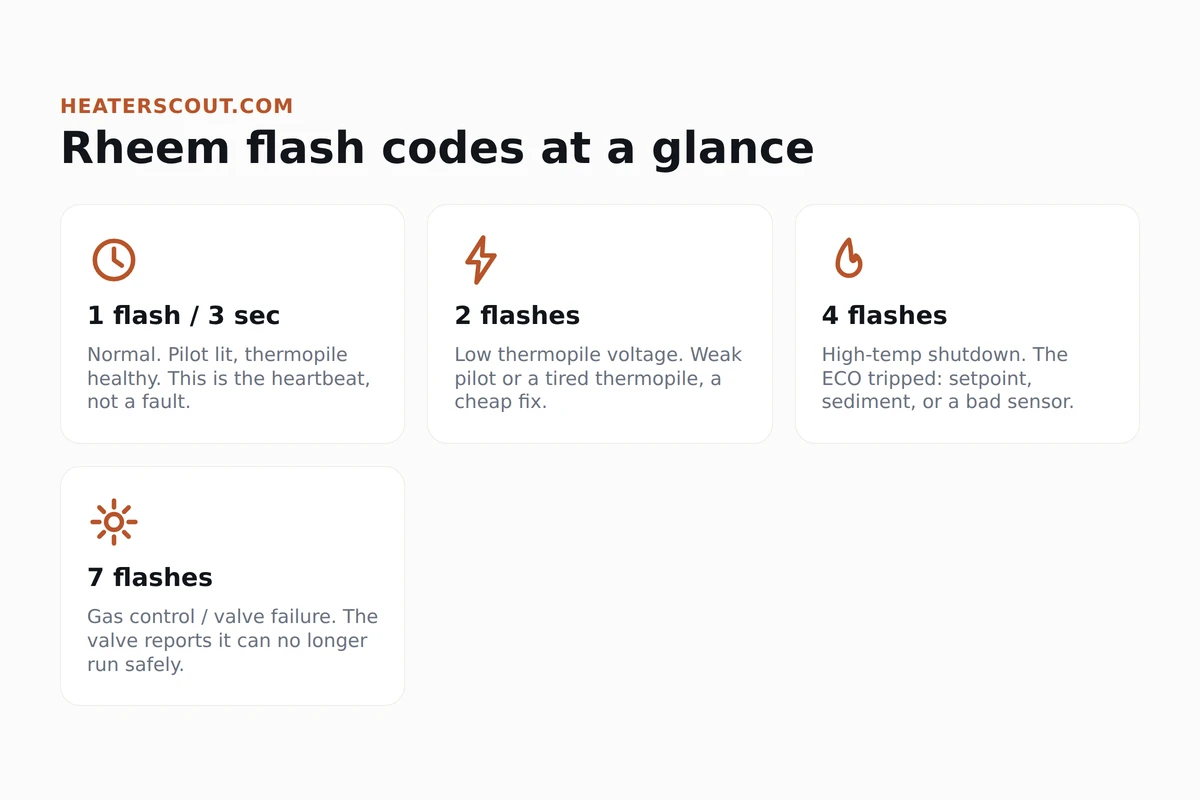
This is the core of the page. The table pulls the status-light codes off the Rheem gas control valve chart and routes each one to the part most likely responsible and to the spoke page that covers it in depth. Counts above one are faults; the color, on Guardian models, tells you whether you are on the red gas-valve track or the blue flammable-vapor track.
| Flash count | What the valve is reporting | Where it points | Fix difficulty |
|---|---|---|---|
| 1 flash / 3 sec | Normal operation | No fault. Pilot lit, thermopile healthy | None needed |
| 2 flashes | Low thermopile voltage | Weak pilot flame, loose lead, or worn thermopile | DIY-friendly, cheap |
| 4 flashes | High-temperature shutdown (ECO) | Setpoint too high, sediment, or a drifting sensor | Some DIY, then a pro |
| 5 flashes | Temperature sensor failure | Sensor is integral to the gas valve | Usually a valve job |
| 7 flashes | Gas control / valve failure | Internal valve fault, replace the valve | Call a pro |
| Blue light lockout | Flammable-vapor sensor tripped (FVIR) | Fumes near the heater, or a tripped FV sensor | Ventilate, then reset / pro |
A note on the six-flash or out-of-sequence state you will see on some sheets: its meaning varies by model line, often a flame-sense timing fault, and Rheem does not publish it consistently across every manual. If your unit shows six flashes, read the chart on that heater's own burner door rather than assuming a cause, and treat it like a seven if the door label routes it to the gas valve.
Reset once, not repeatedly
Do not keep resetting a four-flash or seven-flash code to force the burner back on. Four flashes is a real high-temperature trip and seven is a gas-valve fault, both safety conditions. Reset once to see if it was a one-time event; if the same count returns, stop and diagnose the cause. Never jumper or bypass a sensor to run through a warning.
What each fault count actually is
Two flashes is low thermopile voltage. The thermopile is the little bundle of thermocouples the pilot flame heats to make the small DC voltage that powers the gas valve. When the pilot is weak or the thermopile is worn, the voltage sags below the valve's holding threshold and the burner will not fire. It is the friendliest code on the list: check for a strong blue pilot flame that wraps the thermopile tip, clean and reseat the leads, and if a meter reads low under load, swap the thermopile, a part that usually runs well under fifty dollars.
Four flashes is a high-temperature shutdown. The valve sensed the water climbing past its high limit and cut the burner, the gas equivalent of an ECO tripping. The causes stack from free to expensive: a setpoint dialed toward VERY HOT, sediment on the tank bottom trapping heat over the burner, a temperature sensor drifting high, or a valve failing to shut the burner off. Back the dial to about 120 degrees and flush the tank before you suspect the valve.
Five flashes is a temperature-sensor failure: the valve cannot trust its own reading of the water. On modern Rheem gas heaters that sensor is built into the gas control valve, so a genuine five-flash usually ends in a valve replacement rather than a separate sensor swap. Seven flashes is the valve itself reporting an internal fault, and it almost always means replacing the gas control valve assembly. Both of those are the codes where warranty matters most, because the valve is a covered part on most Rheem gas heaters for several years.
Rheem status light
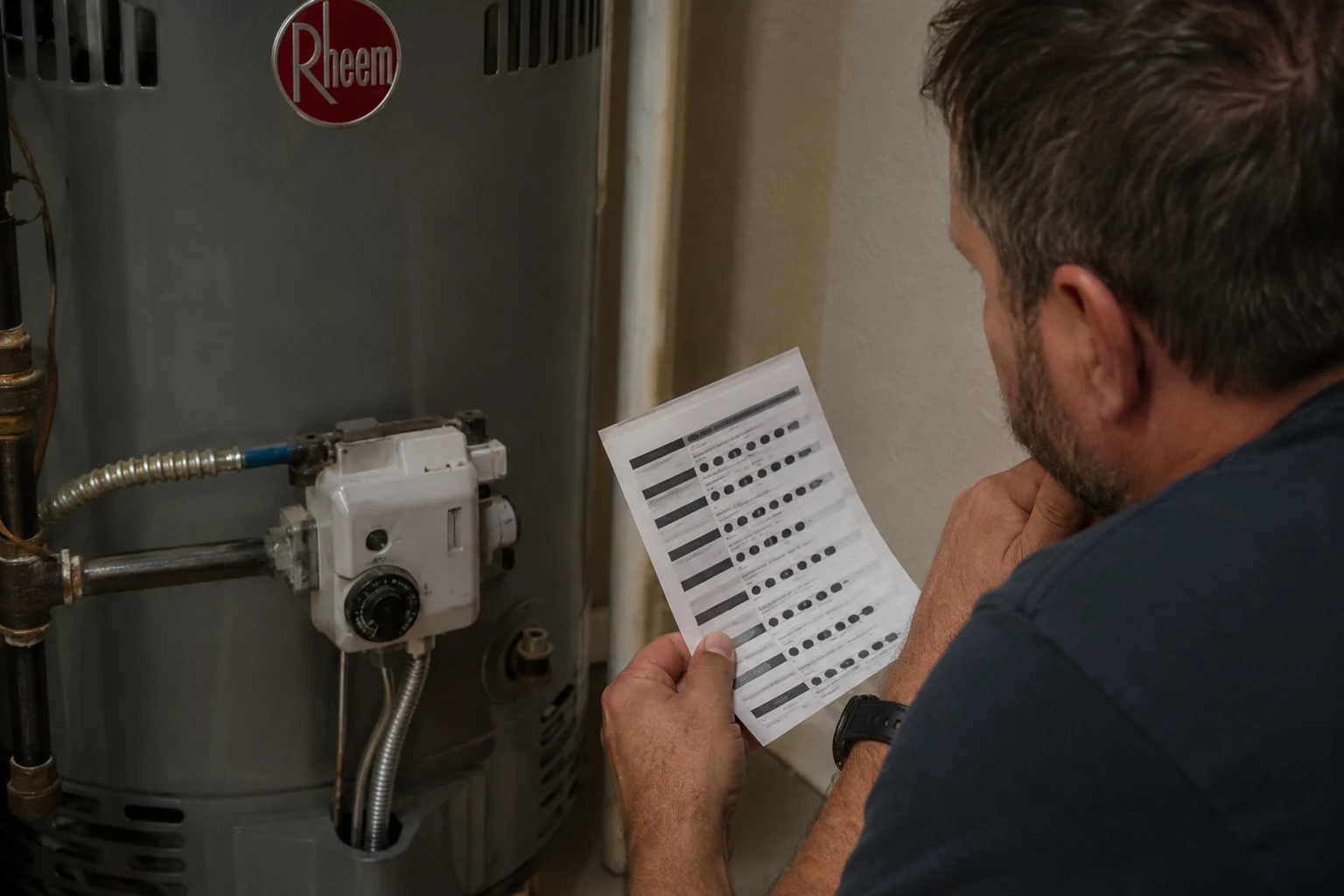
The small diagnostic LED on the gas control valve at the base of a Rheem gas water heater. It reports the heater's state by flash count: one slow flash every three seconds is normal operation, and bursts of two or more quick flashes separated by a roughly three-second pause are fault codes that route to a specific part, from the thermopile at two flashes up to the gas control valve at seven. On Guardian FV-sensor models the light color adds a second track, red for the gas-valve diagnostics and blue for a flammable-vapor lockout. Because Richmond and GE-branded gas heaters are Rheem-built and share the same valve, the same chart applies, though you should always confirm against the label on the heater in front of you.
The general reset, and where the DIY line sits
The soft reset is the same for most of these codes and it is worth doing exactly once before you spend money. On a gas model, turn the gas control knob to OFF, wait three to five minutes for the valve and water to cool, then relight the pilot per the burner-door instructions and return the knob to its setting. On a power-vent or electronic model, cutting power at the switch or breaker for the same few minutes does the same thing. People go looking for a red ECO reset button and get confused when a gas Rheem does not have one; on gas models the high-temperature sensor is integral to the valve, so the knob cycle is the reset. Electric models are the ones with the physical red button behind the access panel.
Where you stop depends on the count. The two-flash thermopile job is squarely homeowner work: a screwdriver, a wrench, a multimeter, and a cheap part. The four-flash code starts as homeowner work, backing off the temperature and flushing sediment, and only becomes a pro job if it returns on a clean tank at a sane setting. Five and seven flashes are the valve, and replacing a gas control valve means draining the tank and disconnecting gas, which is where most people bring in a licensed plumber. Before any valve purchase, check the warranty against the rating label, because a covered valve turns a part-plus-labor bill into labor only.
Red versus blue, and Richmond or GE units
Two things trip people up on this heater. First, color. On Guardian flammable-vapor-resistant models the status light runs two tracks. Red flashes are the gas-valve diagnostics in the table above. A blue light going into lockout is a different message entirely: the flammable-vapor sensor tripped, which means it detected combustible fumes near the heater, gasoline, paint thinner, or solvent stored too close. That is not a valve fault, it is a hazard to clear by ventilating the space and removing the source before you reset. Do not chase the red chart for a blue lockout.
Second, rebrands. Richmond water heaters and many GE-branded gas heaters are manufactured by Rheem and use the same gas control valves, so the red flash chart reads the same. What can shift is the exact label wording, the behavior of the uncommon six-flash state, and small production-year valve changes. The safe habit on any Richmond or GE unit is to count the flashes, then confirm the meaning against the chart printed on that heater's own burner door. If the door label and a generic table disagree, the appliance in front of you wins. From here, each fault count has its own page that walks the full test-and-fix path, so once you have your count, follow it to the code that matches.
Frequently asked
What does a blinking light on my Rheem water heater mean?
The green or red status light low on the gas control valve is a diagnostic readout, and the number of flashes in each burst is the code. One flash every three seconds is the normal heartbeat: the pilot is lit and the valve is happy. Anything more than one flash is a fault. Two flashes is low thermopile voltage, four is a high-temperature shutdown, five is a temperature-sensor failure, and seven is a gas control valve fault. The valve pauses about three seconds between bursts so you can count the flashes in each one. So the first thing to do is not panic and not reset blindly, but watch one full cycle, count the flashes, and match the count to the chart printed on your burner door or in the table on this page. The count tells you which part to chase before you touch anything.
How do I read Rheem flash codes?
Stand where you can see the small status light on the gas control valve near the base of the tank, then watch it through at least two full cycles. Count the quick flashes in one burst, wait for the roughly three-second pause, and confirm you get the same count on the next burst. That count is the code. Do not count across the pause, and do not count the pause itself. If the light does a single slow flash every three seconds with no rapid burst, that is normal operation, not a fault. Rapid multi-flash bursts separated by pauses are the fault codes. Write the number down before you reset, because a power cycle clears the display and you lose the code you were trying to read. On red-and-blue Guardian models, note the color too: red is the gas-valve diagnostics, blue is the flammable-vapor sensor track.
Which Rheem flash count is normal?
One flash every three seconds is normal. That single, steady, evenly spaced blink means the pilot is lit, the thermopile is generating healthy voltage, and the gas control valve sees no fault. People often mistake this heartbeat for a warning and start resetting the heater, which does nothing because nothing is wrong. The tell is the rhythm: normal is one flash, a long pause, one flash, a long pause, steady and unhurried. A fault is a burst of two or more quick flashes, then a pause, then the same burst again. If you are seeing exactly one flash per cycle and still have no hot water, the problem is elsewhere, the thermostat setting, a tripped house breaker on a power-vent model, or a plumbing crossover, not a code.
How do I reset my Rheem water heater?
For a soft reset on a gas model, turn the gas control knob to OFF, wait three to five minutes for the valve and water to cool, then relight the pilot following the lighting instructions printed on the burner door and turn the knob back to your setting. On a power-vent or electronic model you can also cut power at the switch or breaker for the same few minutes. That clears a one-time fault. What resetting does not do is fix a cause. If the same flash count returns after a clean reset, the fault is real and repeating, and forcing more resets on a high-temperature or gas-valve code is the wrong move because those are safety conditions. Reset once to confirm a repair worked, not as the repair itself. There is usually no red ECO button on a gas Rheem the way there is on an electric model; the knob cycle is your reset.
What does 7 flashes mean on a Rheem water heater?
Seven flashes is a gas control valve fault: the valve is reporting an internal failure and that it can no longer operate safely. Unlike the two-flash thermopile code or the four-flash over-temperature code, seven flashes rarely clears with a reset or a cheap part. It almost always means the gas control valve assembly gets replaced. Before you buy one, pull the model and serial number off the rating label and check the warranty, because the gas control valve is a covered part on most Rheem gas heaters for several years, which turns a two-hundred-dollar part into a labor-only job. Because replacing a gas valve means draining the tank and disconnecting gas, seven flashes is the code where most homeowners hand it to a licensed plumber rather than doing it themselves.
Is a blinking Rheem status light dangerous?
The blinking itself is the safety system doing its job, reporting a condition rather than hiding it. Some codes are benign to diagnose, like the two-flash thermopile code, which just means the burner will not fire until you restore voltage. Others are genuine safety trips. Four flashes is a high-temperature shutdown, the valve cutting the burner because the water got too hot, and that is not a code to defeat or keep resetting. A blue lockout on a Guardian model means the flammable-vapor sensor tripped, which points at gasoline or solvent fumes near the heater, a real hazard you address by ventilating and removing the source. The dangerous move is never the blinking light; it is bypassing a sensor or jumpering a safety to force the burner to run through a warning. If a high-temp or gas-valve code keeps returning, shut the gas off and get a tech.
Are Richmond and GE water heater flash codes the same as Rheem?
Mostly yes, because Richmond and many GE-branded gas water heaters are built by Rheem and use the same gas control valves, so the red status-light chart reads the same: one flash normal, two thermopile, four high-temp, five sensor, seven gas valve. What can differ is the exact wording on the label, the behavior of the less-common six-flash or out-of-sequence state, and small production-year changes to the valve. So on a Richmond or GE unit, count the flashes and then confirm the meaning against the chart printed on that heater's own burner door, not just against a Rheem table. If the two disagree, trust the label on the appliance in front of you.