A Rheem gas water heater that flashes its status light twice, pauses about three seconds, then flashes twice again is telling you one specific thing: the gas control valve is not seeing enough voltage from the thermopile to safely open the burner. That is the cheapest fault on the whole Rheem chart. It almost never means a dead gas valve. It usually means a pilot flame that got weak or dirty, or a thermopile that has aged past the point where it can push the millivolts the valve needs. This page explains what the thermopile does, why its voltage sags, how to put a meter on it, and when to clean versus replace.
Where 2 flashes points on a Rheem
On the Rheem and Ruud gas-valve status chart, one slow flash every three seconds is the normal heartbeat and everything above one flash is a fault. Two flashes is the low end: low thermopile voltage. Four flashes is a high-temperature shutdown, five is a temperature-sensor failure, and seven is the gas control valve itself failing. So two flashes is good news relative to the rest of the list. You are chasing a few dollars of pilot cleaning or a sub-fifty-dollar part, not a valve replacement.
Weak or dirty pilot flame
The pilot is lit but small, yellow, or not wrapping the thermopile tip, so the thermopile never gets hot enough to make full voltage. A clogged pilot orifice starving the gas is the usual reason. Cleaning fixes most of these for the price of compressed air.
Loose or corroded leads
The two thermopile wires land on the gas valve. If a terminal is loose or corroded, the thermopile can make good voltage that never reaches the valve. This one is free to fix: power down, reseat the leads, clean the contacts, and retest.
Worn-out thermopile
After years of heat cycling, a thermopile loses output and cannot hit the valve's holding threshold even with a perfect pilot flame. A meter reading low open-circuit voltage confirms it. Swap the thermopile or pilot assembly, roughly twenty to fifty dollars.
Quick answer
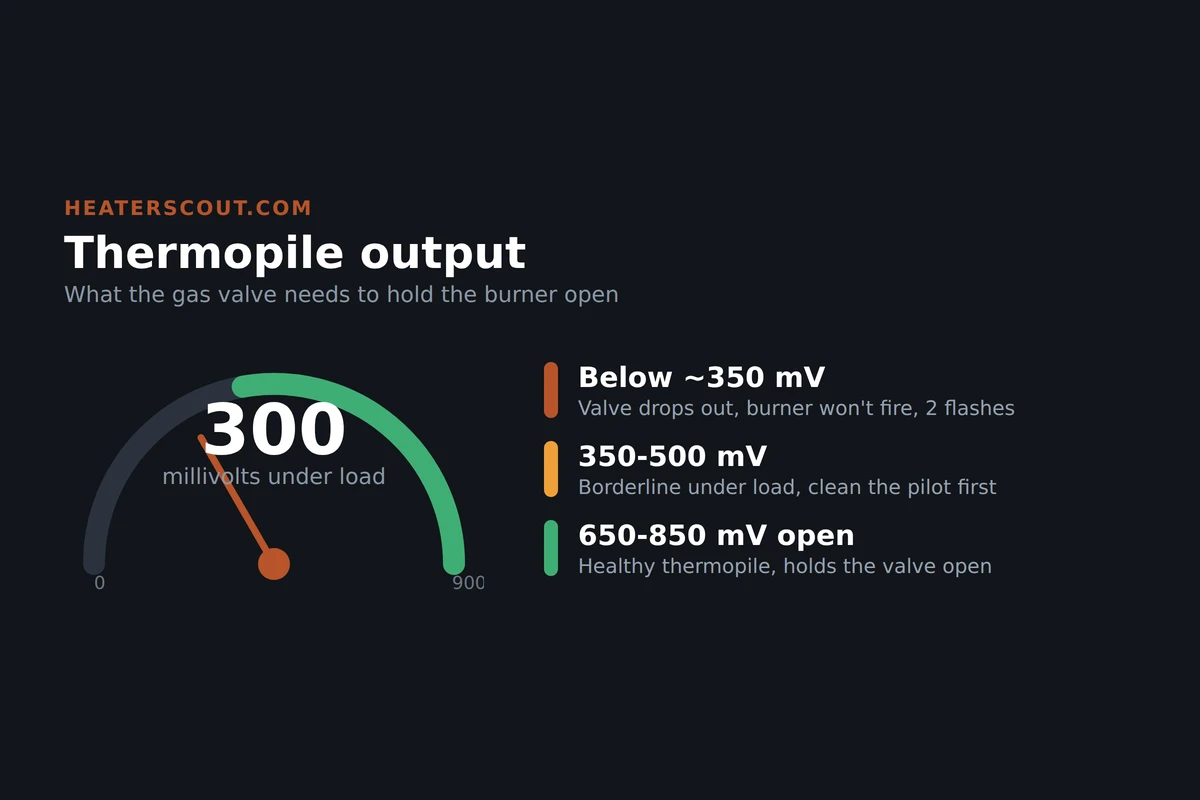
Two flashes on a Rheem or Ruud gas water heater means low thermopile voltage. The pilot-heated thermopile is not making enough millivolts for the gas control valve to hold the burner open. Fix order, cheapest first: confirm a strong blue pilot flame, clean the pilot and its orifice, reseat the thermopile leads at the valve, then test with a multimeter on DC millivolts. A healthy thermopile reads about 650 to 850 mV open-circuit and 350 to 500 mV under load. If it reads low with a clean flame, replace the thermopile, about $20 to $50. It is a DIY-friendly repair.
What the thermopile actually is
The thermopile is the two-wire probe sitting in the pilot flame at the bottom of the tank. It is a stack of thermocouples wired in series. A single thermocouple makes only about 25 to 30 millivolts when the pilot heats it, barely enough to hold a simple pilot safety valve. Bundle a couple dozen of those junctions together and the voltage adds up to roughly 500 to 900 millivolts, which is enough to run an entire millivolt gas valve, its safety logic, and the little status light, all off the heat of the pilot flame with no house wiring involved. That is the elegant part of a standing-pilot Rheem: the flame powers its own controls.
It is also the vulnerable part. The valve is designed to open the main burner only when it reads enough millivolts to prove the pilot is truly lit. That is a safety feature: no flame means no voltage means the gas stays off. So anything that cools or dirties the pilot, or wears the thermopile, drags the voltage down toward the threshold, and the moment it sags below what the valve needs to hold its coil, the burner drops out and the light throws two flashes.
Key takeaways
- Two flashes = low thermopile voltage, the cheapest fault on the Rheem status chart, not a valve failure.
- Cause order: weak or dirty pilot flame, dirty pilot orifice, loose or corroded leads, then a worn thermopile.
- Test on DC millivolts: healthy is about 650-850 mV open-circuit and 350-500 mV under load.
- Below roughly 350 mV under load the valve drops out; below about 400 mV open-circuit the thermopile is dead.
- Clean and reseat before you buy anything. The replacement part is only about $20 to $50 and DIY-friendly.
Why the voltage sags
Walk the causes in order of likelihood, because that order also happens to run cheapest to most expensive. The single most common reason is a weak pilot flame. A healthy pilot is a firm blue flame that fully engulfs the tip of the thermopile. If it is small, lazy, yellow-tipped, or lifting off, the thermopile never reaches full operating temperature and the voltage stays low. Nine times out of ten the flame is weak because the pilot orifice is partially clogged with dust, soot, or spider webbing, which is a real hazard in gas water heaters. Clean the orifice with compressed air or a soft brush. Never poke it with a wire or a drill bit, because opening up the orifice changes the gas flow and can make the flame worse or unsafe.
Second is the wiring. The thermopile lands on the gas valve with two leads. A loose spade terminal or corrosion at the valve means the thermopile can be generating perfectly good voltage that never arrives where it is needed. This is the free fix: shut the gas off, pull and reseat the leads, scrape any corrosion off the contacts, and make sure they are snug. Third, and only after the first two are ruled out, is a worn thermopile. Thermopiles age. Years of heating and cooling degrade the junctions until the part simply cannot make its rated voltage anymore, and no amount of cleaning brings it back. The meter is how you separate a worn thermopile from a dirty flame or a bad connection.
Testing with a multimeter
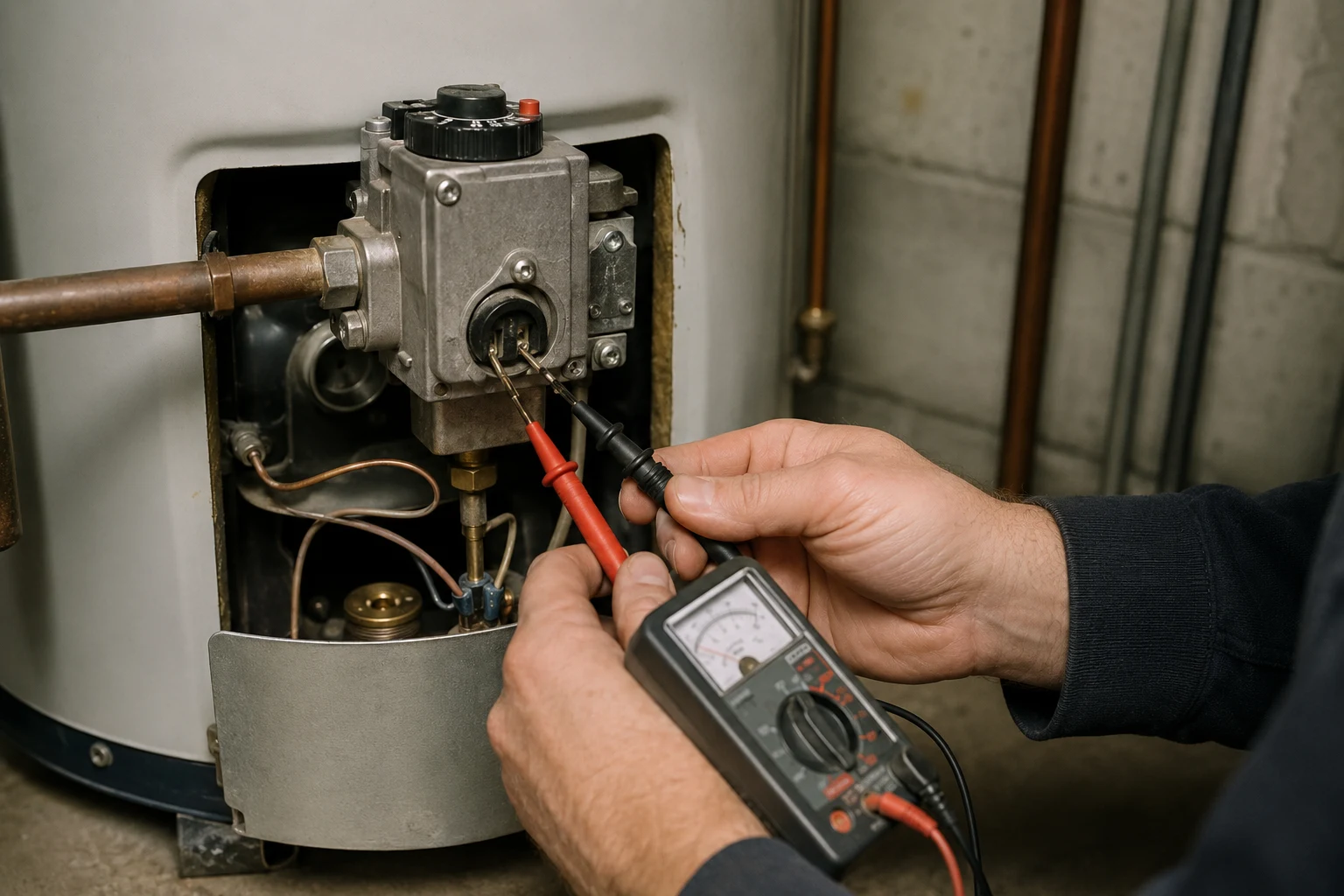
You need a multimeter that reads DC millivolts. There are two measurements, and taking both is what tells you which part is at fault rather than guessing. Give the pilot a full minute to bring the thermopile up to temperature before you read anything, because a cold thermopile reads low even when it is fine.
| Open circuit, healthy | About 650 to 850 mV (some units 500 to 750) with the pilot heating it |
| Open circuit, worn out | Below about 400 mV means replace, cleaning will not recover it |
| Under load, healthy | Drops to about 350 to 500 mV with the valve connected and calling |
| Under load, too low | Below about 350 mV and the valve cannot hold the burner, 2 flashes |
| Meter setting | DC millivolts (mV DC), leads on the thermopile terminals at the gas valve |
| Warm-up time | Let the pilot heat the thermopile ~60 seconds before trusting the number |
Read it like this. Good open-circuit voltage that collapses when the valve is connected points at a connection problem or a thermopile that is only marginal, because it can make voltage but cannot deliver current under load. Low open-circuit voltage points straight at the thermopile itself. And if the open-circuit number is healthy and the under-load number is healthy but the burner still will not stay lit, look harder at the pilot flame and the leads before you condemn the gas valve.
- Confirm the pilot is lit and burning a firm blue flame that wraps the thermopile tip.
- Compressed air or a soft brush on the pilot and orifice, no wires or drill bits.
- Shut the gas off, pull and reseat the two thermopile leads, clean any corrosion.
- Set the multimeter to DC millivolts and read open circuit after a 60-second warm-up.
- Read under load with the valve connected and a call for heat; expect 350 to 500 mV.
- Replace the thermopile or pilot assembly if voltage is low with a clean, strong flame.
- Relight the pilot, then watch for the normal 1-flash-every-3-seconds heartbeat to return.
Clean versus replace, and what the part costs
The decision is simple once you have a meter reading. If the pilot flame was weak and cleaning the orifice brings back a strong blue flame and healthy voltage, you are done and you spent nothing. If the flame is strong and the leads are tight but the open-circuit voltage still reads low, the thermopile is worn out and cleaning cannot save it. Replace it. On modern Rheem gas valves that means a two-wire thermopile or a full pilot assembly, not the old screw-in thermocouple. PROTECH and Rheem pilot assembly kits, the SP20799 and SP21058 families, run roughly twenty to fifty dollars and typically include the thermopile, pilot, igniter, and gaskets so you rebuild the whole pilot bracket at once. A bare thermocouple is cheaper at about ten dollars, but it is the wrong part for a status-light Rheem that runs on a thermopile, so match the part to your valve.
Before you buy anything, pull the model and serial number off the rating label and check the warranty. The pilot and thermopile assembly is a covered part on many Rheem gas heaters for several years, which can turn a paid part into a free one. This whole repair stays on the do-it-yourself side of the line: it is hand tools, a meter, and a cheap part, with no draining the tank and no disconnecting the main gas line the way a seven-flash valve job requires. The only reasons to hand it to a licensed plumber are if you smell gas, cannot get the pilot to light at all, or find the gas control valve itself damaged.
Keeping it from coming back
Most repeat two-flash codes trace to the pilot environment, not the parts. Keep the area around the base of the heater clean and clear of dust, lint, and anything that can be pulled into the burner compartment, because that debris is what clogs the pilot orifice in the first place. On sealed-combustion and flammable-vapor-resistant models, keep the arrestor screen at the bottom clean so the pilot gets the air it needs to burn a strong blue flame. Watch for drafts: a heater in a windy utility closet or near a return-air grille can have its pilot chilled or disturbed enough to drop the thermopile voltage. And if you live where the gas supply pressure sags in cold snaps, a marginal pilot that was fine in summer can start throwing two flashes in January. Fix the pilot environment and the thermopile lasts its full life. Once your under-load reading sits comfortably above 350 millivolts on a clean flame, the light goes back to its single steady heartbeat and stays there.
Frequently asked
What does 2 flashes mean on my Rheem water heater?
Two flashes on the status light of a Rheem or Ruud gas water heater means low thermopile voltage. The thermopile is the sensor the pilot flame heats to make a small DC voltage, and that voltage is what tells the gas control valve it is safe to open the main burner. When the valve does not see enough millivolts, it refuses to fire and reports the shortfall as two quick flashes, a pause, then two flashes again. It is the friendliest code on the Rheem chart because it usually traces to a weak or dirty pilot flame or a tired thermopile, both cheap to fix. It is not a gas-valve failure, which is seven flashes, and it is not a high-temperature trip, which is four. So before you spend anything, confirm the pilot is lit and burning a strong blue flame that wraps the thermopile tip.
Can I fix a 2-flash thermopile code myself?
Usually yes. This is squarely homeowner work if you are comfortable relighting a pilot. The whole job is hand tools, a flashlight, and a multimeter that reads DC millivolts. Start by cleaning: a soft brush or compressed air on the pilot and pilot orifice, and reseating the two thermopile leads at the gas valve after checking them for corrosion. If the pilot then burns a strong blue flame and the code clears, you are done for a few dollars. If it comes back, test the thermopile voltage and, if it reads low even with a clean flame, swap the thermopile or pilot assembly, a part that runs about twenty to fifty dollars. The one time to stop and call a pro is if you smell gas, cannot get the pilot to light at all, or the gas control valve itself looks damaged.
How do I test the thermopile with a multimeter?
Set a multimeter to DC millivolts. There are two readings that matter. Open circuit means the thermopile is disconnected from the valve while the pilot heats it, and a healthy one reads roughly 650 to 850 millivolts after about a minute of heating. Under load means it is connected to the valve with the burner calling for heat, and the voltage sags, normally into the 350 to 500 millivolt range. The valve needs enough millivolts to hold its coil open, so if the under-load reading falls below about 350 the burner drops out and you get two flashes. An open-circuit reading below about 400 millivolts means the thermopile is worn out and cleaning will not save it. Give the pilot a full minute to bring the thermopile up to temperature before you trust the number.
How much does it cost to fix a Rheem 2-flash code?
Almost nothing if it is just a dirty pilot: a can of compressed air and ten minutes. If the thermopile is worn out, a Rheem or PROTECH pilot-thermopile assembly kit runs about twenty to fifty dollars, and the part numbers most people end up with are the SP20799 or SP21058 style kits that include the thermopile, pilot, and gaskets. A bare thermocouple is cheaper, around ten dollars, but modern Rheem gas valves use a two-wire thermopile rather than a screw-in thermocouple, so match the part to your valve. If you hire a plumber, expect a service call plus labor on top of the part, which is why this is a popular do-it-yourself repair. Check your warranty first, because the pilot assembly is a covered part on many Rheem gas heaters for several years.
Why does the 2-flash code keep coming back?
A code that returns after you cleaned everything is usually one of three things. First, the pilot orifice is still partially clogged, so the flame looks lit but is too weak to keep the thermopile hot, and it needs a real cleaning or a new orifice sized for your gas type. Second, a lead is loose or corroded at the gas valve, so voltage is being made but not delivered, which a meter at the valve terminals will show. Third, the thermopile is simply worn out and cannot make the voltage anymore no matter how clean the flame is. Test open-circuit and under-load millivolts to tell these apart: good open-circuit voltage that collapses under load points at a connection or a marginal thermopile, while low open-circuit voltage points at the thermopile itself. Drafts near the heater and a poor gas supply can also chill or starve the pilot, so rule those out too.
Is a 2-flash thermopile code dangerous?
The condition itself is benign to diagnose. Two flashes just means the burner will not fire until you restore voltage, so the worst outcome of ignoring it is no hot water, not a safety hazard. The gas valve is doing exactly what it should by refusing to open a burner it cannot power reliably. That said, the work around it involves gas and an open flame, so treat the usual rules seriously: if you smell gas at any point, stop, shut the gas off, ventilate, and do not create a spark. Never bypass or jumper the thermopile to force the valve open, because that defeats the flame-proving safety that keeps gas from flowing when the pilot is out. Clean, test, and replace the part the way it was designed, and the repair is safe.
What is the difference between a thermopile and a thermocouple?
Both turn pilot heat into voltage, but a thermocouple is a single junction that makes only about 25 to 30 millivolts, just enough to hold a simple pilot safety valve open. A thermopile is a bundle of many thermocouples wired in series, so it stacks that voltage up to roughly 500 to 900 millivolts, which is enough to power a full millivolt gas valve and its small control electronics without any house wiring. That is why Rheem gas heaters with a status light use a thermopile: the light and the valve logic run off the pilot flame itself. Practically, it means the two-wire part on your gas valve is a thermopile, not a screw-in thermocouple, so buy the matching thermopile or pilot assembly when you replace it.
Do I need to reset the heater after fixing the thermopile?
Cycling the pilot is the reset. On a gas Rheem, turn the gas control knob to OFF, wait three to five minutes, then relight the pilot following the instructions printed on the burner door and turn the knob back to your temperature setting. Once the pilot is heating a healthy thermopile again, the status light should return to the normal one-flash-every-three-seconds heartbeat and the two-flash code clears on its own. There is no separate red reset button on a gas model, which trips people up: the red ECO button lives on electric water heaters. If you relight and still get two flashes with a strong pilot flame, the thermopile or a lead is the problem, not the reset.