A Rheem pilot that will not light or will not stay lit is almost always one of five things, and you can walk them in fifteen minutes on any Performance Plus, XR series, or Fury tank. The gas valve is a Honeywell WV8840 on newer builds or a Robertshaw valve on some older ones, and the status LED on that valve is your first clue. A solid green light means the pilot is lit and the thermopile is healthy. Blink counts are fault codes, but the exact meaning of a given count varies by valve generation, so read the legend printed on your own valve rather than a generic chart. Two flashes points at a weak thermopile and seven at a gas valve failure on the builds where that holds. One code you must never keep resetting is a high-temperature or over-temp lockout, because that signals a real overheat. Read the LED, then work gas, spark, and thermopile in that order. Nine calls out of ten end on a twenty-dollar thermopile, not the whole gas valve.
A high-temp code that keeps coming back
The pilot lights but the LED throws a high-temperature or over-temp (ECO) code, and clearing it only buys a little time before it trips again. That is a real overheat, not a nuisance. Back the setpoint to 120 F, flush sediment, check the temp probe, and stop resetting it if it returns.
Slow pilot dropout on an aging heater
The heater is out of warranty, the pilot lights and burns strong, but ten or twenty seconds after you release the knob it goes out. Every time. That is a tired thermopile making less than about 400 mV under load. Meter it, then swap in a 750-mV replacement. Half an hour of work, no plumber.
New Rheem will not fire at all
The tank was set yesterday and the pilot has never lit. On propane, the tank valve may be closed or the line has never been purged. If it was converted between fuels, check the pilot orifice: it is model-specific, so match the old orifice or the parts list. A missed orifice swap is the classic no-light on day one.
Sits for a season, then quits
The heater ran fine, sat unused for a few months in a detached garage or shop, and now the pilot will not light no matter how long you click the ignitor. Suspect a spider web in the pilot tubing. Shut the gas, disconnect the pilot tube at the valve, blow it clear with compressed air.
Before you buy anything: the fast checklist
Most Rheem no-light calls end on this list. Work top to bottom before you pull the burner assembly, meter the thermopile, or price a gas valve. The three-dollar fixes stack, and skipping them is how people end up replacing a $200 valve when a spider web was the actual cause.
- The gas is on at the shutoff behind the heater, and on propane the tank has fuel and its service valve is open.
- The LP tank is not empty. On a propane Rheem this is the number-one first-time-installer miss.
- The status LED is not throwing a high-temperature or over-temp code, which you must diagnose rather than repeatedly reset.
- The viewport lens is clean enough to actually see the pilot, since a soot film hides a small yellow flame that would explain the whole problem.
- The gas control knob is turned to PILOT and pushed all the way down while you click the piezo ignitor, not left on ON.
- The thermopile wire is fully seated on the black insulated terminal at the gas valve, hand tight then a quarter turn with a wrench.
- The pilot tubing is not kinked or crushed where it meets the gas valve, and no spider web is visible at either end.
- The status LED count matches what the burner-door legend says for your exact model year, since Rheem has updated the chart across build years.
Diagnosis: read the LED, then chase the fault
The Rheem status LED is a real diagnostic, not just a power light. Rheem shipped a blink chart on the burner door that tells you which subsystem is complaining, and if you count the flashes first you skip an hour of guessing. Every blink count except a solid green routes to a specific test and a specific part. Do not force a relight through a code, since some of these are safety trips.
Count the LED flashes, then read your own legend
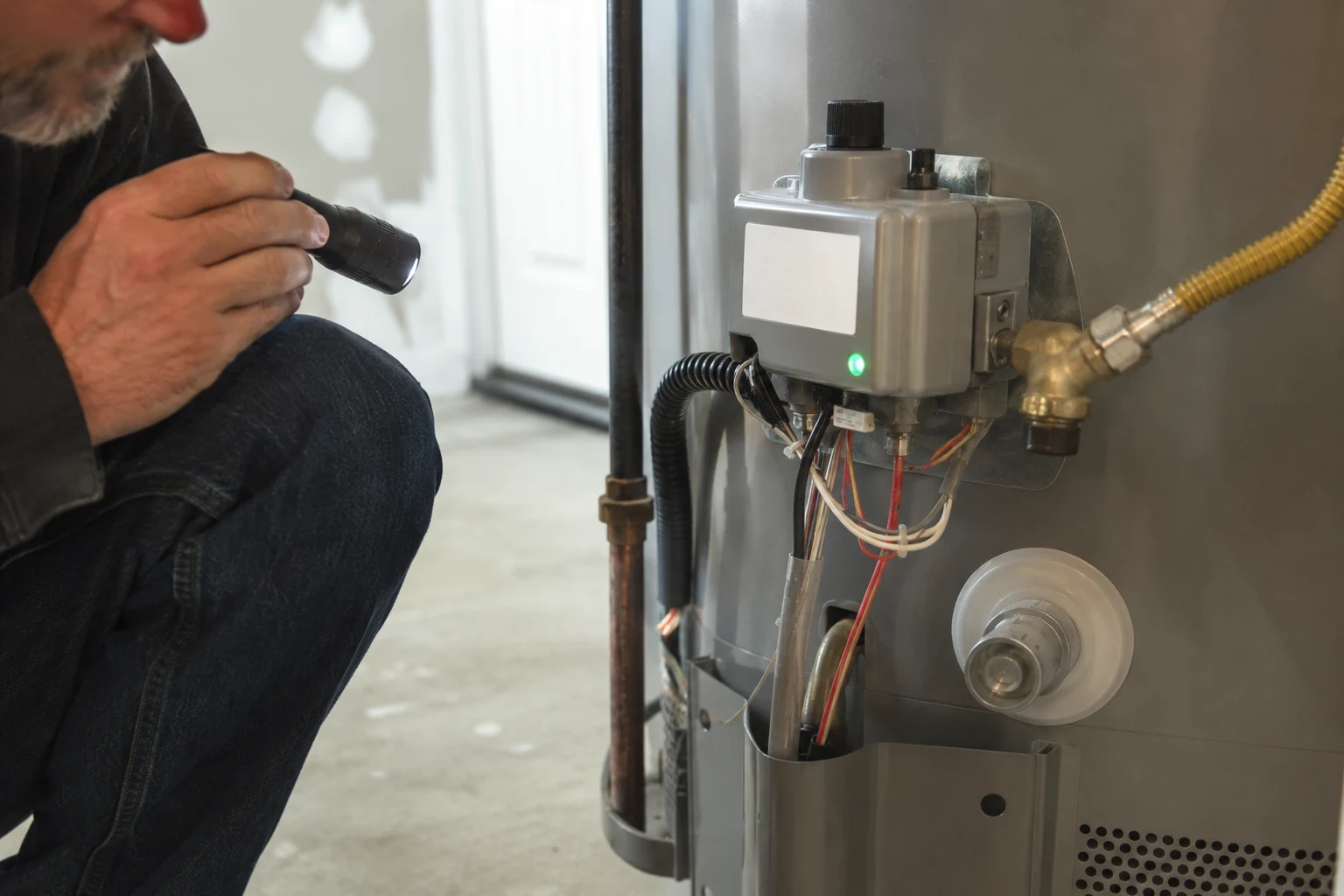
Kneel down to the front of the tank and watch the small status LED on the gas control valve. Solid green means the valve thinks everything is fine, so the fault is elsewhere. Beyond that, the meaning of a given blink count varies by valve generation, so match the count against the legend printed on your own gas valve or under the jacket, not a generic online chart. Two flashes points at a weak thermopile and seven at a gas valve failure on the builds where that holds. Note the count before you touch anything, because a knob cycle will clear the display and lose your code.
Never keep resetting an over-temp code
If your valve's legend identifies the code as a high-temperature or over-temp (ECO) lockout, do not just clear it and relight. That code means the water actually got hotter than the valve allows, and it is a safety, not a nuisance. Back the setpoint to 120 F, flush the tank if sediment is likely, and test the temperature-sensor probe. If the code returns after you clear it, stop and call for service rather than overriding the overheat again.
On propane, confirm actual gas
For an LP Rheem, before you meter anything, check the tank gauge. An empty LP tank produces the same no-light symptom as a dead thermopile, and about a third of propane calls end here. Open the service valve, then set the knob to PILOT, hold it down, and click the ignitor for 60 to 90 seconds while air purges out of a newly opened line. Real gas will not reach the pilot orifice on a fresh line until you do.
Check the pilot tubing for a web
In a storage garage or shop, spider webs inside the pilot tubing are the single most common no-light cause on a heater that sat unused. Shut off the gas, disconnect the small pilot tube at the gas valve, and blow it clear with a can of compressed air aimed into the valve end. Reconnect finger-tight plus a quarter turn, then try to light again. This is a five-minute fix people miss.
Watch the pilot flame shape
Once you get it lit, look through the viewport. The flame should be a firm blue cone about an inch tall that fully wraps the tip of the thermopile probe. A small, yellow, lazy, or lifting flame is a starved or clogged pilot orifice, or the wrong orifice for the fuel. The pilot orifice is model-specific, so match the number stamped on the old orifice or the parts list. A weak flame will not heat the thermopile enough to make holding voltage.
Meter the thermopile under load
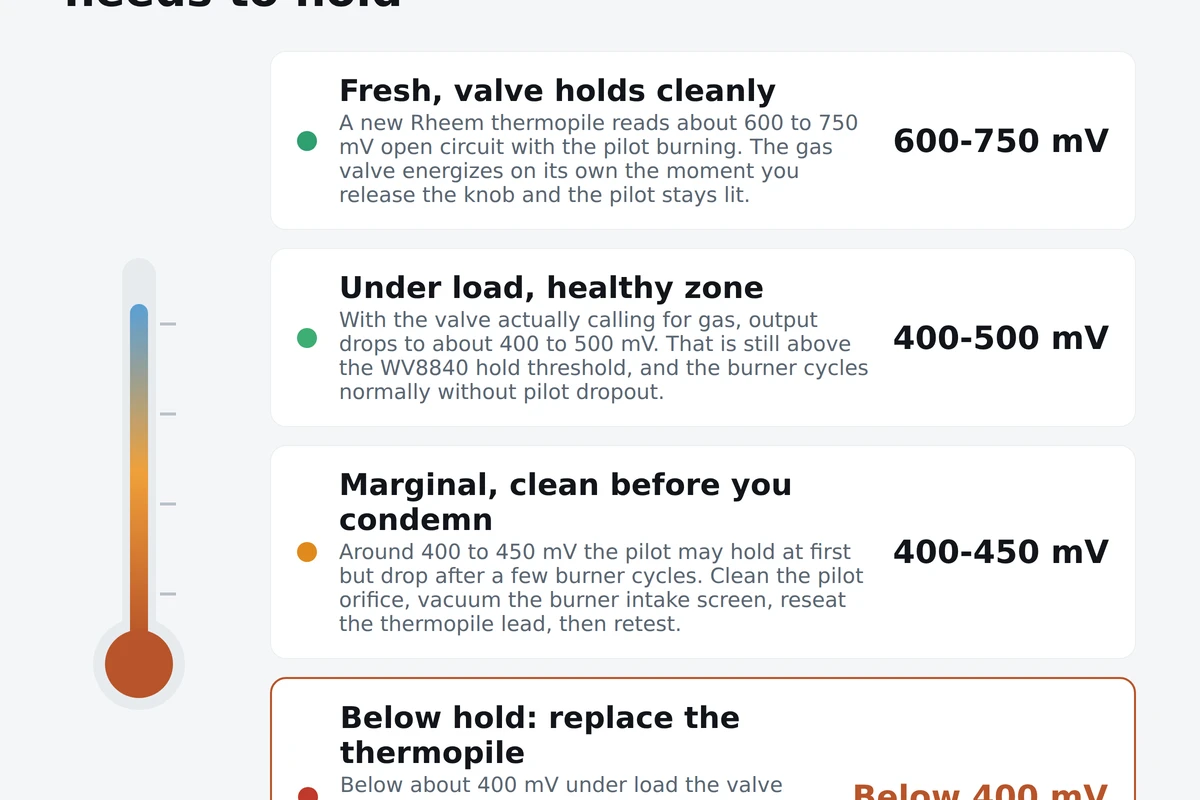
With the pilot lit, set a multimeter to mV DC. Put the red probe on the black insulated wire terminal at the gas valve, black probe on the gas valve body. Open circuit, with the knob on PILOT, expect about 600 to 750 mV. Then have a helper turn the knob to ON so the valve energizes, and read again. Under load, healthy is about 400 to 500 mV. Below about 400 mV under load the valve stops holding, so replace the thermopile.
The Rheem lighting procedure, done to the manual
Most failed relights on a Rheem are a procedure problem, not a broken part. The single thing owners skip is holding the knob down long enough for the thermopile to actually heat. Skip that and the pilot will die on release even on a brand-new thermopile. Follow the sequence Rheem prints on the burner door.
Quick answer
A Rheem pilot that goes out about 30 seconds after you release the knob is telling you the thermopile can no longer make holding voltage under load. The pilot itself is fine while you hold the knob down manually. The moment you let go, the gas valve depends on the thermopile for millivolts. A tired one starts near 600 mV, sags as the valve draws current, drops below about 400 mV within a minute, and the valve closes. Meter it under load with the knob on ON. Below about 400 mV means replace it, roughly a twenty-dollar Honeywell 750-mV thermopile and thirty minutes of work.
Reading the Rheem status LED blink codes
Count the flashes in one burst, wait for the pause, and confirm the same count on the next burst before you order anything. The important thing to know is that the meaning of a given blink count is not universal: Rheem has revised the legend across valve generations and across builds of the Performance Plus, XR series, and Fury lines. So the legend printed on your own gas valve or under the jacket is the final word, not any generic chart. A couple of counts are confirmed across builds, and one class of code you must treat as a genuine safety trip.
| Solid green | Normal operation. Pilot lit, thermopile above hold voltage, valve energized. Not a fault. If the burner still will not fire, the issue is upstream of the valve, at the thermostat or the water side. |
| 2 flashes | Low or weak thermopile, confirmed across builds. Meter across the black terminal and the valve body, under load. Below about 400 mV, replace the thermopile. Right around 400 mV, clean the pilot orifice and burner intake screen first. |
| 7 flashes | Gas valve failure, confirmed across builds. Internal fault in the gas valve itself. Rarely clears with a reset. Confirm with a call to Rheem tech support using the full model and serial, then replace the valve assembly. |
| High-temp / over-temp (ECO) | If your valve's legend identifies the code as a high-temperature or over-temp lockout, do not keep resetting it. That is a real overheat. Back the setpoint to 120 F, flush sediment, test the temperature-sensor probe, and call for service if it returns. |
| Any other count | The meaning varies by valve generation, so match it against the legend printed on your own gas valve or under the jacket rather than a generic online chart. Do not force a relight through a code you have not identified, since some are safety trips. |
One last habit that saves grief on a Rheem. The whole platform is shared: Ruud is Rheem, Richmond is Rheem, and Gladiator and Vanguard on the same OEM. The gas valve, the thermopile, and the pilot orifice are the same parts across those badges. So a Ruud-branded or Richmond-branded thermopile from the plumbing supply on the way home will fit your Rheem. What is not shared or universal is the burner-door label, which carries the flash legend and the pilot-lighting sequence for your specific build year, and that is the label you match to when the count on the LED and a generic chart online ever disagree. The appliance in front of you always wins.
Frequently asked
What do the status LED blink codes mean on a Rheem water heater?
The blink-count meanings are not universal across Rheem gas valves, so the honest answer is to read the legend printed on your own gas valve or under the jacket rather than trust a generic chart off the internet. Rheem has revised the code chart across build years and valve generations, and the same flash count can mean different things on different valves. Two confirmed across builds are two flashes for a low or weak thermopile and seven flashes for a gas valve failure. One code you must take seriously is a high-temperature or over-temp (ECO) lockout: that is a real overheat condition, not a nuisance trip, and you must not keep resetting it. Find your model's legend, match the count, and if it points to over-temp, stop and diagnose the overheat before doing anything else.
Where is the thermopile on a Rheem water heater?
The thermopile is the fatter of the two wires running from the pilot assembly back to the gas control valve on the front of the tank. It looks like a stubby brass or copper probe about the diameter of a pencil, sitting inside the pilot hood so the pilot flame licks the tip. Its lead is the one that lands on the insulated terminal at the gas valve, usually black, held by a small nut you can turn with a quarter-inch wrench. Do not confuse it with the ignitor wire, which is thin white with a spade end, or the thermocouple on older units, which is a slim single-lead sensor that makes only about 25 to 30 mV. On a modern Rheem Fury or XR tank the thermopile is the one that carries the whole gas valve, not just the pilot safety.
What voltage should a healthy Rheem thermopile read?
A fresh Rheem thermopile with the pilot burning should read about 600 to 750 mV open circuit and about 400 to 500 mV under load. Open circuit means the meter is across the black wire terminal at the gas valve and the valve body, with the valve knob on PILOT so the burner is not calling. Under load means the meter stays there while the valve is actually trying to energize, either because you turned the knob to ON and the tank called for heat, or because a helper is completing that circuit. If the under-load reading falls below about 400 mV the valve stops holding, so the thermopile is worn and needs to be replaced. Right around 400 mV is marginal, and a good cleaning of the pilot orifice and the burner intake screen often brings it back for another year or two.
Can I use a Honeywell thermopile on a Rheem water heater?
For most modern Rheem gas tanks with the Honeywell WV8840 gas valve, yes, a Honeywell-branded universal thermopile in the 750-mV class is the correct replacement. Rheem does not manufacture the thermopile itself, and the WV8840 is a Honeywell valve, so the OEM part and a Honeywell universal are the same hardware with different labels. If your Rheem uses a Robertshaw gas valve, which appears on some older Performance Plus builds, match to a Robertshaw-compatible thermopile with the same terminal style. The two things that matter are the millivolt class, 750 mV for these valves, and the physical length so the probe sits properly in the pilot flame. Cheap 30-mV thermocouples are not interchangeable and will not power the valve.
My Rheem is showing a high-temperature or over-temp code, can I just reset it?
No. A high-temperature or over-temp (ECO) lockout is not a nuisance trip you clear and forget. The valve saw the water get hotter than it allows, and that points at a real problem: a setpoint left too high, heavy sediment in the tank holding heat against the sensor, or a temperature probe or gas valve that is not regulating. If you keep resetting it, you are overriding a safety and letting the tank run hot again. Back the setpoint down to about 120 F, flush the tank if sediment is likely, and check the temperature-sensor probe. If the code comes back, stop and call for service rather than clearing it another time. And do not trust a generic online blink chart to identify this code: read the legend printed on your own valve, since the same count can mean different things across Rheem valve generations.
Why does the pilot go out after 30 seconds on a Rheem?
That thirty-second dropout is the thermopile failing under load. While you hold the knob down you are manually forcing gas to the pilot, so the pilot lights and burns fine. When you release the knob, the gas valve depends on millivolts from the thermopile to stay energized. A worn thermopile still makes decent voltage for a few seconds while it is hot, then sags as the valve draws current, drops below the WV8840 hold threshold, and the valve snaps shut. Confirm by metering the thermopile under load. If it starts near 600 mV and collapses below about 400 mV within a minute, the part is done and no amount of cleaning brings it back. A fresh Honeywell 750-mV thermopile is the fix, about a twenty-dollar part and half an hour of work.
What size pilot orifice does a Rheem water heater use?
There is no single answer, because the pilot orifice is model-specific and the NG and LP orifices are not interchangeable. Match the number stamped on the old orifice, or the parts list for your exact model, rather than trusting a generic size off the internet. If someone converted the heater from NG to LP or the other way without swapping to the correct orifice, the pilot flame will be wrong for the fuel: an NG orifice on propane runs the pilot too rich and it burns lazy and yellow, and an LP orifice on natural gas starves the pilot and it will not stay lit at all. The orifice number is stamped on the little brass fitting inside the pilot assembly, and Rheem sells conversion kits that include the correct orifice plus a burner orifice, a valve regulator spring, and a new rating plate. Never field-convert by only changing the burner orifice.