A blue flashing status light on a Rheem gas water heater is not the same conversation as the red flash codes, and treating it like one wastes an afternoon. Red flashes come from the gas control valve: thermopile voltage, high-limit trips, valve faults. Blue is the flammable-vapor sensor on the Guardian system, a separate safety device that watches the air the burner breathes and locks the heater out when it thinks combustible fumes are near. So the fix does not start with a part. It starts with a window open and a look around the floor. This page covers what trips the blue lockout, the ventilate-then-reset order that actually clears it, the full button sequence for a latched lockout, and the point where the FV sensor or the valve gets replaced.
The verdict
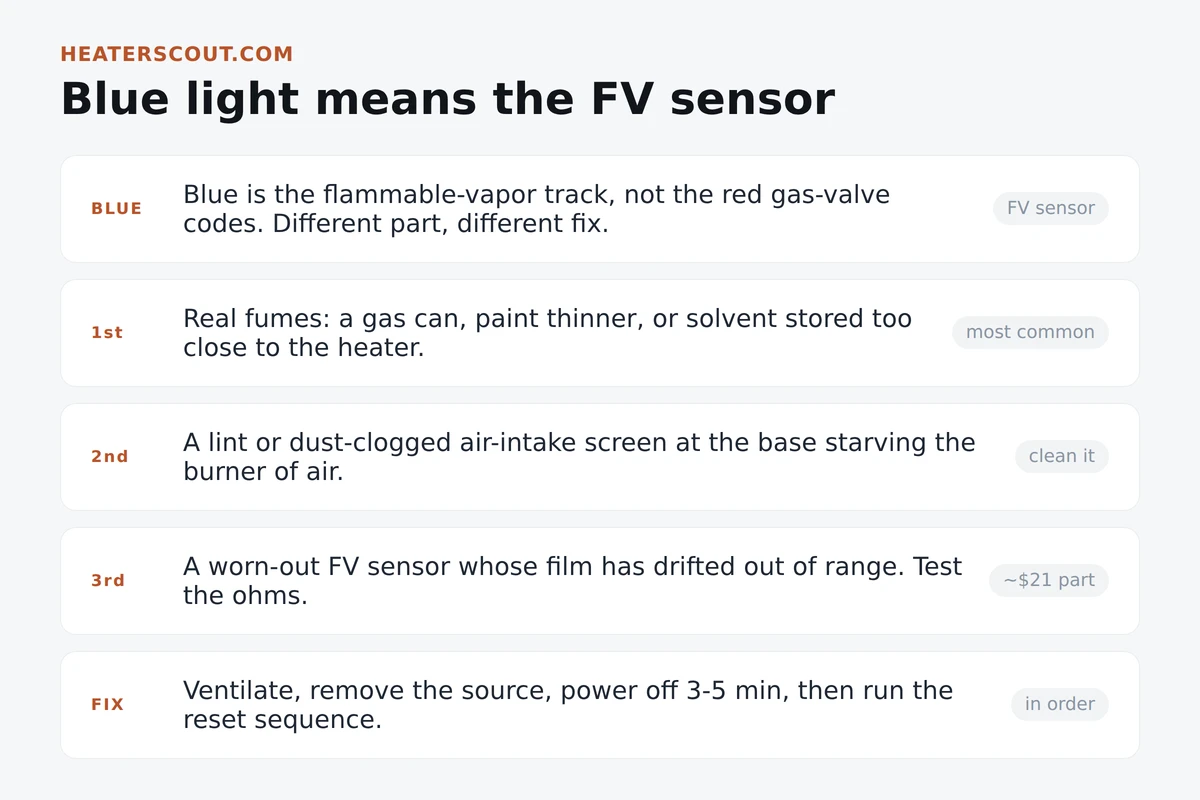
A blue light on a Guardian Rheem is the flammable-vapor (FV) sensor, not the red gas-valve codes. It trips on real fumes near the heater, a lint-clogged air-intake screen, or a worn sensor, in that order. The fix is ventilate the room and remove the source, clean the intake screen, cut power for three to five minutes, then reset. If it will not clear, test the sensor and replace it with a Rheem SP20172 kit, about twenty dollars. A lockout that keeps returning on a clean, ventilated area means the sensor or the valve, and that is where you call a pro.
Blue is a different track from red
The single status light on the gas control valve carries two independent stories. When it flashes red, the gas control valve is reporting on itself: a burst of two is low thermopile voltage, four is a high-temperature shutdown, five is a temperature-sensor fault, seven is a valve failure. Those are internal appliance problems, and the fixes are inside the valve. When it goes blue and locks out, you have left the valve's world entirely. Blue is the flammable-vapor sensor, part of the Guardian flammable vapor ignition resistant design that Rheem, Ruud, and Richmond have built into their gas tank heaters since the early 2000s. It is watching the air, not the burner.
Red flashes are the gas valve talking about itself. A blue lockout is the flammable-vapor sensor talking about the room. Fix the room first.Rheem Guardian FVIR system
What the FV sensor actually does
The Guardian system draws combustion air through a screen around the base of the tank, past a flammable-vapor sensor. That sensor carries a thin film whose electrical resistance changes when gasoline or solvent vapor reaches it. When the concentration climbs, the resistance shifts, the control reads the change, and it refuses to start the blower purge that normally precedes ignition. No purge, no burner. On many models the system also chokes the air path, so it shuts off both the gas and the air before a vapor can ever meet a flame. That is the whole point of FVIR: keep a gas water heater from becoming the ignition source for fumes pooling at floor level, where gasoline vapor is heaviest. A blue lockout is that system latching. It is a safety response, not a breakdown, which is why the first move is never to grab a wrench.
The three things that trip a blue lockout
Work these in order, because the order is the likelihood order. The first two cost nothing to fix and cover most blue lockouts.
Real fumes come first. A gas can, a lawnmower, a jug of paint thinner, a shelf of solvents, or a spilled bit of fuel anywhere near the heater will do it, and so will fresh paint or floor finish off-gassing in the same room. Garage installs are the usual suspects because that is where people store the exact chemicals the sensor is built to catch. The vapor does not have to be strong enough for you to smell it at standing height, because it settles low, right where the sensor sits.
A clogged air-intake screen is second, and it is the one people miss. Lint, pet hair, and dust mat over the screen at the base of the tank, starve the burner of air, and disturb the airflow the sensor reads. That can push it into a lockout with no fume source present at all. Heaters in dusty garages and laundry rooms are the frequent offenders. Vacuum the screen and the base clean and keep anything from being stacked around the heater.
A worn sensor is third. The film degrades with age and heat, and eventually drifts out of range. When that happens the heater locks out even in clean, ventilated air, and no amount of resetting clears it, because you cannot reset a sensor that is reading wrong. This is the one that ends in a part.
| What it means | Flammable-vapor (FV) sensor lockout on the Guardian FVIR system |
| Light color | Blue (the red flashes are the separate gas-valve codes) |
| Cause 1 (most common) | Fumes near the heater: gasoline, paint thinner, solvent, fresh finish |
| Cause 2 | Lint or dust-clogged air-intake screen at the base of the tank |
| Cause 3 | Failed FV sensor, film drifted out of range with age |
| First fix | Ventilate the room, remove the fume source, clean the intake screen |
| Soft reset | Cut power (plug / breaker / blower switch) 3-5 min, then relight |
| Hard-lockout reset | Hold both temp arrows to green blink, then L-R-L-L-R-L-R-R in 30 sec |
| Sensor test | FV sensor ohms out of ~9k-45k range = bad sensor, replace |
| Replacement part | Rheem PROTECH SP20172 FV sensor kit (AP13447-3 / 25VS), about $21 |
| Flash count | Varies by model (6, 7, or 8), route by COLOR not count |
Ventilate first, then reset in order
The order matters more than any single step. Resetting before you clear the cause just re-locks the heater, and on some units repeated blind resets make it harder to bring back. Do it this way. Open a door or window and let the room air out for several minutes. Remove every fume source you can find and get it well away from the heater, ideally out of the room entirely. Cut power at the plug, the breaker, or the blower switch and leave it off for three to five minutes so the control fully de-energizes. While it is off, vacuum the air-intake screen and the base of the tank clean. Then restore power and relight the pilot following the lighting instructions printed on the burner door.
If the lockout is soft, that clears it. If it is a latched hard lockout, the control pad needs the full sequence. With power restored, press and hold both temperature arrow buttons at the same time until the green light starts to blink. Release them, then press the buttons in this exact order within about thirty seconds: Left, Right, Left, Left, Right, Left, Right, Right. When you get it right the lights come on to confirm the reset and the heater returns to normal operation. Miss the timing or the order and it will not take, so start the sequence over from the green blink. This is the Honeywell-family reset Rheem uses on these control pads, and it is the same on Ruud and Richmond units built on the same platform.
Do not defeat the FV sensor
Never jumper, tape over, or bypass the flammable-vapor sensor to force the burner to run through a blue lockout. That sensor is the only thing standing between fumes at floor level and an open flame. If you cannot find and remove the source, or the unit keeps locking out on a clean, ventilated area, stop resetting and call a licensed technician. And never store gasoline, paint, or solvents beside a gas water heater.
Testing and replacing the FV sensor
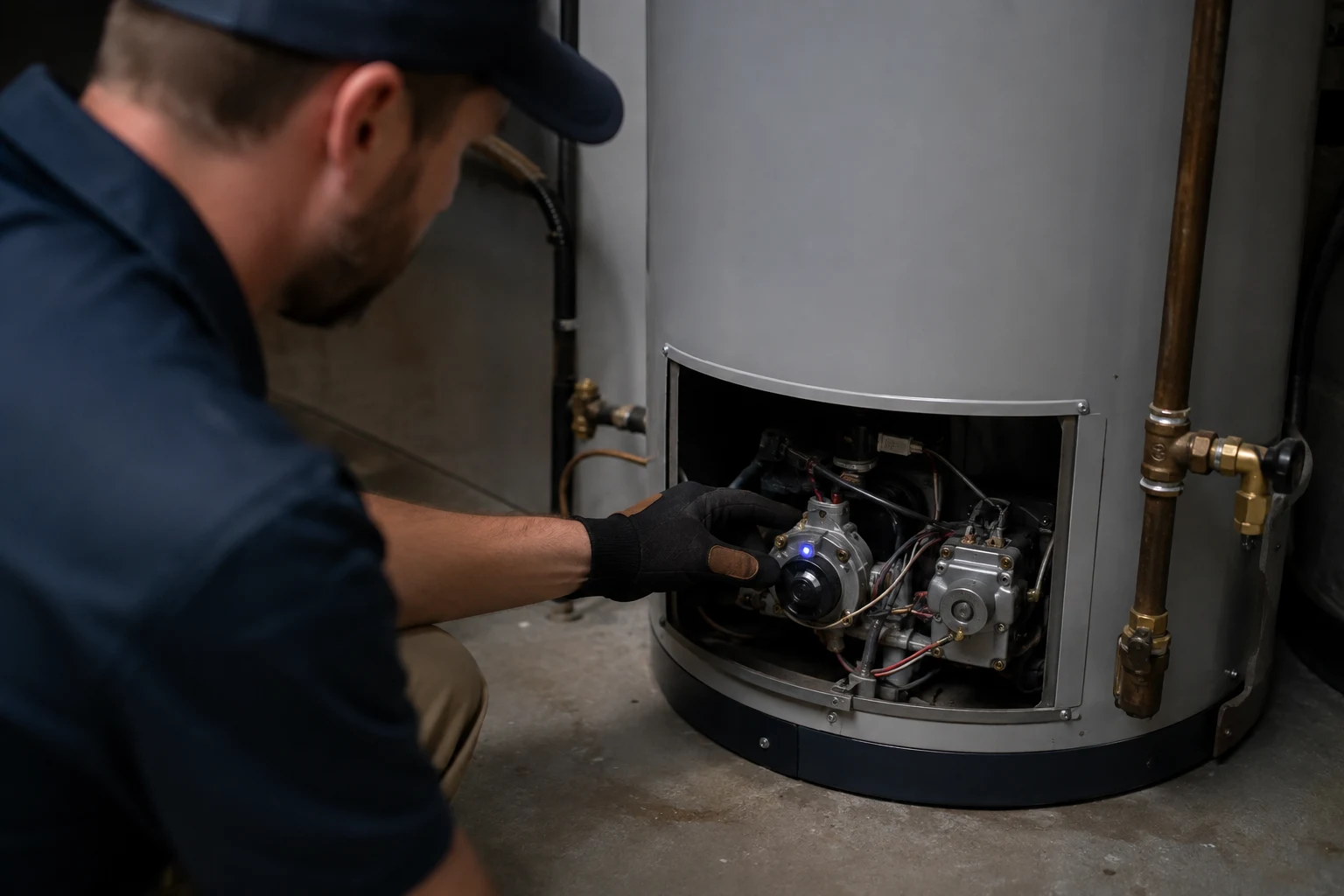
When the area is clean and ventilated and the screen is spotless and it still locks out, the sensor itself is the suspect. You can confirm it with a multimeter. Read the resistance across the FV sensor leads. A healthy sensor falls inside roughly nine thousand to forty-five thousand ohms. A reading below or above that band means the film has failed, and the system will not reset until you replace it. There is no cleaning or reviving a drifted sensor.
The replacement part is the Rheem PROTECH SP20172 flammable vapor sensor kit, also cataloged as AP13447-3 or 25VS, and it fits Rheem, Ruud, and Richmond FVIR heaters. It runs about twenty to twenty-five dollars at a big-box store or through Rheem parts, and the kit includes the sensor, a cap plug, and a wire tie. The sensor lives at the bottom of the jacket, under the outer door cover near the burner opening, and swapping it means pulling the burner assembly on most models. That is within reach for a confident do-it-yourselfer who is comfortable disconnecting the pilot and burner, but it is also a reasonable place to bring in a plumber, especially if the heater is under warranty and the part is covered.
DIY versus pro, and where blue crosses back to the valve
The homeowner side of a blue lockout is broad and cheap. Ventilating, removing fume sources, cleaning the intake screen, running the reset sequence, even ohming and swapping the FV sensor are all reasonable do-it-yourself work with basic tools and care around the gas connections. The pro side starts when the lockout refuses to clear on a clean, ventilated area with a known-good sensor. At that point the blue light may not be a true FV problem at all. A control-board or gas-valve fault can present in ways that look like a flammable-vapor lockout, and sorting that out means combustion testing and diagnosis that belongs with a licensed tech.
Prevention is mostly housekeeping. Do not store gasoline, paint, thinner, or solvents anywhere near a gas water heater, and if you must keep them in the same garage, get them as far away and as low-vapor sealed as possible. Vacuum the air-intake screen a couple of times a year, more often in a dusty garage or a laundry room full of lint. Keep the area around the base clear so the burner gets its air. A flammable-vapor heater in a clean, well-ventilated space with nothing volatile stored beside it almost never throws a blue light. When it does, you now know the light is pointing at the room, not the valve, and the fix starts with the window, not the wrench.
Frequently asked
What does a blue flashing light mean on my Rheem water heater?
On a Guardian FVIR gas model, a blue flashing light or blue lockout is the flammable-vapor sensor track, not the red gas-valve diagnostics. The FV sensor watches the air the burner pulls in near the floor, and when it thinks it sees combustible vapor it locks the heater out before the burner can light. Blue means one of three things: real fumes near the heater, a clogged air-intake screen fooling the sensor, or a worn FV sensor. The important habit is color first. Red flashes route to the thermopile, high-limit, or gas valve. A blue light routes to the flammable-vapor system and a completely different fix that starts with ventilating the space, not with parts. Reading the red flash chart for a blue lockout sends people chasing a gas valve that is fine while the actual hazard, fumes on the floor, sits there unaddressed.
How do I reset the flammable vapor sensor on a Rheem water heater?
First fix the cause, then reset. Ventilate the room, open a door or window, and remove anything that gives off fumes: a gas can, paint, thinner, or solvent. Then cut power at the plug, breaker, or blower switch and wait three to five minutes. Many units clear with that soft reset and a relight per the burner-door instructions. If the lockout is latched, run the full sequence: restore power, hold both temperature arrow buttons until the green light blinks, then press Left, Right, Left, Left, Right, Left, Right, Right within about thirty seconds. The lights should all come on to confirm the reset. If it will not clear no matter how careful you are, the sensor itself has likely failed and needs replacing, because a reset cannot fix a sensor reading out of range.
Why does my Rheem blue light keep coming back after I reset it?
A blue lockout that returns is the sensor telling you the problem is still there: a fume source you missed, a blocked intake screen, or a dead sensor. Walk the area again, because even a capped gas can or a shelf of solvents a few feet away can put enough vapor at floor level to trip it, and so can fresh paint or floor finish. Next, check the air-intake screen at the base of the heater. Lint and dust mat over it, starve the burner of air, and make the sensor misread, so vacuum it clean. If the area is genuinely clear and ventilated and the screen is clean and it still locks out, the FV sensor has drifted out of range. A meter reading below about nine thousand or above forty-five thousand ohms confirms it.
How much does it cost to fix a Rheem blue light lockout?
The cheapest and most common fix costs nothing but a few minutes: ventilate, remove the fume source, clean the intake screen, and reset. If the flammable-vapor sensor itself has failed, the Rheem PROTECH SP20172 FV sensor kit runs about twenty to twenty-five dollars at a big-box store or through Rheem parts, and it is a manageable do-it-yourself swap on many models with the burner assembly out. If you have a plumber replace it, expect roughly one to two hundred dollars in labor on top of the part. If the blue lockout turns out to be a control or gas-valve problem masquerading as an FV fault, that climbs toward a gas control valve replacement, which is a few hundred dollars, or a warranty claim if the heater is still covered.
Is a blue light lockout on a Rheem water heater dangerous?
The lockout itself is the safety system doing exactly what it should. The Guardian FVIR design shuts off gas and chokes the air supply to keep the burner from igniting flammable vapor, so a blue lockout is the heater refusing to become an ignition source. The danger is not the light, it is whatever tripped it. If the sensor caught real fumes, you have combustible vapor near an appliance that makes fire, which is a genuine hazard. Ventilate, find the source, and move it well away from the heater and ideally out of the room. Never bypass or jumper the FV sensor to force the burner to run, and never store gasoline, paint, or solvents next to a gas water heater. If you cannot find a source and the unit keeps locking out, stop resetting and get a licensed tech to check the sensor and combustion.
Can lint or dust cause a Rheem flammable vapor lockout?
Yes, and it is one of the more overlooked causes. The burner on a Guardian FVIR heater draws combustion air through a screen around the base of the tank, and the FV sensor sits in that airflow path. When lint, pet hair, drywall dust, or garage grime mats over that screen, it starves the burner of air and disturbs the airflow the sensor depends on, which can push it into a lockout with no fume source present. This is why heaters in dusty garages and laundry areas lock out more often. The fix is simple: cut the power, vacuum the intake screen and the base clean, make sure nothing is stacked around it, then reset.
How is the blue light different from the red flashing light on a Rheem?
They are two separate diagnostic tracks on the same status light, and mixing them up is the most common mistake. Red flashes are the gas control valve talking about itself and its immediate sensors: two flashes is low thermopile voltage, four is a high-temperature shutdown, five is a temperature-sensor fault, and seven is a gas valve failure. Those live in the valve and the fixes are thermopiles, high-limit conditions, and valves. Blue is the flammable-vapor sensor, a wholly different system that watches the air for combustible fumes and locks the burner out for safety. A red code is generally an internal appliance problem. A blue lockout is usually an external environmental one, fumes or blocked airflow, so your first move on blue is to ventilate and inspect the room, not to open the valve.
What is the exact blue flash count for the FV sensor on a Rheem?
It varies by model line, and that is worth knowing before you count. Different Rheem, Ruud, and Richmond production years and control pads report the flammable-vapor lockout with different patterns, so you will see six flashes on some sheets, seven or eight on others. Because the count is not consistent across every manual, do not diagnose a blue light by count alone. Route by color and behavior instead: a blue light that has locked the heater out and will not let it fire is the FV-sensor track regardless of the exact number, and the fix path is ventilate, clean, reset, then test or replace the sensor. To confirm the count meaning on your specific unit, read the chart printed on that heater's own burner door rather than trusting a generic table.