A Rheem tankless flashing P1 has not failed. It is telling you the water moving through it dropped below the minimum it needs to fire, roughly 0.66 gallons per minute, and it held there for more than about five seconds. The burner will not light on a trickle, so the control board locks it out and shows P1. Nine times out of ten the cause is nothing wrong with the heater at all. The tap is barely open, a filter screen is clogged, the fixture is just too low-flow, or scale has narrowed the waterway. This is a flow message, not a breakdown.
What P1 actually reports
P1 is a low-water-flow code, not a pump-priority or maintenance code. Some guides mislabel it. Rheem publishes P1 on its gas condensing tankless lines, the RTGH, Performance Platinum, and IKONIC / ECOH families, and the meaning is consistent: flow fell below the unit's minimum activation rate. Start every diagnosis by getting more water through the unit, not by ordering parts.
Why a minimum flow exists at all
A tankless heater fires a big gas burner only while water is moving through the heat exchanger to carry the heat away. If it lit with almost no flow, the metal and the small slug of water inside would overheat in seconds. So the control watches a flow sensor on the cold inlet and refuses to light until it sees a real demand. On most Rheem gas tankless units that threshold is about 0.66 GPM. Below it, or if flow sags under it for more than roughly five seconds after the burner was running, the board declares P1 and shuts the burner down. The code is protective. It is the same logic that keeps the unit from scalding a heat exchanger, just reported as an error on the display.
P1 is almost always this
- The hot tap is only cracked open, under the minimum flow
- A low-flow fixture or aerator sits below 0.66 GPM wide open
- The cold-inlet filter screen is clogged with sediment
- The service shutoff valve is not fully open
- Scale has narrowed the heat-exchanger waterway
- A recirculation pump is undersized or air-bound
P1 is rarely this
- The flow sensor or turbine has stuck or failed
- A kinked or partially closed cold supply line
- A pressure-reducing valve set too low for the house
- A control board misreading a good flow signal
- Debris lodged in the flow turbine paddle wheel
The fix, cheapest first
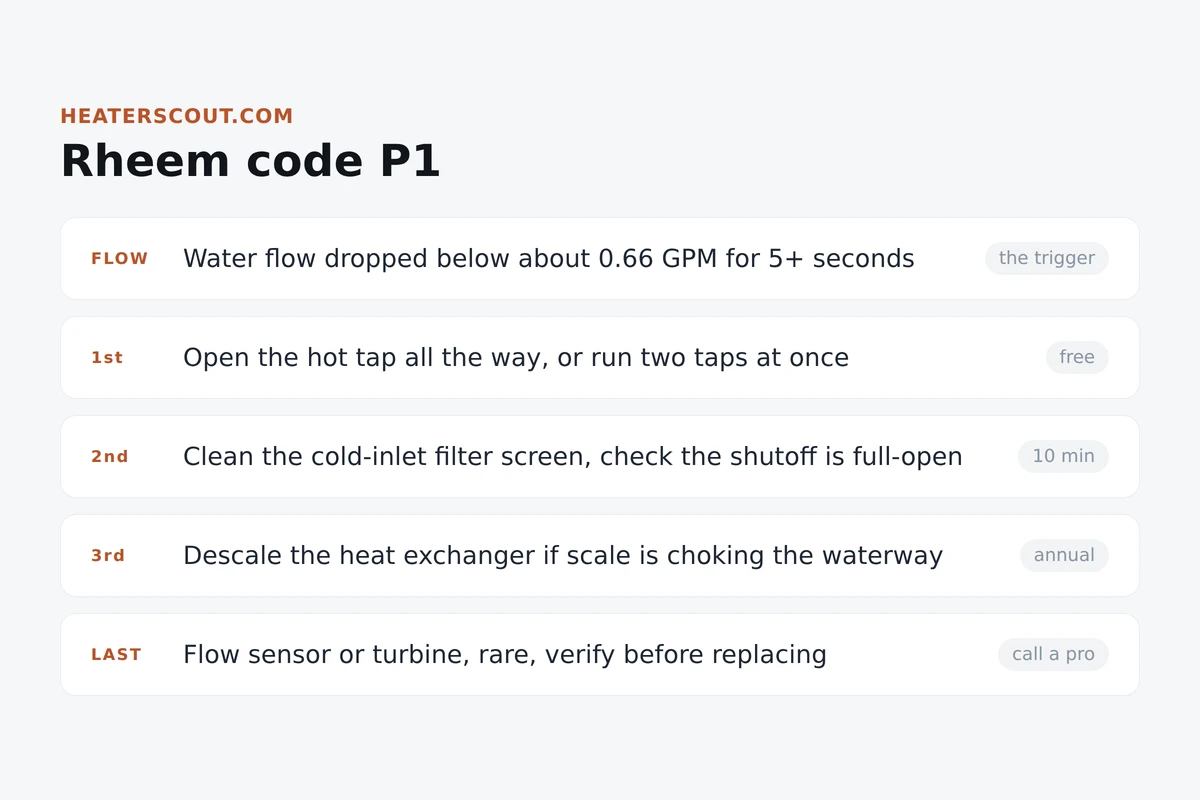
P1 rewards working from free to expensive better than almost any other tankless code, because the top causes cost nothing. Do not buy a flow sensor because a code scared you. Compare where the causes sit and what each one takes.
| Cause | How likely | What it takes | DIY? |
|---|---|---|---|
| Tap barely open / low-flow fixture | Very common | Open the tap fully or run two hot fixtures | Yes, free |
| Clogged cold-inlet filter screen | Common | Shut water, pull the screen, rinse it clean | Yes, 10 min |
| Service shutoff not fully open | Common | Turn the isolation valve fully open | Yes, free |
| Scale in the heat-exchanger waterway | Common on hard water | Descale 45 min with a pump kit | Yes, 1 hr |
| Recirculation pump too weak / air-bound | Setup-specific | Bleed air, resize pump, check config | Sometimes |
| Flow sensor / turbine stuck or failed | Rare | Clean or replace the sensor | Call a pro |
Before you open anything
The first two checks need no tools and rule out most P1 cases in a minute.
Does P1 clear if I open a second hot tap?
Often, yes. If opening a shower plus the kitchen sink together makes the burner light and P1 vanish, the original single fixture was simply below the minimum flow. That is a flow problem at the fixture, not a fault in the heater. Clean or remove that fixture's aerator, or open it further, and the heater is fine.
The whole house trips P1 now, but used to work. What changed?
When every fixture starts throwing P1 on a unit that ran fine for years, the restriction is upstream of the fixtures: a clogged inlet filter screen, a service valve someone bumped partly closed, or scale narrowing the waterway. Clean the filter first, confirm the valves are wide open, then descale if the water is hard. One of those three fixes it.
Step-by-step diagnosis
If the quick checks did not clear it, walk the list in order. Each step either clears P1 or hands you off to the next one.
Open the hot tap all the way
Fully open the hot side of a normal fixture, a tub spout or a kitchen faucet, not a low-flow bathroom sink. If the burner lights and P1 clears, the fault was low flow at a specific fixture. Done. If it still shows P1 at full flow on a strong fixture, keep going.
Clean the cold-inlet filter screen
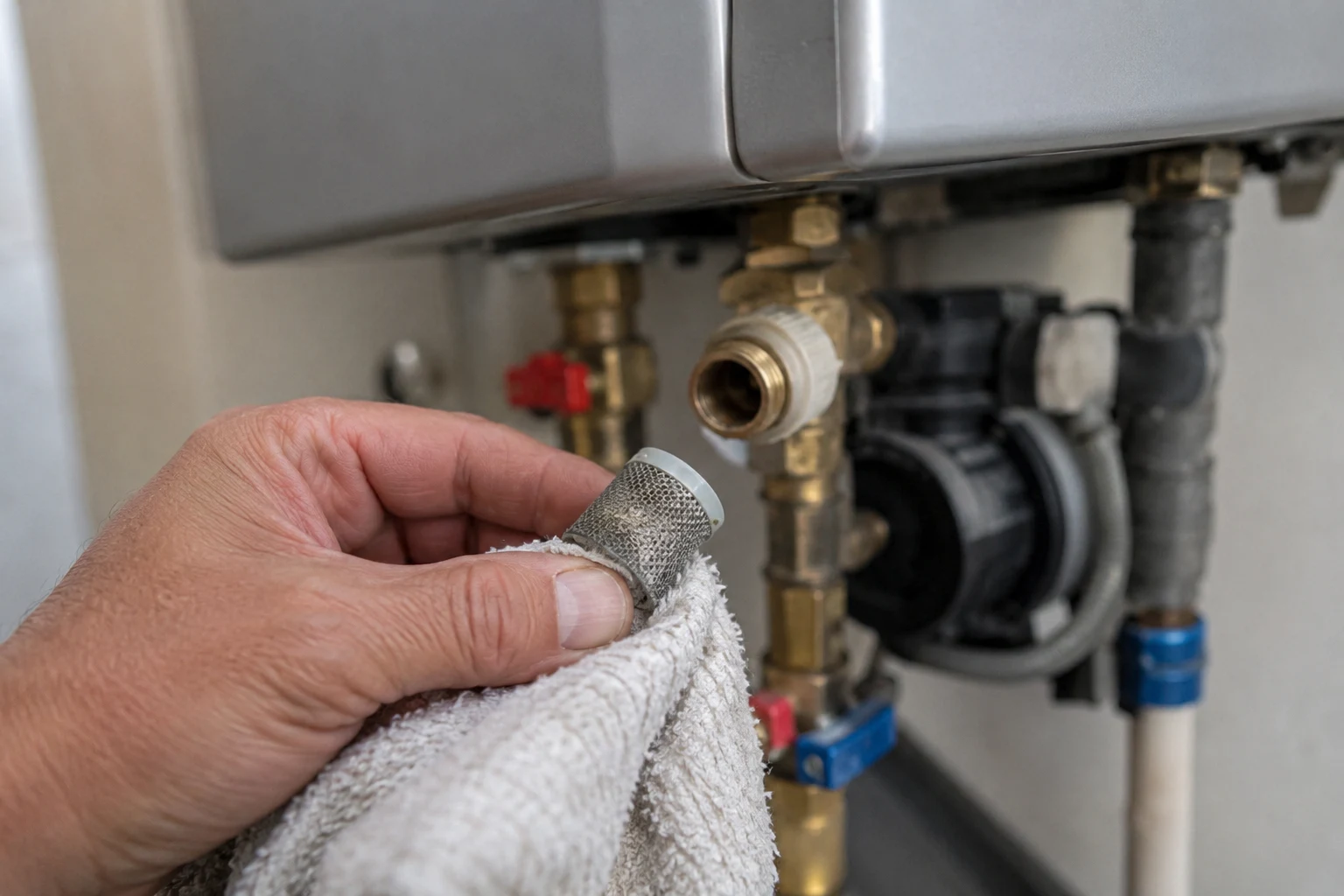
Shut the cold isolation valve, relieve pressure at a hot tap, and unscrew the inlet filter on the cold service valve. It is a small cylindrical screen. Rinse out sediment and scale, reinstall it, reopen the valve. A clogged screen is one of the most common P1 causes on units more than a year or two old.
Confirm both service valves are fully open
The cold inlet and hot outlet isolation valves must be all the way open. A valve left half-turned after service will starve the flow sensor. Turn each one to its full stop.
Descale the heat exchanger
On hard water, scale inside the waterway restricts flow the same way sediment does. Connect a descaling pump to the service valves and circulate solution or white vinegar for about 45 minutes, then rinse and clean the inlet filter again. This restores flow when scale is the cause and should be an annual habit anyway.
Check the recirculation setup
If P1 only appears in recirculation mode, the pump is the suspect. Bleed trapped air, verify the pump is sized for the loop length and head, and confirm it is wired and configured for your model. On EcoNet units, check that the recirculation schedule and pump wiring agree.
Have the flow sensor checked last
Only after flow is clearly healthy, two strong fixtures open together, and P1 still shows, is the flow turbine suspect. Debris on the paddle wheel or a worn sensor under-reports flow. Clean it if accessible, replace it if it is genuinely dead. This is the rare ending, not the first move.
Where the homeowner line sits
Almost all of P1 is fair game for a homeowner. Opening a valve, cleaning a filter screen, and descaling are jobs anyone patient can do with basic tools and a descaling kit. The line you reach is the flow sensor and the recirculation wiring. Pulling and replacing a flow turbine means opening the water side of the unit and getting the paddle wheel seated right, and a misconfigured recirculation pump can mean checking control wiring and EcoNet settings. Those are reasonable calls for a plumber, especially if the unit is still under warranty and you do not want to open it. What you should never do is try to defeat the flow sensor to force the burner to run on low flow. That minimum exists to keep the heat exchanger from overheating.
Keeping P1 from coming back
P1 that keeps returning is telling you flow is chronically marginal. On hard water, descale the unit once a year and clean the inlet filter screen at the same time. If a specific low-flow fixture always trips it, either open that fixture more or swap its aerator for one that flows above the minimum. If you added a recirculation pump and P1 started, the pump is undersized or air-bound for your loop, so fix the pump rather than the heater. And if your house runs on a pressure-reducing valve set low, the whole system may sit near the edge of the minimum, which is worth a look. Handle the flow and P1 stops being the code that shows up on the coldest morning of the year.
Frequently asked
Can I reset Rheem code P1 myself?
Yes, but P1 usually clears on its own once real flow returns, because it is an operational code and not a latched fault. Open the hot tap fully and, in many cases, the code disappears and the burner lights. If it hangs on, do a full power cycle: switch off the water heater at the breaker or unplug it, close and reopen the hot fixtures, wait 10 to 20 seconds, then restore power and open a hot tap. That clears the display. The important part is that resetting does not fix anything if the water still cannot reach the flow sensor. If the tap is barely cracked open, the inlet filter is clogged, or the fixture puts out less than the minimum, P1 comes right back the moment the unit tries to fire. Fix the flow, not the code.
What flow does a Rheem tankless need to avoid P1?
Most Rheem gas condensing tankless units, the RTGH, Performance Platinum, and IKONIC / ECOH lines, need roughly 0.66 gallons per minute of hot demand to activate the burner. That is the minimum activation flow. If the flow sensor sees less than that for more than about 5 seconds, the control board throws P1 and will not light or drops the flame it had. Newer models can modulate down close to that figure, but they cannot fire on a trickle. A bathroom faucet on a low setting, a water-saving aerator, or a single low-flow fixture can sit right at or under the line. That is why the first move is always to open the tap wide or run two hot fixtures at once and see whether the burner catches.
Why do I get P1 only at certain faucets?
Because those fixtures do not pass enough water to cross the activation threshold. A modern low-flow bathroom faucet might deliver half a gallon a minute wide open, which is below the 0.66 GPM most Rheem tankless units want. Aerators, flow restrictors, and a valve that is only partly turned all cut the number further. A kitchen tap or a shower usually moves plenty of water and never trips P1, while the powder-room sink throws it every time. The fix is either to open that fixture fully, remove or clean a clogged aerator, or accept that the smallest fixtures sit at the edge of what a gas tankless can fire on. If several fixtures that used to work now trip P1, the problem is upstream: a clogged inlet filter or scale, not the fixtures.
Will descaling clear code P1?
It can, when scale is the reason flow is low. Hard-water scale builds up inside the heat exchanger waterway and the inlet, and over time it chokes the passage the same way sediment does. If a heater that fired fine for years starts throwing P1 at fixtures that used to work, scale narrowing the waterway is a prime suspect. Flush the unit with a descaling solution or white vinegar through the service valves for about 45 minutes, then clean the inlet filter screen. That often restores enough flow to clear P1 for good. If your water is hard and you have never descaled, do this first before chasing sensors. Descaling will not help if the cause is a barely open tap or a genuinely low-flow fixture, so rule those out first.
Why does my recirculation pump cause P1?
A recirculation pump that cannot move enough water, or that has air trapped in it, presents the flow sensor with less than the minimum and trips P1. This shows up on retrofit setups where an add-on pump is undersized for the loop, or where the pump lost prime and is pushing a mix of air and water. It also happens when a third-party pump and the Rheem control are not talking properly about when to run. If P1 appears in recirculation mode but never when you open a tap by hand, look at the pump: bleed the air, confirm it is rated for the loop length and head, and check that it is wired and configured for your model. On EcoNet-equipped units, verify the recirculation settings match how the pump is actually plumbed.
How much does it cost to fix Rheem P1?
Most of the time it costs nothing. Opening a tap, cleaning the inlet filter screen, or removing a clogged aerator are free and take minutes. A descaling kit with a pump and hoses runs about $40 to $70 if you do it yourself, and descaling solution is around $15 to $25 a jug. If the flow sensor or turbine really has failed, the part is roughly $40 to $120 depending on model, and a plumber's visit to diagnose and swap it usually lands between $150 and $350 once you add the trip and labor. The expensive scenario is rare, because P1 is a flow problem far more often than a sensor problem. Work the cheap causes first and most people never buy a part at all.
Is Rheem code P1 dangerous?
No. P1 is a protective lockout, not a hazard. The unit refuses to fire the burner when it cannot confirm enough water is moving to carry the heat away safely. Firing a gas burner into a heat exchanger with too little flow would let the metal and the water spike in temperature, so the control simply will not light. That is the code doing its job. There is no gas leak, no carbon monoxide risk, and nothing on fire. The only real consequence is no hot water until flow is restored. Do not try to defeat or bypass the flow sensor to force the unit to run on low flow. If you have ruled out the tap, the filter, scale, and the pump and P1 still returns at healthy flow, get the flow sensor checked rather than working around the safety.
Does P1 mean my flow sensor is bad?
Rarely, and only after you have ruled out everything cheaper. The flow sensor, sometimes called the flow turbine, is a small paddle wheel that spins as water passes and tells the board the flow rate. It can stick from debris or scale, or wear out and under-report flow, which trips P1 even when water is moving fine. But a stuck or failing sensor is the last item on the list, not the first. If you open a shower and a kitchen tap wide open together, so the unit is clearly getting well over a gallon a minute, and P1 still shows, then the sensor reading is suspect. Clean it first if it is accessible, because debris on the turbine is more common than a truly dead sensor. Replacement is a job most owners hand to a plumber.