A Rheem tankless flashing C7 is not asking for a descale, no matter what a quick web search suggests. C7 is a combustion and control call code, and it almost never shows up alone. Look at the two digits next to it: C7 11, C7 12, C7 13, or C7 76. That second number is the actual fault, and it decides whether you are cleaning a $15 flame rod with sandpaper or looking at a gas-pressure problem that needs a licensed tech. The descale reminder people confuse this with is a different code entirely, LC or 551.
Quick answer
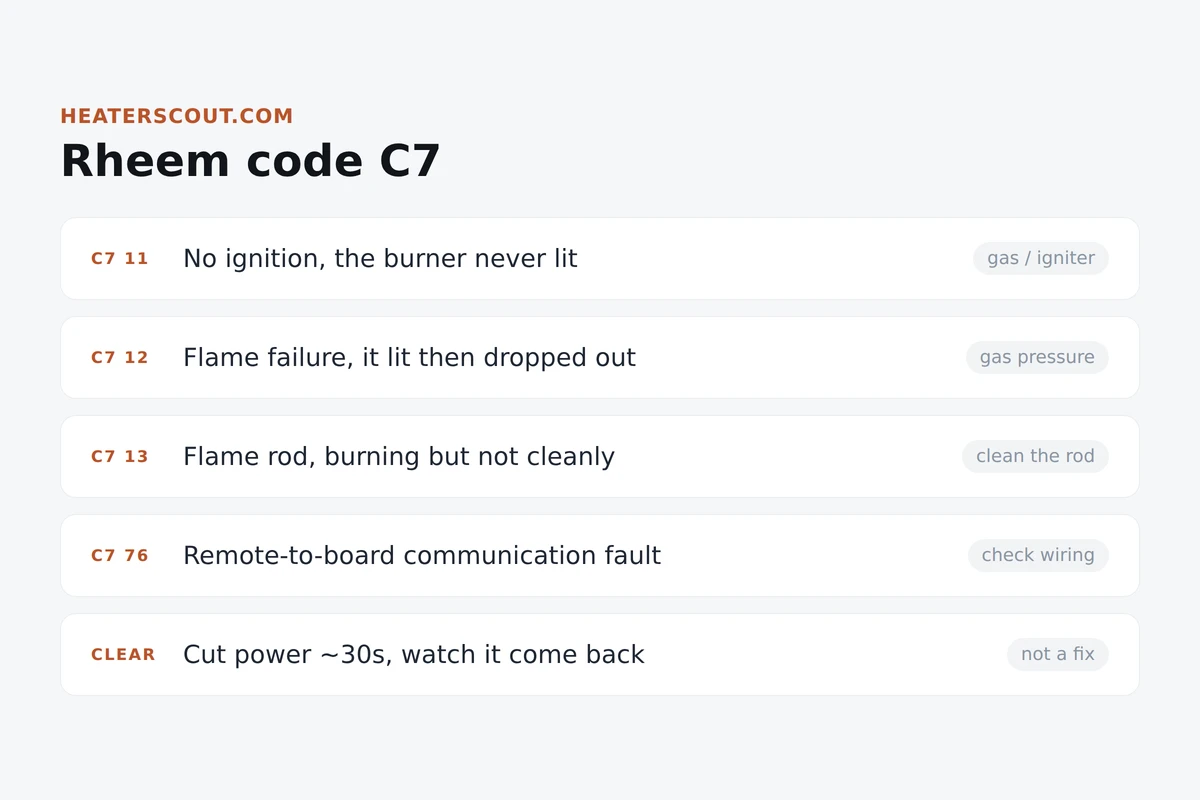
Rheem code C7 is the burner and controller fault group, read together with the two-digit sub-code shown next to it. C7 11 is no ignition, C7 12 is flame failure, C7 13 is a flame rod fault with improper combustion, and C7 76 is a communication fault between the remote and the circuit board. Clear the latch by cutting power for about 30 seconds, but that only resets the display. Fix the sub-code fault first: gas supply and igniter for 11 and 12, a carboned flame rod or restricted venting for 13, and remote wiring for 76. It is not a descale reminder, that is LC or 551.
Read the sub-code, not just the C7
The mistake that sends people down the wrong path is treating C7 as one fault. On Rheem tankless units, and on the Paloma-built heaters Rheem rebadges, the two-character remote shows a call code and then a two-digit maintenance code. The call code groups the fault; the sub-code names it. C7 groups the burner and controller family, so the digits that follow are where the diagnosis actually lives. A C7 13 and a C7 76 are both C7, but one is a dirty flame rod and the other is a wiring fault at the remote. If you order a flame rod for a 76, you wasted your money. Write down the full display, both parts, before you do anything else.
| Sub-code | What it means | Most likely cause | First move |
|---|---|---|---|
| C7 11 | No ignition, burner never lit | Gas off or low pressure, igniter | Confirm gas valves open, inspect igniter |
| C7 12 | Flame failure after lighting | Gas pressure drop, flame sensing | Check gas supply under demand |
| C7 13 | Flame rod, improper combustion | Carboned flame rod, venting, blower | Clean the flame rod, clear the vents |
| C7 76 | Remote-to-board communication | Remote wiring or the remote itself | Reseat and test the remote wiring |
The flame side: 11, 12, and 13
Three of the four C7 sub-codes are about the burn. C7 11 means the unit tried to light and no flame ever established. The first thing to rule out is the boring one: is the gas actually on, at both the meter or tank and the valve at the unit. A closed valve, an empty propane tank, or a tripped gas shutoff throws 11 every time. After that it is gas pressure, the igniter, and the gas solenoid. C7 12 is different in timing: the burner did light, then the board lost the flame signal mid-run. That points at a pressure drop under demand, a marginal regulator, or a flame rod that is reading intermittently. C7 13 is the subtle one. The unit is burning, but the board sees improper combustion, meaning the burn is not clean.
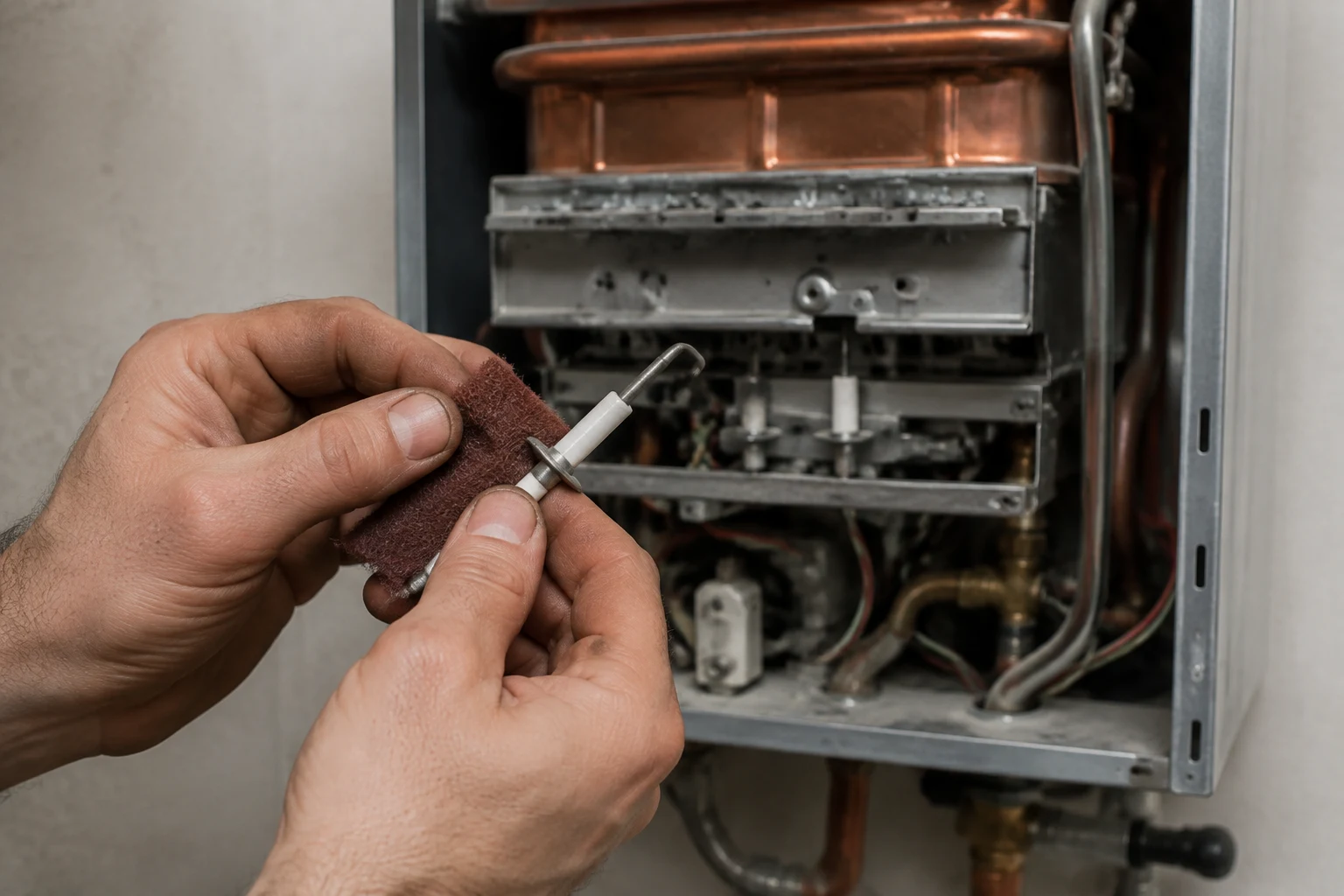
The flame rod is the piece doing the sensing on all three. It works by passing a tiny DC current, on the order of one to three microamps, through the flame back to the board. That current is proof of flame. When carbon builds up on the rod it insulates that signal, the microamps fall below the detection threshold, and the board reads a poor or missing flame even though the burner is lit. That is why a C7 13 so often clears after nothing more than pulling the flame rod and cleaning the carbon off with fine sandpaper. Blocked or undersized intake and exhaust venting causes the same symptom from the other direction, by starving the burn of air so it runs dirty. Check the vent runs for lint, nests, ice, or a screen packed with debris.
Is C7 13 a gas problem or a sensor problem?
It is usually the flame rod, but it can be either, and improper combustion blurs the line. The board is reporting that the flame it senses is not clean. The cheapest and most common cure is cleaning carbon off the flame rod, because a fouled rod under-reads a perfectly good flame. If the rod is clean and correctly positioned in the flame and C7 13 stays, look at what would actually make the burn dirty: restricted or undersized venting, a weak blower or fan not moving enough air, or a gas pressure that is off spec. The sensor side is the DIY part. The gas pressure and blower side is where a licensed tech with a manometer and a combustion analyzer earns the call, because guessing at manifold pressure is not safe or legal to do by feel.
The control side: C7 76
C7 76 is the outlier in the group. It has nothing to do with the burner. It means the remote controller and the unit's main circuit board stopped communicating. On most units the remote talks to the board over a two-wire connection, and if that link drops the board flags 76. The overwhelming cause is the wiring: a terminal backed out, a corroded connection, water or heat damage to the run, or a wire nicked during install. The fix path is reseat the remote wiring first, then substitute a known-good remote to see if the remote itself failed, and only after both check out do you suspect the PCB. A temporary trick that works on some units is powering the remote off, waiting about five minutes, and powering back on, but if 76 returns you still have a wiring or hardware fault to chase.
Clearing the code versus fixing it
There is no dedicated reset button for C7. To clear the latched code, turn the unit off at the remote, then cut power at the breaker or unplug the heater for about 30 seconds, and restore power. Some Rheem remotes lock out after a fault and need the up arrow held for roughly ten seconds to unlock. All of that resets the display. None of it fixes anything. If the flame rod is still carboned, the gas is still low, or the remote wire is still broken, C7 comes right back on the next call for hot water. The power cycle is how you confirm a repair, not the repair. If the code returns immediately, the fault is live and you have not found it yet.
Where the homeowner line sits
Split the work by whether it touches the gas train. Cleaning the flame rod, confirming both gas valves are open, clearing the intake and exhaust of blockage, and reseating or replacing remote wiring are all reasonable for a careful homeowner with a screwdriver and fine sandpaper. Those handle most C7 13 and C7 76 cases outright. The parts are cheap: a Rheem flame rod is about $15 to $20 and an igniter is roughly $10 to $20. Where you stop is gas pressure and combustion. Setting manifold pressure, running a combustion analysis, diagnosing a blower under load, or swapping the control board are licensed-tech jobs, and on many units doing gas work yourself voids the warranty. The board is also the expensive part, commonly $180 to $380 on its own, which is the whole reason you exhaust the cheap causes before anyone touches it.
Keeping C7 from coming back
Most repeat C7 faults trace to two things: a burner that never gets serviced and venting that slowly clogs. An annual look-over that includes pulling and cleaning the flame rod, checking the intake and exhaust are clear, and confirming the gas supply is solid heads off the bulk of C7 13 and C7 12 events before they strand you without hot water. Descaling on schedule is still worth doing for the heat exchanger's sake, just do not expect it to touch C7, since scale and combustion are different systems. If you run propane, keep an eye on tank level and regulator health, because a sagging supply under a big draw is a classic intermittent C7 11 or 12. And keep a carbon monoxide alarm near the unit, since improper combustion is exactly the condition C7 13 is warning you about.
Frequently asked
Does Rheem code C7 mean the unit needs descaling?
No, and this is the most common mix-up. C7 is a combustion and control-communication call code, not a maintenance timer. The descale or lime reminder on a Rheem tankless shows as LC or 551, and you clear that one manually after you flush the heat exchanger. C7 is telling you the burner side or the remote link has a fault: it either did not light, lit and lost the flame, is burning dirty, or the remote and the control board stopped talking. Flushing the unit will not clear C7. You have to read the two-digit sub-code next to the C7 and chase that specific fault. If your display actually reads LC or 551, that is the descale reminder, and a proper vinegar or descaler flush plus a manual reset is the answer there.
What do the numbers after C7 mean, like C7 13 or C7 76?
On Rheem and the Paloma-built units Rheem sells, the display shows a call code and then a two-digit maintenance sub-code. The sub-code is the useful part. C7 11 is no ignition, meaning the burner tried and never lit, usually a gas supply or igniter problem. C7 12 is flame failure, the burner lit and then the flame dropped out, often a gas pressure or flame-sensing issue. C7 13 is a flame rod fault with improper combustion, the unit is burning but not cleanly, which points at a carboned flame rod, weak blower, or restricted venting. C7 76 is a communication fault between the remote controller and the unit's circuit board, usually the remote wiring. Same C7 group, four different repairs. Read the second number before you order any part.
Can I reset Rheem code C7 myself?
You can clear the latched code, yes. There is no dedicated reset button for C7. Turn the unit off at the remote, then kill power at the breaker or unplug it for about 30 seconds, then restore power. Some Rheem remotes also lock after a fault, and you unlock them by holding the up arrow for about 10 seconds. That drops the current fault so you can watch whether it returns. But clearing is not fixing. C7 fired because the burner or the remote link had a real problem, and if that problem is still there the code comes back the next time the unit calls for heat. Use the power cycle to confirm your repair worked, not as the repair itself. If C7 returns immediately on the next hot-water draw, the underlying fault is live.
Is Rheem error code C7 dangerous?
The lockout itself is the safety system doing its job. C7 on the flame side means the unit either failed to ignite, lost its flame, or detected improper combustion, and in every one of those cases the board shuts the gas valve rather than keep pushing fuel it cannot confirm is burning cleanly. That is exactly what you want it to do. The risk is not the code, it is ignoring it or bypassing it. Never jumper the flame rod or force the unit to fire past a C7, because then you are running a gas appliance with no proof of flame. If you smell gas at any point, shut the gas off at the valve, ventilate, and get a licensed tech out before you touch anything. Improper combustion can also mean incomplete burn, so a working carbon monoxide alarm near the unit is not optional.
How much does it cost to fix Rheem C7?
It depends entirely on which sub-code fired and what the diagnosis finds. Cleaning a carboned flame rod costs nothing but your time if you are comfortable opening the cover. A replacement Rheem flame rod runs about $15 to $20, and an igniter is roughly $10 to $20, both cheap DIY parts. A diagnostic service call from a plumber typically runs $75 to $150, and a straightforward sensor or igniter swap with labor lands around $150 to $350. The expensive outcome is the control board. A Rheem tankless PCB is commonly $180 to $380 for the part alone, and with labor a board job can reach $500 to $1,000. That gap is exactly why you work the cheap causes first: gas supply, flame rod, venting, and remote wiring all get checked before anyone spends on a PCB.
Why does Rheem C7 keep coming back?
A code that returns after you cleared it means the real fault is still live. On C7 13 the usual repeat offender is a flame rod that is still carboned or sitting slightly out of the flame, so the microamp signal stays weak and the board keeps flagging poor combustion. Blocked or undersized intake and exhaust venting does the same thing by starving the burn of air. On C7 11 and C7 12 a marginal gas supply, a sagging regulator, or a long undersized gas line drops pressure under demand, so the unit lights fine on a small draw and faults on a big one. On C7 76 an intermittent break or corroded terminal in the remote wiring drops the signal only when the harness moves. If everything upstream checks out and C7 still cycles, the PCB reading circuit is the last suspect.
Should I call a pro for Rheem C7 or fix it myself?
Split it by the sub-code and by whether the job touches the gas train. Cleaning the flame rod with fine sandpaper, checking that both gas valves are open, inspecting the intake and exhaust for blockage, and reseating or replacing remote-control wiring are all fair for a careful homeowner with basic tools. Those cover most C7 13 and C7 76 cases. Where you stop is anything involving gas pressure and combustion. Setting manifold pressure, running a combustion analysis, diagnosing a weak blower under load, or replacing the control board are licensed-tech work, and on many units doing gas work yourself voids the warranty and can violate code. If C7 11 or C7 12 survives confirming the gas is on and the venting is clear, that is your signal to call a pro rather than keep guessing at the burner.