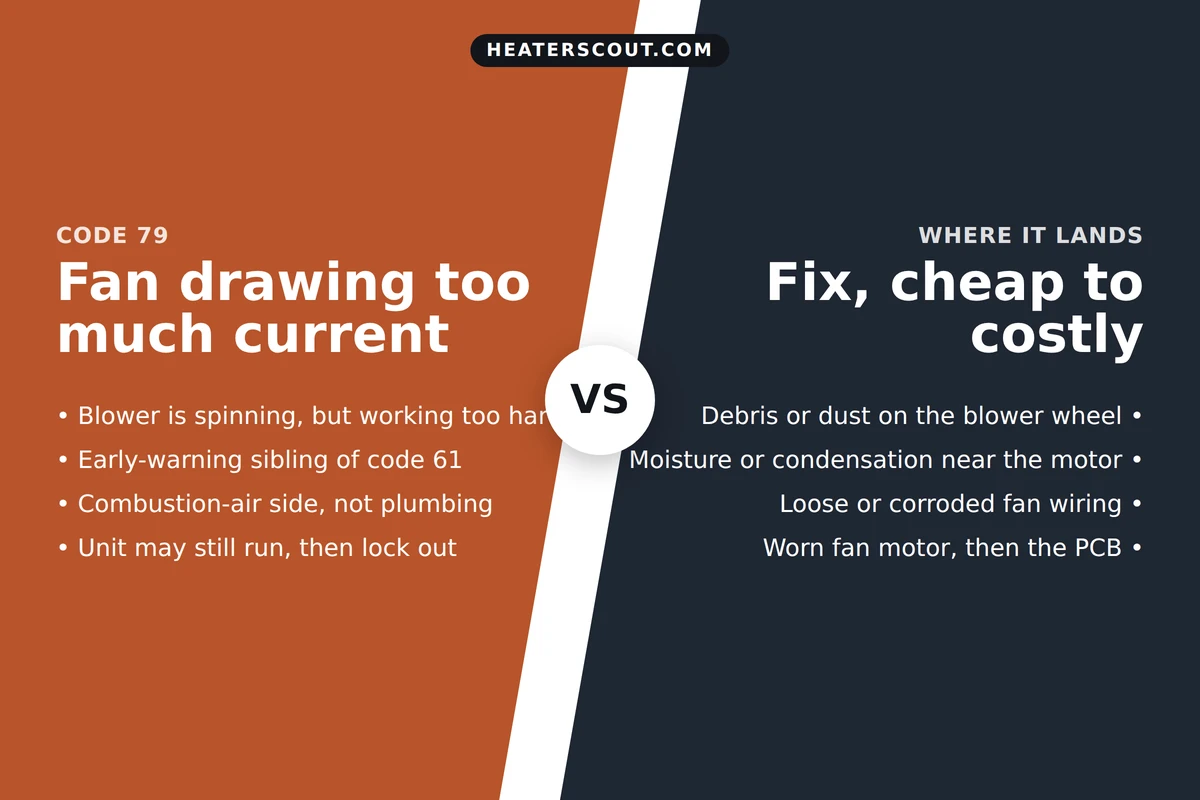
A Rheem tankless flashing 79 is not a plumbing problem, whatever a quick search might suggest. The code has nothing to do with water flow, isolation valves, or internal piping. It is a fan motor current fault. The control board is watching how hard the combustion blower is working, and it just decided the fan is pulling more current than it should. The fan is usually still spinning. It is straining. Rheem documents this code in its service manuals, and the honest read is that 79 is an early warning: fix it now, or meet its uglier sibling, code 61, on a cold morning when the fan finally quits.
Which situation are you in?
Code 79 shows up a few different ways depending on how far the blower has degraded. Find the row that matches what your unit is doing, because it points you at the likely cause and how urgent the fix is.
79 flashes once, then clears
A single 79 that resets and does not return usually means the fan hit a transient load, a bit of debris that cleared, or a brief voltage dip. Watch it. If it stays gone for weeks, you likely dodged it. If it creeps back, the motor is starting to go.
79 returns every few cycles
A code that comes back on a schedule means a real mechanical cause: a loaded blower wheel, moisture in the motor, or a wire that is loose. The fan is straining under load every time the burner calls for heat. This is the classic 79 and it needs the unit opened.
79 today, 61 creeping in
If you are seeing 79 flip to 61, or the fan sounds louder, grindy, or slow to spin up, the motor bearings are on their way out. This is the end stage. Plan on a blower replacement before the fan seizes and you lose hot water entirely.
How to diagnose it, in order
Work from the cheap, likely causes toward the expensive, rare ones. The fan and its air path fail long before the control board does, so do not let a code that mentions the PCB push you into buying a board first.
Clear the code and watch one run
Cut power at the breaker or the unit's on/off for about 30 seconds, then restore it to drop the latched fault. Run a hot tap and listen to the blower spin up. A healthy fan winds up smoothly and quietly. A straining fan sounds louder, hums, or spins up slowly. That first listen tells you a lot.
Check the combustion-air path
Dust, lint, and debris loading the blower wheel or blocking the intake make the motor pull extra current, which is exactly what 79 flags. With power off, inspect the intake and exhaust terminations for blockage, and clear any obvious dust from the air path you can reach. A starved or dirty blower is a common, fixable cause.
Look for moisture near the motor
Condensation is a known contributor. Water or dampness on the fan motor or the connector near it adds drag and load, and near the control board it is an electrical risk too. Check for signs of moisture, a leaking condensate path, or corrosion around the blower and its wiring.
Inspect and reseat the fan wiring
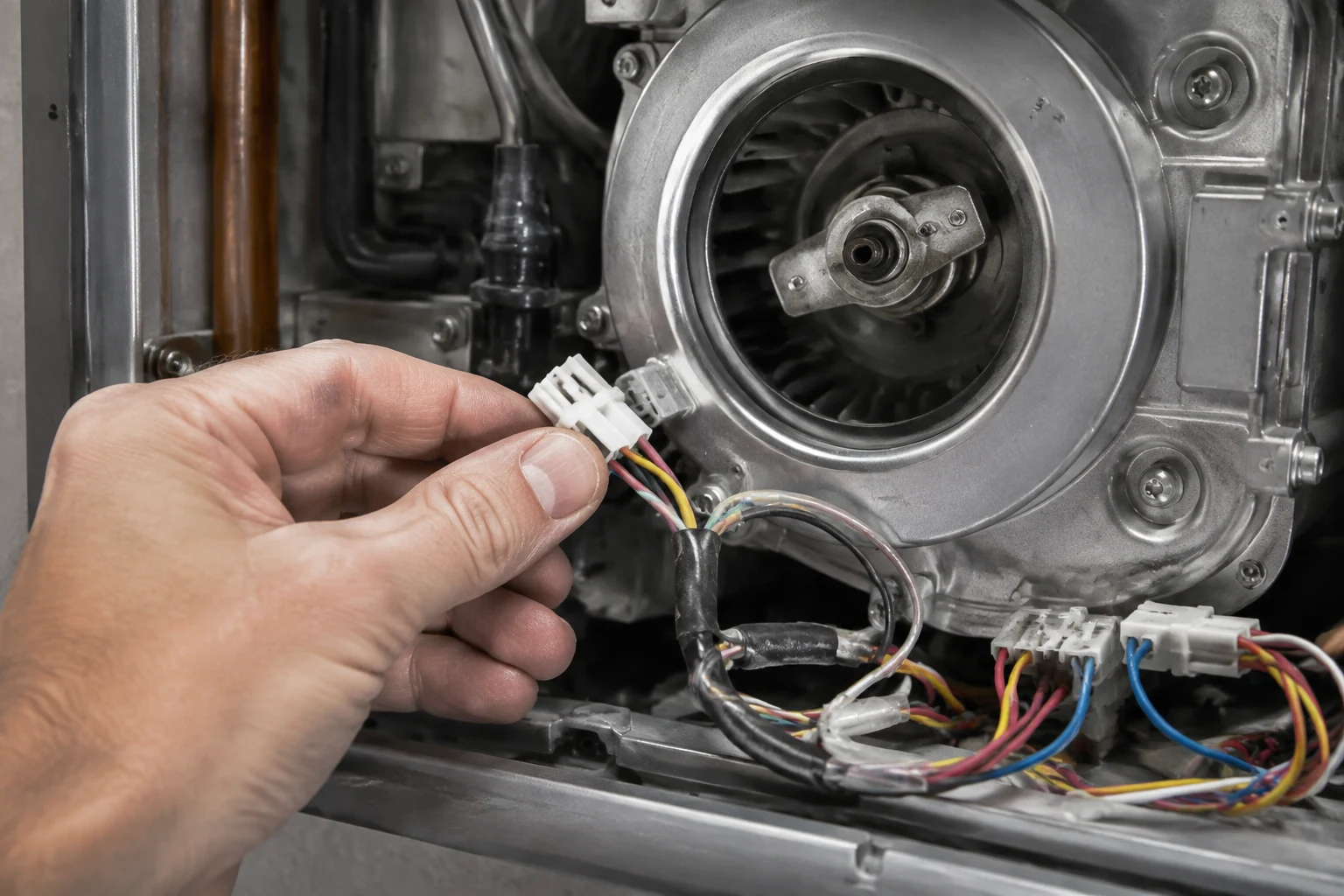
A loose or corroded connector at the fan or the board makes the current reading erratic and can mimic a failing motor. With power off, unplug and reseat the fan connectors. Look for green corrosion, melted insulation, or a burnt terminal. Firm, clean connections matter here.
Verify the fan turns freely and gets voltage
Rheem's own remedy: confirm the fan spins freely by hand with power off, and that it receives proper voltage when it should run. A fan that drags when you turn it, or one getting correct voltage but still straining, is a worn motor. That is a blower replacement.
Replace the fan, then suspect the PCB
If the fan is worn, fit a genuine Rheem combustion blower assembly. Only after the fan, the air path, the moisture check, and the wiring all come back clean do you consider the control board, which is the most expensive and least likely cause of a 79.
Power and gas off first
Before you open anything, cut the power at the dedicated breaker and shut off the gas. Rheem tankless units are sealed combustion appliances with a live control board and gas at the burner. Give the unit a few minutes, then work with power confirmed off. If you are not comfortable around a sealed gas appliance, stop here and call a licensed tech.
Why the fan matters more than you'd think
The combustion blower is not a cooling fan. It sets how much air reaches the burner, and correct airflow is what keeps combustion clean. When the board monitors fan current, it is really monitoring whether the unit can still move the right amount of air. A motor that strains today drifts toward wrong airflow tomorrow, which is why Rheem treats a current fault as a fault worth stopping for and not just a warning light.
Does code 79 mean my fan is broken right now?
Not necessarily. The fan is usually still spinning when 79 trips, which is exactly what separates it from code 61. What the board is telling you is that the fan is working harder than normal to do its job. That can be a temporary load like debris, or the first sign of a motor wearing out. It is a warning that the combustion blower needs attention, not proof that it has already died.
What you can safely do at home
The homeowner-safe end of a 79 is short but useful. Handle these, and if the code persists, you have already given a tech a head start.
- Cut power at the breaker for about 30 seconds, then restore it to clear the latched code.
- Run a hot tap and listen to the blower spin up. Note if it is loud, grindy, or slow.
- Inspect the intake and exhaust terminations outside for blockage, nests, or debris.
- With power off, vacuum visible dust from the accessible combustion-air path.
- Check around the fan motor and PCB for moisture, condensation, or corrosion.
- If the code returns every few cycles, or you hear a straining motor, book a service call.
Where the pro takes over
Everything past the air-path check and the reset is service-level work. Testing fan voltage and current, pulling and swapping the blower assembly, and diagnosing a control board on a sealed gas unit are jobs for a licensed tech with the right meter and parts. The blower assembly itself commonly runs about $150 to $350 for the OEM part, and installed you are usually looking at $350 to $600 depending on model and market. A control board, the worst case, can be $300 to $600 for the part alone, which is exactly why nobody should buy one before the fan and wiring are ruled out. If a tech tells you the board is the first thing to replace on a 79, get a second opinion.
Keeping code 79 from coming back
A combustion blower fails from load and moisture more than from age alone. Keep the intake and exhaust clear so the fan is not fighting a restriction, and keep the area around the unit free of the dust and lint that end up on the blower wheel. Make an annual service include a look at the fan: spin it by hand, check for moisture around the motor and board, and confirm the wiring is clean and tight. If your unit lives somewhere damp or dusty, that yearly check is cheap insurance against a 79 turning into a 61 on the coldest morning of the year, which is precisely when a dying fan tends to give up.
Frequently asked
What does Rheem error code 79 actually mean?
Code 79 is a fan motor current fault. The control board watches how much electrical current the combustion blower pulls while it runs. On a healthy unit that current sits in a normal band. When the fan starts drawing more than the board expects, meaning the motor is straining, the board flags 79. The fan is usually still spinning, it is just working harder than it should to hit the airflow the burner needs. That is the key difference from a dead-fan code. Rheem does publish 79 in its service manuals, so this is a real, documented code and not a generic catch-all. The remedy Rheem lists is to make sure the fan turns freely and gets proper voltage, then replace the fan motor, then the PCB if it comes to that.
Is code 79 the same as code 61?
They are close cousins on the same part, and it helps to think of them as a sequence. Code 61 is a fan motor fault where the board either sees no rotation feedback or the fan will not spin at all, a hard failure. Code 79 is the current fault, the fan is still turning but pulling abnormal current, which is the early-warning stage. A blower that throws 79 today often throws 61 a few weeks or months later once the motor bearings finally give up. That is why a 79 is worth acting on rather than resetting and ignoring. Both point at the same combustion blower assembly, so the diagnostic path overlaps almost completely.
Can I reset Rheem code 79 myself?
Yes, and clearing it is simple, but understand that a reset is not a repair. On most Rheem RTG and RTGH tankless units you clear a fault by turning the unit off at the remote controller or the on/off switch, or by cycling the power at the dedicated breaker or unplugging the unit for about 30 seconds, then restoring power. That drops the latched code. Because 79 is a mechanical current problem, though, it comes right back the next time the burner fires and the fan strains again. Use the reset to get one more run so you can watch and listen to the blower, not as a fix. If it clears and stays gone, something transient like a bit of debris cleared itself, but do not count on that.
Will descaling clear code 79?
No. This trips up a lot of owners because descaling is the fix for so many other tankless faults, but it does nothing here. Descaling flushes vinegar or a descaling solution through the heat exchanger to strip mineral scale off the water side. Code 79 lives entirely on the combustion-air side, at the blower motor that pushes air through the burner. There is no water anywhere near the part that is faulting. Keep descaling on schedule for the health of the heat exchanger, but if you are chasing a 79, the flush is the wrong tool. Cleaning the air path and checking the fan are the right moves.
How much does it cost to fix Rheem code 79?
It depends on where the fault lands. If it is dust or debris loading the blower wheel, cleaning the combustion-air path costs you nothing but time, or a service-call minimum if a tech does it, typically $100 to $200. If the fan motor is worn and needs replacing, an OEM Rheem combustion blower assembly commonly runs about $150 to $350 for the part, and installed with labor the job usually lands around $350 to $600 depending on the model and your market. If the fault turns out to be the control board misreading a healthy fan, a Rheem PCB is the expensive path, often $300 to $600 for the part alone. Because the board is the priciest and least likely cause, a good tech rules out the fan and wiring first.
Is Rheem code 79 dangerous?
The code itself is a protection, not the danger. The combustion blower controls how much air the burner gets, and correct airflow is what keeps combustion clean and safe. When the board sees the fan straining, shutting the unit down rather than letting a stressed blower keep feeding a burner is the safe move. So the lockout protects you. What you should not do is bypass or ignore it repeatedly. A blower that is failing can drift toward wrong airflow, which risks incomplete combustion, and a struggling motor near a control board is also a moisture and electrical concern. Treat a persistent 79 as a service item, not a nuisance to reset around, and never defeat the safety logic to force the unit to run.
Why does code 79 keep coming back after I reset it?
Because the reason the fan is straining is still there. The usual repeat offenders: the blower wheel is loaded with dust or lint and cannot move air freely, so the motor pulls extra current every cycle. Or condensation and moisture have crept into the motor or its connector, adding drag and load. Or a wire to the fan is loose or corroded, so the current reading is erratic. Or, most commonly on an older unit, the motor bearings are simply wearing out and the fan will keep pulling more current until it eventually seizes and throws code 61. A code that returns is telling you to open the unit and address the mechanical cause, not to keep clearing it.
Can a homeowner fix code 79 or do I need a pro?
A careful homeowner comfortable shutting off power and gas can handle the light end: cutting power, checking that the intake and exhaust are clear, and vacuuming visible dust from the air path where accessible. Beyond that, code 79 leans toward a pro. Opening a sealed combustion unit, testing fan voltage and current, replacing the blower assembly, and diagnosing a suspect PCB are service-level tasks. These units run on gas, so if you are not fully comfortable working around a sealed gas appliance, call a licensed tech. The reset and the air-path check are fair game at home. The blower swap and any gas or board work are not.