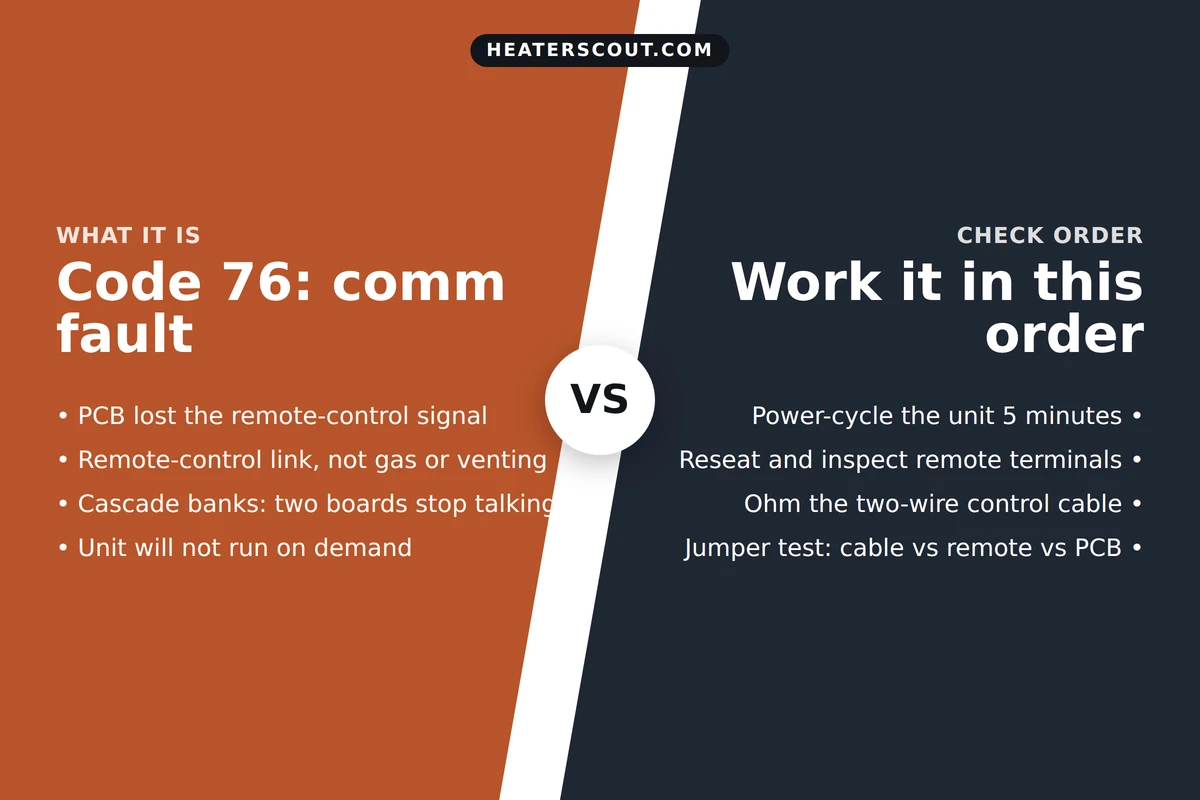
A Rheem tankless throwing code 76 is not a gas problem, a venting problem, or a heat-exchanger problem. It is the control board reporting that it has lost its conversation with the remote thermostat, the wall-mounted UMC controller you use to set the temperature. Two wires carry that conversation, and when one of them goes loose, corroded, or nicked, the board stops hearing the remote and refuses to fire. The good news is that 76 lives entirely on the low-voltage control side, so it is safe to work on and, more often than not, fixable without a new circuit board.
What the board means by 76
Inside a Rheem tankless, the main control board (Rheem calls it the PCB) is the brain, and the wall remote is how you tell that brain what temperature you want. They talk over a two-wire communication link. Code 76 is the board saying it can no longer hear the remote on that link. Depending on the model line the display may show it as a plain 76, or paired with a C4 prefix on older Paloma-built units, but the meaning is the same: the remote-control signal is gone.
Because 76 is a communication fault and not a combustion fault, the unit is not in a dangerous state. There is no carbon monoxide angle, no gas-valve angle, no venting angle. The only real consequence is that the board no longer gets a run command from the remote, so it will not fire the burner and you get cold water. That single fact shapes the whole repair: you are chasing an electrical connection, not a flame.
Is it always the wall remote, or can the board itself throw 76?
Either end can be at fault, plus the wire in between. The board throws the code because it stopped hearing the remote, but that silence can come from a broken cable, a corroded terminal, a failed remote, or a failed board. The code alone cannot tell you which. That is why the whole job is an isolation exercise: you prove the cable good, then the remote good, and whatever is left is the board. Do not assume it is the board and buy the most expensive part first.
The three ways a 76 actually starts
Almost every real-world 76 traces to one of three situations. Read these before you start pulling wires, because the situation you are in tells you where to look first and saves you from testing parts that are fine.
Loose or nicked control cable
The two-wire link between the board and the remote has a bad spot: a terminal backing out, a screw that never fully bit, green corrosion on a lug, or a spot where the cable was pinched behind drywall or nicked by a staple during install. The connection makes and breaks, so 76 comes and goes, often worse when the wire is disturbed. This is where you start every time.
Failing remote thermostat
The UMC remote itself is dying. A remote can work cold and drop out once its display warms up, or fail outright and go blank. If the cable ohms out clean end to end and the terminals are tight but 76 stays, the remote is the next thing to prove with a known-good swap. Remotes are far cheaper than boards, so confirm this before you touch the PCB.
Cascade link wiring
On ganged or cascaded installs, units talk to each other and to a common controller over communication cabling. A loose plug, a cable in the wrong terminal, or a mismatched unit address can make one board throw 76 even though its own wall remote is perfect. On any multi-unit system, check the inter-unit link and the dip-switch or address settings first.
Fix it in this order
Work the fault from cheapest and easiest to most expensive, and prove each part before you replace it. The whole point of the sequence is to spend money only on the part that is actually bad. Kill power at the breaker before you open the front cover: the low-voltage remote terminals sit close to line-voltage connections, and you want the unit dead while your hands are inside it.
On a cascaded or multi-unit bank, insert one more check between steps two and three: confirm the link cable between boards is landed on the correct terminals at every unit and that each unit's address or dip-switch setting matches the installation manual. A single misplugged link or a duplicated address can make one board show 76 while its own remote is perfectly fine, and no amount of remote testing will find it. Verify the common controller is wired to the lead unit before you suspect any single board.
Before you call a pro, run this list
A service call for a tankless runs real money, and a 76 is one of the codes a handy owner can often clear without one. Work down this checklist first. If you reach the bottom and the code stands, you have genuinely narrowed it to the board or a cascade-wiring issue, and that is worth a tech's time.
- Power-cycled the unit for a full five minutes and the code came right back.
- Front cover off with power dead, both remote terminals on the PCB reseated and free of corrosion.
- Every wire strand landed fully in its lug, no splayed strands, no screws left loose.
- Two-wire control cable ohmed end to end and reads near zero, including while flexing the run.
- Jumper test done: known-good wire straight from PCB to remote, result noted (fires or still 76).
- Known-good remote proven on the jumper if the cable tested good but 76 stayed.
- On multi-unit banks: inter-unit link cable seated on correct terminals, addresses and dip switches match the manual.
- Line power to the unit confirmed steady, since a sagging supply can mimic a comm dropout.
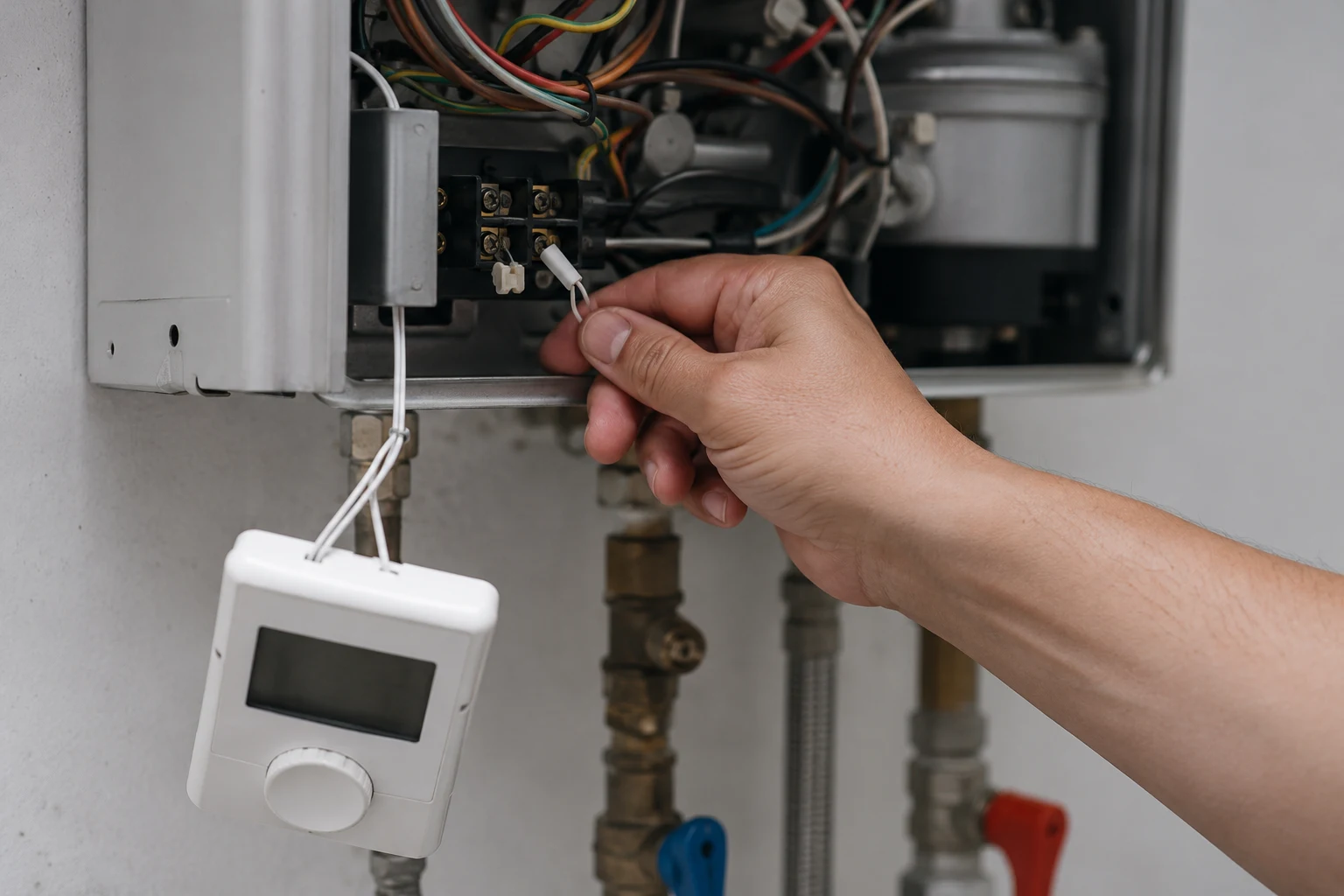
The reason 76 frustrates people is that they treat it like a mystery when it is really a process. The board is not being vague; it genuinely cannot hear the remote, and there are only four things in that conversation: the board, the remote, and the two wires between them. Prove each one and the failed part names itself. Skip the proving and you end up buying a $350 board to fix a $2 corroded terminal, which is the single most common way this repair goes wrong.
Frequently asked
Can I reset Rheem code 76 myself?
You can try, and it clears the fault often enough to be worth the two minutes. Kill power to the unit at the breaker, wait a full five minutes so the control board fully discharges, then restore power and call for hot water. If the code was a one-time glitch from a voltage sag or a momentary loose contact, it comes back clear. What a reset does not do is fix a bad cable, a corroded terminal, or a dying remote. If 76 returns the first time you run hot water, or within a day, stop resetting and start diagnosing. A code that comes right back is telling you the fault is still physically present on the remote-control link, and no amount of power cycling will make a broken wire whole.
Is Rheem code 76 dangerous?
No. Code 76 is a communication fault between the control board and the remote thermostat, or between two boards in a cascaded bank. It has nothing to do with gas, combustion, venting, or the heat exchanger, so there is no carbon monoxide risk and no fire risk tied to the code itself. The practical consequence is that the unit will not fire on demand, so you lose hot water. That is an inconvenience, not a hazard. The one caution is electrical: the low-voltage remote wiring runs near line-voltage terminals inside the unit, so shut power off at the breaker before you open the front cover and reseat or test anything. Do the work de-energized and there is nothing about a 76 that puts you in danger.
Why does Rheem code 76 keep coming back?
Because the underlying break is still there. Code 76 recurs when a remote-control wire is nicked, pinched, or corroded at a terminal and the connection makes and breaks as the wire flexes or the terminal oxidizes. It also recurs when the remote itself is failing intermittently, working when it is cool and dropping out when the display heats up. On cascaded units the recurring cause is usually the link cable between boards or a loose plug at one end. Chasing a recurring 76 with resets alone never works. You have to find the physical fault: reseat both ends, ohm the cable end to end, and run the jumper test to isolate whether it is the cable, the remote, or the board. Fix the physical connection and the recurrence stops.
How do I know if it is the cable, the remote, or the board?
Rheem's own manual gives you a clean test. With power off, disconnect the remote at the unit and run a short length of known-good wire straight from the remote terminals on the PCB out to the remote, bypassing the installed cable. Restore power and call for hot water. If the unit fires and the remote works on the jumper, the original in-wall cable is the fault, so replace it. If 76 still shows with a good jumper in place, move the test to the remote: swap in a known-good remote on the same jumper. Works now means the old remote was bad. Still shows 76 with a good cable and a good remote both proven means the fault is on the control board and the PCB needs replacing.
How much does it cost to fix Rheem code 76?
It depends entirely on which part is at fault, and the spread is wide. Reseating a loose terminal or cleaning corrosion costs nothing but your time. A replacement two-wire control cable is $10 to $30 in parts, plus labor if you cannot fish it yourself. A replacement Rheem UMC remote thermostat runs roughly $60 to $130. The expensive outcome is the control board: a Rheem tankless PCB is commonly $250 to $450 for the part, and with a service call and labor a board swap can land between $400 and $700 installed. This is exactly why you run the jumper test before buying anything. Confirm the failed part first so you are not spending board money on a cable problem, or the other way around.
Will code 76 stop my Rheem from making hot water?
Usually yes, because the control board takes its run command from the remote. When the board cannot hear the remote, it does not know you are asking for hot water, so it will not fire the burner and you get cold water at the tap. On some setups a fault-free bypass keeps the unit running at a default setpoint, but you should not count on that. Treat a live 76 as no hot water until the link is restored. If you have proven the fault is in the remote or its cable and you need hot water immediately while you wait on a part, the jumper test that runs a known-good wire straight to the board is also the temporary fix: it puts the remote back in contact with the board on wire you trust.
Does code 76 affect cascaded or multi-unit Rheem systems?
Yes, and on a bank of cascaded units it usually points at the link between boards rather than the wall thermostat. Rheem lets you gang multiple tankless units together so they share load, and those units talk to each other and to a common controller over communication cabling. If that cabling is loose, damaged, or plugged into the wrong terminal, one unit can throw 76 even though its own remote is fine. On a multi-unit system, check the inter-unit link cable and the connectors at every board, confirm each unit's address or dip-switch setting matches the install manual, and verify the common controller is wired to the lead unit. The isolation logic is the same as a single unit: reseat, ohm the run, then jumper to find the bad segment.