Code 61 shows up the moment you ask for hot water, and it means the same thing on every Rheem tankless model that uses it: the combustion fan, the small blower that moves air through the burner and out the vent, did not reach the speed the control board demanded. No proven airflow, no ignition. The board would rather leave you with a cold shower than light the burner with a fan it cannot trust. That is a good instinct, and it is why 61 is one of the more honest error codes: it points straight at the blower and the air it moves.
Two families of cause, and they get fixed differently
Every 61 traces to one of two places. Either the fan cannot spin the way it should, or the signals between the fan and the board are wrong. Sort your symptom into the correct column before you touch anything, because a mechanical clog gets a vacuum and a licensed tech gets the meter. Most homeowners can safely handle the left column. The right column is voltage work on a sealed gas appliance and belongs to a pro.
Fan or airflow (mechanical)
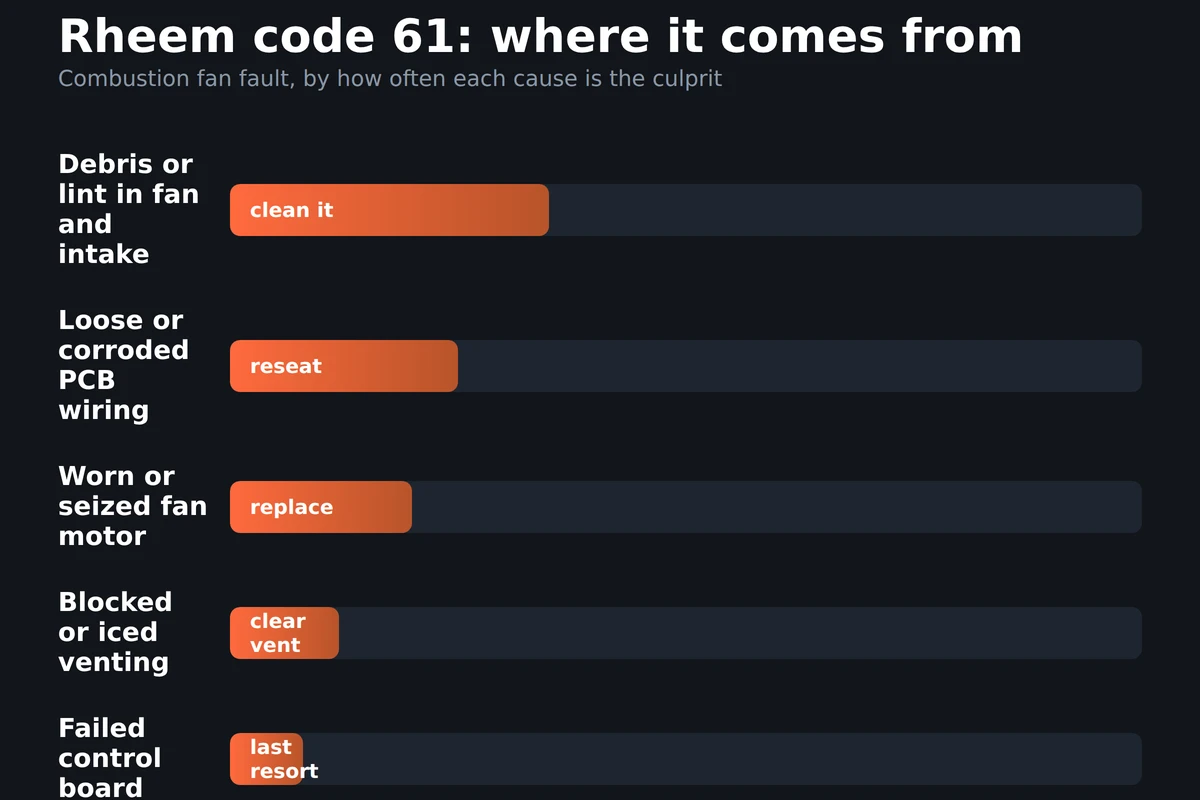
- Fan wheel packed with lint, dust, cobwebs, or an insect nest, dragging it below target speed.
- Motor bearing worn or starting to seize, so the wheel stalls or grinds when it warms up.
- Intake screen blocked with leaves or debris, or an exhaust vent choked, nested, or iced at the termination.
- Vent run too long, crushed, or improperly installed so the fan cannot move enough air to satisfy the board.
- Safe to inspect: kill power, look, vacuum gently, spin the wheel by hand to feel for free rotation.
Wiring or control (electrical)
- Loose or backed-out pin in the Molex connector where the fan harness plugs into the PCB.
- Corroded or damaged fan wiring dropping voltage under load, common on outdoor units.
- Board sending too little DC drive voltage to the fan, so it never spins up.
- Failed combustion fan motor that will not run even with correct voltage present.
- Failed control board, the least common cause and the last one to replace.
Sorting into the right column tells you how far you can safely go. Anyone can clear a screen and spin a wheel. Nobody without training and a meter should be probing connectors on a live gas control while chasing a combustion fault. Keep that line clear as you work.
Should I just keep resetting until it fires?
No. A reset is fine once, to confirm the code was not a one-time hiccup. Press the Power button off and on, or pull power for a minute or two, and try one hot-water call. If 61 comes right back, the fan or its air path is genuinely faulty and you are now overriding a safety interlock every time you reset. That interlock is the only thing confirming the unit can move combustion air and clear exhaust before it lights gas. Cycling past it repeatedly is how people end up burning gas with a dead fan and a vent that is not moving anything. Reset once, then diagnose, and if it will not clear on its own, shut it down.
Quick facts before you open the cover
These are the numbers worth having in front of you. They set expectations for what 61 is, what safely resets it, and roughly what the diagnostic voltages look like so you know when a tech is on the right track. The exact reading varies by model, so treat the voltage figures as a range from the field, not a spec to hold your unit to.
| What it reports | Combustion fan (blower) fault: fan did not reach the commanded speed during ignition |
| When it appears | On a hot-water call, before or during the ignition sequence, then a lockout |
| Safe homeowner reset | Press Power off and on, or unplug / trip breaker for 1 to 2 minutes |
| Safe DIY steps | Clear intake screen and vent debris, vacuum the fan wheel, confirm it spins freely |
| Pro-only steps | Measure fan DC drive voltage and Molex continuity, replace fan or control board |
| Typical fan drive voltage | Roughly 15 to 30 VDC at the fan connector during ignition (some indoor models 4 to 10 VDC at connector G, blue/yellow) |
| Common parts | Combustion fan / blower motor assembly, fan wiring harness, control board (PCB) |
| Do not | Keep resetting to force hot water; it defeats a combustion safety interlock |
Working through it in order
Diagnose 61 from cheapest and safest to most expensive, and stop at the first thing that fixes it. Skipping to a new board because 61 is on the display is how people spend 600 dollars to fix a clogged fan wheel. Each row below is a symptom paired with what it usually means and what to do about it.
Fan wheel is dirty, spins with drag or grinds
Lint, dust, cobwebs, or a nest in the wheel is the single most common cause of 61. Kill power, pull the cover per the manual, and inspect. Vacuum the wheel gently and spin it by hand: it should turn freely with only slight resistance and no grinding. Clean it, restore power, and retry. If the fan now reaches speed, you are done. This is safe for a homeowner and free.
Intake screen or vent is blocked
The fan can be perfect and still fail 61 if it cannot move air. Check the intake screen for leaves and debris, and on outdoor and vented units look at the exhaust termination for nests, crushed pipe, or ice in winter. A partially blocked vent starves the fan so it never satisfies the board. Clear what you can safely reach; a long or improperly installed vent run is a job for a pro to correct.
Fan will not turn at all, no noise
If the blower makes no sound and does not move during ignition, either it is dead or it is getting no drive voltage. This is where the meter comes in and where the homeowner steps back. A tech checks for the fan's DC drive voltage at the connector during the ignition sequence. Voltage present but no rotation means the fan motor is bad. No voltage means look upstream.
Wiring at the board looks loose or corroded
The fan harness plugs into the PCB through a Molex connector, and a pin that has backed out or corroded will drop voltage under load and throw 61 intermittently. A tech reseats the connector, checks each pin, and looks for chafed or damaged wire, especially on outdoor units exposed to weather. A 15-dollar connector fix beats a new board, which is why this comes before condemning the PCB.
Fan and wiring test good, voltage is missing or wrong
Only when the wheel spins free and clean, the wiring and connectors check out, and the board is not sending correct drive voltage to a known-good fan does the control board become the suspect. It is the last part to replace, not the first, because 61 is reported by the board but rarely caused by it. A tech confirms this by elimination, not by guessing off the display.
What the combustion fan actually does
Understanding the part makes the code obvious. The blower is not there for comfort or noise control; it is a metered part of combustion, and the board treats its speed as a live safety signal.
Combustion fan (blower)
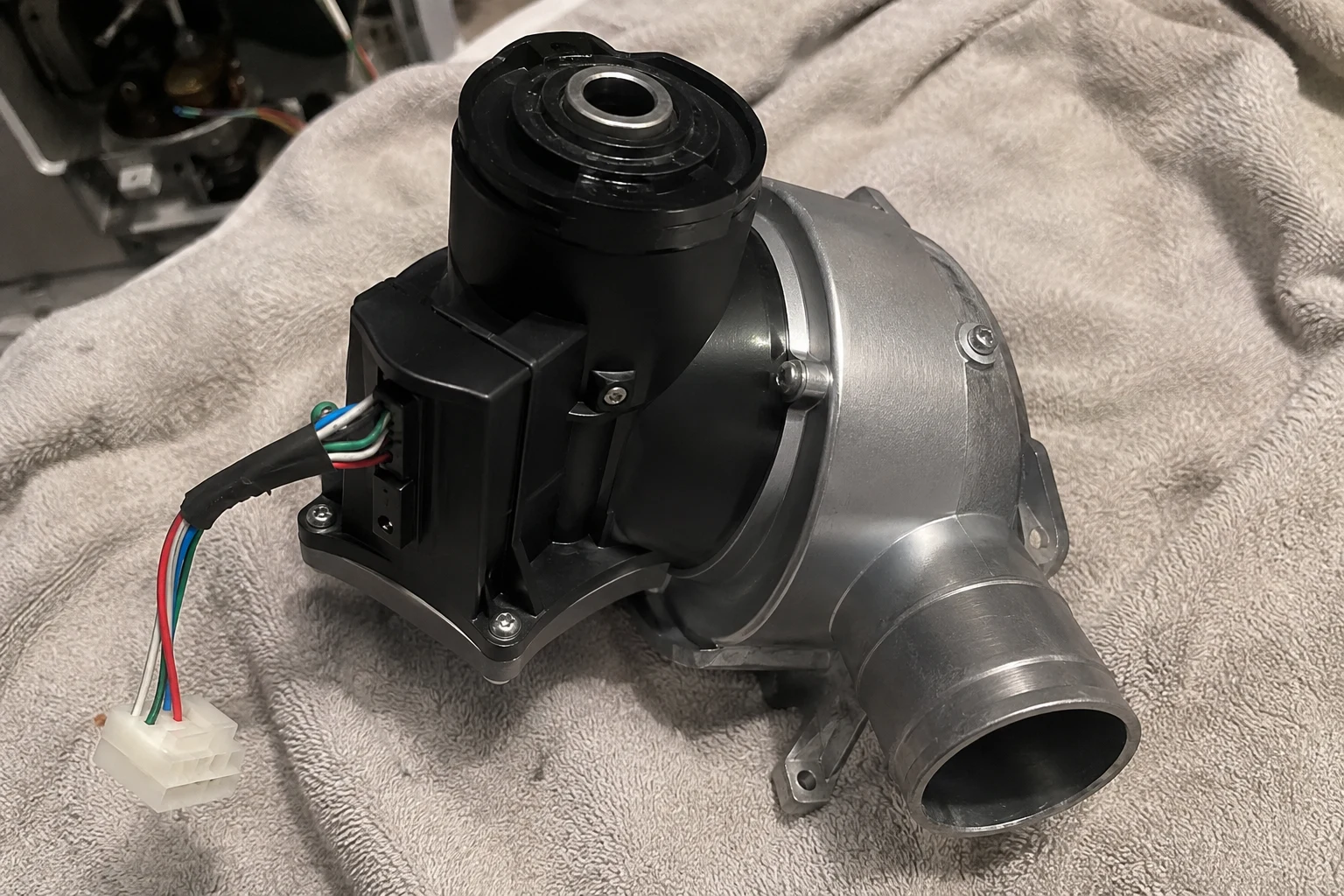
The combustion fan is a small variable-speed blower inside the tankless unit that moves combustion air through the burner and pushes exhaust out through the vent. On a sealed, power-vented tankless heater there is no natural draft to rely on, so the fan is what guarantees the burner gets enough air to burn gas cleanly and enough push to clear the byproducts outside. The control board commands it to a specific speed for the firing rate it wants and reads the fan's speed feedback continuously. Before it opens the gas valve and sparks the igniter, the board waits for the fan to prove it has reached that speed. That proof is the whole point of the interlock: it confirms air is moving before fuel ignites. When the fan cannot reach the commanded speed, the board has no proof of airflow, so it aborts and posts code 61 instead of lighting a burner it cannot vent safely.
That is why 61 is a hard line and not a warning you can dismiss. The fan is the difference between controlled combustion vented outdoors and unburned gas or exhaust with nowhere to go. The board is doing its job when it refuses to fire without a fan it trusts.
If you have cleared the code once, cleaned a free-spinning wheel, checked the intake and vent, and 61 still returns, that is your signal to stop resetting and bring in a licensed tech. The remaining causes all live behind a meter on a live gas control, and forcing the unit to fire past its own airflow check is the one thing you should never do to chase a hot shower.
Frequently asked
What does error code 61 mean on a Rheem tankless water heater?
Code 61 is a combustion fan fault. Rheem's control board runs a small blower, sometimes called the combustion fan or air-fuel blower, before and during every burn. That fan pulls combustion air in and pushes exhaust out through the vent, and the board reads its speed off a feedback signal. When you call for hot water, the board commands the fan up to a target RPM and waits for it to get there before it opens the gas and sparks the igniter. If the fan never reaches the commanded speed, spins too slow, or does not turn at all, the board aborts ignition and posts 61. It is a safety lockout with a simple logic behind it: no verified airflow, no fire. So 61 always points at the blower, its wiring, its drive voltage from the board, or the vent path the fan has to move air through.
Can I reset code 61 myself?
You can clear it once to confirm it is not a one-off. Press the Power button on the front panel to shut the unit off, wait a few seconds, and press it again, or pull the plug (or trip the dedicated breaker) for one to two minutes and restore power. That resets the lockout and the unit will retry the fan on the next hot-water call. If 61 clears and never comes back, a bit of lint or a momentary wiring hiccup was likely the cause. What you should not do is sit there resetting a combustion code over and over to force hot water. The fan interlock exists so the unit will not fire without proven airflow. If 61 keeps returning, stop cycling it and get the air path and fan looked at, because you are overriding the one check that keeps unburned gas and exhaust in bounds.
Is code 61 dangerous?
The code itself is the safe outcome. By locking out, the unit is refusing to burn gas without a working fan to move air and clear exhaust, which is exactly what you want. The danger is in defeating it. If you keep resetting to chase hot water, or if the real problem is a blocked or disconnected vent that the fan cannot overcome, you are pushing toward combustion without proper venting, and that is how carbon monoxide ends up indoors. Treat a persistent 61 as a reason to shut the unit down and call a pro, and make sure you have a working CO alarm near any gas appliance. The nuisance of a cold shower is not worth improvising around a combustion safety.
How much does it cost to fix Rheem code 61?
If it is dust in the fan wheel or a loose Molex plug at the board, the fix is free beyond a service-call fee, roughly 90 to 175 dollars for a tech to diagnose and clean. A replacement combustion fan or blower motor assembly runs about 120 to 300 dollars for the part on most Rheem tankless models, plus an hour or so of labor, so figure 300 to 550 dollars installed. A control board, the PCB, is the expensive end: 250 to 500 dollars for the board and 400 to 800 dollars installed depending on model and region. A good tech proves the fan and its wiring before condemning the board, because boards get blamed for what is really a 15-dollar connector or a clogged wheel.
Why does code 61 keep coming back?
A 61 that returns after a reset is telling you the fault is still physically present, not a glitch. The usual repeat offenders are a fan wheel packed with lint or a bug nest that drags the motor below target speed, a wiring pin at the PCB that is backed out just enough to drop voltage under load, or a motor bearing that is starting to seize and stalls when it warms. Outdoor and vented-through-a-long-run units add another: a partially blocked intake or exhaust, a screen full of leaves, or ice at the termination in winter, so the fan spins but cannot move enough air to satisfy the board. Chasing the same code with resets will not fix any of those. Each needs the actual part cleaned, reseated, or replaced.
Will cleaning the fan or intake clear code 61?
Often, yes, and it is the first thing to try because it is free and safe. On an outdoor unit or one with a screened intake, kill the power, pull the front cover per the manual, and look at the fan wheel and the air inlet. Lint, dust, spider webs, leaves, and insect nests are common, and any of them can drag the blower below the speed the board wants to see. Clear the screen, vacuum the wheel gently, and spin it by hand to confirm it turns freely with only slight resistance and no grinding. Restore power and call for hot water. If the fan now reaches speed, 61 stays gone. If it still throws the code with a clean, free-spinning wheel, the problem has moved to wiring, drive voltage, or the motor itself, and that is meter work for a tech.
Does code 61 mean I need a new control board?
Not usually, and it should be the last thing replaced, not the first. The board is what reports 61, so it gets blamed, but the code far more often comes from the fan, its wiring, or the vent. The correct order is to prove those out first. A tech confirms the wheel spins free and clean, checks the Molex connectors for loose or corroded pins, and measures the DC drive voltage the board sends to the fan. On many Rheem tankless models that reads roughly 15 to 30 volts DC at the fan connector during ignition, and on some indoor models the check is 4 to 10 volts DC at connector G between the blue and yellow wires. If that voltage is present but the fan will not run, the fan is bad. Only if the fan and wiring test good and voltage is missing or wrong does the board become the suspect.