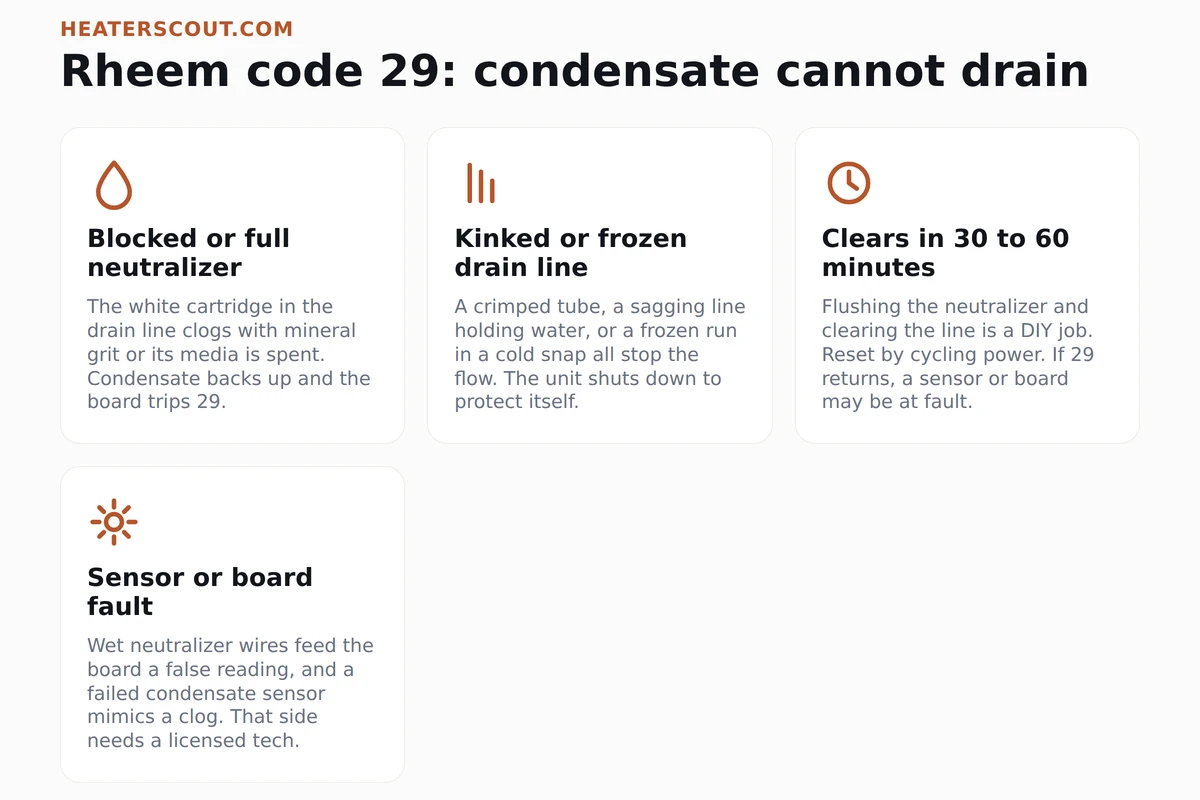
A Rheem condensing tankless pulls so much heat out of its own exhaust that water vapor condenses to liquid inside the heat exchanger, and a mid-size unit can make a gallon or more of that water an hour. It is mildly acidic, so it has to run through a neutralizer and out a drain before it leaves the cabinet. Error code 29 means that water is not getting out. The board sees condensate backing up, and it shuts the burner off rather than let acidic water sit inside. Nine times out of ten the cause is a clogged neutralizer or a blocked drain line, and both are things you can clear yourself in under an hour.
Does code 29 mean my Rheem is broken?
No. Code 29 is a protection shutdown, not a component failure by itself. The control board detected that condensate is not draining and stopped the burner on purpose. In most cases the unit is fine and the drain path is the problem: a clogged neutralizer cartridge, a kinked or sagging drain line, or in winter a frozen run. Clear the path, cycle power, and the unit runs again. It only points to a real component fault, a wet sensor or a bad board, when the drain is genuinely clear and 29 still comes back.
What is actually failing when you see 29
The condensate side of a high-efficiency tankless is a short, simple path, which is good news because there are only a handful of things that can block it. Condensate forms in the heat exchanger, drips into a collection point, runs through the neutralizer cartridge, and leaves through a drain line to a floor drain or condensate pump. Code 29 fires when the level in that path backs up past where the board expects it. The table below sorts the three mechanical causes by how you tell them apart, because the fix for each is different.
| What is wrong | How you spot it | The fix |
|---|---|---|
| Clogged or spent neutralizer | The white cartridge in the drain line is packed with gray mineral grit, or it is a couple of years old and the media inside is used up. Water pools above it. | Pull it, flush under a faucet until clear. If the media is spent or it clogs again fast, replace the cartridge, roughly $30 to $70. |
| Kinked or blocked drain line | The tube downstream of the neutralizer is crimped, sagging and holding water in a low spot, or packed with slime and scale. Flow is slow or stopped. | Straighten kinks, remove sags so the line runs continuously downhill, and flush the line clear. No low spots that can hold standing water. |
| Frozen drain line | It only happens in a cold snap, on a line that runs through an unheated space or outside. The unit ran fine until the temperature dropped. | Thaw the line, then reroute or insulate it so it stays above freezing. A frozen run will refreeze every cold night until you protect it. |
One caveat on the code itself. The dominant, board-defined meaning of 29 on Rheem condensing models is condensate drainage, and that is what this article covers. A few sources and a few older or non-condensing Rheem and rebadged model lines list 29, or a number close to it, against an ignition or flame problem instead. If your unit is not a condensing model, or your own manual lists 29 as something else, trust the manual for your exact model number rather than a general write-up. On a true condensing unit with a neutralizer, condensate drainage is the meaning you want.
Quick facts before you open the cabinet
A minute of orientation saves you from chasing the wrong part. Here is what the code is, which units throw it, and roughly what you are dealing with.
| What the board reports | Condensate is not draining; the neutralizer or drain path is blocked, or a sensor reads wet. |
| Affected units | Condensing (high-efficiency) Rheem tankless models with a condensate neutralizer, indoor RTGH and similar lines. |
| Most likely cause | Clogged or spent neutralizer cartridge, then a kinked, sagging, or frozen drain line. |
| Homeowner-fixable? | Yes for the neutralizer and drain line. No for a wet sensor or control board fault. |
| Reset | Clear the drain path, restore water, then cycle power to the unit. |
| Typical DIY time | 30 to 60 minutes. |
| When to call a pro | Drain and neutralizer are clear and 29 still returns, or you smell exhaust and the unit will not stay lit. |
| Rough cost | $0 to $70 DIY (rinse or new cartridge); $150 to $800 pro depending on whether it is the drain, a sensor, or the board. |
Clear it now, then keep it from coming back
There are two jobs here and they are worth separating. The left column is the repair you do today to get hot water back. The right column is the maintenance habit that stops you from doing the left column again next season. Most people do the left and skip the right, then see 29 again in a year when the neutralizer media runs out or the line sags back down.
Clear the drain now
- Cut power to the unit at the breaker or the on/off button, and shut the water off. Do not work on a live, hot unit.
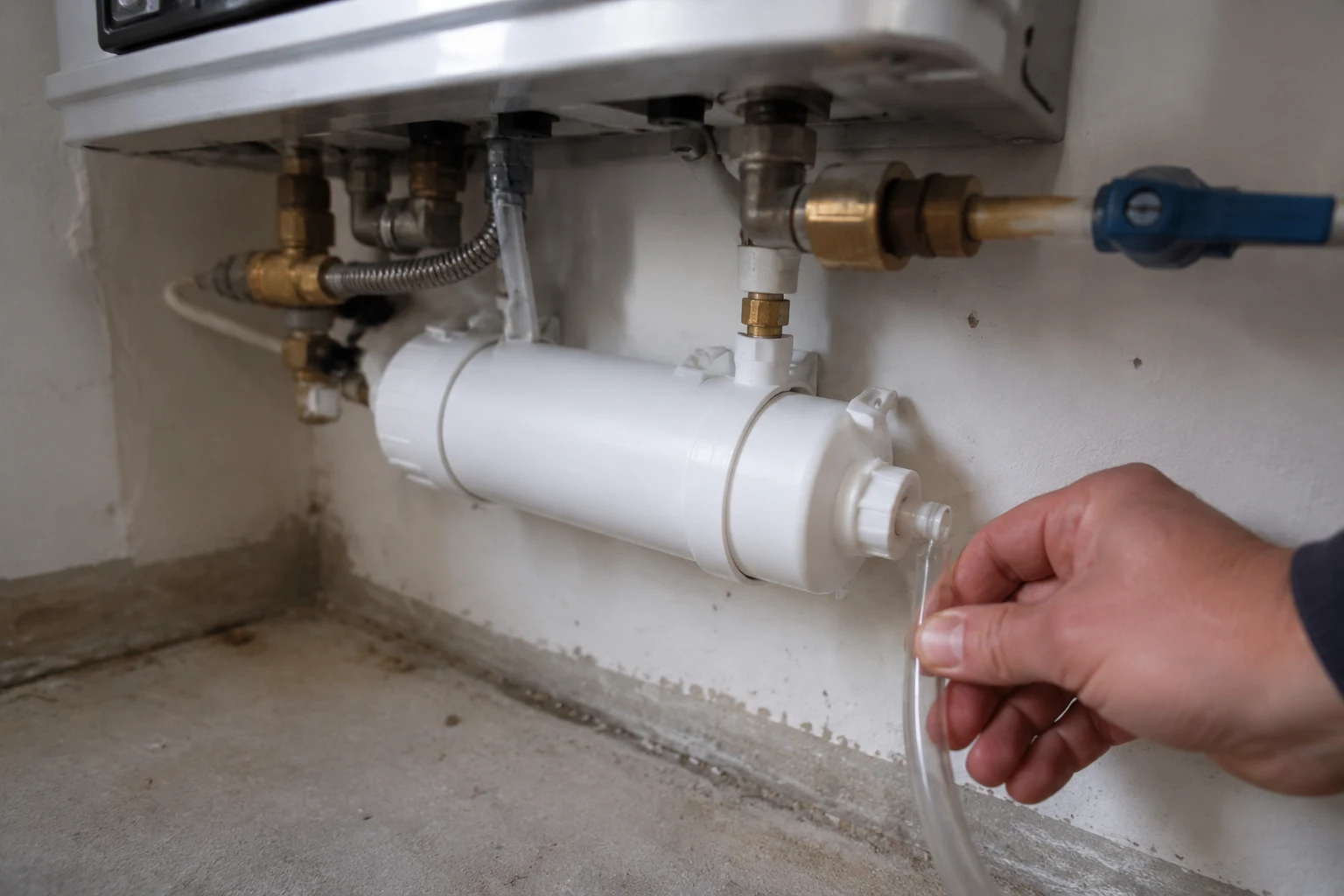
- Find the neutralizer, the white plastic cartridge spliced into the condensate drain line under or beside the unit. Have a towel and a small bucket ready.
- Disconnect the drain tubes and any small sensor wires, unclip or unscrew the bracket, and lift the neutralizer out.
- Flush the cartridge under a faucet, shake it, and keep rinsing until the water runs clear instead of gray. If the media is used up or it clogs again fast, replace the cartridge.
- Clear the drain line downstream: straighten kinks, flush out slime and scale, and make sure it runs continuously downhill with no low spots.
- Reinstall the neutralizer, reconnect tubes and wires, restore water, then restore power to reset the 29.
Keep it from coming back
- Replace the neutralizer media on schedule. The stones inside get used up in a couple of years; a rinse cleans grit but does not restore spent media.
- Route the drain line with continuous downward slope. No sags, no long flat runs that hold standing water and clog again.
- In cold climates, keep the entire drain run above freezing. Insulate it or reroute it out of unheated space so it cannot freeze on a cold night.
- Fold neutralizer service into your annual descale visit. The covers are already off, so clean the condensate side while you are at the water side.
- Keep the area around the drain and any condensate pump clear so a backed-up pump cannot push water the wrong way into the unit.
- If you see 29 twice in one season after clearing it, stop resetting and have the condensate sensor and board checked before damage adds up.
When 29 is not the drain at all
Assume you pulled the neutralizer, flushed it clean, cleared the line so it runs downhill, reset the unit, and 29 came right back within a cycle or two. At that point the mechanical path is not your problem and you should stop flushing. Two electrical causes remain. The condensate level sensor can fail or read wet, telling the board water is backing up when it is not. And the small wires at the neutralizer can get wet or corroded and feed the board a false signal. Both involve testing live low-voltage circuits and, on a gas appliance, working around the burner and venting, so that is where a homeowner should hand off to a licensed tech. Forcing repeated resets past a 29 you cannot clear is the one thing not to do: the code exists to stop acidic condensate from sitting in the cabinet, and every reset that ignores it lets that water keep working on the heat exchanger and the electronics.
The reason 29 is worth taking seriously on a condensing unit, more than a nuisance flow code, is what it is protecting. Condensing efficiency comes from wringing the last heat out of the exhaust, and the price of that efficiency is a steady stream of acidic water the unit has to get rid of cleanly. Keep that one drain path clear and the neutralizer fresh, and a high-efficiency Rheem will run for years without ever showing you a 29.
Frequently asked
What does error code 29 mean on a Rheem tankless water heater?
On a condensing Rheem tankless, code 29 means the unit made condensate it cannot drain. Every high-efficiency Rheem pulls so much heat out of the exhaust that water vapor condenses inside the heat exchanger. That water is mildly acidic, so it runs through a neutralizer cartridge and out a drain line before it leaves the unit. When the neutralizer is clogged or spent, the line is kinked, blocked, or frozen, or the condensate sensor reads wet, the control board sees the level backing up and shuts the burner down with a 29. It is a self-protection fault: the board would rather stop than let acidic water sit in the cabinet. A few older or non-condensing model lines list 29 or a close number against an ignition problem instead, so if your unit is not a condensing model, verify the code against your own manual before you chase the condensate side.
Can I clear code 29 myself, or do I need a plumber?
The most common cause, a clogged neutralizer or drain line, is a homeowner job. You cut power and water, pull the neutralizer cartridge, flush it under a faucet until the water runs clear, clear the drain line, reinstall everything, then cycle power to reset. That is a 30 to 60 minute job with hand tools. Where you should stop and call a licensed tech is when the drain and neutralizer are visibly clear and 29 still comes back. At that point you are looking at a wet or failed condensate sensor, damaged neutralizer wiring, or a control board reading the level wrong, and those involve live electrical testing and Rheem-specific parts.
How do I reset a Rheem tankless after fixing the condensate drain?
After you have flushed the neutralizer and cleared the line, restore the water, then restore power to the unit. Cycling power clears the active fault. On units with a remote controller you press the on/off button to power the unit back up; the 29 should be gone from the display. If your model logs error history, the past 29 may still show in the history menu, which is normal, that is a record, not an active fault. Run hot water for a few minutes and watch that the burner fires and stays lit. If 29 reappears within a cycle or two, the drain is not actually clear or a sensor is at fault.
Why does Rheem code 29 keep coming back after I cleaned it?
Three reasons show up again and again. First, the neutralizer media is spent, not just dirty: the little stones inside get used up over a couple of years and stop neutralizing, and a rinse does not restore them, you replace the cartridge. Second, the drain line has a low spot or a long horizontal run that holds water, so it clogs again as soon as it refills; the line needs continuous downward slope with no sags. Third, the fault is not really the drain at all but a condensate sensor or wet wiring feeding the board a false full reading, which no amount of flushing will fix. If you have cleared the mechanical side twice and 29 keeps returning, stop flushing and get the sensor and board checked.
Is Rheem error code 29 dangerous?
The code itself is the safe outcome, not the danger. The board fires 29 and shuts the burner off specifically so acidic condensate does not pool inside the cabinet where it can corrode metal and wiring. The risk is ignoring it: if you keep resetting past 29 without clearing the drain, condensate keeps backing up, and over time that acidic water eats at the heat exchanger and electronics. There is also a carbon monoxide angle on any gas appliance that is not venting and draining correctly, so a unit that will not stay running should not be forced. Fix the drainage or have it serviced rather than resetting around it.
How much does it cost to fix Rheem code 29?
If it is a clogged neutralizer or drain line and you do it yourself, it costs nothing but time, or the price of a replacement neutralizer cartridge, which runs roughly $30 to $70 depending on the model. A plumber clearing the drain and flushing the neutralizer typically runs $150 to $350 in labor for a straightforward call. If the fault turns out to be a condensate sensor, expect the part plus labor in the $200 to $450 range. A failed control board is the expensive end, often $400 to $800 installed. The spread is wide because 29 covers everything from a $0 rinse to a board swap, which is exactly why you clear the cheap causes first.
Will descaling my Rheem tankless clear code 29?
No, and it is worth understanding why. Descaling flushes vinegar or a descaler through the water side of the heat exchanger to remove hard-water scale that causes flow and heating faults. Code 29 lives on the condensate side, which is a completely separate path: the water the unit makes and drains, not the water it heats. A descale will not touch a clogged neutralizer or a blocked drain line. That said, doing an annual descale and cleaning the neutralizer at the same visit makes sense, since you already have the covers off. Just do not expect the descale itself to move a 29.