On a Rheem tankless the number 14 on the remote is not a nuisance blink, it is the heat exchanger telling the control board it got too hot. Rheem's own RTG-series troubleshooting pages label the fault plainly: Overheat Film Wrap Activated. A thermal safety wrapped around the exchanger opened because the metal ran past its limit, roughly 207 degrees at the surface on most units, and the board cut the burner to protect the machine. Clearing the code is easy. Clearing the reason it overheated is the actual job, and nine times out of ten it starts with the scale nobody flushed out.
Code 14: Overheat Film Wrap Activated
The overheat film wrap is a thin thermal-limit sensor bonded around the heat exchanger, a last-resort safety that watches the metal temperature directly. In normal operation the exchanger surface tracks close to your setpoint and the wrap stays closed and silent. When the surface climbs past its limit, near 207 degrees on typical Rheem RTG and RTGH units, the wrap opens and the control board reports code 14 and locks the burner out. So 14 is not a reading of your water temperature or a flame fault. It is the board saying the physical body of the heat exchanger got hotter than it is ever supposed to get, and the safety did its job.
That distinction matters because it tells you where to look. A flame-loss code sends you to gas and igniters. Code 14 sends you to anything that lets the exchanger hold heat it should be shedding into the water or venting out the flue. The heat is real. Something is trapping it or feeding the burner more than the exchanger can safely dump. Find that, and the code stays gone.
Will descaling clear code 14, or am I wasting my time?
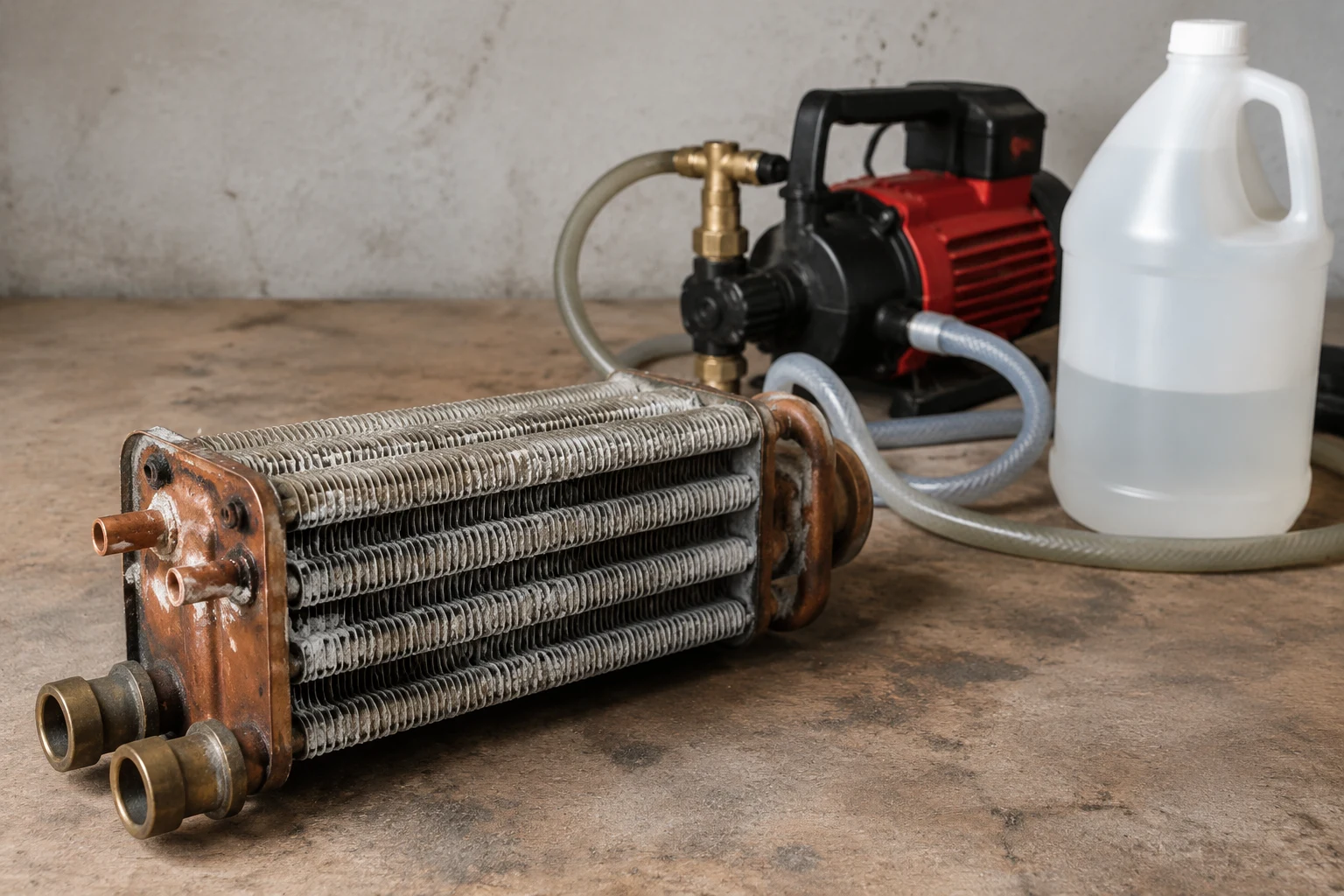
Descaling is the highest-odds first move, not a shot in the dark. Scale is an insulator. When calcium and magnesium plate the inside of the copper exchanger, heat that should pass into the flowing water gets stuck in the metal, the surface temperature climbs, and hot spots form where the deposit is thickest. Those hot spots are exactly what pushes the film wrap past its limit. A 45 to 60 minute descale flush dissolves that mineral layer and restores heat transfer, so on a unit that has never been serviced in a hard-water home, a descale clears a large share of code 14 events outright. Where it does not help is when the real cause is airflow, gas type, or a cracked exchanger, so if 14 returns within a day or two of a thorough descale, stop there and move to the vent and combustion checks instead of running the flush again.
Why the exchanger overheats in the first place
Code 14 has a short list of real causes, and they sort by how likely they are and how much of the fix you can safely do yourself. Scale leads the list in almost every hard-water region. Airflow and venting come next, and they are half homeowner-checkable. Gas type and a damaged exchanger are pro territory. Work the list in order and you rarely chase your tail.
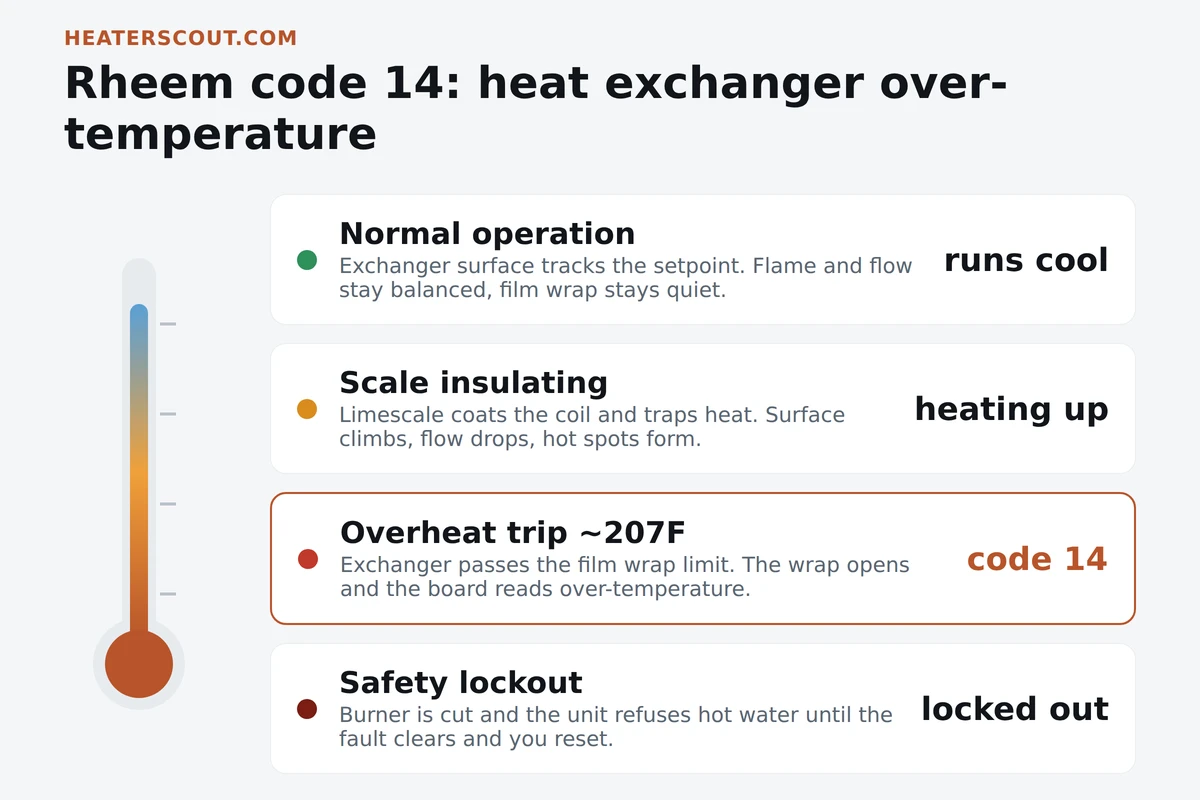
Scale is the quiet cause because it builds for years before it trips anything. Every gallon of hard water that flashes to hot inside the exchanger leaves a little calcium and magnesium on the copper. That layer does two bad things at once. It insulates, so the burner runs the metal hotter to move the same heat into the water, and it narrows the water passages, so flow slows and the same flame heats less water. Both push the exchanger surface up. On a unit that has never been descaled in a home with 15-plus grains of hardness, this is the default answer to code 14 until a descale proves otherwise.
Airflow and venting are the next tier, and a gas tankless unit is fussy about both. The burner needs clean combustion air in and a clear path for hot exhaust out. Block either and the heat has nowhere to go but back around the exchanger. A vent terminal outside can get packed with a nest, leaves, snow, or lint. An exhaust run can be crushed or too long for the manufacturer's limit. An intake screen can clog, or the unit can sit in a sealed closet starved of makeup air. Any of those traps flue heat against the exchanger and trips 14. The outside terminal is the one thing here a homeowner can safely inspect and clear.
The last two causes are less common but more serious. If the unit is fed the wrong gas, for example a propane machine run on natural gas or configured wrong at install, combustion runs off and can overheat the exchanger. And the exchanger itself can crack or separate at a seam after years of heat cycling, especially if it has been overheated repeatedly by scale or a bad reset habit. Both need a licensed tech, and both are why you do not just keep resetting a code 14 to make it go away.
| Rheem name for the code | Overheat Film Wrap Activated (heat exchanger over-temperature) |
| Typical units | Rheem RTG and RTGH tankless, RTG2-series and similar (natural gas and LP) |
| What tripped | The thermal film wrap around the heat exchanger opened on high temperature |
| Overheat threshold | Exchanger surface roughly 207 degrees Fahrenheit on most models |
| Most likely cause | Scale insulating the heat exchanger in hard-water homes |
| Next causes | Blocked vent or airflow, wrong gas type, cracked or separated exchanger, failed sensor |
| Difficulty | Descale and vent-terminal check are DIY; the rest is a licensed pro |
| Do not | Repeatedly reset or bypass the overheat safety; it is protecting the exchanger |
Scale vs low flow vs a bad sensor: telling them apart
Three failure patterns hide behind the same number, and they call for different fixes. The way they behave over time is your best clue before a tech ever opens the cover. A code that creeps in gradually over months points one way; a code that appears only during long draws points another; a code that fires cold and instantly points at the sensor circuit itself.
| Pattern | Scale insulation | Restricted flow or airflow | Failed film wrap or thermistor |
|---|---|---|---|
| When it trips | Gradually more often over months, worse in winter | During long or high-demand draws, or right after a vent block | Can trip cold, immediately, or randomly with no heat load |
| What you notice | Weaker hot water, slower recovery, unit runs hotter to keep up | Fluctuating temperature, unit hunting, exhaust smells or backs up | Code with no logical heat cause; unit was fine seconds earlier |
| First check | Service history: has it ever been descaled on hard water? | Vent terminal outside, intake screen, exhaust run length and crush | Sensor resistance and wiring, done by a tech with the service manual |
| Homeowner fix | Run a proper descale flush (45 to 60 min) | Clear the outside vent terminal and any intake screen | None; this is a diagnostic and parts job for a pro |
| Pro fix | Deep descale, inspect exchanger for damage from prior overheating | Correct vent run, verify length and clearances, restore combustion air | Test and replace film wrap or thermistor, verify gas type and pressure |
| Rough cost | $150 to $300 descale | $100 to $250 service call | $30 to $120 part plus 1 to 2 hours labor |
The single most useful question is whether the unit has ever been descaled. In a hard-water home that has run for years with no maintenance, code 14 is scale until proven otherwise, and the descale is both the diagnosis and the fix. If the log shows a recent descale and 14 still comes back, the odds shift toward airflow and the exchanger, and the reset button stops being a reasonable response.
What to do, in order
Start with the safe, high-odds moves and escalate only if they fail. First, reset once at the breaker or remote to confirm 14 was not a one-time flow hiccup. If it clears and stays gone through normal use, you had a fluke. If it returns, do not keep resetting. Next, walk outside and inspect the vent terminal: clear any nest, leaves, snow, or lint, and check that nothing is leaning against it or blocking the exhaust. Check the intake screen if the unit is direct-vent. Those two steps handle the airflow tier and cost nothing.
Then, if the unit has isolation valves and you are comfortable with the procedure, run a full descale. Pump a food-grade or commercial tankless descaler through the heat exchanger for 45 to 60 minutes, flush with clean water, and clean the inlet filter screen while you are in there. That clears the most common cause. If 14 still returns after a good descale and a clean vent, stop and call a licensed tech. At that point the likely answers are wrong gas type, a vent run that violates the manufacturer's limits, a failed film wrap or thermistor, or a cracked heat exchanger, and each needs instruments and, for the exchanger, a real repair-versus-replace decision.
Keeping code 14 from coming back
The one habit that prevents most of these is an annual descale in any home with hard water, plus a cleaning of the inlet filter screen at the same time. On very hard water, twice a year is not overkill, and a whole-house softener upstream makes the exchanger last far longer. Keep the outside vent terminal clear of nests, snow, and lint, and never let anyone reduce or extend the vent run past what the manufacturer allows. If a tech ever converts the unit between natural gas and propane, confirm the conversion kit and settings match your fuel. Do those things and the film wrap around your heat exchanger stays closed and quiet, which is exactly where you want it.
Frequently asked
Will descaling clear code 14 on my Rheem tankless?
Often, yes, and it is the first real fix to try because scale is the most common driver of code 14. Limescale from hard water plates onto the copper heat exchanger and acts like a blanket. Heat that should move into the water gets trapped in the metal, the surface temperature climbs past the film wrap limit, and the safety trips. A proper descale flushes a food-grade or commercial descaler through the exchanger for 45 to 60 minutes, dissolves the mineral layer, and lets the coil shed heat normally again. If the unit has never been descaled and you are on hard water, this alone clears a lot of code 14 events. It will not help if the real cause is a blocked vent, the wrong gas, or a cracked exchanger, so if 14 comes back within days of a good descale, stop resetting it and get the airflow and the exchanger checked.
Can I reset code 14 myself?
You can, by cycling power at the breaker or the remote, and the display will clear. But understand what you are doing. Code 14 is an overheat safety, the last line before real damage. Resetting it tells the unit to fire again into the exact condition that just cooked the heat exchanger. If the cause was a one-time flow hiccup, it may run fine. If the cause is scale, a plugged vent, or a cracked exchanger, you are stacking heat cycles on a part that is already failing, and you can turn a descale into a new heat exchanger. Reset once to confirm it was not a fluke. If 14 returns, treat it as a real fault and diagnose the cause before you reset again.
Is Rheem code 14 dangerous?
It is the code that exists to keep things from getting dangerous, so treat the trip itself as the system working. An overheating heat exchanger can push scalding water downstream and, if the cause is a venting or combustion problem, it can point to poor exhaust of hot flue gases. The film wrap cutting the burner is the safe outcome. The danger comes from defeating it, repeatedly resetting an overheat safety or, worse, bypassing the film wrap so the unit keeps firing. Never do that. A gas unit that overheats from a blocked vent is a combustion concern, not just an inconvenience, and that is a licensed-tech call.
How much does it cost to fix Rheem code 14?
It depends on the cause. A professional descale, which clears most scale-driven 14s, runs about $150 to $300 depending on your area and whether the tech adds isolation valves. Clearing a blocked vent terminal is usually a service-call charge, roughly $100 to $250. A failed film wrap sensor or thermistor is a modest part, maybe $30 to $120, plus an hour or two of labor. The expensive outcome is a cracked heat exchanger. On many units the exchanger is a large share of the machine's value, so a replacement can run several hundred to over a thousand dollars installed, and at that point owners often weigh it against a new unit.
Why does code 14 keep coming back after I reset it?
Because a reset clears the display, not the reason the exchanger overheated. If 14 returns, the heat is still building somewhere. On hard water the usual answer is scale you have not removed yet, so the descale is still owed. If the unit was descaled and 14 still returns, look at airflow: a vent terminal blocked by snow or a nest, a crushed or too-long exhaust run, or intake air starved in a tight closet. A code 14 that keeps returning after descaling and a vent check usually means the exchanger itself is cracked or separated, a pro diagnosis.
Does a blocked vent really cause an overheat code?
Yes, and it is one of the top causes after scale. A gas tankless unit needs a clear path for combustion air in and hot exhaust out. If the exhaust terminal is blocked by a nest, leaves, snow, or lint, or if the run is crushed or too long, hot flue gases back up around the heat exchanger instead of leaving the building. That trapped heat drives the exchanger surface past the film wrap limit and trips code 14. The same happens if combustion air is starved, for example a sealed closet with no makeup air. Check the vent terminal outside first, it is the easiest thing to clear, then have the full run and gas type verified by a tech.
Should I call a pro for code 14 or fix it myself?
Split it. The homeowner-safe part is clearing the obvious airflow blocks, the outside vent terminal and any intake screen, and running a descale if the unit has isolation valves and you are comfortable with the flush. Those handle the two most common causes. Everything past that is a pro job: verifying gas type, inspecting the exchanger for cracks, testing the film wrap and thermistors, and confirming the vent run meets the manufacturer's limits. Because 14 is an overheat safety on a gas appliance, if a quick vent check and descale do not clear it, bring in a licensed tech rather than resetting your way through it.