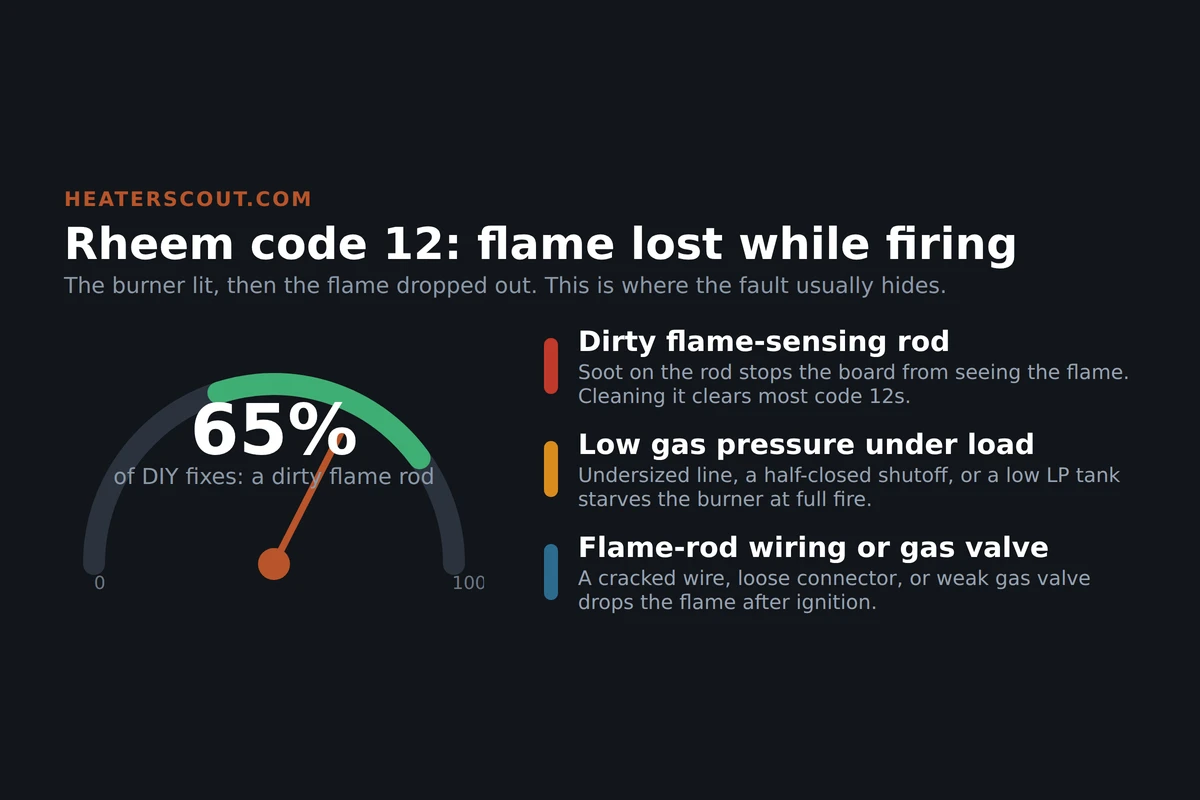
Code 12 on a Rheem tankless water heater means the burner lit, ran for a moment, and then the control board lost sight of the flame, so it shut the gas off and locked out. That is different from a unit that never lights at all. Roughly two out of three times a homeowner clears this without a tech, the cause is a flame-sensing rod coated in soot, and the fix is a few minutes with fine steel wool. The rest of the time it is gas pressure sagging under full firing, a cracked flame-rod wire, or a tired gas valve. This walks the causes in the order a Rheem tech would check them on an RTG or RTGH unit.
Is code 12 the same as no ignition?
No. No ignition shows as code 11: the unit tried to light and got no flame at all, so you look at the igniter and the gas valve opening. Code 12 is flame loss: the unit did light, the board saw a flame, and then the flame dropped out during the run. Watch the burner. If it fires briefly and then dies with a 12, you have a flame-holding problem, and the flame rod and gas pressure are the first two suspects, not the igniter.
Quick facts on Rheem code 12
Before you pull a single panel, here is what the code is telling you and how to clear it. The reset clears the fault memory, but if the flame keeps dropping out the code returns the next time you run a long hot draw, so treat the reset as step zero, not the fix.
| Code | 12 (flame failure / flame lost during operation) |
| What the board reports | The unit ignited, then the flame-sensing rod stopped confirming a flame, so the gas valve closed and the unit locked out. |
| Series affected | Rheem RTG and RTGH gas tankless units (indoor and outdoor), and the matching Ruud models. |
| Reset method | Press the reset / on-off button on the control board until it clicks, or turn the unit off, wait about 30 seconds, and back on. A breaker cycle works too. |
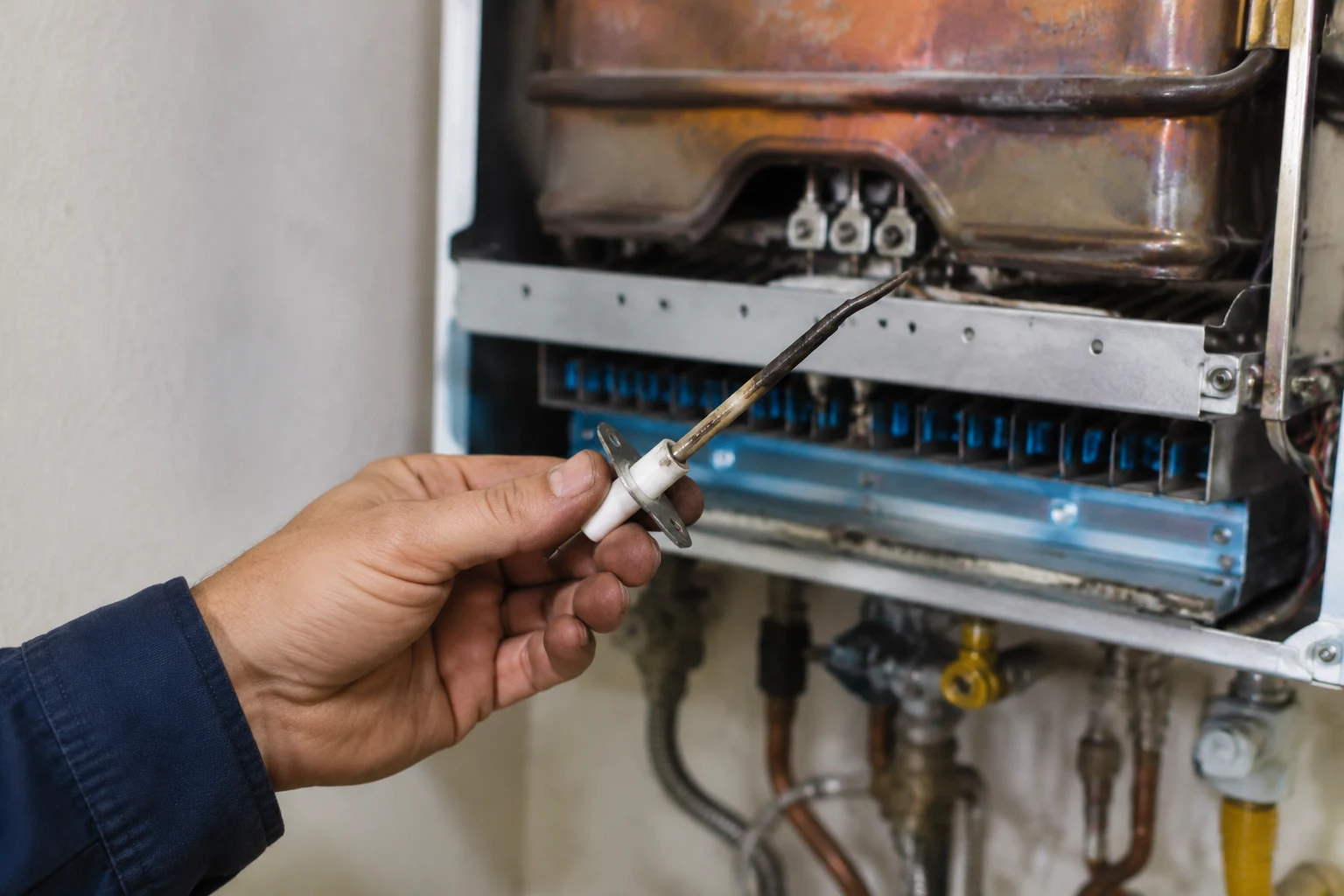
| Most common part | The flame-sensing rod on the burner assembly, cleaned with 0000 steel wool. A replacement rod runs about $30 to $80. |
| Gas pressure target | Dynamic (firing) inlet pressure at least 3.5 in. WC for natural gas, at least 8.0 in. WC for LP, measured while the unit runs at full output. |
| DIY friendly? | Partly. Cleaning the flame rod, checking the shutoff, and reseating wiring are safe. Adjusting the gas valve or manifold pressure is a licensed-tech job. |
Work the fix in this order
Do the cheap, likely fixes before you touch anything gas-related that needs a manometer or a wrench on the valve body. Between each step, reset the unit and run a long hot draw, because code 12 only shows up once the burner has been firing for more than a few seconds. If the code clears after a step and stays gone through a full-demand test, you are done.
Code 11 vs 12 vs 13: which flame fault you actually have
Rheem groups its flame and combustion faults into three codes, and mixing them up sends you after the wrong part. The short version: 11 is a burner that never lit, 12 is a burner that lit and then lost the flame, and 13 is a burner running with the wrong air-to-fuel mix. Match the symptom you see at the unit to the row below before you start pulling parts.
| Code | What it means | What you see | First things to check |
|---|---|---|---|
| 11 | No ignition. The unit tried to light and got no flame at all. | Unit clicks or sparks, no burner light, then faults. | Gas shutoff open, gas line not empty (bled after LP refill), igniter, gas-valve opening. |
| 12 | Flame loss. The unit lit, then the flame dropped out during the run. | Burner fires briefly, then dies and locks out under load. | Sooted flame-sensing rod, flame-rod wiring, gas pressure sagging under full firing, gas valve. |
| 13 | Combustion problem. The burner runs with a poor air-to-fuel ratio. | Unit runs but flags 13; more common on indoor vented units. | Blocked or recirculating intake and exhaust venting, debris or nests in the vent, combustion air supply. |
The overlap that trips people up is between 12 and 13. Both involve the flame rod reading something the board does not like. The tell is timing and behavior: a 12 unit lights and then the flame physically drops out and it locks out, while a 13 unit keeps running but complains that the mix is off. If your unit fires and holds but throws 13, chase the venting. If it fires and then dies with a 12, chase the flame rod and gas pressure.
Keeping code 12 from coming back
A flame rod that fouled once will foul again if the unit runs rich or the venting keeps disturbing the burner, so the durable fix is often upstream of the rod. Descale the heat exchanger on schedule, because scale changes how the burner runs and speeds up sooting. Keep the intake and exhaust terminations clear of leaves, lint, snow, and nests, and make sure the exhaust cannot recirculate back into the fresh-air intake. If the unit shares a gas line with a furnace and range and code 12 shows up only when everything runs at once, the real fix is a properly sized gas line, not another rod cleaning. On propane, do not let the tank run down to the bottom, where firing pressure sags. Get those right and a clean flame rod stays clean.
Frequently asked
Is code 12 the same as no ignition on a Rheem tankless?
No. Those are two different faults, and telling them apart saves you from chasing the wrong part. Code 11 is no ignition: the unit tried to light and never got a flame at all, so the fault sits with the igniter, the gas valve opening sequence, or a gas line that is empty or shut off. Code 12 is flame loss: the burner did light, the board confirmed a flame, and then the flame dropped out mid-run. That difference matters because a unit that lights and then dies almost always has enough gas to start but not enough to hold, or a flame rod too sooted to keep confirming the flame it is watching. If you see the unit fire for a second or two and then throw 12, treat it as a flame-holding problem, not an ignition problem.
Can I reset Rheem code 12 myself?
Yes, and it is the first thing to try, but a reset alone rarely fixes it. Pull the front panel or open the control-panel cover, find the reset or on/off button on the control board, and press it until you hear a click. Some RTG and RTGH units clear by turning the unit off at the on/off button, waiting about thirty seconds, and turning it back on; a full power cycle at the breaker or unplugging the unit for a minute does the same. The catch is that code 12 is a flame-loss fault, so if the flame rod is sooted or the gas pressure sags under load, the code comes right back the next time you run hot water for more than a few seconds. Reset to clear the memory, then run a long hot draw and watch whether 12 returns. If it does, the section on cleaning the flame rod is where to start.
Will cleaning the flame sensor fix Rheem code 12?
In most cases, yes. A soot-covered flame-sensing rod is the single most common cause of code 12 on Rheem RTG and RTGH units, and cleaning it resolves a large share of the cases people fix without a tech. The flame rod carries a tiny electrical current through the flame back to the board, which is how the unit proves a flame is present. A film of carbon or oxide on the rod chokes that current, so the board decides the flame vanished even while the burner is still lit, and it shuts down with 12. Shut off gas, power, and water, remove the burner-area access, find the rod on the burner assembly, and clean the metal tip with 0000 steel wool or fine sandpaper until it is bright. Do not bend it. Reassemble, reset, and test.
How much does it cost to fix Rheem error code 12?
It ranges from nothing to a few hundred dollars depending on the cause. Cleaning the flame-sensing rod costs only your time plus a couple of dollars for steel wool, and that clears most code 12s. A new flame rod, if the old one is corroded past cleaning, runs roughly $30 to $80 for the part. If the problem is gas pressure, the fix might be free (open a partly closed shutoff, refill an LP tank) or it might mean a plumber runs a larger gas line, which is a several-hundred-dollar job. A failing gas control valve is the expensive end: the valve itself is often $150 to $300, plus a service call. A licensed tech visit to diagnose and fix runs about $150 to $400 in most of the country. Start with the free checks before you assume a part failed.
Why does Rheem code 12 keep coming back?
A code 12 that returns after every reset is telling you the flame is still dropping out, so the underlying fault is not fixed. The usual repeat offenders are a flame rod that was cleaned but is corroded and needs replacing, gas pressure that reads fine at idle but collapses under full firing because the supply line is undersized or shared with a furnace and range, and recirculating exhaust on a poorly vented unit that keeps disturbing the burner. Low LP in the tank does the same thing: the unit runs until demand peaks, the pressure sags, the flame drops, and 12 comes up. Check dynamic gas pressure while the unit is firing at full output, not just static pressure with everything off. If it sags below spec under load, you have found why it keeps coming back.
Is Rheem code 12 dangerous?
The code itself is a safety response, so the unit is doing the right thing. When the board loses sight of the flame, it closes the gas valve and locks out, which prevents raw gas from flowing into a chamber with no flame to burn it. That lockout is protecting you. What you should not do is defeat it, jump out the flame rod, or keep hammering reset to force the unit to run, because a real flame-loss fault means gas is being commanded without a confirmed flame. If you smell gas at any point, stop, shut the gas off at the unit, ventilate, and call the gas utility or a licensed tech. Cleaning a flame rod and checking a shutoff valve are safe homeowner tasks; opening the gas valve internals or adjusting manifold pressure is not.
Does code 12 mean my Rheem tankless needs to be replaced?
Almost never. Code 12 points at a specific serviceable part or a supply condition, not the whole unit. The flame rod, its wiring, and the gas control valve are all replaceable, and gas pressure and venting are external to the heater. Even a bad gas valve is a repair, not a reason to scrap a unit that is otherwise sound. The only time replacement enters the conversation is on a very old unit that is stacking multiple faults, where the cost of chasing each one approaches the price of a new heater. For a unit under ten years old throwing only code 12, work through the flame rod, gas supply, wiring, and gas valve in that order and you will almost certainly bring it back.