A Rheem EcoNet water heater does not blink a light at you the way an older gas tank does. It shows an alphanumeric code on its LCD and, if it is on Wi-Fi, pushes that same code to the EcoNet app on your phone. The catch is that the code format changes with the product. A hybrid heat-pump model throws A-series alarms like A004 or A104. A gas EcoNet tankless throws plain numbers like 11 or 61. And a chunk of what people call errors are really just the Wi-Fi module dropping off the router, which has nothing to do with whether you have hot water. Sorting those three buckets apart is the whole game.
Key takeaways
- Hybrid heat-pump models report A-series alarm codes (A004 compressor, A101-A106 sensors, A107 leak); gas EcoNet tankless reports numbers (11, 13, 29, 61, 76).
- An A prefix is an active alarm that usually disables a heat source; a T prefix is a transient warning the unit keeps running through.
- A Wi-Fi or EcoNet offline message is a connectivity issue, not a hardware fault. Real codes show on the unit's own LCD regardless of Wi-Fi.
- Reset once by cutting power for 1 to 5 minutes to clear a fluke. If the code returns, it is real and repeating.
- Sensor codes are often a loose connector; compressor and sealed-system faults are usually a warranty repair, so check coverage before you buy parts.
The two code systems, and why format matters
Rheem uses EcoNet as the connectivity and app brand across very different appliances, so there is no single EcoNet error-code chart. On a hybrid, the ProTerra and Performance Platinum heat-pump tanks, the control board reports alphanumeric codes with a letter prefix. On a gas EcoNet tankless, the same numbered codes that non-connected Rheem tankless units have show up, and EcoNet just relays them to the app. So the first thing to read off a code is its shape. A letter and three digits is a hybrid alarm. A one or two digit number is a gas fault. Getting that wrong sends you down the completely wrong troubleshooting path.
Quick answer
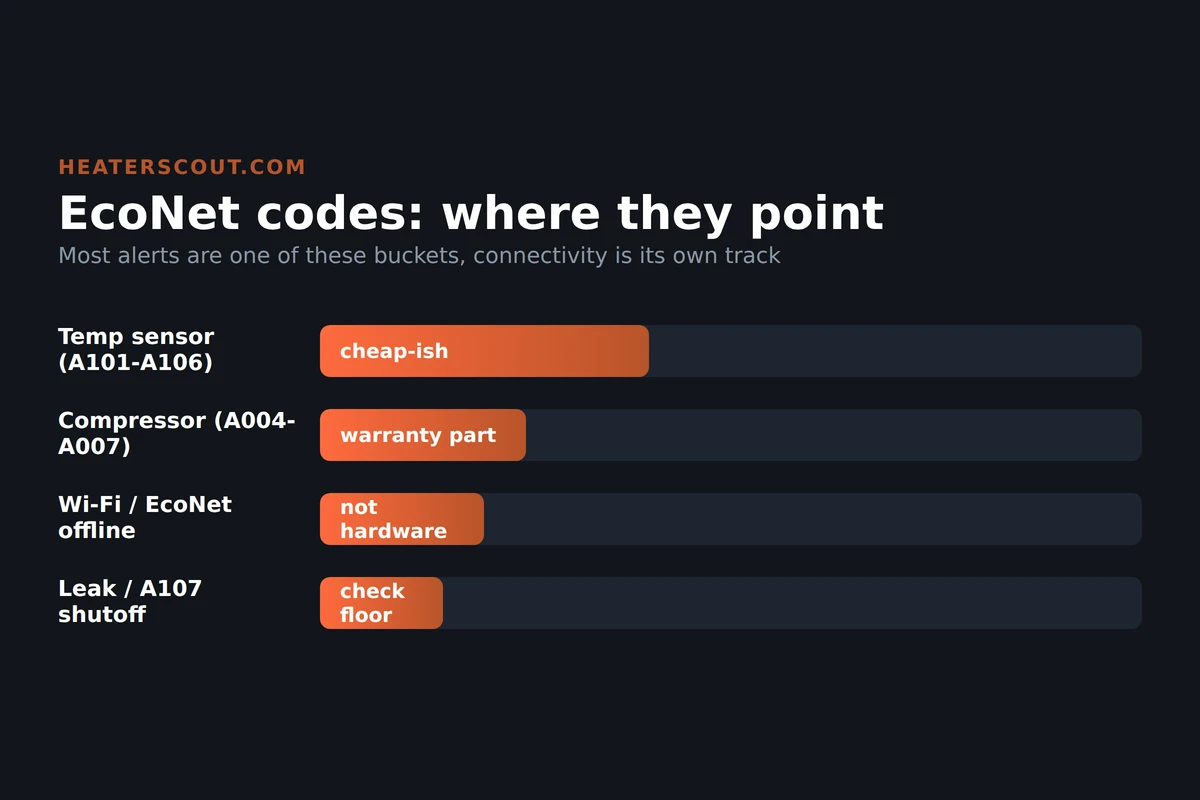
Read the code shape first. A letter-plus-digits code (A004, A104, A107) is a hybrid heat-pump alarm from the control board. A plain number (11, 13, 61) is a gas EcoNet tankless fault. A message that the unit is offline or lost connection is a Wi-Fi issue, not a hardware fault, and does not affect hot water. Write the exact code down, power-cycle once to clear a fluke, and if it returns, match it to the buckets below before buying any part.
A letter-plus-digit code is a hybrid alarm from the board. A plain number is a gas fault. An offline message is just Wi-Fi. Those are three different problems.Rheem EcoNet code convention
Hybrid A-series alarms: sensors, compressor, and leaks
On a Rheem hybrid you read active alarms and alarm history at the unit by pressing Service, then Alarms. The letter prefix is the key. An A means an active alarm, and the heater generally disables the heat pump or an element until the condition clears, which is why an A code usually means weaker or slower hot water while the unit leans on its electric backup. A T means a transient warning, a condition the unit noticed but is still running through. The same numeric code can appear as either an A or a T depending on firmware, so trust the words next to the code on your own screen.
The most common hybrid codes fall into three families. The temperature-sensor family runs A101 through A106: A101 is the suction sensor, A102 ambient, A103 the lower tank sensor, A104 the upper tank sensor, A105 the evaporator sensor, and A106 the discharge sensor. These are all 10,000-ohm thermistors, and on the Service, Sensors screen a reading of minus 40 degrees means the circuit is open and positive 250 degrees means it is shorted. A repeating sensor code is frequently just a loose or corroded connector, so reseat the plug before you condemn the part. A129 is a cousin that reports a thermistor running over-temperature from poor heat dissipation, which points at airflow and mounting rather than a dead sensor.
The compressor family is the one that costs money. A004 is a compressor shutdown on a discharge-to-suction pressure trip, the heat-pump protection stopping the compressor because refrigerant pressures fell outside their safe window. A005 is a high discharge temperature, A006 is suction temperature too low, and A007 is a compressor feedback failure. The free first moves for all of these are the same: clean the air filter and the evaporator coil, clear space around the unit, and make sure the room is warm enough and big enough for heat-pump mode. If a compressor code returns on a clean, well-ventilated unit, the sealed refrigerant system is involved, and that is a licensed-tech, usually warranty, repair rather than owner work. A300, separately, is a communication error with the control board, which points at wiring or the board itself.
What does A107 mean and should I reset it?
A107 is water detected on the floor. On ProTerra models with the leak-detection and auto-shutoff feature, the sensor found moisture and the unit may have closed the incoming water valve to limit damage. Do not reset A107 to make the alert go away. Find the water first: check the tank fittings, the temperature-and-pressure relief line, the condensate drain on the hybrid, and the surrounding floor. Only after you have located and dried the source, and confirmed it was a fitting you tightened rather than the tank itself weeping, do you clear the code and restore the valve. A tank that leaks from its own shell is done, and A107 is the early warning that saved your floor.
Gas EcoNet tankless: the numbered codes
A gas EcoNet tankless uses the standard Rheem numeric fault codes, and EcoNet simply mirrors them from the remote controller into the app. Code 11 is no ignition: the burner tried to light and failed, usually a gas-supply, igniter, or gas-valve issue, and it is the single most common tankless code. Code 13 is a flame loss or abnormal combustion condition during a call for heat, often venting, gas pressure, or a dirty flame rod. Code 29 shows on condensing models and means a condensate drainage problem, typically a clogged neutralizer or a kinked or frozen drain line backing acidic condensate into the unit. Code 61 is a combustion fan or blower fault, and with no proven airflow the unit will not fire safely. Code 76 is a communication loss between the unit and its remote controller, usually loose or damaged remote wiring.
None of those numbered codes are Wi-Fi problems. They are hardware and combustion faults that would show on the wired remote controller whether or not the unit ever joined a network. The gas codes that involve ignition, flame, or venting are also the ones where a homeowner does the easy checks, gas on, water flow present, vent clear, and then hands anything involving the gas valve, combustion tuning, or a smell of gas to a licensed tech.
Connectivity is not a fault code
A large share of EcoNet complaints are not error codes at all. The app says the heater is offline, or it lost connection, or it will not finish setup. That is the Wi-Fi module talking to your router and the Rheem cloud, and while it is offline the water heater keeps running exactly as it did before. The fixes are network fixes. The EcoNet module joins only the 2.4GHz band, so if your router broadcasts one blended network name for both bands, the module can fail to connect or drop off, and separating or temporarily disabling 5GHz during setup usually solves it. Power-cycle the heater, confirm the router has internet, and check for a firmware update in the app. The tell that it was only connectivity is simple: a genuine hardware code still shows on the unit's own LCD with the Wi-Fi turned completely off, while a connection message vanishes the instant the module rejoins the network.
Reset, DIY, and where the warranty line sits
The universal reset is a power-cycle. Cut power at the breaker, or unplug a plug-in hybrid, wait one to five minutes, and restore power. On a gas model you can cycle the gas control to off for the same few minutes. That clears a one-time or transient fault. It is worth doing exactly once. What it does not do is repair anything, so if the identical code returns after a clean reset, stop resetting and start diagnosing, because you now know the fault is real and repeating.
Where you stop depends on the code. Connectivity, resettable flukes, a dirty filter behind a compressor trip, a clogged condensate line, and a loose sensor connector are all squarely homeowner work. A failed temperature sensor is a modest part and a manageable job on most models. The line you do not cross as an owner is the sealed refrigerant system on a hybrid and the gas valve and combustion on a tankless. Both need a licensed tech, and both are exactly where the warranty matters, because Rheem ProTerra and Performance Platinum hybrids typically carry a ten-year tank and parts warranty. A failed compressor or control board is frequently a covered part, which turns an expensive repair into labor only. Before you buy any major component off a code, pull the model and serial number and check coverage first. The code told you what broke. The warranty tells you who pays.
Frequently asked
How do I read Rheem EcoNet error codes in the app?
Open the EcoNet app, tap your water heater, and look at the status banner. If the unit has an active fault it shows the code and a short description there, and the same code appears on the heater's own LCD. On a hybrid model you can also pull the full list at the unit by pressing Service, then Alarms, which shows both the current alarm and the alarm history so you can see whether a code fired once or keeps repeating. Write the exact code down before you reset anything, letters and digits both, because A004 and A104 are completely different faults. On a gas EcoNet tankless the code is numeric, like 11 or 61, and the app mirrors whatever the remote controller is showing. The app is a convenience readout, not a separate diagnostic system: the code you see there is the same one the control board generated.
What is the difference between an A code and a T code on a Rheem hybrid?
The letter tells you how serious the unit thinks the condition is. An A prefix means an active alarm, and the heater usually disables a heat source or shuts the compressor down until the condition clears, so an A code costs you hot water. A T prefix is a transient notice or warning: the unit flags a condition but keeps running, often because it is riding a limit rather than failing. A005, for example, shows up in some Rheem literature as a T005 warning and in others as an A005 alarm depending on firmware, which is a good reminder to trust the description next to the code on your own screen over any generic list. As a rule, chase A codes first because those are the ones actually stopping the heater.
Is a Wi-Fi or EcoNet connection error the same as a real fault?
No, and this is the most common mix-up. If the EcoNet app says the heater is offline or lost connection, that is a communication problem between the Wi-Fi module and your router or the Rheem cloud, not a fault in the tank, compressor, or burner. The water heater keeps making hot water normally while it is offline. Fix connectivity by confirming your network is on the 2.4GHz band, since the EcoNet module does not join 5GHz, then power-cycle the heater and check for a firmware update in the app. A genuine hardware code, an A-series alarm or a numbered gas code, will still show on the unit's own LCD whether or not Wi-Fi is working. If the code disappears the moment you reconnect Wi-Fi, it was never a hardware fault.
Can I reset a Rheem EcoNet error code myself?
Yes, a power-cycle reset is safe to try once. Turn the heater off at the breaker, or unplug a plug-in hybrid, wait one to five minutes, then restore power and let it boot. On a gas model you can also turn the gas control to off for a few minutes. That clears a one-time or transient fault. What a reset does not do is fix a cause. If the same code returns after a clean reset, the fault is real and repeating, and forcing repeated resets on a compressor alarm or a no-ignition code just cycles a unit that has a genuine problem. Reset once to confirm that a repair worked, or to clear a fluke, not as the repair itself. For a leak code like A107, do not reset until you have found and dried the water it detected.
What does compressor shutdown A004 mean on my Rheem hybrid?
A004 is a compressor shutdown on a discharge-to-suction pressure trip: the heat-pump's protection logic saw the refrigerant pressures out of their safe window and stopped the compressor to protect it. The unit usually falls back to electric elements so you still get hot water, just less efficiently and with a higher bill. Common triggers are a blocked or dirty air filter and evaporator, poor airflow or a too-small or too-cold installation space, or a refrigerant-side problem. Start with the free checks: clean the filter, clear space around the unit, and confirm the room is warm enough for heat-pump mode. If A004 keeps returning after that, the compressor and sealed refrigerant system are a warranty repair, not homeowner work, because the sealed system is not field-serviceable by an owner.
How much does it cost to fix a Rheem EcoNet hybrid error code?
It depends entirely on which code. Connectivity and reset-clearable codes cost nothing but your time. A dirty-filter or airflow cause behind an A004 compressor trip is a free cleaning. A failed temperature sensor in the A101 to A106 family is a modest part, often in the range of a few tens of dollars for the sensor plus an hour of labor if you hire it out, though on some models the sensor is bundled into a harness that raises the price. A compressor or sealed-system failure behind a repeating A004 or A007 is the expensive end, often several hundred dollars, which is exactly why you check the warranty first. Rheem ProTerra and Performance Platinum hybrids carry a long tank and parts warranty, commonly ten years, so a failed compressor or control board is frequently a covered part and you pay labor only.
Why does my Rheem hybrid keep showing a sensor code like A104?
A repeating temperature-sensor code, A101 suction through A106 discharge, means the control board cannot trust that sensor's reading. The sensors are 10,000-ohm thermistors, and the two classic failures show on the Service, Sensors screen: minus 40 degrees means the circuit is open, usually a broken or disconnected wire, and positive 250 degrees means it is shorted. So a code that keeps coming back is either a genuinely bad thermistor or, just as often, a loose connector at the plug, so reseat it before you condemn the part. A129 is a cousin that reports a thermistor running over-temperature from poor heat dissipation, so treat it as an airflow and mounting check first.
Is a Rheem EcoNet error code dangerous?
Most are the safety system doing its job rather than a hazard in themselves. A compressor shutdown or a high-discharge-temperature alarm is the unit protecting its own hardware, and it fails safe by dropping to electric backup. The two codes to take literally are the leak and the combustion faults. A107 means the leak sensor found water and, on models with auto-shutoff, may have closed the water valve, so you go looking for the source first. On a gas EcoNet tankless, a no-ignition or flame-loss code involves gas, so if you smell gas you stop, ventilate, and call a pro rather than resetting. The dangerous move is never the code on the screen, it is overriding a safety to force the unit to run through the warning it is giving you.