A Reliance tank that quits making hot water is rarely the mystery it feels like when the shower goes cold. Reliance is a retail brand in the State Industries and A.O. Smith family, sold at Lowe's, Menards, and the hardware store, and its gas tanks run the same Honeywell control as its cousins. So on a gas unit a small status light near the floor is already blinking a code at you, and on an electric one a single red button behind a panel explains most dead heaters. The job is sorting the handful of things you can safely check, the flash count, the pilot, the reset button, the dial, from the two or three failures where the right move is to shut the gas or the breaker and call a licensed tech.
Key takeaways
- Gas Reliance status light: one bright-dim blink every three seconds is normal. Faults are repeating bursts.
- The Reliance Honeywell valve codes are 2, 4, 5, 7. There is no 3-blink or 6-blink. A dead pilot shows as no light.
- Electric reset is the red ECO button on the upper thermostat. Breaker off first, and never reset a repeat trip.
- Factory temperature is about 120 F. On electric, set both thermostats to the same mark.
- A T&P drip during heating can be normal. A weep from the tank body means the tank is done.
Quick answer
Split it by fuel first. On a gas Reliance, read the status light on the gas control valve: one bright-then-dim blink every three seconds is normal, and a repeating burst of 2, 4, 5, or 7 blinks is a fault you match to the label on the front. No light means the pilot is out, so relight it per the label. On an electric Reliance with no hot water, kill the 240 volt breaker and press the red ECO reset on the upper thermostat once. If it holds, you are done. If it trips again, or if the gas unit throws a 4, 5, or 7 blink, stop and diagnose rather than reset on a loop.
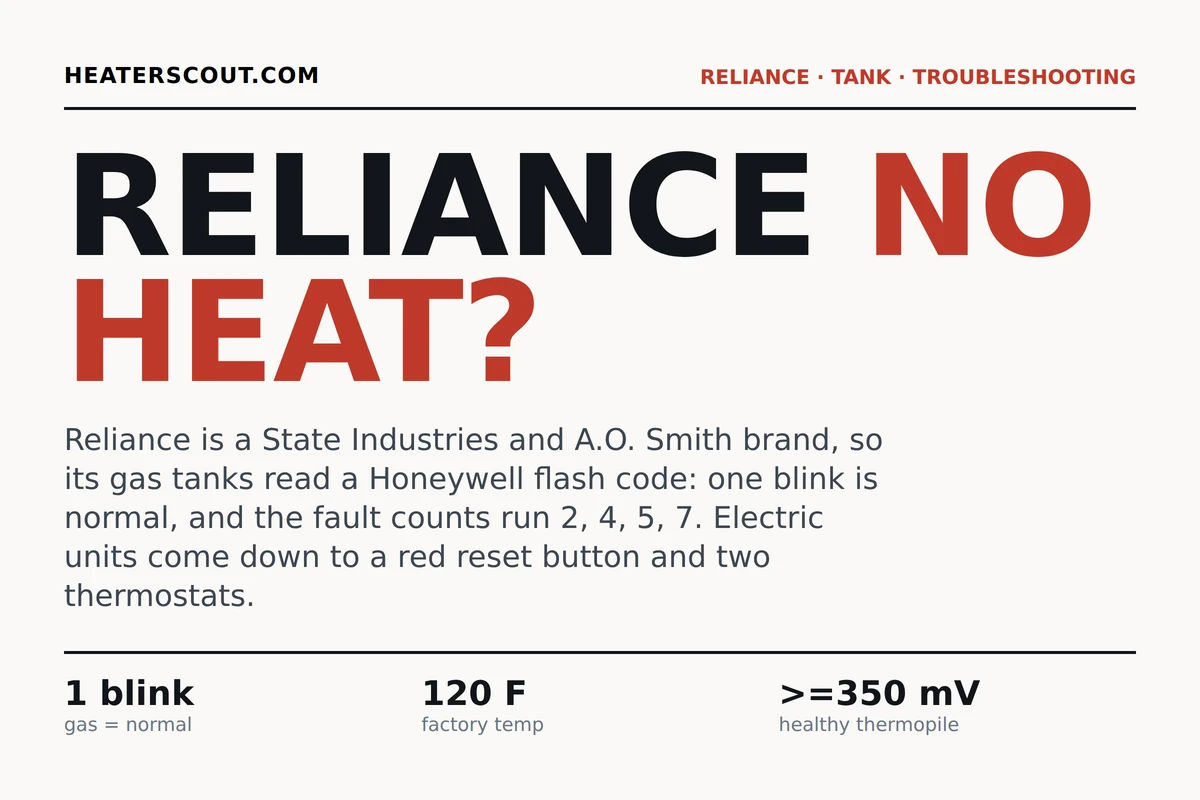
No hot water on a gas Reliance: read the light
No hot water is the call that starts most of these, and on a gas Reliance the heater has already told you what it thinks is wrong. Kneel at the base and find the small status light on the gas control valve. One blink that pulses bright then dim, once every three seconds, is the normal heartbeat. That single blink looks like a warning but it is the heater saying it is fine, pilot lit and thermopile healthy. A repeating burst of more than one blink is a fault code. Count the blinks in one burst, wait through the three second pause, and confirm the same count on the next burst before you act.
Here is where a Reliance differs from the Rheem chart people find online. The Honeywell control on a Reliance uses a short code list: two blinks is low thermopile voltage, four is an over-temperature trip, five is a sensor failure, and seven is an internal control failure. There is no three-blink and no six-blink code on this valve. A pilot that has actually gone out does not flash three times, it shows no light at all, which the manual reads as control off or pilot out. So if you counted a code off a generic chart and got a three or a six, recount, because this valve does not speak those. Match your real count to the label on the front of your heater, which is the authority for your exact model.
Before anything else
If you smell gas near the heater, stop. Do not touch the igniter, a light switch, or the reset button. Leave, and call your gas utility or 911 from outside. A gas smell is never a flash-code problem to work through. Everything else on this page assumes there is no gas odor and no visible scorching around the burner.
The pilot, the thermopile, and the relight
A two-blink code or a no-light condition usually comes back to the pilot and the thermopile. The thermopile is the bundle the pilot flame heats to make the small DC voltage that powers the valve, and on a healthy Reliance it reads 750 to 900 millivolts open and at least 350 under load. Below 350 the valve cannot hold its solenoid open and the burner will not fire. That shows up as two blinks, or as a pilot that lights while you hold the knob but dies the moment you let go. The fix ladder is clean the pilot, reseat the leads at the valve, and if a meter still reads low under load, replace the thermopile. It is an inexpensive part and squarely homeowner work.
Relighting a Reliance pilot follows the label, and the sequence matters. Turn the gas control knob to Pilot and hold it in. Click the piezo igniter button continuously, up to 90 seconds, until the status light begins to blink. Keep the knob pressed the whole time, because the flame has to warm the thermopile before the valve trusts it. Once the light blinks, release the knob and turn it to your temperature setting. If the pilot lights but the status light still will not blink after 90 seconds, the thermopile leads may be loose, the TCO thermal switch behind the burner door may have tripped, which you reset by pressing the button in its center, or the thermopile is dead. And the valve makes you wait a full 10 minutes between lighting attempts, so a failed relight is not a cue to keep stabbing the igniter. Wait the 10, then try once more.
No hot water or short showers on an electric Reliance
Electric splits into two symptoms that point at two different parts. No hot water at all usually means a tripped ECO, a dead upper element, or a bad upper thermostat, because the upper element heats the top of the tank first and, if it is out, the whole stack stays cold. Hot water that runs out fast, a good burst that turns cold after a few minutes, usually means a dead lower element. The upper element has priority and locks out the lower one while it runs, so it heated the top slug and handed off to a lower element that never came on, and once you drain the top the tank has nothing hot left.
The reset lives on the upper thermostat, the red ECO button behind the upper access panel. The rule that matters more than its location: kill the 240 volt breaker before you open that panel. Fold back the insulation, press the red button until it clicks, and close everything up before you restore power. If it holds, you are done. If it trips again within a day, the water is really overheating, and the causes are a failed thermostat, an element shorted to the tank, or cool air fooling the thermostat. That is where you stop resetting and start testing, checking each element for resistance and a short with the power off.

Too hot, leaking, or noisy
Water that comes out scalding is a setting first and a fault second. Reliance ships around 120 degrees, marked by the small triangle on the gas dial, and that is where it should stay for most homes. If it runs hotter than the dial claims, or will not turn down, the thermostat is failing. On electric, both thermostats have to match, so a top set to 120 and a bottom cranked high will overheat the tank. Leaks sort by location. A drip from the T&P valve at the end of a heat cycle can be normal thermal expansion, but a steady drip means high pressure or a worn or fouled valve, and the T&P is your last-line safety, rated near 150 psi or 210 degrees. Replace it, never cap it, and add an expansion tank if a new valve still weeps. Water from the body of the tank is a corroded-through tank and a replacement. Popping or rumbling is sediment flashing to steam, cured by a drain and flush.
| Gas, 1 blink / 3 sec | Normal operation. Bright-then-dim heartbeat, no fault. Nothing to reset. |
| Gas, no light | Control off or pilot out. Relight per the front label. If it will not hold, check the thermopile and TCO switch. |
| Gas, 2 blinks | Low thermopile voltage. Weak or dirty pilot, loose lead, or worn thermopile. Below 350 mV under load, replace it. |
| Gas, 4 blinks | Over-temperature (ECO) trip. Water overheated. Drop to 120 F, flush sediment; if it repeats, call a pro. |
| Gas, 5 blinks | Sensor failure. Gas off, replace the gas control valve. Not a homeowner reset. |
| Gas, 7 blinks | Internal control failure. Gas off, replace the valve assembly. |
| Electric, no hot water | Tripped ECO, dead upper element, or bad upper thermostat. Reset once, breaker off; if it repeats, test parts. |
| Electric, runs out fast | Dead lower element, or heavy sediment burying it. Test the lower element for a short and resistance. |
| Water too hot / scalding | Set above 120 F, mismatched thermostats on electric, or a failed thermostat sticking the heat on. |
| Leak at T&P valve | Thermal expansion or a worn, fouled valve. Replace it, add an expansion tank if it recurs. Never cap it. |
| Leak at tank body | Steel corroded through. Not repairable. Replace the unit. |
| Popping / rumbling | Sediment on the tank floor flashing to steam. Drain and flush the tank. |
Does this apply to a Reliance tankless or hybrid heat pump unit?
Only the temperature, leak, and sediment notes carry over. Reliance tankless and hybrid heat pump units use digital displays with their own numbered error codes, not this status-light blink chart or a red ECO button. If you have one of those, use its display code and its own manual. This hub is for the standard gas and electric storage tanks.
The stop-and-call-a-pro line
Plenty of this is a careful homeowner's afternoon: relighting a pilot, resetting an ECO once, dialing scalding water back to 120, swapping a thermopile or a single element, flushing sediment. The line worth respecting is where a fault keeps returning or where the failure is the tank itself. A four-blink over-temperature code, or an electric ECO that trips a second time, both mean the water is genuinely overheating, and chasing that with repeated resets wears out a safety device and ignores a real hazard. A five-blink sensor failure and a seven-blink internal control failure both mean a new gas valve, which involves draining the tank and breaking the gas line. Any gas smell is a hard stop, and so is water weeping from the body of the tank.
Everything above that line is reasonable work with the breaker off and the label in front of you. Below it is where a licensed plumber or gas tech earns the call, because the failure mode is a burn, a flood, or a combustion problem rather than an inconvenience. When you are unsure, the label on the front of your specific Reliance is the tie-breaker, and the blink count printed there beats any chart you found online.
Frequently asked
What do the flashing light codes mean on a Reliance gas water heater?
The small status light on the gas control valve near the floor is the code, and the number of blinks in each burst is the message. One blink that pulses bright then dim, once and then a three second pause, is normal, so a single steady heartbeat is not a fault. Faults are repeating bursts. Two blinks is low thermopile voltage, usually a weak or dirty pilot. Four blinks is an over-temperature trip. Five blinks is a sensor failure and seven is an internal control failure, and both end in a new gas control valve. No light at all means the control is off or the pilot is out. Owners coming from a Rheem get tripped up here: the Reliance Honeywell valve has no three-blink or six-blink code, so a dead pilot shows as no light, not three flashes. Match your count to the label on the front of the heater.
Where is the reset button on a Reliance electric water heater?
It is the red ECO button on the upper thermostat, behind the upper access panel with the insulation folded back. Turn the breaker off before you touch anything in there, because those terminals sit on 240 volts. Press the red button until it clicks, then close everything up before you restore power. The part people miss is why it tripped. The ECO only cuts out when the water actually climbed past about 180 degrees, so a reset that holds is fine, but a reset that trips again within a day means a failed thermostat, an element shorted to the tank, or cool air fooling the thermostat. Stop resetting after the second trip and find the cause. A gas Reliance has no red button; the same job shows up as a four-blink over-temperature code.
What temperature should a Reliance water heater be set to?
Reliance ships them close to 120 degrees Fahrenheit, and 120 is where most homes should leave it. On the gas dial the small down-pointing triangle marks roughly 120 and is the recommended start, hot enough for showers and low enough that a hand under the tap does not scald instantly. Every step past 120 shortens the time it takes to burn skin, the real hazard with kids or older adults in the house. On an electric Reliance there are two thermostats, upper and lower, and both have to be set to the same mark with the breaker off. If the water runs hotter than the dial says or will not turn down, that is a failing thermostat, not a setting.
Why won't the pilot light or stay lit on my Reliance gas water heater?
Follow the label. Turn the gas control knob to Pilot, hold it in, and click the piezo igniter continuously for up to 90 seconds until the status light blinks. Keep the knob pressed the whole time, because the flame has to warm the thermopile before the valve trusts it. Once the light blinks, release and set your temperature. If nothing lights, confirm the igniter sparks and the gas is on. If the pilot lights but the light will not blink after 90 seconds, the thermopile leads may be loose, the TCO thermal switch may have tripped (reset it by pressing the button in its center), or the thermopile is reading below the 350 millivolts the valve needs. The valve makes you wait a full 10 minutes between attempts, so do not keep stabbing the igniter.
My Reliance water heater is leaking, is it dangerous and can I fix it?
Where it leaks decides everything. A little drip from the T&P relief valve at the end of a heat cycle can be normal thermal expansion. A steady drip means high pressure or a worn, fouled valve, and the T&P is the tank's last-line safety against rupture, rated to open around 150 psi or 210 degrees. Never plug or cap it or its discharge tube. Replace the valve, and if a new one still drips, the house likely needs a thermal expansion tank. A weep at a threaded fitting can be resealed. The leak nobody fixes is water from the body of the tank, which means the steel corroded through. On a tank that old the answer is replacement, with a drip pan underneath in the meantime.
When should I replace a Reliance water heater instead of repairing it?
Age plus the type of failure. A residential tank usually lasts 8 to 12 years. The clearest replace-it sign is water weeping from the body of the tank, meaning the steel rusted through. Rusty hot water that stays rusty after a full flush and heavy sediment causing rumble and over-temperature trips on an old unit point the same way. Repairs make sense on a younger Reliance: a bad thermostat, a burned-out element, a worn T&P valve, a weak thermopile, or a pilot that will not hold are normal parts jobs. The judgment call is a repeatedly tripping ECO or a five or seven-blink valve failure on a ten year old tank, where the money is better spent on a new unit.