A gallon of propane holds about 91,500 BTU. A cubic foot of natural gas holds about 1,030. Those two numbers, more than anything on the price tag, explain why a propane water heater and a natural gas one cannot trade fuels without swapping parts, why one costs more to run than the other where both are available, and why the choice is usually made for you by whether a gas main reaches your street. The heaters look identical on the showroom floor. The fuel underneath them is not, and the difference in energy density drives every practical decision from the orifice drilled into the burner to the bill you pay each month.
| Propane | Natural gas | |
|---|---|---|
| Energy content | ~91,500 BTU/gal (2,516 BTU/ft3) | ~1,030 BTU/ft3 (100,000 BTU/therm) |
| Typical residential price | ~$2.59-2.67 per gallon (EIA) | ~$12-16 per 1,000 cu ft (EIA) |
| Cost per million BTU | ~$25-32 / MMBTU | ~$12-18 / MMBTU |
| Supply pressure at valve | ~11 in. water column | ~7 in. water column |
| Burner orifice | Smaller hole (higher drill no.) | Larger hole |
| Availability | Tank on property, truck delivery | Piped main, ~60% of US homes |
| Field conversion | To natural gas only, factory kit | To propane: not allowed on most |
The verdict
If a natural gas main reaches your house, natural gas is the cheaper fuel to run, roughly two to two and a half times less per BTU than propane at recent EIA prices, and it never needs a tank refill. Choose propane when there is no gas main, which is the reality for a large share of rural homes: it delivers the same hot water from a tank on your property and recovers fast, you just pay more per BTU for the trucked-in convenience. The heaters are not interchangeable. Buy the unit that matches the fuel you actually have, because the burner orifice, the regulator, and the safety listing are all set for one gas at the factory.
Start with the energy in the fuel
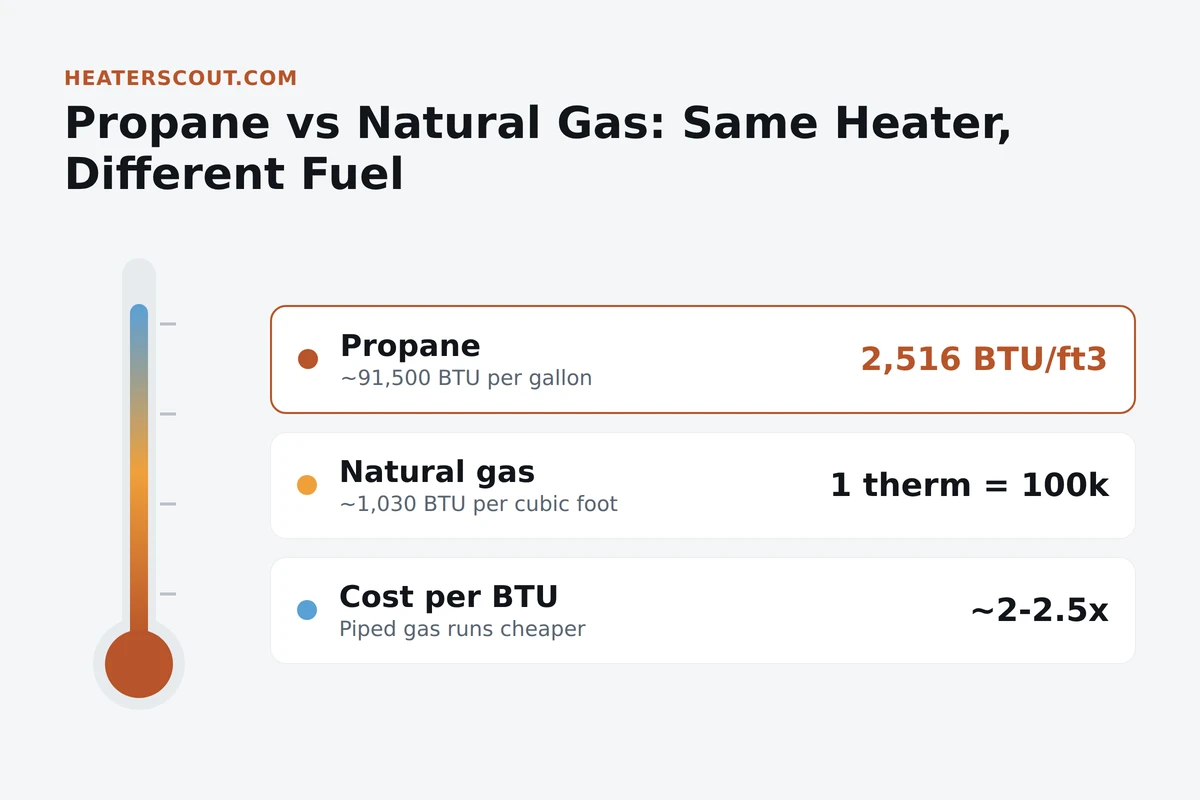
Every other difference between these two heaters traces back to how much heat each fuel carries. Propane holds about 91,500 BTU in a gallon, and about 2,516 BTU in a cubic foot. Natural gas holds about 1,030 BTU per cubic foot, which the industry usually rolls up into the therm, a unit defined as exactly 100,000 BTU. Line those up and propane carries roughly two and a half times the heat per cubic foot that natural gas does. That is not a small gap. It means a burner that needs a certain BTU output has to pass far less propane by volume than natural gas to get there, and it is the reason the two fuels cannot share the same orifice.
Put on a common scale, one gallon of propane is worth about nine tenths of a therm of natural gas, so it takes a hair more than a gallon of propane to match a single therm. That conversion matters when you try to compare a per-gallon propane price against a per-therm or per-cubic-foot gas price, because the units hide the real cost. A dollar figure per gallon and a dollar figure per thousand cubic feet are not remotely comparable until you bring them both back to BTU, and doing exactly that is how you cut through the marketing on either side.
Choose propane if
- No natural gas main reaches your street, which is common for rural and semi-rural homes and covers a large slice of the roughly 40% of US homes with no pipeline access.
- You want fast recovery and independence from the grid: a propane tank keeps making hot water through a power outage that shuts off an electric heater.
- You are comparing against electric resistance or oil, not against piped gas. In that field propane's higher energy density and quick reheat often come out ahead.
- You already have a propane tank on site feeding a furnace, range, or generator, so adding a water heater to the same fuel is the simple move.
Choose natural gas if
- A gas main already serves the house. Piped gas runs roughly two to two and a half times cheaper per BTU than propane at recent EIA prices, and the savings compound every month.
- You never want to watch a tank gauge or schedule a delivery. The main just flows, metered by the utility, with no refill to forget in a cold snap.
- You want the lowest lifetime running cost on a gas heater and the infrastructure is already there, so there is no truck route or tank rental folded into the price.
- You are replacing an existing natural gas unit like for like, which keeps the orifice, regulator, and venting matched to a fuel the house already supplies.
What the fuel does to the burner
Because propane is so much denser in energy, the hardware that meters it has to be different. The burner orifice is nothing more than a precisely drilled hole that controls how much gas reaches the flame. To hit the same BTU output, a propane heater needs far less gas by volume, so its orifice is drilled smaller, which on the machinist's chart means a higher drill number. A natural gas heater, working with a thinner fuel, needs a larger hole to flow enough volume for the same heat. That single dimension is why you cannot feed propane into a natural gas orifice: too much energy pours through the larger hole and the burner overfires, sooting the flue and risking flame rollout. Feed natural gas into a propane orifice and the opposite happens, a starved flame that may not light or hold at all.
Burner orifice
The metering hole. It is a small brass fitting with a drilled bore that sets how much gas reaches the burner. Its diameter is matched to the fuel and the supply pressure so the burner hits its rated BTU input. Propane, at about 2,516 BTU per cubic foot, uses a smaller bore than natural gas at about 1,030, because less propane by volume delivers the same heat. Swap the fuel without swapping the orifice and the burner runs badly rich or badly lean, which is the core reason a natural gas heater and a propane heater are not interchangeable.
Supply pressure is the other half of the match. Propane arrives at the gas valve at a higher pressure, commonly around eleven inches of water column, and its burner manifold runs near ten to eleven inches. Natural gas comes in lower, around seven inches at the valve, with a manifold pressure near three and a half to four. The regulator inside the gas valve is set for one of those regimes. So converting fuel is never just changing the line, it is changing the orifice and resetting or replacing the regulator so the whole metering chain matches the new gas. That is precise work with a manometer, not a driveway swap.
Running cost, where both fuels are on the table
When a home genuinely could take either fuel, the running-cost math is lopsided toward natural gas. Bring both prices back to a common BTU basis and the picture is clear. At recent EIA residential prices, propane has averaged roughly $2.59 a gallon in 2025 and about $2.67 a gallon heading into 2026, which works out to somewhere in the twenty-five to thirty-two dollars per million BTU range once you account for the 91,500 BTU in each gallon. Natural gas, at typical residential rates near twelve to sixteen dollars per thousand cubic feet, lands closer to twelve to eighteen dollars per million BTU. Propane, in other words, costs roughly two to two and a half times as much for the same delivered heat.
That gap is not about one fuel being wasteful and the other thrifty at the burner. Both heaters convert gas to hot water at essentially the same efficiency, and a propane and natural gas version of the same model carry the same energy factor on the yellow label. The whole difference is in what the fuel costs to get to your house. Piped natural gas rides an existing utility pipeline that was built and paid for over decades. Propane has to be trucked as a liquid to a tank on your property and pumped in, and every gallon carries a slice of that logistics cost. So the per-BTU premium on propane is really a delivery premium, which is also why it is worth nothing to a home the pipeline never reached.
Availability usually makes the call
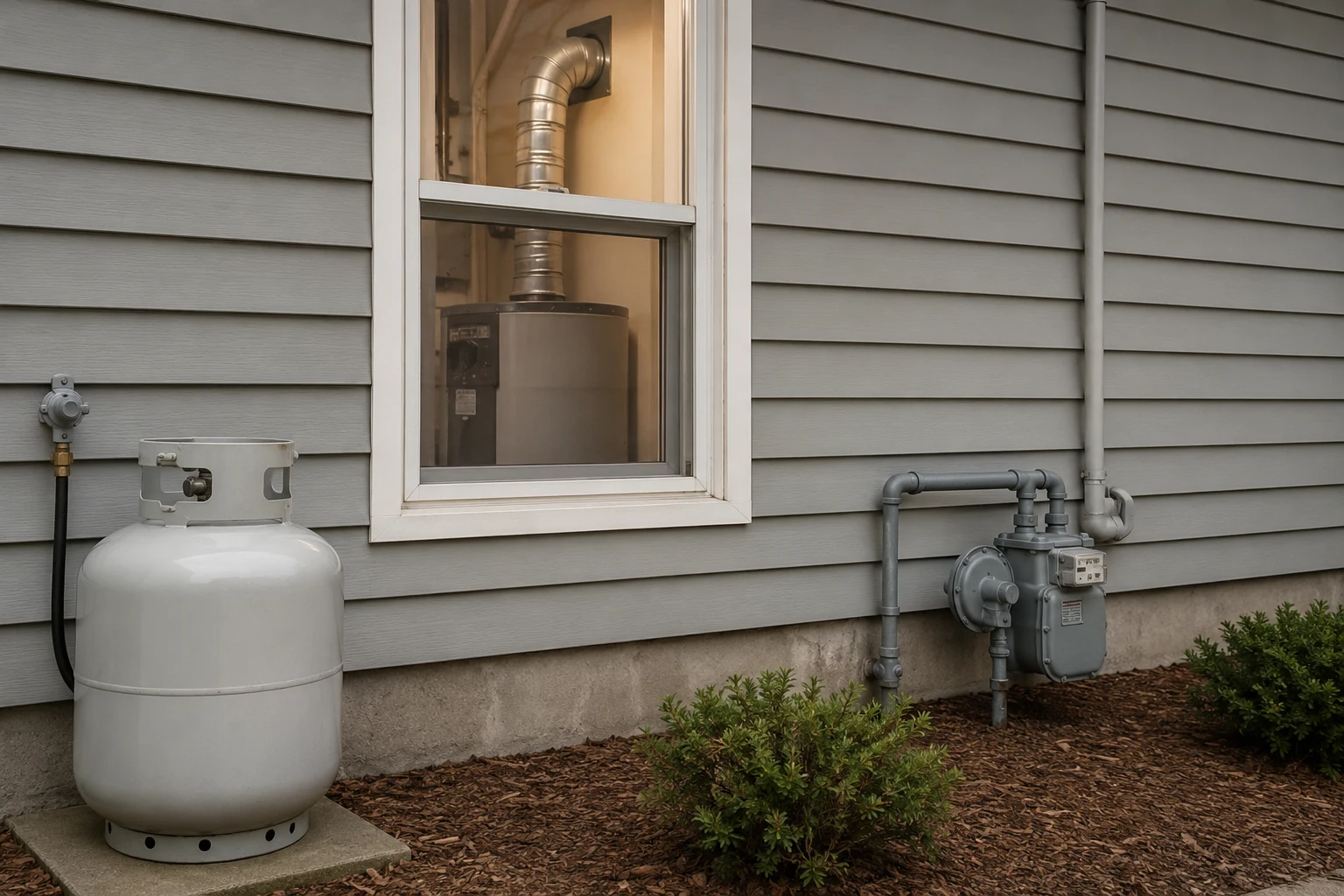
For most people the propane-versus-natural-gas question is answered before they ever price a heater, because only one fuel actually reaches the house. About forty percent of US homes have no natural gas pipeline connection, and that share climbs the farther you get from town. If a main runs down your street, natural gas is almost always the cheaper long-run choice and the tank on the neighbor's lot is a non-issue. If no main reaches you, propane is the standard answer, because it needs no utility pipeline, only a tank and a delivery route. A lot of rural homes already have a propane tank feeding a furnace, a range, or a standby generator, and hanging a water heater on the same fuel is simply the path of least resistance.
Propane also has a couple of quiet advantages that matter more in the country than in the suburbs. It keeps working through a power outage that would leave an electric water heater cold, since a standing-pilot or thermopile gas unit needs no grid power to fire. And its high energy density means a fill lasts a while and recovers hot water fast. None of that erases the per-BTU cost gap against natural gas, but when natural gas is not an option, the real comparison is propane against electric resistance or a heat pump, and there propane's fast recovery and outage independence often justify the fuel cost.
Conversion, warranty, and the safe way to switch fuels
People who change fuels, say a rural home that finally gets a gas main, ask whether the existing heater can just be reorificed. Mostly, no. A.O. Smith's conversion policy, published as Technical Bulletin 137, is blunt: their gas water heaters may be converted only from propane to natural gas, never the reverse, and even the allowed direction must be done by an A.O. Smith service agent or a gas utility technician using the factory kit and the written instructions. Rheem draws a similar line, with many models simply not field-convertible, where the manufacturer's answer is to replace the unit. The one-way rule exists because the failure modes are asymmetric: overfiring a natural gas unit on propane is the dangerous direction, and no manufacturer wants to certify it.
Will converting a water heater's fuel void the warranty?
Almost certainly, if it is done outside the manufacturer's written procedure. Gas water heaters are listed and certified for a specific fuel from the factory, and the warranty and the safety listing both assume the orifice, regulator, and burner stay as shipped. A factory-authorized propane-to-natural-gas conversion done with the correct kit by an approved technician keeps you inside the lines. A driveway reorifice, or any natural-gas-to-propane attempt, typically voids coverage and breaks the listing that makes the unit code-legal. When the fuel is changing, pricing a new heater rated for the new gas is usually cheaper and always safer than fighting the conversion.
So the clean way to think about it is this. Match the heater to the fuel you have, at purchase. If you are on a gas main, buy the natural gas version and enjoy the lower running cost. If you are on a tank, buy the propane version and accept the delivery premium as the price of having gas at all. If your fuel situation is genuinely about to change, plan on a new appliance rated for the new gas rather than a conversion, and let a licensed technician handle any change to the gas line, the orifice, or the regulator. The heaters are cousins, not twins, and the fuel underneath is what makes them different.
Frequently asked
Is a propane water heater the same as a natural gas water heater?
No, and this trips up a lot of buyers. A propane and a natural gas storage water heater look identical from the outside and often share the same tank, burner shape, and gas valve body, but the two are set up for fuels with very different energy density and supply pressure. Propane carries about 91,500 BTU per gallon, and roughly 2,516 BTU in every cubic foot, while natural gas holds only about 1,030 BTU per cubic foot. Because propane packs about two and a half times the heat per cubic foot, its burner orifice is drilled smaller so less gas flows, and its regulator expects a higher supply pressure, around eleven inches of water column against natural gas at about seven. Run one fuel through the other's orifice and you either starve the burner or badly overfire it, so the two units are not interchangeable off the shelf.
Is propane or natural gas cheaper to run a water heater?
Where a natural gas main reaches the house, natural gas almost always wins on running cost. At recent EIA residential prices, natural gas lands somewhere around twelve to eighteen dollars per million BTU delivered, while propane runs closer to twenty-five to thirty-two dollars per million BTU, so propane costs roughly two to two and a half times as much for the same heat. That gap comes from delivery: piped natural gas rides an existing pipeline, while propane has to be trucked to a tank on your property, and that logistics cost is baked into every gallon. The honest caveat is that about forty percent of US homes have no gas main at all, and for those homes the comparison is not propane against natural gas, it is propane against electric or oil, where propane often looks a lot better.
How many BTU are in a gallon of propane compared to natural gas?
A gallon of propane holds about 91,500 BTU. Natural gas is measured differently, by the cubic foot, at about 1,030 BTU each, or by the therm, which is defined as exactly 100,000 BTU. Put on the same scale, one gallon of propane is worth about 0.9 therm of natural gas, so it takes a little more than a gallon of propane to match one therm. Per cubic foot the contrast is sharper: propane delivers about 2,516 BTU per cubic foot to natural gas at about 1,030, roughly a two and a half to one edge in energy density. That density is exactly why the two fuels need different orifices and different supply pressures, and why you cannot simply swap the tank feeding the same heater.
Can I convert a natural gas water heater to propane?
For most storage water heaters the answer is no. A.O. Smith's conversion policy, Technical Bulletin 137, spells it out plainly: their gas water heaters may be converted only from propane to natural gas, never the other way, and even that allowed direction must be done by an A.O. Smith service agent or a gas utility using the factory kit and written instructions. Rheem takes a similar line, with many models simply not field-convertible at all. The reason is safety, not stinginess. A natural-gas unit's larger orifice and low-pressure regulator would badly overfire on propane's higher energy density and pressure, which risks a sooting, rollout, or worse. If your fuel is changing from natural gas to propane, the manufacturer's answer is almost always to buy a propane-rated heater, and doing anything else can void the warranty and the listing that keeps the unit code-legal.
Why does a propane water heater have a smaller orifice than natural gas?
Because propane is far more energy dense per cubic foot. The burner orifice is just a precisely drilled hole that meters how much gas reaches the flame, and since propane carries about 2,516 BTU per cubic foot against natural gas at about 1,030, you need far less propane by volume to hit the same BTU output. So the propane orifice is drilled smaller, a higher drill number on the chart, to pass less gas. Natural gas, being thinner in energy, needs a larger hole to flow enough volume for the same heat. Pressure differs too: propane arrives at the valve around eleven inches of water column with a manifold pressure near ten to eleven, while natural gas comes in near seven inches with a manifold around three and a half to four. The orifice size and the regulator are matched to the fuel as a set, which is why swapping fuel means swapping parts, not just the gas line.
Which is more efficient, a propane or natural gas water heater?
On the appliance itself, efficiency is essentially a wash. A propane and a natural gas heater of the same model line carry the same energy factor or uniform energy factor rating, because the tank, insulation, burner design, and heat exchanger are the same hardware. Both burn a hydrocarbon at the bottom of a steel tank and lose heat up the same flue, so neither fuel is inherently more efficient at turning gas into hot water. Where the two genuinely differ is cost per delivered BTU and, for some households, cleanliness of combustion, but the sticker efficiency you compare on the yellow energy label will read the same. If efficiency is your real lever, the bigger jump is from a standard atmospheric tank to a condensing or a heat-pump unit, not from one gas to the other.
Do rural homes without a gas line have to use propane?
Often, yes, propane is the practical gas choice for a rural home with no natural gas main, and that is by far the most common reason people end up on propane. Roughly forty percent of US homes are not connected to a natural gas pipeline, and outside of town the odds of a main running to your lot drop sharply. Propane solves that because it ships as a liquid in a tank on your own property and gets topped up by truck, so it does not need a utility pipeline at all. The trade is running cost: you pay more per BTU than a piped-gas neighbor would. For a rural home the real comparison is usually propane against electric resistance or a heat pump, and propane's fast recovery and independence from the grid during outages keep it in the running even though it costs more per BTU than natural gas would if you could get it.