The rotten-egg smell was the tell. A homeowner flushes the tank, runs the water hot for an hour, even shocks it with peroxide, and the sulfur stink comes right back the next morning. That smell is not dirt in the tank. It is hydrogen sulfide gas, and it usually means the magnesium anode rod, the soft water it sits in, and a colony of sulfate-reducing bacteria have struck a deal you cannot flush away. A powered anode rod breaks that deal, and it does it by working nothing like the rod it replaces.
Impressed-current cathodic protection (ICCP)
The principle a powered anode runs on. A sacrificial rod protects a steel tank by being more reactive than the steel, so it corrodes away instead of the tank walls. A powered anode flips the approach: the titanium rod does not corrode at all, and instead a plug-in transformer pushes a small direct current through the water to the tank. That current makes the entire steel shell the cathode of the circuit, the part that does not rust, at bare spots where the glass lining has chipped. Because titanium is inert and only carries the current rather than dissolving to supply it, the rod is not used up. The same technique protects ship hulls, pipelines, and bridge rebar, scaled down here to a device that sips under a watt.
Quick answer
A powered anode rod is a titanium rod that plugs into a standard 120V outlet and drives a tiny protective current into your water heater tank, a method called impressed-current cathodic protection. Unlike a sacrificial magnesium or aluminum rod that dissolves and needs replacing every few years, the titanium rod never gets consumed and carries a 20-year warranty. It is the go-to cure for the rotten-egg sulfur smell, usually clearing it within a day or two, and it is the answer when soft water eats through ordinary rods too fast. It costs more up front, around 150 dollars, and needs an outlet nearby.
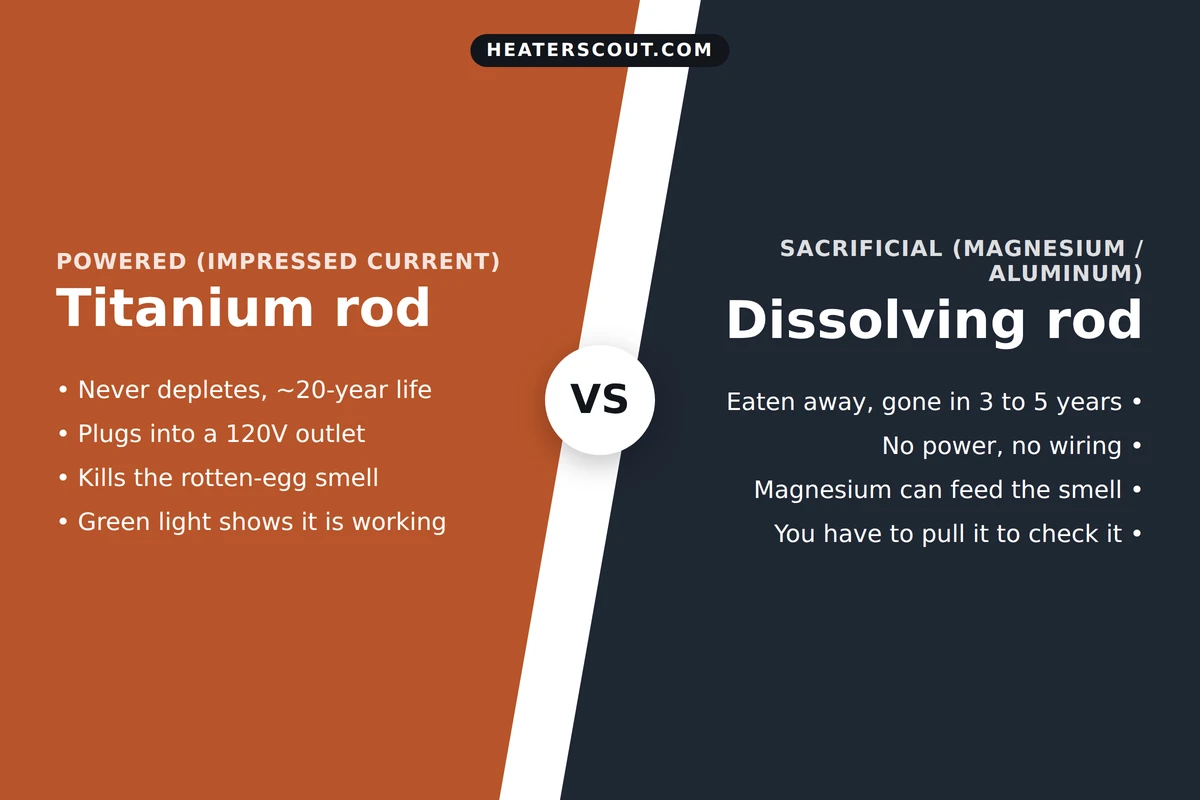
How the two rods differ where it counts
Both rods have the same job, keeping the glass-lined steel tank from corroding at the spots where the lining is thin or chipped. They go about it in opposite ways, and that difference decides which headaches each one solves and which it creates. Line them up side by side and the trade is clear.
Powered anode: current, not sacrifice
- Titanium rod that never depletes; the tank does the wearing, not the rod
- One-time buy, backed by a roughly 20-year warranty on residential installs
- Drives a few milliamps into the tank, drawing under a watt, about $2 to $3 a year
- Ends the hydrogen-sulfide rotten-egg smell, usually inside 24 to 48 hours
- Needs a 120V outlet within the cord's reach and a green light you can glance at
Sacrificial anode: chemistry, no wiring
- Magnesium or aluminum that dissolves; gone in 3 to 5 years in soft or aggressive water
- Cheap, $20 to $40, but you buy several over the life of one tank
- No power, no outlet, nothing to plug in or troubleshoot
- Magnesium plus soft water plus bacteria is the classic recipe for the sulfur smell
- You only know it is spent by draining down and pulling it to look
Who actually benefits from the swap
A powered anode is not an automatic upgrade for every tank. If your magnesium rod lasts a healthy eight to ten years and your hot water smells like nothing, the cheap rod is doing its job and the powered one is a solution looking for a problem. The people who get real value fall into a few clear buckets.
You cannot flush the sulfur smell away
This is the number-one reason people buy a powered anode. If the hot water smells like sulfur or rotten eggs, comes back after every flush, and the cold water is fine, you have hydrogen sulfide from bacteria feeding on a magnesium rod. A powered rod removes the food source and sours the tank for the bacteria at the same time. Most owners report the smell gone within a day or two. It is the cleanest fix short of chlorinating your whole water supply.
Soft or softened water is eating your rods
Soft water, whether it comes that way from a well or through a softener, is aggressive toward sacrificial anodes. It can chew a magnesium rod down to a bare wire in a couple of years, which means frequent replacements and a tank that spends stretches unprotected between them. A titanium rod does not care how soft the water is because it never gives up any metal. For a softened house, this is the difference between a rod you forget about and one you babysit.
The anode port is a wrestling match
Some tanks sit in a closet or under low joists with barely a foot of clearance above the port, and some rods seize so hard that pulling them is a two-person, breaker-bar ordeal. If you dread the job, doing it once with a powered rod and never again has obvious appeal. Corro-Protec even makes a flexible segmented version for tight spots where a rigid rod will not clear the ceiling, so low headroom stops being the reason you skip anode maintenance entirely.
What it costs and what you are buying
The sticker shock is real up front, and it fades once you count replacements. Here is the honest side-by-side on money and specs so you can see where the powered rod wins and where it does not.
| Powered (titanium) | Sacrificial (magnesium/aluminum) | |
|---|---|---|
| Up-front cost | About $150 | $20 to $40 |
| Replacements over tank life | None, one-time buy | 3 to 4 rods, every 3 to 5 years |
| Service life | ~20 years, warranted | 3 to 5 years in soft water, up to ~10 in easy water |
| Power | 120V outlet, under 1 watt, ~$2 to $3/yr | None |
| Fixes rotten-egg smell | Yes, usually 24 to 48 hrs | No, magnesium can cause it |
| Confirms it is working | Green LED on the transformer | Pull and inspect the rod |
| Tank sizes | Sized by range, e.g. 40 to 89 gal | One rod, cut to fit |
Installing one: it is a rod swap plus a plug
If you have ever changed a regular anode rod, you already know most of this. The powered rod threads into the very same anode port. The only additions are refilling and then plugging in and watching the light. Cut the energy to the tank first, always.
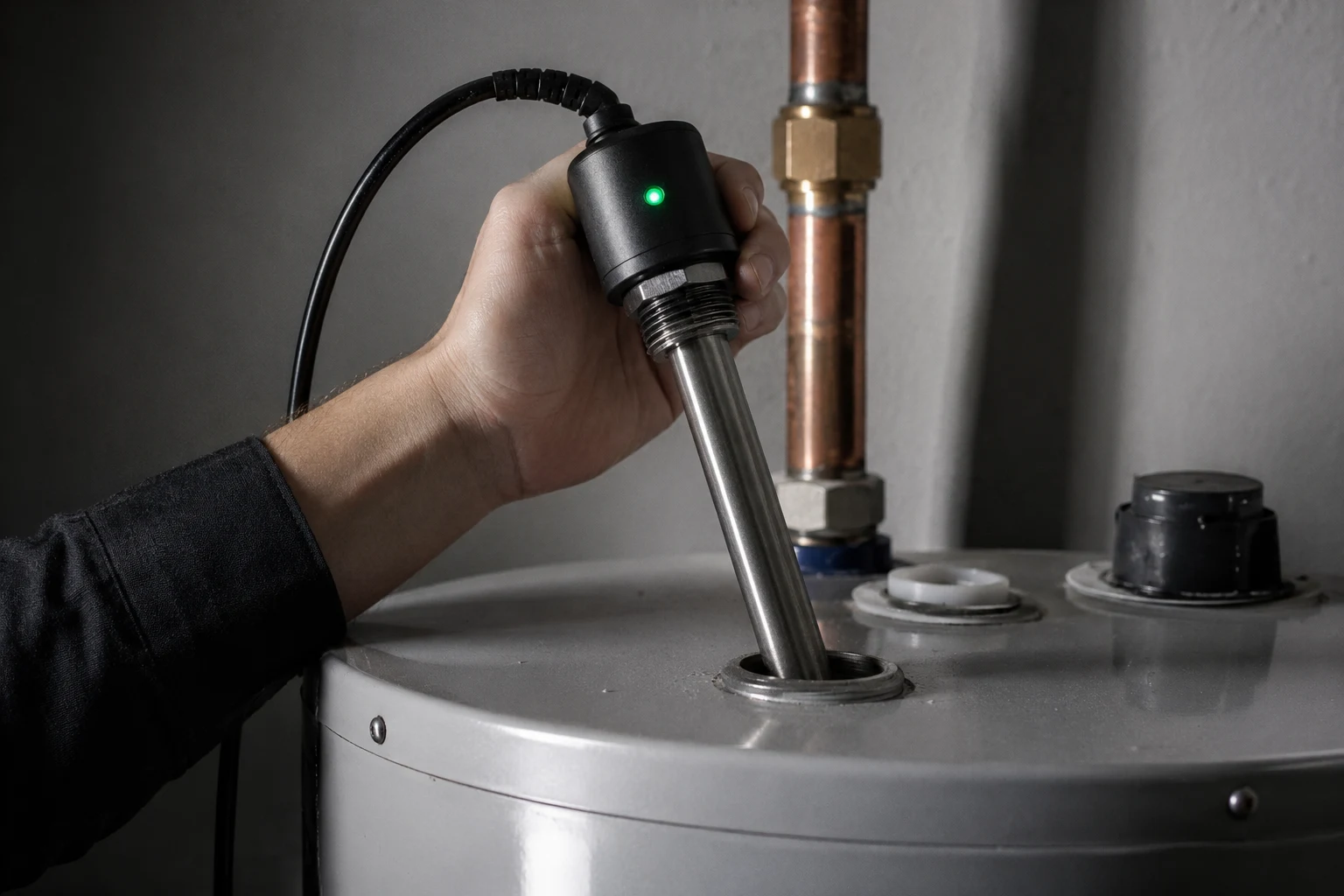
Power it safely, and shut the tank down before you open it
A powered anode runs on line voltage and lives in a wet mechanical space, so treat the electrical side with respect. Plug the transformer into a properly grounded 120V outlet, ideally one on a GFCI, and never run it off a lightweight extension cord snaking across a damp floor. If your heater has no outlet within reach of the roughly 12-foot cord, have an electrician add one rather than improvising. And always cut the gas or the breaker and relieve tank pressure before you open the anode port. Hot water under pressure and a live burner do not forgive shortcuts.
Weigh it by your own water and your own tank. Chasing a sulfur smell or burning through rods in soft water, the powered anode earns its price the first year. Sitting on easy water with a rod that lasts a decade, the cheap magnesium is doing fine and there is no rush. Either way, an anode is the part standing between your steel tank and the rust that ends it, so the worst choice is the one nobody ever checks.
Frequently asked
Does a powered anode rod really get rid of the rotten egg smell?
In most cases, yes, and fast. The sulfur or rotten-egg smell in hot water is hydrogen sulfide gas, produced when sulfate-reducing bacteria in the tank feed on the hydrogen given off by a magnesium sacrificial anode. Soft water, a private well, or water low in dissolved oxygen makes it worse. A powered anode does not shed metal for the bacteria to work on, and the small protective current it drives makes the tank an unfriendly place for them. Corro-Protec, the main maker, says the smell usually clears within 24 to 48 hours of installing and powering the rod. The one thing that will not fix it is another sacrificial rod, and swapping magnesium for aluminum only trades one problem for a milder version of the same one. If the smell is coming out of every tap including the cold side, that is not the water heater, that is your source water, and the anode swap will not touch it.
Will installing a powered anode void my water heater warranty?
The major manufacturers treat the anode rod as a maintenance item, and swapping a spent sacrificial rod for a powered one is considered normal anode maintenance rather than a prohibited modification. Rheem and A.O. Smith both fall in that camp, and a properly installed powered rod should not void the tank warranty. Here is the part people miss: those same warranties cover manufacturing defects, not neglect. If a tank rusts through because the original anode was left to dissolve to nothing and never replaced, the warranty was already dead. A powered anode arguably protects your warranty by keeping the tank from corroding. If you want to be certain for your exact model, read the warranty card or call the maker before you install, and keep the receipt. Rules can differ on high-end or commercial units.
How much does a powered anode rod cost, and is it worth it?
Expect to pay somewhere around 150 dollars for a residential powered anode from a name like Corro-Protec, with the RV and specialty versions running a little higher, near 160. That is real money next to a plain magnesium rod that costs 20 to 40 dollars. The math changes when you count how often you replace the cheap one. A sacrificial rod in soft or aggressive water can be gone in three to five years, sometimes less, so over the life of a tank you might buy and wrestle in three or four of them. The powered rod is a one-time buy that carries a 20-year warranty and never needs replacing. It runs on about two to three dollars of electricity a year. If your only complaint is a rod that lasts a normal eight to ten years, the payback is slow. If you fight the sulfur smell or you are on soft water burning through rods, it pays for itself quickly.
Does a powered anode rod need to be plugged in all the time?
Yes. That is the whole point of the design. A sacrificial rod works on its own chemistry with no power, slowly giving up its own metal so the steel tank does not. A powered anode is titanium, which will not sacrifice itself, so it needs a small steady current from the plug-in transformer to push protection onto the tank walls. Pull the plug and the protection stops that instant. The draw is tiny, milliamps, under a watt, so you are not adding a noticeable load. You do need a standard 120V outlet within reach of the cord, which runs about 12 feet on the common models. If your heater sits in a spot with no outlet nearby, plan for one before you buy the rod, because an extension cord in a damp mechanical space is not how you want to power a device that runs around the clock.
How do I know the powered anode is actually working?
Look at the light on the power supply. The common units use a green LED that only lights up once the system detects that protective current is actually flowing through the water to the tank. Green means the circuit is complete and the tank is being protected. If that light is off, protection is not happening. The usual reasons are a loose plug, a tripped outlet, or a bad ground connection where the rod threads into the tank, which the current needs in order to complete its path through the steel shell. Reseat the rod, make sure the port is tight and clean, and confirm the outlet has power. Some people leave the transformer where they can glance at it during other basement chores so a dropped light gets caught early. A dark light for weeks means the tank was running unprotected the whole time.
Can I put a powered anode in any water heater, tank or tankless?
It is a tank-heater device. Powered anodes protect glass-lined steel storage tanks, the kind that hold 40, 50, or 80 gallons and rely on an anode rod to keep the lining from corroding at any bare spots. A tankless unit has no storage tank and no anode rod, so there is nothing to replace and nothing for a powered rod to do. Within the tank world, powered anodes come sized by capacity, commonly split into ranges like 10 to 39 gallons, 40 to 89 gallons, and 90 to 120 gallons, so you match the rod to your tank size. They fit standard residential electric and gas storage heaters, and there are dedicated versions for RV and Suburban tanks. What matters is that your heater has an accessible anode port and a 120V outlet within reach, not the brand on the label.
Is it hard to install a powered anode rod myself?
For a handy homeowner it is a manageable afternoon job, on par with replacing a regular anode rod plus plugging in a cord. Cut the power or gas to the heater, shut the cold inlet, open a hot tap to break the vacuum, and drain a couple of gallons so the level drops below the anode port. The old rod usually backs out with a 1-1/16 inch six-point socket on the hex head, and a six-point socket matters because a stuck rod will round off a twelve-point. Some rods are seized hard and need a breaker bar or an impact wrench, and that is the step that trips people up. Thread the powered rod into the same anode port, snug it with thread sealant per the instructions, refill the tank, purge air from a hot tap, check for leaks, restore power, and plug in the transformer. Then watch for the green light. If the old rod will not budge or you are not comfortable draining the tank, this is a fair call for a plumber.