Two water heaters can hold the same 50 gallons, run on the same gas line, and heat water at the same rate, yet cost you a few hundred dollars apart at install. The entire gap between them sits on top of the tank, in the hardware that gets the burned exhaust out of your house. One lets that exhaust drift up a metal flue for free. The other blows it out a wall with a fan. Which one belongs in your basement depends almost entirely on what your install spot can actually vent.
| Atmospheric | Power vent | |
|---|---|---|
| How it vents | Hot gas rises up a vertical flue by itself | Blower forces exhaust out under pressure |
| Vent material | Metal B-vent or a lined chimney | PVC, CPVC, or ABS plastic pipe |
| Vent direction | Straight up through the roof | Usually horizontal, out a side wall |
| Electricity to vent | None | 120V outlet for the blower |
| Where it can go | Only under a vertical flue | Almost anywhere within pipe range |
| Backdraft / CO risk | Real if the draft fails | Low, exhaust is forced out |
| Noise | Silent | Audible blower while it fires |
| Runs in a power outage | Yes, with a standing pilot | No, the blower needs power |
| Up-front cost | Lowest on the shelf | $300 to $600 more installed |
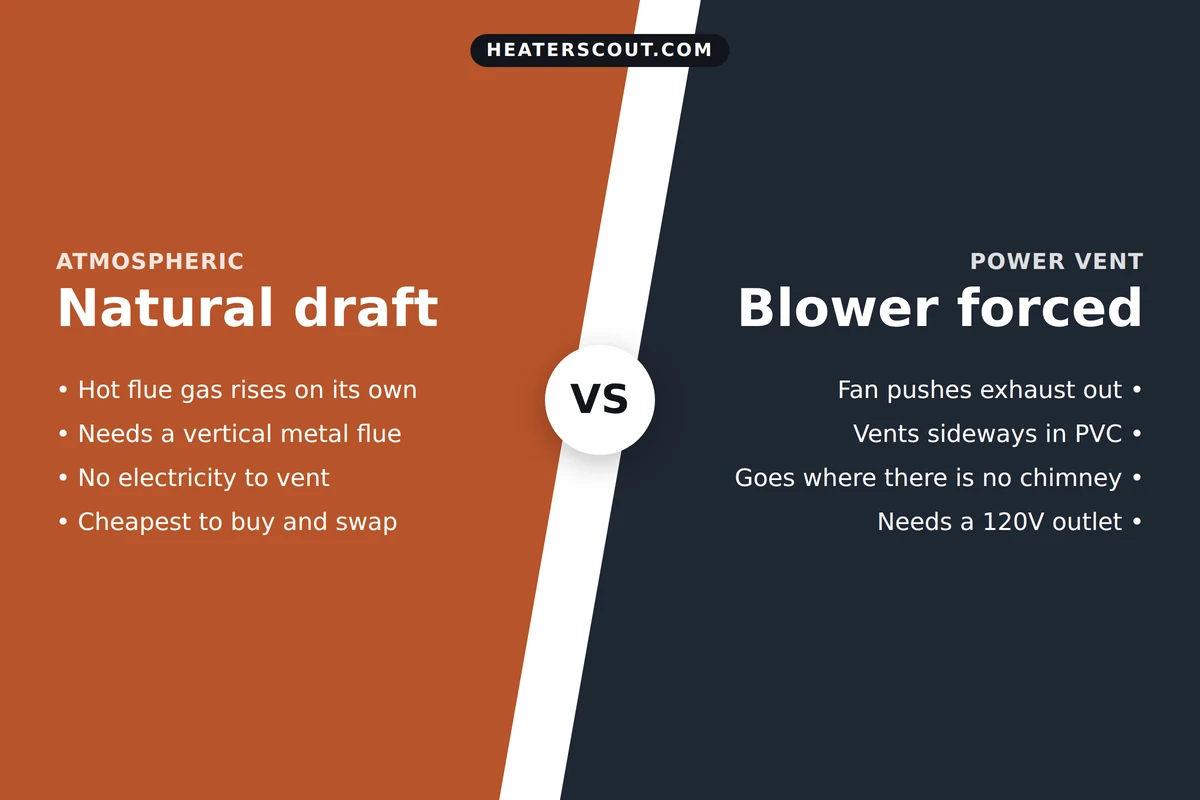
The whole decision is a venting decision
Both of these heaters burn gas under a steel tank and heat the same water the same way. The burner, the thermostat, the anode rod, the dip tube, all of that is common ground. What separates them is one thing: how the burned exhaust leaves the building. That single difference cascades into cost, where the heater can sit, how safe the draft is, and whether it keeps working when the lights go out. Once you see the split as a venting question, not a hot-water question, the choice stops being confusing.
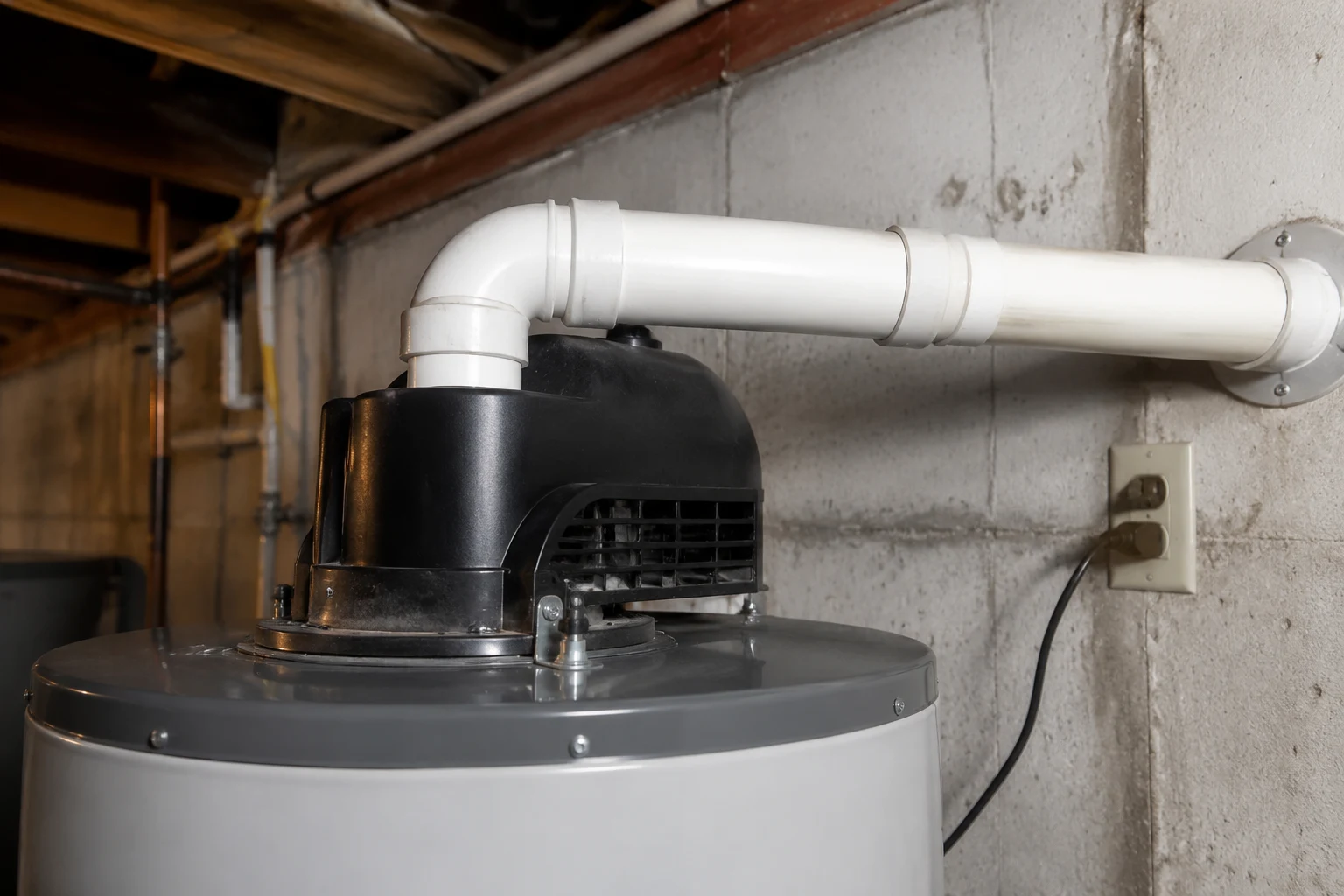
You can spot which one you are looking at in a few seconds. Look at the top of the tank. If there is a wide sheet-metal draft hood and a single metal flue pipe heading up toward the ceiling, that is an atmospheric unit. If instead there is a squat plastic-housed fan sitting on top with a run of white PVC leaving it, you have a power vent. Rheem, AO Smith, and Bradford White build both styles in the same tank sizes, so the brand badge on the front tells you nothing useful. The vent hardware on top is the only thing that does, and it is the only thing worth arguing about.
The one advantage that survives every other argument is what happens in a blackout. An atmospheric heater with a standing pilot has no electronics and no fan, so it keeps burning gas and keeps making hot water when the power drops. A power vent locks out the instant it loses its outlet, because the blower has to prove airflow before the burner will fire. In a suburb that rarely loses power for more than a few minutes, that difference is trivia. In a rural house at the end of a long line, where a winter storm can take the grid down for a day or two, a hot shower during the outage is a real reason to keep the natural draft tank. Weigh that against how often your power actually fails, not against the worst storm you can imagine.
People reach for the atmospheric heater because it is the default, the cheapest box on the shelf, the one that has been in American basements for decades. That reflex is often right and sometimes quietly wrong. The natural draft design assumes two things about your house that were true in 1975 and are not always true now: that there is a clear vertical flue overhead, and that the house leaks enough air to feed and replace what goes up that flue. Break either assumption and the cheap heater becomes the risky one. That is the reason power vent exists, and the reason it has been eating market share.
There is a middle option worth knowing about before you settle. Direct vent heaters sit between the two: a direct vent unit still uses no blower and drafts more or less naturally, but it pulls combustion air from outside through a concentric pipe and pushes exhaust out the same fitting, usually through a wall, so it does not depend on room air. Power direct vent, mentioned again later, combines the outdoor air intake with a blower. For most homeowners the real fork is still the plain atmospheric versus the plain power vent, so that is where the weight of this comparison sits, but if an installer floats a direct vent model, it is not an upsell trick. It is a legitimate answer for a specific kind of tight or awkward space.
Natural draft (atmospheric) venting
The oldest and simplest way a gas water heater gets rid of its exhaust, and it runs on physics with no help. The burner produces hot combustion gas. Hot gas is less dense than the cooler room air around it, so it wants to rise. A draft hood on top of the tank lets a little room air mix in, which both dilutes the exhaust and helps establish a steady upward pull, and the whole column then floats up a vertical metal flue and out through a chimney or a B-vent above the roofline. No fan touches it, no electricity is involved, nothing switches on. That elegance is also its weakness. The draft only works if the flue is truly vertical, clear, and warm, and if the room can supply enough combustion and dilution air to keep the column moving. Starve it of air by sealing the house tight, or pull the house negative by running a range hood and a dryer at once, and the column can stall or even reverse. When it reverses, the exhaust spills out of the draft hood into the room instead of going up, and that spillage can carry carbon monoxide with it. Everything good and everything dangerous about an atmospheric heater traces back to this one unforced, unmonitored draft.
You already have a good, lined vertical flue
A basement or utility room with a working masonry chimney liner or a B-vent that already runs straight up through the roof, and you are swapping an old gas tank for a new one in the same footprint. This is a like-for-like replacement. The flue is present and drafting fine, so a blower and a run of PVC would buy you nothing but noise and a bigger bill. Buy the atmospheric tank, keep the three to six hundred dollars, and put a CO detector nearby. Do have the flue and the liner inspected while the old unit is out of the way, because a swap is the one moment the vent is easy to see.
No usable chimney, or the tank sits far from a vertical vent
The heater has to live somewhere with no flue above it: an interior closet, a far corner of a basement, a spot where running a new vertical vent up through two floors and the roof would turn into a demolition project. A power vent solves it in an afternoon. The blower pushes exhaust through PVC across the ceiling and out the nearest exterior wall, a horizontal run that can stretch well past a hundred equivalent feet on many models. Here the premium is not really a premium at all. It is the only practical way to vent the heater, and it is worth every dollar.
A tight house, a finished basement, or a backdraft-prone room
New or heavily air-sealed construction, a utility closet packed near a laundry with a strong dryer, or a basement you are finishing off into living space. There may not be enough loose air to feed a natural draft flue, and appliances fighting for that air can pull the room negative and reverse an atmospheric draft. A power vent forces its own exhaust out regardless of house pressure. For the tightest homes, step up to a power-direct-vent, which also draws its combustion air from outdoors through a second pipe and depends on the house for nothing at all.
What the extra money actually pays for
The premium on a power vent is not buying you hotter water or a lower gas bill. That surprises people who assume the fancier-looking heater must be more efficient. In practice a standard atmospheric tank and a standard power vent tank both land in the low 0.60s for UEF, and the power vent runs at most a hair better because its forced draft is steadier and wastes a little less heat up the flue. If you want a real efficiency jump you are looking at a condensing power vent, which is a different and pricier tier. For the plain models most homeowners compare, efficiency is close to a wash. So the money is going somewhere else. The chart below breaks down where. Read it as four separate cost factors, because the up-front difference and the yearly running cost pull in different directions and you want to see both before you sign off on a unit. Vent material and length feed into that too: an atmospheric heater reuses the metal flue you already own, while a power vent needs new two- or three-inch PVC or CPVC run to an exterior wall, and every extra elbow and foot of horizontal pipe adds a little labor and a little back pressure the blower has to fight. Most units are rated well past a hundred equivalent feet, so length rarely kills the job, but a longer, twistier run is one reason two power vent quotes for the same tank can land a couple hundred dollars apart.
How to read the four cost factors
The four factors do not move together, and that is the point. Sticker price and install labor are where the power vent costs you real money, a few hundred dollars once. The yearly operating gap is tiny, because the blower draws only a small amount of power and the gas efficiency is nearly identical. The electrical need is not about cost so much as a hard requirement: no 120V outlet within reach means an electrician gets added to the job, or the power vent is off the table entirely. Weigh the power vent against what it uniquely gives you, which is placement freedom, not a cheaper month.
Should I switch from atmospheric to power vent even though my chimney still works?
Usually no. If your existing flue is lined, clear, and drafting well, an atmospheric swap is the cheaper and simpler choice, and you are not gaining meaningful efficiency by paying for a blower. The times a switch makes sense despite a working chimney are specific: you are converting the chimney over to a high-efficiency furnace and want the water heater off it, you are finishing the basement and want to reclaim the space around the flue, or you keep having draft problems because the house has gotten tighter over the years. Absent one of those reasons, keep the flue you have and buy atmospheric.
Frequently asked
What is the difference between a power vent and an atmospheric water heater?
An atmospheric, or natural draft, heater lets hot combustion gas rise up a vertical metal flue on its own, using nothing but buoyancy. A power vent heater has an electric blower on top that pushes the exhaust out through PVC pipe, usually sideways through an exterior wall. The atmospheric unit is cheaper and needs no electricity to vent. The power vent unit can go where there is no chimney and drafts more reliably.
Is a power vent water heater worth the extra cost?
It is worth it when you do not already have a good vertical flue. Power vent models from Rheem, AO Smith, and Bradford White run roughly $300 to $600 more installed than a comparable atmospheric tank. That premium buys you the ability to set the heater in a basement or an interior closet and vent it out the nearest wall. If you already have a working chimney or B-vent, the premium buys you little and a plain atmospheric tank is the smarter swap.
Does a power vent water heater need electricity?
Yes. The blower on top runs on 120 volts, so a power vent heater needs a standard grounded outlet within reach, and it will not make hot water if the power is out or the fan fails. An atmospheric heater with a standing pilot needs no electricity at all and keeps heating through an outage. That is one of its few genuine advantages, and it matters most in rural areas that lose power in storms.
Can an atmospheric water heater leak carbon monoxide?
It can if the draft fails. Atmospheric units depend on hot gas rising up the flue. If the flue is blocked, disconnected, or the house is pulled negative by strong exhaust fans, the exhaust can spill back into the room. That backdraft can carry carbon monoxide indoors, which is why a working CO detector near a natural draft heater is not optional.
What vent pipe does a power vent water heater use, and how far can it run?
Most power vent heaters vent through PVC, CPVC, or ABS pipe rather than metal, because the forced draft cools the exhaust enough that plastic is safe. Two- and three-inch diameters are common. A typical unit will push exhaust through a horizontal run of anywhere from about 40 to over 100 equivalent feet depending on the model and pipe size, so you can cross a finished ceiling and exit a side wall well away from where the tank sits.
What is a power-direct-vent water heater?
It is a sealed-combustion version of a power vent. A plain power vent pulls combustion air from the room and blows exhaust outside through one pipe. A power-direct-vent uses two pipes, one drawing fresh air in from outdoors and one pushing exhaust out, so it takes no air from the house at all. That makes it the right pick for a tight, sealed home or a small mechanical closet with no dedicated combustion air.