You turn on the powder-room sink and it takes 45 seconds before warm water arrives. That is not a plumbing problem. That is geometry. A 50-foot run of 3/4 inch copper holds about 1.5 gallons of water, and at a normal faucet flow of 1.5 gallons per minute you have to push all of that cold water down the drain before the hot from the central tank ever reaches the tap. A point-of-use water heater fixes that by moving a small heater to the fixture instead of trying to drag hot water across the house. It is not a replacement for the main tank. It is a targeted fix for one problem faucet, one added bathroom, or one utility sink at the far end of the garage, and the sizing math and electrical realities decide whether it is worth doing at all.
The numbers that tell you a POU pays off
Before you buy hardware, work the arithmetic on your actual fixture. A POU makes sense when the wait is long enough to notice, and the alternative (recirculation loop or re-plumbing the branch shorter) costs more than the small heater.
How to spec a POU without guessing
Get the numbers below before you shop. They decide whether you need a 12-amp plug-in tank or a 40-amp dedicated circuit, and those two answers are hundreds of dollars apart.
The two form factors and what they really deliver
POU units come in two shapes with very different install stories. A mini-tank is a scaled-down version of a central tank, holding 2.5 to 20 gallons and running on a normal outlet at the small end. A mini-tankless heats on demand and holds almost no water, which sounds better until you look at the flow and the electrical it needs. The spec table below is a straight comparison of what actually ships.
| 2.5 gal tank, 1500W 120V | Draws about 12 amps and plugs into a standard outlet. Recovers around 6 gph at a 90 F rise. Covers a single hand-wash sink comfortably. Price $175 to $250. The default choice for a remote powder room. |
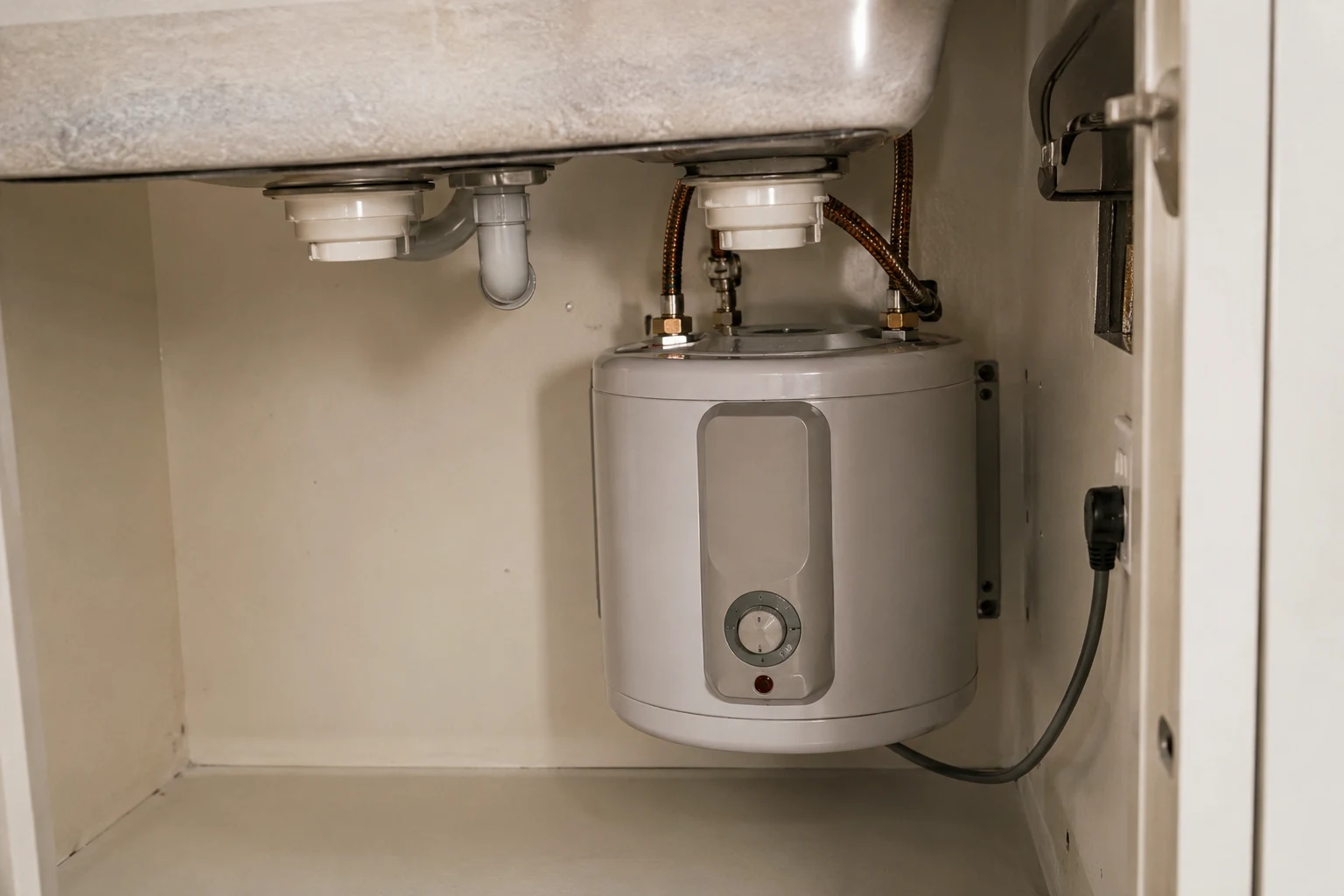
| 4 gal tank, 1500W 120V | Same electrical as the 2.5, more storage buffer. Handles a hand-wash sink plus occasional pot fills or a small dishwasher without running cold. Price $200 to $280. Good middle ground under a kitchen sink. |
| 6 gal tank, 1500-2000W 120V | Handles a hand-wash sink plus a residential dishwasher plus short utility draws. Still fits under most cabinets. Price $250 to $350. Common pick for a garage utility sink or a kitchen with slow arrival from a distant tank. |
| 10-20 gal tank, 1500-2500W 120V or 240V | Wall-mount or floor-standing, size of a small suitcase to a small dorm fridge. Enough for a partial bathroom (sink plus a small shower at a slow flow) or a wet-bar setup. Price $350 to $600. Needs a shelf or the floor with a drain pan; not an under-sink unit. |
| Mini-tankless 3.5 kW, 120V | About 0.5 gpm at a 50 F rise, which is a trickle suitable only for hand rinse. Plugs into a 20A circuit. Price $200 to $350. Fine for a bar sink where flow does not matter, wrong for a real sink. |
| Mini-tankless 6-8 kW, 240V | Roughly 0.75 to 1.5 gpm at a 50 F rise, dropping to about 0.5 to 1.0 gpm at a 90 F rise. Needs a dedicated 240V circuit at 30 to 40 amps. Price $250 to $500 plus the electrical work. A viable hand-wash and kitchen answer if you have the circuit; not enough for a shower. |
| Mini-tankless 10-14 kW, 240V dual breaker | About 1.5 to 2.0 gpm at a 55 F rise, edging toward a low-flow shower head at a warm-climate rise. Needs two dedicated 240V circuits at 40 amps each in most cases. Price $400 to $700 plus significant electrical. Only pencils out where a central heater absolutely cannot reach and a shower is required. |
The recovery question, and why hand-wash fixtures win
Recovery is the reason a tiny tank can cover a busy fixture. A 1500W element in a 2.5 gallon tank puts about 6 gallons per hour of new hot water in at a 90 F rise, or 0.1 gpm on average. A hand-wash cycle pulls maybe a quarter gallon over 20 seconds and then the sink sits idle for minutes. The tank refills faster than the fixture drains it. That same math falls apart the moment you attach a shower, because a shower pulls 1.5 gpm continuously for five minutes and no small POU recovers that fast. The rule of thumb: match recovery to average draw, not peak draw, and only put continuous fixtures on units sized for continuous flow.
Will a POU cause water hammer or affect house pressure?
A properly installed POU with a shutoff on the cold inlet does not cause hammer, but it can expose existing hammer that the long run was masking. If your system has a check valve or a PRV without an expansion tank, adding a POU tank creates another closed volume that heats and expands, and the T&P will dribble on hot cycles. The fix is a small potable-water expansion tank on the cold inlet, or verifying the house already has one at the central heater and that the POU is on the downstream side. Pressure at the fixture stays the same, because POU heaters do not restrict flow.
What the terms actually mean
The vocabulary matters here because manufacturer sheets use it precisely. Two definitions worth getting straight before you shop.
Point-of-use (POU) water heater
A small heater installed at or very near the fixture it serves, rather than centrally in a mechanical room. Includes mini-tanks from 2.5 to 20 gallons and mini-tankless units up to about 2 gpm. Sized around one fixture or a small cluster, not a whole house. The opposite is a central water heater, which feeds all fixtures through the home's hot-water distribution.
Hot-water wait time
The seconds between opening a hot tap and hot water arriving. Equal to the volume of water in the pipe between the heater and the fixture divided by the flow rate at the fixture, plus a small delay while the pipe warms up. A 50-foot 3/4 inch copper run holds about 1.5 gallons, so at 1.5 gpm the wait is roughly 60 seconds before hot arrives, and every drop of that goes down the drain.
Three scenarios where a POU is the right call
These are the situations where owners are usually happy with POU after the fact. Each one has a different reason and a different size answer.
Fixture far from the central heater with sporadic use
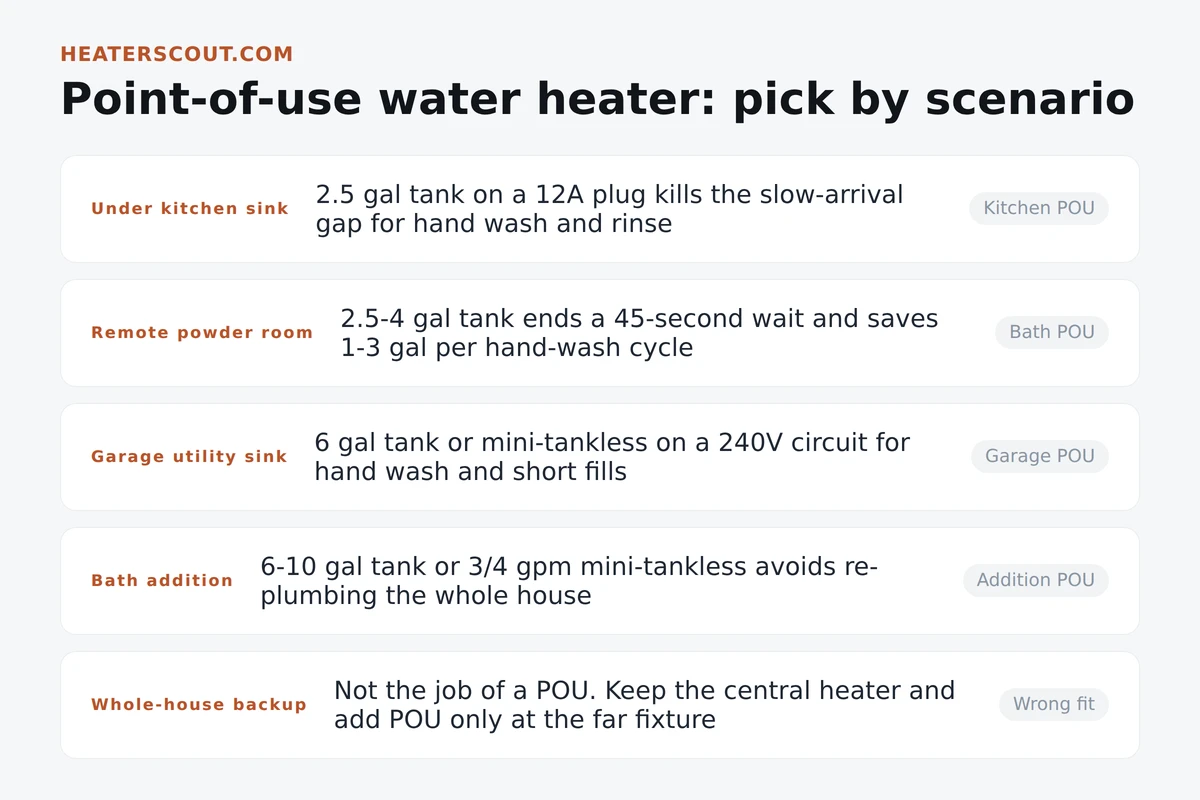
The workshop or garage sink is 60 feet from the central tank, so the run holds 2 gallons of cold water and the wait is a minute. Use is short, maybe a hand wash after a project or filling a bucket. A 6 gallon POU tank on the wall solves the wait completely, recovers well between uses, and needs only a nearby 120V outlet. Skip the mini-tankless here; the flow you gain does not matter for a fill-and-walk-away fixture.
New fixture group without re-plumbing the whole house
You added a half-bath in the far corner during a remodel and the shortest run from the central heater is 45 feet through joists you do not want to open again. A 6 to 10 gallon POU tank, or a 240V mini-tankless if the panel is close, handles the sink at full flow and lets you skip a hot line back to the main heater. The permit conversation is simpler too, because you are not extending the DHW system, you are adding a small appliance.
Central tank works fine, but the kitchen is at the far end
The showers and laundry get hot water fast, but the kitchen dumps a gallon and a half of cold water before it warms up. A 2.5 or 4 gallon POU under the kitchen sink, on the existing outlet, gives instant warm water for hand washing and rinsing dishes. The central heater still handles the actual dishwasher fill through the hot supply, so the POU only covers the arrival gap, which is exactly what it is good at.
Combined systems, and where POU quietly saves the most
The most common upgrade path is not POU alone, it is POU as an add-on to a working central system. Keep the central tank or tankless for the showers, the laundry, and the primary bathrooms, and add a small POU only at the one or two fixtures where the run is too long to be tolerable. That way you buy one $250 tank and a plug, not a whole new plumbing strategy, and the water and energy you save at the remote fixture pays back faster than a recirculation loop would. A household using the far bathroom four or five times a day runs 2,000 gallons a year in avoided waste at the low end, which starts to matter in drought-code jurisdictions. Codes vary: most treat a plug-in mini-tank as an appliance install needing only a drain pan and T&P discharge, while a hardwired mini-tankless triggers a full electrical permit. Check locally before you buy.
Frequently asked
Can a point-of-use water heater replace a central water heater?
For a normal household, no. A POU unit is sized around one fixture, not a whole house. The biggest common POU tank is around 20 gallons and the biggest mini-tankless tops out near 1.5 gpm at a 55 F rise, and neither number covers a shower plus a dishwasher plus a laundry fill. What POU does well is take one problem fixture off the central heater. In a studio or a tiny cabin with only a sink and no shower a 4 to 6 gallon POU can be the whole hot-water system, but the moment you add a real shower you are back to needing a central tank or tankless.
What size POU do I need for a bar sink or a hand-wash bathroom?
For hand-wash service only, a 2.5-gallon plug-in unit is the standard answer. It runs on a normal 120V outlet, draws about 12 amps, and recovers around 6 gallons per hour at a 90 F rise, which is far more than a hand-wash faucet pulls in a stretch. If the same sink also has to fill a coffee pot or a small pan for cooking, step up to a 4 or 6 gallon unit so a longer draw does not run the tank cold mid-fill. Anything smaller than 2.5 gallons is really for hand rinse only.
Does a POU water heater work with a dishwasher?
It can, with limits. A dishwasher wants water in the 120 F range and pulls about 1 to 2 gallons per fill cycle, with several fills in a run. A 2.5-gallon POU under the sink cannot keep up with back-to-back fills, so the last rinse comes in cold. Step up to a 6-gallon POU and match the temperature at 120 F and it handles a normal residential dishwasher, because the appliance heats its own final rinse anyway.
Does a POU water heater need its own T&P relief valve?
Every water heater that stores hot water under pressure needs a T&P valve, and tank-style POU units are no exception. Most 2.5 to 6 gallon POU tanks ship with a T&P valve installed on top or on the side, and it has to be piped to a safe discharge point, not left as an open threaded port under the cabinet. That discharge line is full-size copper or CPVC, runs downhill by gravity, and terminates within 6 inches of the floor or into a drain. Mini-tankless units heat on demand and hold almost no water, so they usually rely on the plumbing system's own relief and do not carry their own T&P.
Do I need a 240V circuit for a POU tankless?
For anything with real flow, yes, and this is the single biggest install cost people underestimate. A hand-wash-only 3.5 kW mini-tankless can squeak by on a 20A 120V circuit, but it will only give you about a half gallon per minute at a 50 F rise. Anything that promises 1 gpm or more at a useful rise wants 240V and a dedicated 20 to 40 amp breaker, and often two separate breakers on a larger unit. If the fixture is nowhere near the panel, the cost of running that circuit can equal the heater itself, which is when a plug-in mini-tank quietly wins the job.