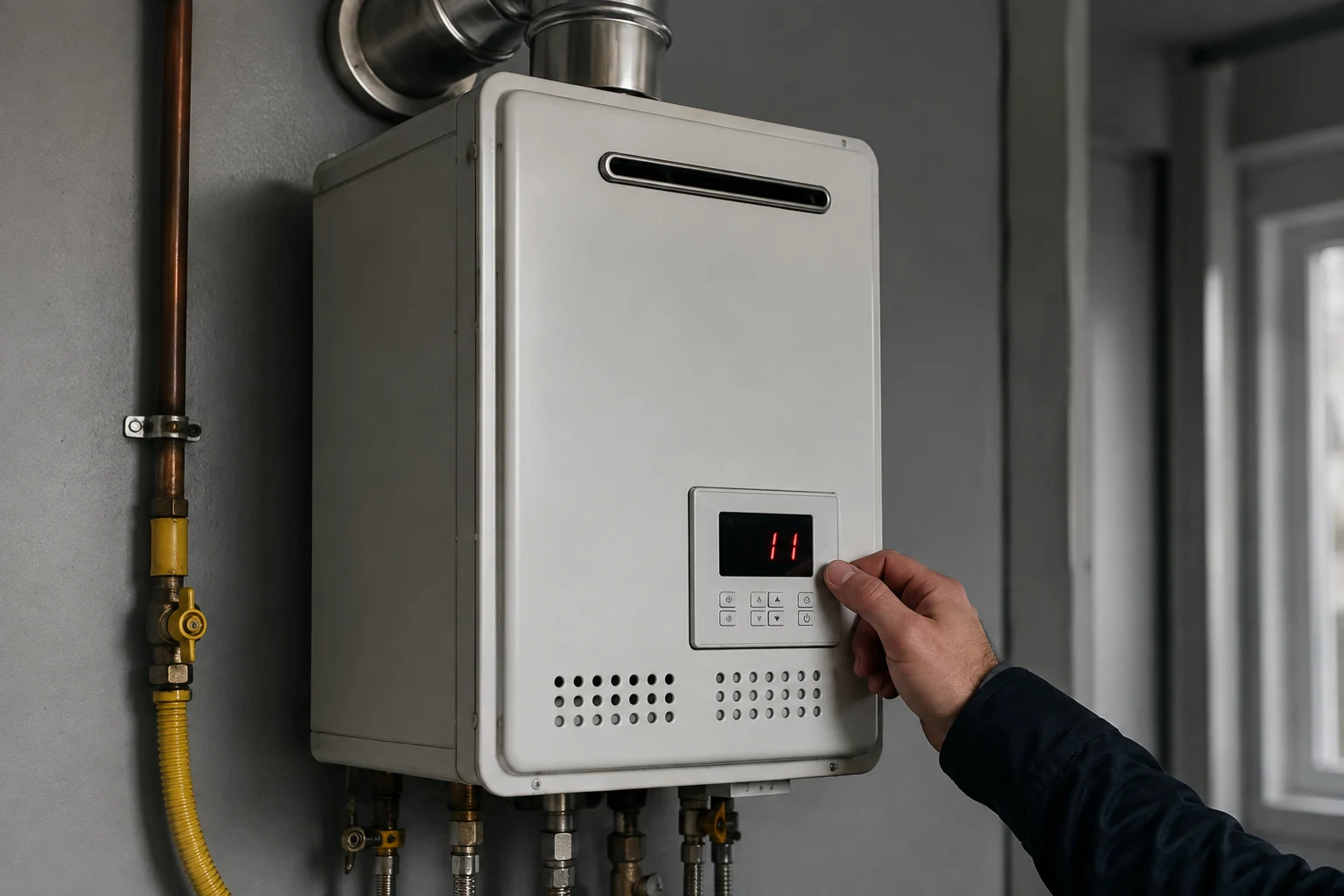
A Noritz tankless does not leave you guessing the way an old pilot-light tank does. When something is wrong it puts a number on the remote controller, and that number is the whole diagnosis if you know how to read it. An 11 is not a 12, a 14 is not a 16, and telling them apart decides whether you are looking at a five-minute check or a heat-exchanger replacement. This hub covers the codes people actually see on Noritz condensing and non-condensing gas units, and it draws a hard line between the ones you can chase yourself and the ones that mean hands off, call a tech.
Does this cover both condensing and non-condensing Noritz models?
Yes. The ignition, flame, flow, and scale codes read the same across the line, so an 11 or a 14 means the same thing whether you have an older non-condensing unit or a newer condensing one. Condensing models add a second heat exchanger and a condensate drain, which brings in codes the non-condensing units never show, mainly 29 for condensate drainage and 92 or 93 for the neutralizer.
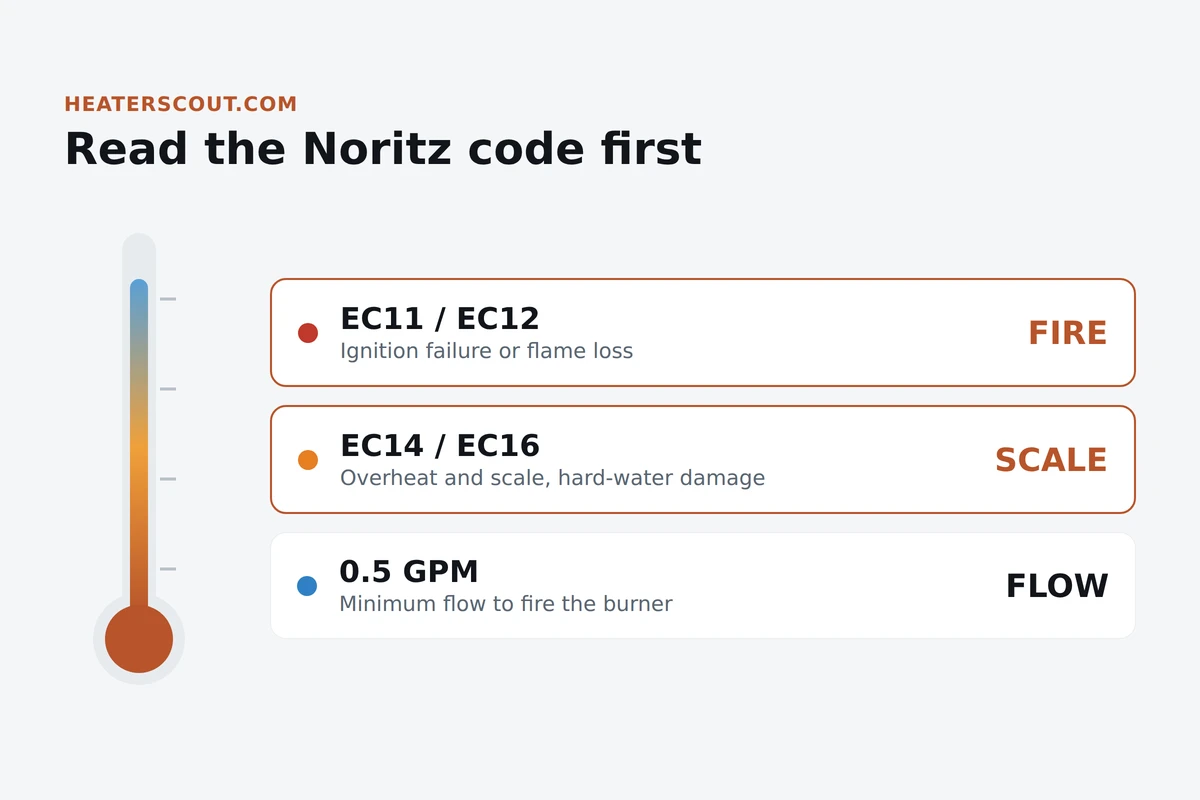
The code is the diagnosis. An 11 is a burner that never lit; a 12 is one that lit and quit; a 14 is a heat exchanger that already overheated. Reading which one you have is half the repair.
Start here: read the remote, then sort the code
Every Noritz fault shows a two-digit code on the remote controller, sometimes with a letter in front. Before you touch anything, read it and write it down, because the code tells you which system failed. The codes fall into a few families. The lighting faults are 11 and 12. The overheat and scale faults are 14 and 16. The combustion and air-fuel faults are 10, 90, and 99. The condensing-only faults are 29 for condensate and 92 for the neutralizer. The component faults are 51 for the gas solenoid valve, 61 for the combustion fan, and 65 for the main water servo. Knowing the family tells you whether this is a supply-and-vent check you can make or an internal part a tech has to touch.
Read the code and note whether it repeats
A code that clears on a power cycle and does not come back was a hiccup. A code that returns every time the unit tries to fire is a real fault. Write down the exact number, including any leading letter, because 51 and 511 or 90 and 99 are different faults.
Check the free stuff first: gas, flow, vent
For lighting codes, confirm the gas is on and the shutoff at the heater is open, and confirm the fixture is flowing more than about half a gallon a minute. For any combustion code, walk outside and look at the intake and exhaust terminations for snow, leaves, lint, or a nest. A smothered vent throws several codes.
Try one reset, the right way
Cut power to the unit for about 30 seconds and restore it, or press the reset button behind the front panel. That clears soft faults like a stray 73 circuit-board setting. If the same code comes right back, stop resetting. A code that will not clear is telling you the fault is still present.
Know the codes that never reset
A 14 thermal fuse is a broken one-time safety part and will not clear no matter what you do. Combustion codes like 90 should not be cleared-and-run because they involve how the burner is actually burning. Those are call-a-tech faults.
The lighting faults: 11, 12, and the flow that fools you
The most common calls are the lighting codes. Code 11 is an ignition failure, the burner never lit despite a call for hot water. Ignition needs air, spark, and gas together, and an 11 means one of the three did not show up. On a new install an 11 is almost always the gas side, a closed valve, an undersized line, the wrong regulator, or an empty propane tank. On an established unit that suddenly throws 11, check the gas is on and the vent is clear, then hand it off, because a fouled igniter or flame rod lives inside the cabinet. Code 12 is the close cousin, a flame that lit and then dropped out, which points at flame stability rather than ignition: a dirty flame rod, gas pressure that sags under load, or a vent choking the flame.
Then there is the failure with no code at all. If the unit runs fine at a full-open tap but goes cold when you barely crack a faucet, you are under the minimum activation flow. Noritz needs water actually moving to fire the burner, and for most models that floor sits around half a gallon per minute. Below it, the flow sensor never asks the burner to light, so you get cold water and a blank remote. A clogged inlet screen or a fouled aerator can drop you under that floor on a fixture that used to work fine.
| 10 | Combustion abnormality: uneven or non-stopping combustion, often low gas pressure or low gas heating value. Verify inlet gas pressure. Pro diagnosis. |
| 11 | Ignition failure, burner never lit. Homeowner: confirm gas on and vent clear. Then pro for igniter, flame rod, gas pressure. |
| 12 | Flame loss or weak flame, lit then dropped out. Same first checks as 11; a repeating 12 is a combustion diagnosis for a pro. |
| 14 | Thermal fuse tripped by heat-exchanger overheat, usually from scale. One-time fuse, cannot be reset. Replace fuse and often the heat exchanger. Pro. |
| 16 | Outlet over-temperature, a sharp temperature spike, commonly from scale buildup. Descale or add a softener; verify with a tech. |
| 29 | Condensate drainage problem on condensing models. Line must be at least 1/2 inch ID, routed and unobstructed, or it can flood the burner. Pro. |
| 51 | Gas solenoid valve or its circuit. Check connections and coil resistance; replace valve, manifold, or board as needed. Pro. |
| 61 | Combustion fan (blower) motor abnormality. Check motor operation and incoming voltage. Pro. |
| 65 | Main water servo / flow-control valve abnormality. Inspect the servo and clear debris. Pro. |
| 90 | Combustion abnormality from improper air-fuel mixture after repeated failure to reach temp. Insufficient gas, vent blockage, or fan debris. Stop and call a pro. |
| 92 / 93 | Neutralizer near end of life on condensing models. Replace the neutralizer and reset the burner timer. Pro. |
| 99 | Combustion / exhaust blockage (part of the 90-91-99 group). Clear intake and exhaust vents and the fan; verify gas type and a blue flame. Pro. |
The scale story: 14, 16, and why hard water is the real enemy
If you take one thing from a Noritz troubleshooting page, make it this: hard water is what kills these units, and it kills them through scale. Codes 14 and 16 are both scale stories. A 16 is a sharp spike in outlet temperature, often the first warning that scale is starting to insulate the heat exchanger. A 14 is the endgame, the thermal fuse breaking because the exchanger overheated, and scale acting as insulation is the usual reason it got that hot. The 14 is the one that hurts, because the fuse is a one-time part that physically breaks and there is no reset. Someone has to open the unit and swap the fuse, and because pulling the heat exchanger is most of the labor, shops usually replace the exchanger at the same time. That is a several-hundred-dollar afternoon that a routine flush would have prevented.
The prevention is descaling, a vinegar or CLR flush circulated through the heat exchanger with a small pump and a bucket. On hard water with no softener, plan on every six months. On soft water or behind a softener, once a year or longer is fine. If your unit was installed with isolator service valves, the flush is a bucket-and-pump job you can do in under an hour, so get those valves added the first time a tech is out.
The short version
Most Noritz faults are a two-digit story. The homeowner half is gas, flow, and a clear vent, plus one reset and a descale schedule. The pro half is anything about combustion (10, 90, 99), a broken safety fuse (14), a condensate or neutralizer fault on a condensing unit (29, 92), or an internal component (51, 61, 65). If a code will not clear after gas, vent, and one reset, it is a real fault.
Condensate, venting, and freeze: the install-dependent faults
A few codes only make sense once you know how the unit is installed. On a condensing Noritz, the second heat exchanger pulls extra heat out of the exhaust and leaves behind acidic condensate that has to drain away. Code 29 is that drain complaining. If the condensate line is undersized, Noritz calls for at least a half-inch inner diameter, or it is kinked, clogged, or run uphill, the condensate backs up and can flood the burner. Code 92 or 93 on the same units is the neutralizer, the cartridge that neutralizes that acidic condensate, telling you it is near the end of its life; replace it and reset the burner timer. Non-condensing units never show either code because they have no condensate to manage.
Venting ties into the combustion codes. A vent that is too long, blocked, or improperly sloped starves the burner for air and can throw a 10, a 90, or a 99. The homeowner-safe part is the outside terminations: clear them of snow, leaves, lint, and nests. Everything past that, vent length, slope, and material, is a sizing question for the installer, not a field fix.
Noritz units carry built-in electric freeze-protection heaters, and here is the part that matters: they only work while the unit stays plugged in. The freeze heaters run on electricity, so a winter power outage is exactly when the protection quits, and a hard freeze on a dead outlet is how a heat exchanger cracks. If you live where it freezes, Noritz recommends a battery backup or drain-down solenoids. Before a long winter trip, isolate the unit at the service valves and drain it. Freeze damage is excluded from most warranties, so the prevention is cheaper than the lesson.
Frequently asked
What does error code 11 mean on a Noritz tankless water heater?
Code 11 is an ignition failure. The unit saw a call for hot water, tried to light, and never got a burner flame going. Ignition needs three things at once: combustion air, a spark, and gas. If any one is missing, you get an 11. The homeowner-safe checks are the boring ones that fix a lot of 11s. Confirm the gas is actually on at the meter and the shutoff valve at the heater is open, check that a propane tank is not empty, and make sure the intake and exhaust vents are clear of nests, snow, or lint. If the gas is on, the vent is clear, and it still throws 11, the next steps live inside the cabinet, a dirty or loose igniter, a fouled flame rod, low gas pressure, and those belong to a licensed tech. An 11 on a brand-new install almost always traces to gas supply, undersized line, wrong regulator, or a closed valve, not a broken heater.
What is the difference between Noritz error code 11 and code 12?
They are the two halves of a lighting problem. Code 11 means the burner never lit at all. Code 12 means it lit and then lost the flame, a flame-loss or weak-flame fault. An 11 leans toward the ignition side: spark, igniter, gas getting to the burner. A 12 leans toward flame stability: a dirty flame rod, marginal gas pressure that sags under load, or a partially blocked vent starving the flame. The homeowner checks overlap, gas on and vent clear, but a repeating 12 after those basics is a combustion diagnosis for a pro, not a reset-and-hope.
What causes Noritz error code 14 and can I reset it?
No, you cannot reset a 14, and that is the whole point of the code. Error 14 is the thermal fuse, a one-time safety fuse that physically breaks when the heat exchanger overheats. Once it opens it stays open. Pulling power will not clear it and there is no button that resets it. The fuse has to be replaced, which means opening the unit and pulling the heat exchanger, a two to four hour job that most shops price with a new heat exchanger installed at the same time. The usual cause is heavy scale inside that exchanger: hard water leaves mineral scale on the walls, the scale acts like insulation, the metal runs hotter than it should, and the fuse finally trips to stop it. The real fix is descaling on a schedule so it never gets there again.
Why does my Noritz shut off in the shower with no error code?
Because you dropped below the minimum activation flow. A Noritz needs a certain amount of water actually moving through it to fire the burner, and for most models that floor is about half a gallon per minute. Open the tap only a crack, run a low-flow fixture, or mix in so much cold that very little hot is called for, and the flow sensor never sees enough demand to keep the burner on. The water goes cold and no code appears, because from the heater's point of view nothing is wrong. It also shows up when an aerator or inlet filter screen is clogged and choking the flow. If the shutoff is random and codeless, check for a fouled inlet screen and try opening the fixture wider before you assume a fault.
How often should I descale a Noritz tankless water heater?
Annually is the baseline most techs and Noritz land on, and your water hardness moves that number in both directions. On genuinely hard water with no softener, every six months is closer to right, because scale builds fast and scale is what drives the expensive failures like a code 14 thermal fuse. On soft water, or with a softener or a Noritz anti-scale device upstream, you can often stretch to a year or longer. The job itself is a vinegar or CLR flush: isolate the unit at the service valves, hang a submersible pump in a bucket of solution, and circulate it through the heat exchanger for around 45 to 60 minutes, then rinse. If your unit has isolator valves installed, it is a bucket-and-pump afternoon. If it does not, having those valves added during the first service pays for itself every flush after.
What does Noritz error code 90 mean and is it safe to keep running?
Code 90 is a combustion abnormality, the unit deciding the air-to-fuel mixture is wrong after it repeatedly failed to reach target temperature. The common causes are insufficient gas supply, a blocked or too-long vent run, or debris in the combustion fan. This is not a code to keep clearing and running through, because it is about how the burner is actually burning, and a combustion that is off can mean incomplete burn and carbon monoxide. Treat a 90 like a stop-and-call. A licensed tech will check the manifold gas pressure, the vent, the fan, and the dip-switch settings for gas type and altitude. The one thing a homeowner can safely do first is make sure the intake and exhaust terminations outside are not blocked by snow, leaves, or a nest, because a smothered vent alone can throw a 90.
Does my Noritz have freeze protection, and what happens in a power outage?
Yes, Noritz units have built-in electric freeze-protection heaters, but they only work while the unit stays plugged in and powered. That is the catch that bites people every winter. The freeze heaters run on electricity, so the exact moment a winter storm knocks out your power is the moment the protection stops, and a cold snap plus a dead outlet is how a heat exchanger cracks. If you are in freezing country, Noritz recommends a battery backup or drain-down solenoids so the unit can either stay warm or empty itself when power drops. Before a long winter absence, isolate the water at the service valves and drain the unit. Freeze damage is specifically excluded from most warranties, so this is prevention that actually saves you the price of the unit.