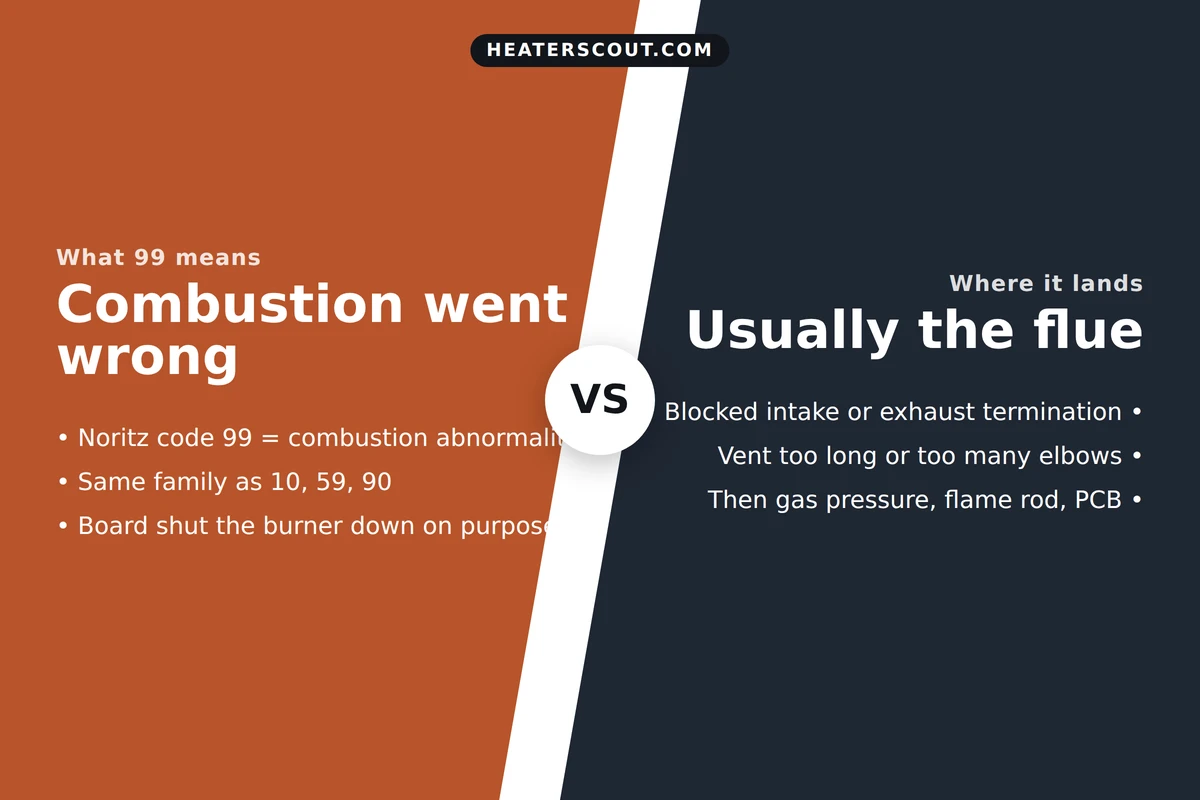
A Noritz tankless that flashes 99 has not run out of hot water and it has not blown a fuse. Its control board watched the burner light, compared the actual combustion against what it expected, decided the two did not match, and shut the unit down on purpose. Code 99 is a combustion abnormality, and in the field the cause is a blocked or restricted flue far more often than a failed part. Before anyone orders a control board, the fix usually lives at the vent termination on the outside wall.
What Noritz code 99 is telling you
Noritz groups several codes under one idea. Codes 10, 59, 90, and 99 all report that combustion went wrong in some way, which is why a tech reads them as a family rather than four unrelated faults. Code 99 is the general combustion-abnormal flag. The board meters the fan speed and the burner and expects the exhaust and the air-to-fuel balance to sit in a narrow window. When the real numbers drift out of that window, the unit posts 99 and stops. The most common reason that window gets missed is airflow. A sealed-combustion unit pulls its own combustion air in and pushes exhaust out, and anything that chokes either path, or a vent run that was borderline from the day it was installed, upsets the balance and trips the code.
Blocked or restricted flue
A plugged intake or exhaust termination, a bird or wasp nest, leaves, lint, snow or ice at the cap, or a vent that is too long or has too many 90-degree elbows. This is where 99 lands most often. Check it first.
Gas supply pressure
Low or sagging gas pressure starves the burner and produces the same abnormal combustion. It often looks like clean venting because the pipe is clear, but the flame is wrong. Needs a manometer to confirm.
Fouled flame rod or igniter
Carbon or corrosion on the flame rod or igniter throws off flame detection and ignition, which the board can read as bad combustion. A clean or an inexpensive OEM swap covers most of these.
Fan motor or control board
A weak combustion fan or a misreading PC board is real but rare, and it is the most expensive outcome. You only get here after the venting, the gas, and the flame rod all check out clean.
That order matters. People see a code in the 90s and assume the electronics failed, then spend several hundred dollars on a board that was never the problem. Work from the outside in and from cheap to expensive, because the flue is both the most likely cause and the one you can inspect for free.
Is code 99 the same as code 90?
They are cousins, not twins. Both belong to the combustion-abnormal family, and both often trace back to venting or gas. Code 90 tends to point more specifically at combustion and venting, while 99 is the broader abnormal-combustion catch that the board posts when things are out of the expected range. Practically, you chase them the same way: clear the flue, verify the intake, check gas pressure, inspect the flame rod. If your unit alternates between 90 and 99, treat it as one venting-and-combustion problem, not two.
Diagnostic order that actually works
Kill power at the breaker and shut the gas before you open anything, and never work on a hot unit. Then walk the causes in this order. The first two steps clear most 99 faults on their own.
Inspect the vent termination outside
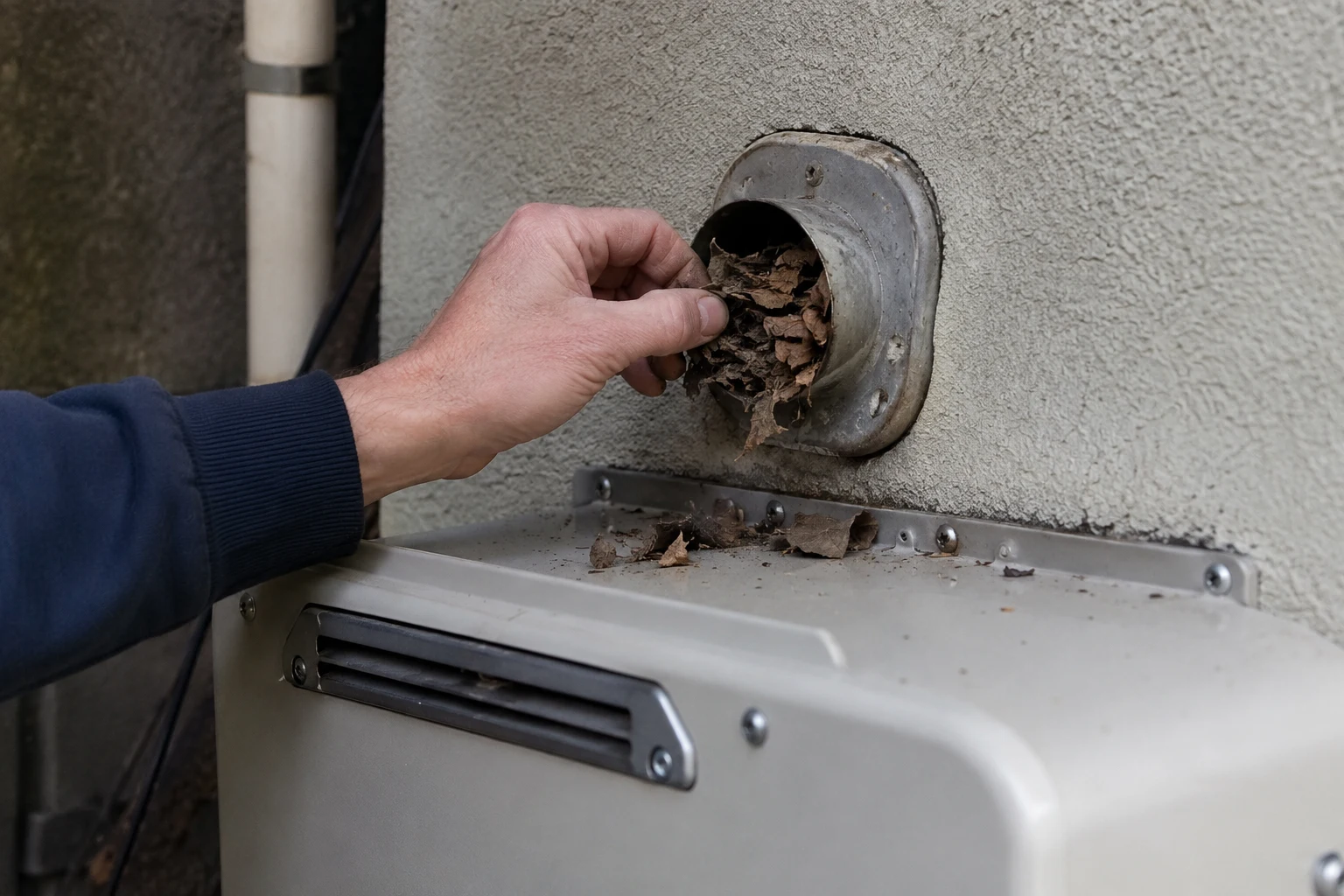
Go to the exhaust and intake terminations on the exterior wall or roof. Look for a nest, leaves, lint, snow, ice, or a screen packed with dust. Clear anything you find. In winter, ice at the cap after a cold snap is a classic 99. Also confirm nothing nearby, like a dryer vent or another appliance's exhaust, is dumping into the intake.
Trace the vent run back to the unit
Follow the pipe from the termination to the heater. Look for a section that pulled apart, a sag that holds condensate, a crushed or kinked flex length, or a slope that runs the wrong way. Confirm the run matches the install manual: within the maximum rated length and within the allowed number of 90-degree elbows. A vent that is over-length or elbow-heavy acts like a partial blockage even when it is clear.
Power cycle and watch one firing
Turn the controller off, flip the breaker off for about five minutes, then restore power. Run a hot tap and watch the burner try to light. If 99 returns the instant the burner fires, the combustion problem is still present and you keep going. If it fires and holds, the blockage you cleared was the cause.
Check gas supply pressure
If the venting is clean but 99 persists, the burner may be starving for gas. This needs a licensed tech with a manometer to read the inlet and manifold pressure under load. Pressure that sags when the unit fires hard produces abnormal combustion that mimics a vent problem.
Inspect the flame rod and igniter
With power and gas off, get to the burner and look at the flame rod and igniter. Carbon or corrosion on the rod dulls flame detection, and a worn igniter weakens ignition. Clean the rod bright with fine sandpaper or replace an OEM part if it is pitted. This covers the sensing-side share of 99.
Fan motor and control board, last
Only after venting, gas, and the flame rod all check out do you consider a weak combustion fan or a control board misreading a good burner. These are the expensive parts, and they fail far less often than a flue gets blocked. Have a Noritz-experienced tech confirm before you buy either.
What you can do safely, and what you cannot
Clearing a blocked termination and power cycling the unit are fair game for a careful homeowner. So is a visual walk of the vent run and a look at the flame rod, as long as you shut off power and gas first and let the unit cool. This checklist keeps you on the safe side of the line.
- Turn off the controller, kill the breaker, and close the gas valve before opening anything.
- Clear debris, nests, lint, snow, or ice from the exhaust and intake terminations.
- Confirm nothing nearby is dumping exhaust or lint into the air intake.
- Walk the vent run for a disconnected joint, a sag holding condensate, or a wrong slope.
- Check the vent length and elbow count against the Noritz install manual.
- Power cycle five minutes at the breaker, then watch the burner fire once.
- Keep a working carbon monoxide detector near the unit and its living space.
- If 99 returns, or you smell exhaust indoors, stop and call a licensed tech.
Where the homeowner line sits
The jobs that need a pro are the ones that involve gas, sealed combustion internals, or code compliance. Setting or reading gas pressure takes a manometer and a license. Re-running or re-sloping venting has to meet the manufacturer's spec and local mechanical code, because a vent that leaks exhaust is a carbon monoxide risk, not just a nuisance. Swapping a fan motor or a control board inside a sealed unit is a tech's call after real diagnosis. The two columns below split it cleanly.
Safe for a homeowner
- Clear the exhaust and intake terminations of debris
- Knock ice or snow off the vent cap after a cold snap
- Power cycle the unit at the breaker for five minutes
- Visually walk the vent run for obvious problems
- Inspect and lightly clean the flame rod with power and gas off
- Keep a CO detector working near the unit
Call a licensed tech
- Measure or adjust gas supply and manifold pressure
- Re-run, re-slope, or reseal venting to spec
- Diagnose a vent that is over-length or elbow-heavy
- Test or replace the combustion fan motor
- Diagnose or replace the control board
- Any repair where you smell exhaust or the CO alarm sounds
Keeping code 99 from coming back
A 99 that keeps returning is almost always a venting or gas problem that was never fully fixed, not a flaky board. If the code shows up under high demand or on the coldest mornings, the venting design and the gas supply are the usual suspects, because that is when the unit fires hardest and any restriction bites. Put the vent terminations somewhere they will not re-collect debris or ice, keep them clear of other appliance exhaust, and have the annual service include a combustion check, not just a descale. A tech should inspect the flue and terminations for soot and blockage, look at the burner and flame rod, and confirm gas pressure holds under load. Do that once a year and code 99 stops being the surprise that greets you on the first freezing morning of winter.
Frequently asked
Can I reset Noritz code 99 myself?
You can clear it, and clearing is a legitimate first move to see whether the fault was a one-off or a real problem. There is no dedicated reset button on most Noritz tankless controllers, so you power cycle the unit. Turn the heater off at the remote controller, then flip the breaker feeding the water heater off for about five minutes. That drains the control board and clears the latched code. Flip the breaker back on, power the controller up, and run a hot tap to make the burner fire. If 99 comes right back the moment the burner tries to light, the reset did its job of clearing the memory, but the underlying combustion problem is still there. A code that returns on the next firing is telling you to go find the blockage, not to keep resetting.
What does Noritz error code 99 actually mean?
Code 99 is a combustion abnormality. The control board watches the burner and the fan, and when the actual combustion does not match what the board expects, it shuts the unit down and posts 99. On Noritz units the codes 10, 59, 90, and 99 all belong to the same combustion-abnormal family, which is why a tech treats them as neighbors. In the field, 99 lands on the venting side more than anything else. A blocked or restricted flue, a plugged intake, or a vent run that is too long or has too many elbows starves the burner of clean air or traps exhaust, and combustion goes bad. Gas supply pressure and a dirty flame rod or igniter round out the list.
Why is a blocked vent the first thing to check on code 99?
Because it is the most common cause and the cheapest to rule out. A sealed-combustion Noritz pulls its own combustion air through the intake and pushes exhaust out the flue. Anything that chokes either path, a bird nest or wasp nest at the termination, leaves and lint, snow or ice in a cold snap, a screen packed with dust, or a vent cap that got covered, throws off the air-to-fuel balance the board is metering. The heater reads the abnormal combustion and posts 99. Installation problems count too. A flue that is longer than the maximum rated length or has more 90-degree elbows than the manual allows behaves like a partial blockage even when nothing is stuck in it. Start at the outside termination, work back toward the unit, and confirm the vent matches what the install manual permits.
How much does it cost to fix Noritz code 99?
If it is a blocked termination, the fix costs nothing but a ladder and a few minutes to clear the debris and reset. If a vent joint pulled apart or a section sags and holds condensate, a plumber's visit to reseat and re-slope the venting usually runs $150 to $400 depending on how much pipe is involved and how bad the access is. A fouled flame rod or igniter is a clean or a swap, and OEM flame-rod or igniter parts for common Noritz models run roughly $25 to $70. Gas pressure problems need a tech with a manometer, which is again in the $150 to $350 diagnostic range. The expensive outcomes, a fan motor or a control board, run several hundred dollars for the part alone, which is exactly why you clear the venting and the cheap causes before anyone talks about a board.
Will descaling clear code 99?
Usually not. Descaling flushes scale out of the heat exchanger waterways, which matters for flow-related and overheat codes, but 99 is a combustion fault on the air and fuel side of the unit, not the water side. A blocked flue or a starved intake will not care how clean your heat exchanger is. That said, a heater neglected on descaling is often neglected on combustion service too, so if you are already inside for a flush, have the tech inspect the vent, the burner, and the flame rod at the same time. Descaling is good annual maintenance, it is just not the lever that clears a 99.
Why does Noritz code 99 keep coming back?
A 99 that returns after a reset means the combustion problem never left. The repeat offenders: a vent that is marginal by design, too long or too many elbows, so the unit runs fine on a mild day and trips 99 when it fires hard on a cold morning. Or a termination in a spot that keeps re-collecting debris, leaves, snow, or exhaust from a nearby appliance being pulled back into the intake. Or gas pressure that sags under load, which looks like clean venting but starves the burner right when demand peaks. Or a flame rod that re-fouls because combustion is running dirty. If the code always shows up under high demand or in cold weather, suspect the venting design and the gas supply, not a random part.
Is Noritz code 99 dangerous?
The code is a safety response, not the danger itself. By posting 99 and shutting the burner down, the unit is refusing to keep burning gas when combustion is not clean, which is exactly what you want it to do. Incomplete combustion is how carbon monoxide gets produced, and a blocked flue is a classic path to it, so a heater that stops and shows 99 is protecting you. The danger is in defeating that protection. Never try to force the unit to run past a combustion fault, never cap or reroute venting to something the manual does not allow, and if you smell exhaust indoors or your CO alarm sounds, treat it as an emergency. Clear the blockage or get a licensed tech, and make sure a working CO detector is nearby regardless.