A Noritz that shows 73 is almost never telling you a part broke. It is telling you its own settings do not add up. The most common story behind a 73 is a person: someone opened the cover to change a dipswitch or a gas-type connector, and did it with the power still on. The board read its configuration changing mid-run and locked out. That means the fix is usually free, a power-down and a corrected setting, and the scary reading, a dead control board, is the least likely cause, not the first.
What the board is actually complaining about
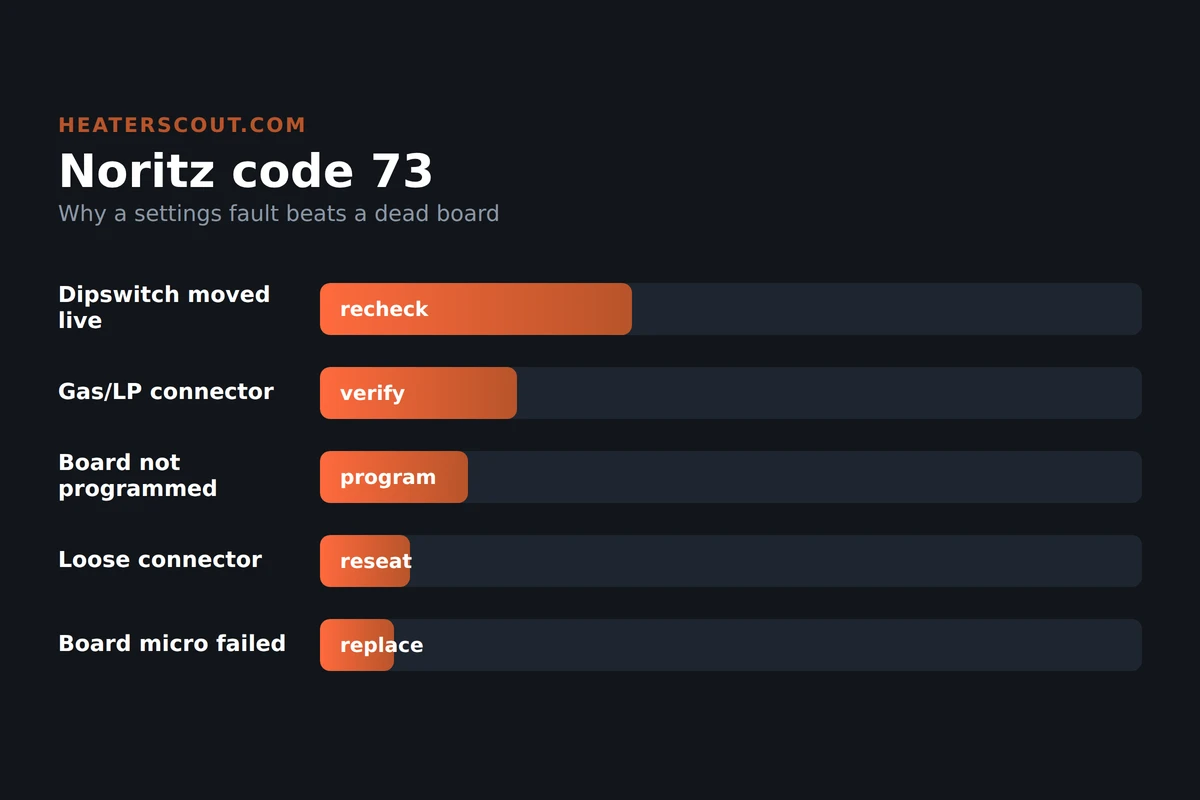
Code 73 is a configuration fault. Every Noritz control board carries internal settings that tell it what it is running: gas type, model behavior, and service options set through dipswitches, jumper connectors, and a setting device Noritz calls the maintenance writer. The board reads all of that at power-up and expects it to stay consistent. When the settings the board sees do not match what it expects, or change while it is energized, it throws 73 and refuses to fire. Here is the order those causes actually show up in the field.
A dipswitch or connector was moved with power on
This is the headline cause. The dipswitches and jumper connectors inside the unit are read at boot. Flip one, or unplug and replug a connector, while the heater is energized and the board sees its own configuration change out from under it and reports 73. Nothing is broken; the change just was not made the way the board needs.
The gas-type or LP conversion connector is wrong
Noritz units are configured for natural gas or LP, and a conversion involves a specific connector and dipswitch setting. If that gas-type configuration is inconsistent, set for one gas while the hardware or the rest of the settings say another, the board flags 73. This is the cause that also carries real safety weight, because a mismatched gas setting is not just an error, it is a bad burn waiting to happen.
A replacement board was never programmed
If the control board was swapped, it has to be programmed for your specific model before it will run. A fresh, unprogrammed board does not know what it is installed in, so it comes up throwing 73. This is a Noritz or factory step, not a homeowner one.
A connector is loose or backed out
Less common than a switch moved live, but a configuration connector that is not fully seated, or a pin that has backed out, can read as a wrong setting. Reseating it with power off can clear the code.
The board's microprocessor has failed
Last and least likely. The maintenance writer or the microprocessor on the board can genuinely malfunction, in which case the settings read wrong no matter what you do. Only after every configuration cause is ruled out does a bad board become the answer, and it is the most expensive one.
Four of the five causes of a 73 are settings a person introduced. Only the last one is a board that actually died.Noritz Knowledge Base, Error Code 73
The safe way to clear it
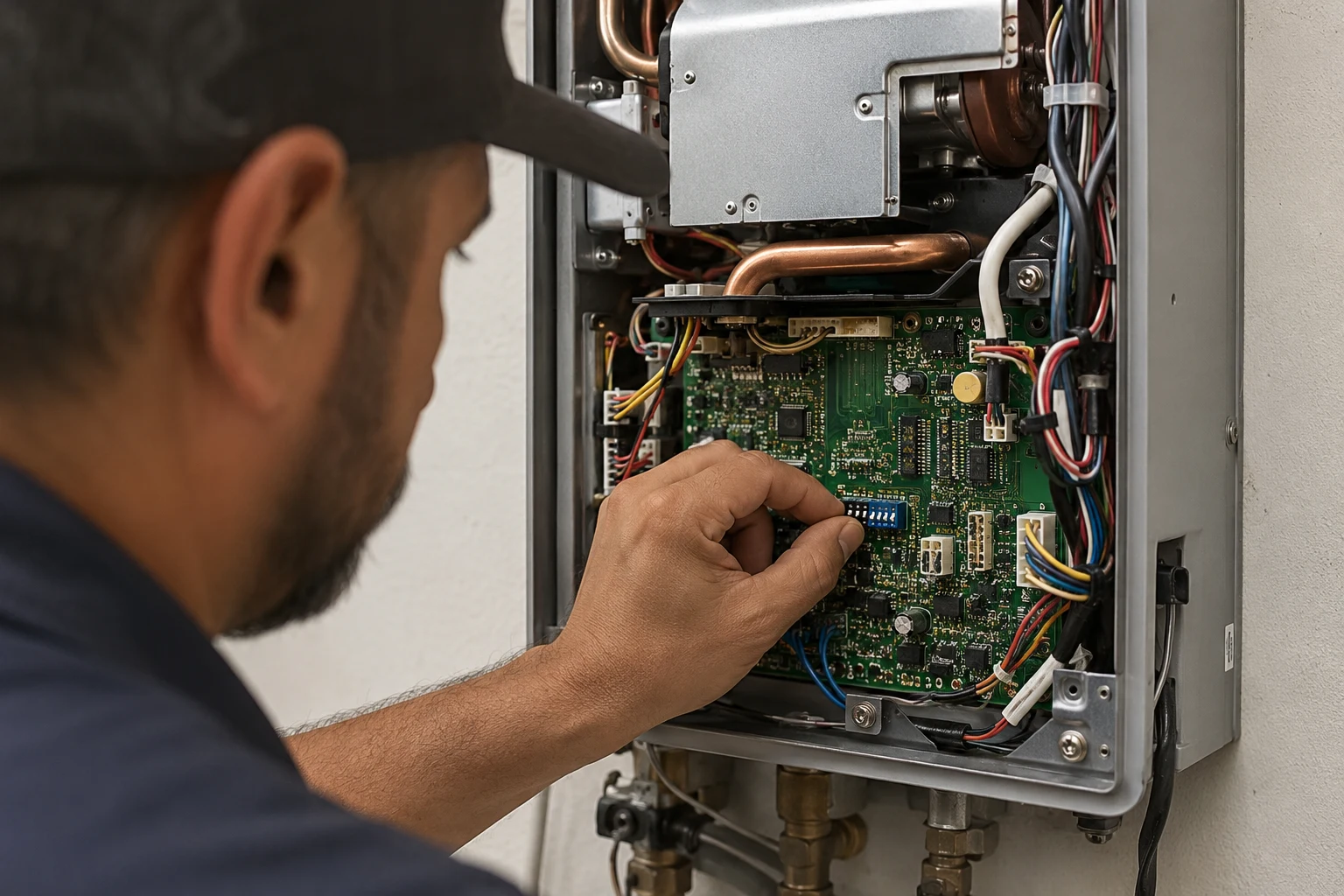
Because 73 is about configuration, the reset and the fix are the same motion done correctly: settle the settings with power removed, then let the board read the final state on boot. Work it in this order.
- Turn the heater off at the remote controller, then cut power at the breaker or unplug the unit.
- Wait at least 30 seconds with power fully removed before you open the cover or touch anything.
- Open the cover and find the dipswitch bank and the gas-type / conversion connectors on the control board.
- Confirm every dipswitch against the setting table in the manual for your exact Noritz model.
- Confirm the gas-type setting and LP conversion connector match the gas actually feeding the unit.
- Reseat any configuration connector that looks loose or backed out; make all changes with power off.
- Close up, restore power, and let the board boot so it reads the finalized settings; watch for 73 to clear.
Confirm the gas type before you fire it
A wrong gas-type setting is the one part of a 73 that is genuinely dangerous. If a unit set for natural gas is fed LP, or a unit set for LP is fed natural gas, firing it can produce an unsafe burn. Never force or bypass a 73 to make the heater run. If you are not certain the gas-type setting matches your supply, stop and have a licensed tech verify it before the unit fires.
Where a homeowner stops and Noritz starts
Checking dipswitches against the manual, confirming the gas-type setting, reseating a connector, and doing a clean power cycle are all fair for a careful homeowner with the cover off and the power off. That is a screwdriver and the model manual, and it clears the large majority of 73 cases because the large majority are configuration mistakes. The line is the board itself. If the settings are correct, the gas type matches, every connector is seated, and a clean power-up still shows 73, the fault is in the board's programming or its microprocessor. Programming a replacement board is a Noritz step, and a failed board is a parts-and-labor repair best left to a licensed tech who can confirm the diagnosis before anyone spends on a PCB.
Keeping 73 from coming back
Almost every repeat 73 traces to the same habit: making changes inside the cover with the power on. Break that habit and the code rarely returns. Before you touch a dipswitch, a jumper, or a gas-type connector, cut power at the breaker and give it a full 30 seconds. Make all your changes, then verify them against the manual before you close up. If you are converting between natural gas and LP, follow the Noritz conversion kit exactly, because the gas-type setting is the one that carries safety weight as well as a 73. And if a board is ever replaced, make sure whoever installs it programs it for your model before they hand the unit back to you. A 73 is not a sign the heater is wearing out. It is a sign the last person in the cover left the settings unsettled.
Frequently asked
Can I reset Noritz error code 73 myself?
You can clear it, and clearing it is often the whole fix, which makes 73 different from most Noritz codes. The reset is a full power cycle: unplug the heater or switch off its breaker for about 30 seconds, then restore power. That forces the control board to re-read its own settings on boot. If 73 was caused by a dipswitch or connector that got moved while the unit was live, the reset with power removed lets the board accept the corrected configuration and the code clears. The important rule is that any change to a dipswitch or a jumper inside the cover must be made with power OFF. If you reset and 73 stays, the board is either still set wrong or its programming is bad, and that is where it stops being a homeowner reset.
What does error code 73 mean on a Noritz tankless?
It means the control board detected a bad internal setting, not a bad heat exchanger or sensor. Noritz's own knowledge base lists the triggers: the maintenance writer on the board is set incorrectly, the gas-type setting or LP conversion connector is configured wrong, a dipswitch or connector was changed while the unit had power, a replacement board was installed but never programmed, or the microprocessor on the board is malfunctioning. Notice that four of those five are configuration problems a person introduced, and only the last is a genuinely failed board. So 73 is best read as the heater saying its settings do not add up, please power me down and finalize them, rather than the board is dead.
Why did code 73 appear right after I changed a dipswitch?
Because that is the single most common cause. The dipswitches and jumper connectors inside a Noritz set things like gas type, model behavior, and service options. The board reads them at power-up. If you flip a switch or unplug a connector while the unit is energized, the board sees its configuration change out from under it mid-run and throws 73 to say the settings are now inconsistent. The fix is not to undo your work, it is to make the changes correctly: cut all power to the heater, set the dipswitches and connectors to where they belong, double-check them, then restore power so the board reads the final state cleanly.
How much does it cost to fix Noritz code 73?
In most cases it costs nothing. If the trigger was a dipswitch, jumper, or gas-type connector changed with power on, powering down, correcting the setting, and powering back up clears it for free. The expense only shows up at the far end of the list. If the board itself was replaced and never programmed for your model, a Noritz technician or the factory has to program it, which is labor rather than parts. If the microprocessor on the board has actually failed, a genuine Noritz control board (PCB) commonly runs about $250 to $500 for the part on residential models, plus $150 to $300 of diagnostic and installation labor, so a real board replacement can land between $400 and $800. Because a dead board is the least likely cause, chase the settings first.
Will descaling clear Noritz code 73?
No. Descaling flushes scale out of the heat exchanger and is worth doing on schedule, but 73 has nothing to do with water flow, scale, or the exchanger. It is a control-board configuration fault. Running vinegar or a descaling solution through the waterways will not change a dipswitch position, reprogram a board, or fix a gas-type connector. If someone told you to descale to clear 73, they are treating the wrong system. Verify the dipswitches and connectors, power cycle correctly, and if that fails, the board is the issue, not mineral buildup.
Does code 73 mean my Noritz control board is dead?
Usually not. That is the assumption the code invites and it is wrong most of the time. 73 fires whenever the board cannot trust its own settings, and the everyday reason is a dipswitch or connector moved while the unit was powered, or a gas-type configuration that does not match the hardware. A truly failed board microprocessor is on the list, but it is the last and least common item. Rule out the configuration causes first: confirm the dipswitches against the manual for your model, confirm the LP or natural-gas setting matches the unit, power cycle with everything correct. Only when a clean, correctly configured power-up still shows 73 do you conclude the board is bad.
Is Noritz error code 73 dangerous?
The code itself is a lockout, not a hazard. The board refuses to run because it does not trust its own configuration, which is the safe response. The one thing that turns a benign 73 into a real risk is a wrong gas-type setting. If a unit built for natural gas is set or converted to LP, or the reverse, firing it can produce a dangerous burn. So do not force or bypass a 73 to make the heater run. Confirm the gas type matches your supply, confirm the conversion connector and dipswitches are correct, and if you are not sure the unit is set for the gas actually feeding it, get a licensed tech to verify before it fires.