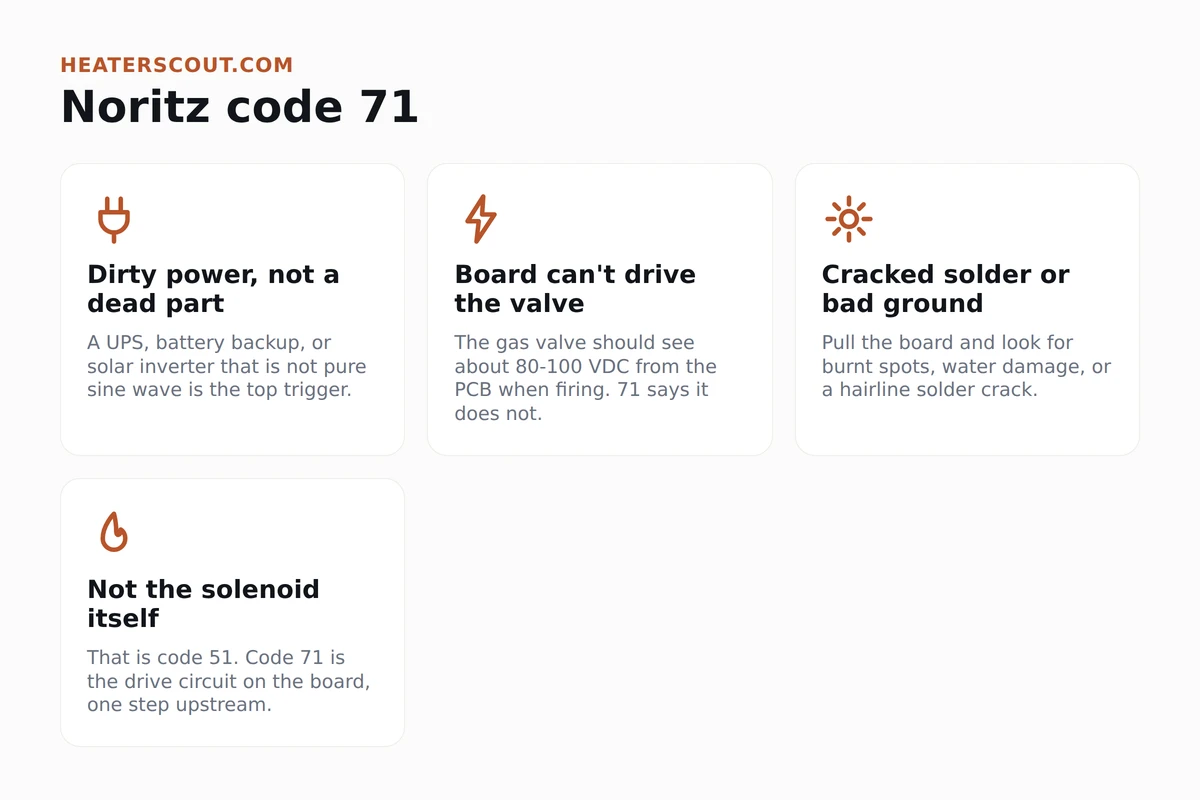
A Noritz that flashes 71 is not telling you the gas is off or the valve is clogged. It is telling you the control board cannot drive the gas valve the way it should. When the unit fires, the board is supposed to push roughly 80 to 100 volts DC to the main gas valve and solenoids, and code 71 means that drive signal is wrong, missing, or being fed dirty power. The surprising part for a lot of owners is that the fix often has nothing to do with gas at all. It is a power-quality problem or a failing circuit board, and on newer installs the number one trigger is a battery backup or solar inverter that is not a true pure sine wave.
Code 71 is the board saying it cannot run the gas valve. Code 51 is the valve itself failing. Read the exact code before you buy a single part.Noritz Knowledge Base, Error Code 71
What the drive circuit does
To see why 71 shows up, follow the gas. When you open a hot tap, the Noritz board decides how much gas the burner needs and then energizes the gas solenoid valves to let that gas through. It does this electrically, sending a drive voltage to the valve coils. On most models the valve and solenoids should read about 80 to 100 volts DC from the board while firing, and 14 to 16 volts DC on some lines. That drive circuit lives on the control board. Code 71 is the board's own check reporting that the drive is out of spec: the voltage is wrong, it is absent, the ground for that circuit is bad, or a component on the board has failed. Because the board is watching its own output, 71 can trip either from a genuinely failed board or from the power that feeds the board being unclean enough to upset the drive.
Work the diagnosis in order
The trap with 71 is jumping straight to a board replacement. Sometimes the board is fine and the power feeding it is the problem. Rule that out before you spend on parts.
Power cycle and watch it
Turn the unit off at the controller, kill the breaker or unplug for three to five minutes, then restore power and run a hot tap. If 71 clears and never returns, you had a momentary disturbance. If it comes right back within a firing cycle, the fault is live and you keep going.
Check the power source for a pure sine wave
If the heater is fed by a battery backup, a UPS, or a solar inverter, confirm it is rated pure sine wave, not modified sine wave. A dirty waveform makes the drive circuit misread and throw 71. This is the most common cause on newer and off-grid installs, and it fools people into buying boards they did not need.
Try a different circuit
Plug the unit into a different outlet on a different circuit fed by utility power. If 71 disappears, the original circuit, its wiring, or something else sharing it is the problem, not the heater. If it follows the unit to clean power, the fault is inside.
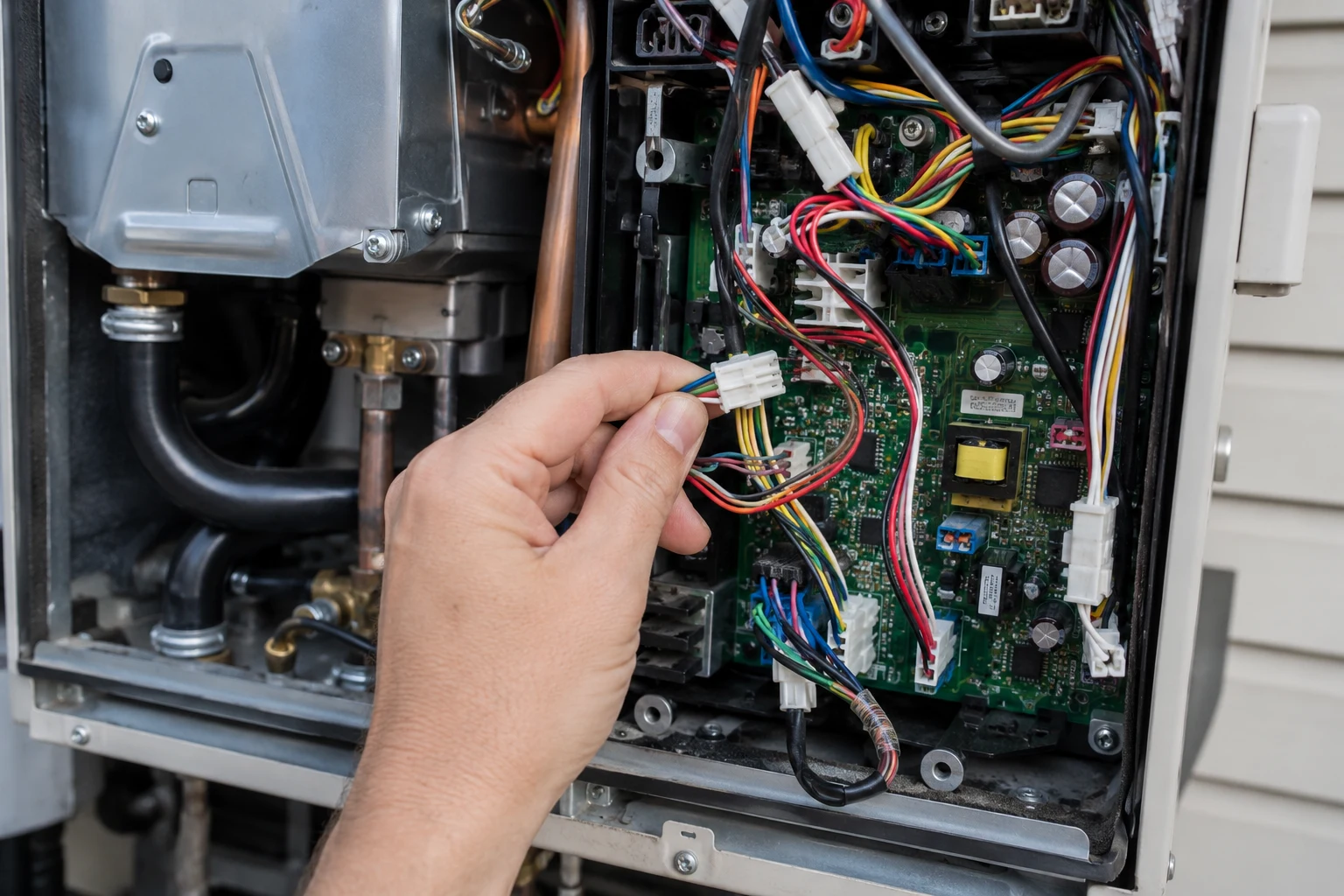
Inspect the control board
With power off, pull the board and look it over: burnt or discolored components, a cracked solder joint, corrosion, or water damage. A hairline crack that opens under heat explains a 71 that only shows once the unit warms up. Any visible damage condemns the board.
Measure the drive voltage
For a tech with a meter, verify the gas valve and solenoids see roughly 80 to 100 volts DC (or 14 to 16 VDC on some models) while the unit attempts to fire. No voltage or wrong voltage with clean incoming power points at the board's drive circuit and, in most cases, a board replacement.
What a homeowner can safely check
You can do the no-tools half of this yourself. None of it touches the gas train, so it is safe as long as you never try to force the burner to fire around the lockout.
- Turn the unit off at the controller, cut power at the breaker for three to five minutes, restore, and retest.
- Note whether 71 appears only on backup or solar power and never on normal wall power.
- Confirm any UPS, battery backup, or inverter feeding the unit is rated pure sine wave, not modified sine.
- Plug the heater into a different outlet on a different utility circuit and see if 71 goes away.
- Look for other loads on the same circuit that could dirty the power or drop the voltage under load.
- If 71 follows the unit to clean power and keeps returning, stop and book a licensed Noritz tech.
The short version
Code 71 is the control board's gas valve drive circuit, not the solenoid and not the gas supply. Reset once to confirm it is real, then check power quality before parts: a battery backup, UPS, or solar inverter that is not pure sine wave is the top trigger. If the power is clean and 71 still returns, the board is the usual endpoint, and diagnosing or replacing it is a licensed tech's job.
| Code meaning | Gas valve drive-circuit abnormality (board cannot drive the valve) |
| Where it lives | Control board (PCB), gas valve drive circuit and its ground |
| Normal drive voltage | About 80 to 100 VDC (14 to 16 VDC on some models) |
| Top real-world trigger | Battery backup / UPS / solar inverter that is not pure sine wave |
| Other causes | Cracked solder joint, failed board component, bad ground, dirty circuit |
| Not the same as | Code 51, which is the solenoid / modulation valve itself |
| Reset method | No dedicated button; 3 to 5 minute power cycle to clear |
| Homeowner can do | Power cycle, check pure-sine power, try a different circuit |
| Pro job | Measure drive voltage, inspect and replace the control board |
| Part most often replaced | Control board (PCB) |
| Control board cost | Roughly $300 to $600 for the part, plus labor |
| Pro diagnosis range | About $150 to $350 before parts |
| Difficulty | Call a pro (fix usually ends at board diagnosis or replacement) |
Why the power source matters so much
Noritz flags this one specifically because it burns so many people. A tankless heater draws very little power, so owners assume any backup source will run it. But the board's electronics, and the gas valve drive circuit in particular, expect the smooth sine wave that comes out of a wall outlet. A modified sine wave, the stepped waveform that cheaper inverters and some UPS units produce, looks close enough to run a lamp but wrong enough to upset sensitive drive electronics. The board sees the drive circuit acting abnormally and reports 71. The giveaway is behavior: the heater runs fine on utility power and codes out the moment it is on the backup. Before anyone condemns a board, confirm the inverter or UPS is rated pure sine wave. Correcting the waveform can make a stubborn 71 vanish without touching the heater.
Where the DIY line stops
The homeowner half is real diagnosis, not busywork. Confirming the code is stable, ruling out the power source, and trying a clean utility circuit can solve a 71 outright or at least tell the tech exactly where to look. Past that point the work turns into measuring the drive voltage at the gas valve while the unit attempts to fire and, if it is wrong on clean power, replacing the control board. That is a licensed technician's job, both because it involves a gas appliance and because a board swap on a Noritz needs the right part and setup for your model. The one rule that never bends: do not try to bypass or jumper the gas valve to force the burner to light around a 71. The lockout is there because the board is not sure it can control the gas, and defeating that is exactly the wrong move on a gas appliance.
Keeping 71 from returning
Most repeat 71 faults trace back to power. If your install has any backup or off-grid source, spec a true pure-sine-wave inverter or UPS from the start and keep the heater off shared circuits that dip under load. On utility power, a 71 that returns after a clean board and good power is uncommon, and it usually means the board itself is on its way out. Annual service does not directly prevent a drive-circuit fault the way descaling prevents a scale code, but a tech who has the cover off can spot early corrosion or a connector working loose before it turns into a no-hot-water morning. The practical takeaway: read the code carefully, do not confuse 71 with 51, and chase the power before the parts.
Frequently asked
Can I reset Noritz error code 71 myself?
Yes, and it is the right first move. Turn the unit off at the remote controller, then cut power at the breaker or unplug the heater and leave it off for three to five minutes. Restore power and run a hot tap to see whether 71 comes back. That power cycle clears the latched code and keeps your temperature setting. What it does not do is repair anything. Code 71 is the control board reporting that its gas valve drive circuit is not behaving, so if the board or the power feeding it is genuinely bad the code returns the next time the unit tries to fire. Use the reset to confirm a fix or to see whether 71 was a one-off glitch, not as the cure itself. If it clears and never returns, you likely had a momentary power disturbance. If it comes right back, you have a real fault to chase.
What does Noritz code 71 actually mean?
Noritz calls 71 a gas valve abnormality, but the important word is drive. The code is the control board telling you it cannot drive the gas solenoid valves correctly, or that the grounding for that circuit is bad, or that a component or solder joint on the board itself has failed. When the heater is firing, the main gas valve and solenoids should receive roughly 80 to 100 volts DC from the board, or 14 to 16 volts DC on some model lines. Code 71 fires when the board detects that this drive signal is wrong or absent. It is not saying the gas valve is clogged or the gas is off. It is saying the electronics that operate the valve are not doing their job. That points the repair at the circuit board and the power feeding it, not at the plumbing or the gas supply.
Is code 71 the same as code 51 on a Noritz?
No, and mixing them up sends you after the wrong part. Code 51 is the gas modulation or solenoid valve itself, or its direct circuit, and it often ties to abnormal gas pressure or a failed solenoid. Code 71 is one step upstream: the board's drive circuit that operates that valve. Think of 51 as the valve is bad and 71 as the board cannot run the valve. With 51 you are often looking at the solenoid or gas supply. With 71 you are looking at the control board, its ground, and the power feeding the unit. They can produce similar symptoms, a unit that will not fire, so read the exact code off the controller and treat them differently. Replacing a solenoid for a 71 fault wastes money, and swapping a board for a 51 fault does the same.
Why does Noritz code 71 keep coming back after a reset?
The single most common reason on newer installs is the power source. If the heater is fed by a battery backup, a UPS, or a solar inverter that does not output a true pure sine wave, the board's drive circuit cannot work cleanly and throws 71 over and over no matter how many times you reset it. The unit runs fine on utility power and codes out on the backup. Another repeat cause is a cracked solder joint or a failing component on the board that only misbehaves once the circuit warms up under load. And a bad ground for the gas valve circuit will do it too. If a reset clears 71 but it returns within a firing cycle or two, stop resetting and start checking the power waveform and the board, because the fault is live and repeating is a symptom, not a solution.
How much does it cost to fix Noritz code 71?
It swings wide depending on the cause. If the trigger is a non-pure-sine-wave power source, the fix can cost nothing beyond moving the unit to clean utility power, or the price of a pure-sine inverter or UPS if the install truly needs backup power. If the board itself is bad, a replacement Noritz control board is the expensive part, commonly a few hundred dollars, often in the $300 to $600 range for the part depending on model, plus labor. A licensed tech visit to diagnose 71 and confirm whether it is the power or the board typically runs $150 to $350 before parts, more in high-cost metros. Because the usual endpoint is a board swap, 71 is not a cheap DIY sensor code. The one genuinely cheap outcome is discovering your backup power is the culprit and correcting the waveform.
Is Noritz error code 71 dangerous?
The lockout itself is the safety system doing its job. When the board cannot trust that it is driving the gas valve correctly, it refuses to fire rather than risk operating a gas valve it cannot control. That is exactly what you want a gas appliance to do. The code is protecting you from a valve being driven with the wrong voltage or an uncertain state. What you must not do is try to bypass, jumper, or force the gas valve to open to get around a 71. Anything that makes a gas valve operate outside the board's control is a real hazard. The electronics are on the low-voltage and board side, so the diagnostic work is not itself dangerous, but the moment you are tempted to defeat the safety and make the burner light anyway, stop and get a licensed technician. If you ever smell gas, shut the gas off and ventilate first.
Can a battery backup or solar inverter cause code 71?
Yes, and Noritz calls this out directly. The board's gas valve drive circuit needs clean AC to work. A battery backup, UPS, or solar inverter that produces a modified or stepped waveform instead of a true pure sine wave feeds the board dirty power, and the drive circuit reads that as an abnormality and throws 71. The tell is that the heater works on normal wall power and only codes when it is on the backup or off-grid source. The fix is to confirm the inverter or UPS is rated pure sine wave, not modified sine wave. As a quick test, plug the unit into a different outlet on a different circuit fed by utility power. If 71 disappears, the original circuit or its power source is the problem, not the heater.