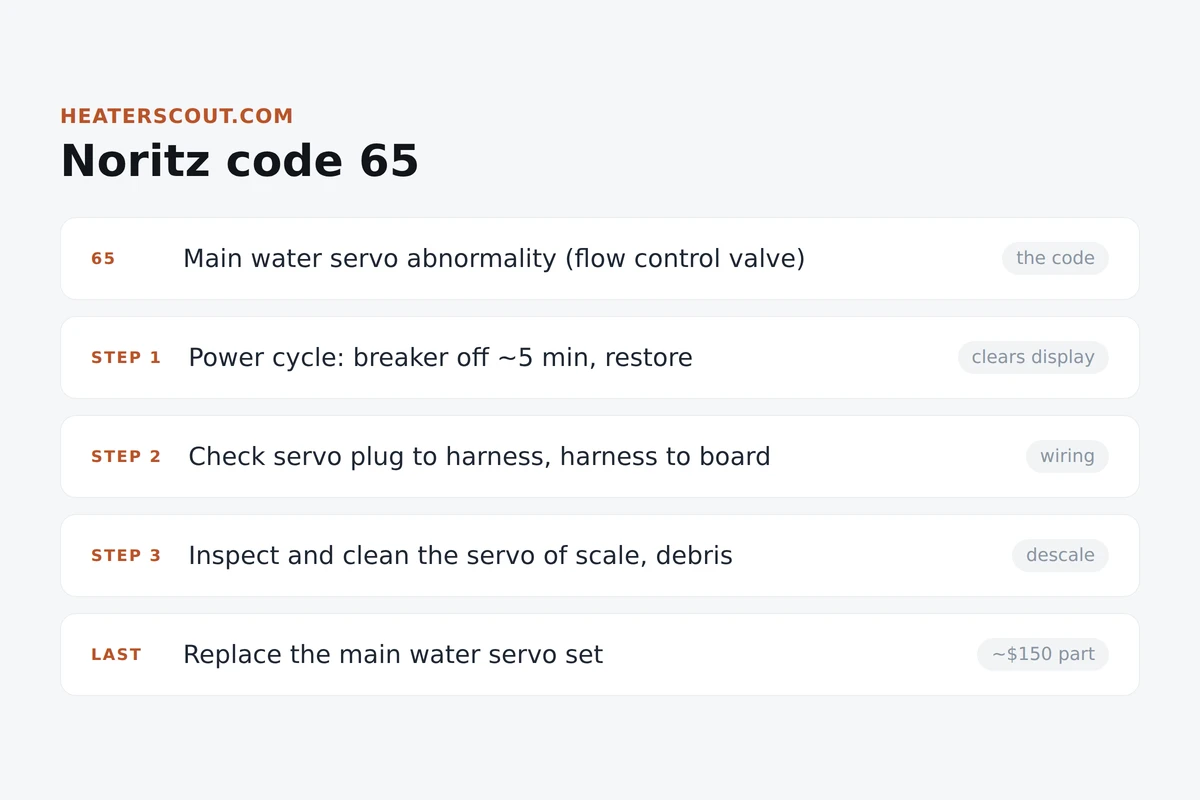
A Noritz that flashes 65 is not complaining about temperature. It has lost confidence in the valve that controls how much water it lets through. Noritz calls that valve the main water servo, a small motorized flow-control valve that meters water across the heat exchanger so the burner can hold your setpoint. When the board commands the servo to a position and the feedback does not match, it throws code 65 and shuts down. The usual cause is scale binding the valve or a loose connector, not a dead control board, so the fix is often cheaper than the code makes it look.
What code 65 is
- Main water servo (main flow control valve) abnormality
- The motorized valve that sets total flow through the exchanger
- Command position and feedback do not agree, so the board locks out
- Distinct from code 66, which is the bypass servo
What it is not
- Not a burner, gas, or venting fault
- Not the bypass servo (that is code 66)
- Not automatically a control-board failure
- Not confirmed as a flow or temperature sensor, despite some Q&A sites
Quick answer
Noritz code 65 is a main water servo abnormality: the motorized valve that controls water flow through the heat exchanger is not responding to the board the way it should. Power-cycle the unit (breaker off about five minutes, then on) to clear the display. If it returns, check the servo's plug to the wire harness and the harness to the circuit board, then descale to free a scaled valve. If 65 still comes back, the main water servo set (about $150 genuine) needs replacing, which is a job for a tankless tech.
Why a tankless heater needs a servo at all
A tank heater keeps forty gallons hot and hands you whatever you draw. A tankless unit has none of that reserve. Every time you open a hot tap it has to raise the water from whatever temperature it arrives at, right now, to your setpoint, in the couple of seconds it takes to cross the heat exchanger. To do that cleanly it controls two things together: how hard the gas burner fires, and how fast the water moves. The main water servo handles the second one. Crack a bathroom faucet and the servo pinches flow down so that thin stream still comes out hot. Open the shower and the tub at once and it lets more water through. The board is constantly telling the servo where to sit and reading back whether it got there.
Code 65 is the board saying that conversation broke down. It commanded a position and either got no feedback, or feedback that says the valve is somewhere it should not be. On the Pro Series, Noritz's own knowledge base points the first check at connections: verify the main water servo is securely plugged into the wire harness, and that the harness is properly seated on the circuit board. A vibrating heater on a garage wall works connectors loose over years, and a single backed-out pin drops the signal.
Code 65 is the board saying it commanded the water valve to move and cannot confirm it got there.Noritz main water servo fault
Where sources disagree, and who to trust
Most references agree code 65 is a main water servo or main flow control valve problem. A couple of consumer Q&A threads on specific models, notably the N-0751M, describe 65 as a flow sensor or temperature sensor issue instead. Noritz's knowledge base and parts catalog do not support that reading; they tie 65 to the servo and keep the sensors under other codes. When a manufacturer's own documentation and a random forum answer disagree, side with the manufacturer, but confirm against the code table for your exact model before you buy a part. The label inside the front cover lists the codes for that unit.
What to check, cheapest first
Work the free causes before you order a valve. Kill power at the breaker before the cover comes off. First, cycle power the right way: unit off at the remote, breaker off for about five minutes, then back on. That clears a one-time glitch and confirms whether the fault is persistent. If 65 returns, open the cover and find the main water servo on the cold water path. Unplug its connector and look for green corrosion, a backed-out pin, or a burnt terminal, then trace the harness back to the board and check that plug too. Reseat both firmly.
If the wiring is clean, suspect scale. The servo sits in the waterway, so hard-water minerals can build up until the valve binds and cannot travel where the board commands. A full descale flush with a Noritz descaling solution or white vinegar, run through the service valves for the recommended time, can free a lightly scaled servo and clear the code for good. This is also the single best thing you can do to keep 65 from coming back, and it is on the maintenance schedule anyway in hard-water regions.
If descaling and reseating do not fix it, what is left?
The servo assembly itself. If the connector is clean, the harness passes continuity, and a descale did not free the valve, the main water servo motor or its position sensor has worn out and the valve set needs replacing. A genuine Noritz Water Servo - Main set runs about $150. This is where most homeowners should stop and call a tankless tech, because pulling the servo means opening the sealed waterway, draining the unit, and reassembling it without leaks. Only after the servo, wiring, and valve all check out does the control board become the suspect, and a board is both uncommon as the cause and the most expensive part in the heater.
Where the homeowner line sits
The safe DIY zone for code 65 is narrow. Power cycling, inspecting and reseating the servo connector, and running a descale flush are all fair game for a careful owner. Those cover the majority of 65 faults that clear without a new part. The moment the fix requires pulling the main water servo, the job crosses into pro territory. You are opening a pressurized water path inside a gas appliance, and a reassembly leak there can drip onto the burner or electronics. A licensed tankless tech has the model service sheet, the genuine servo set, and the reassembly torque specs. Never force or bypass the valve to keep hot water running, because then the heater is modulating temperature with no idea how much water is actually flowing.
Keeping code 65 from coming back
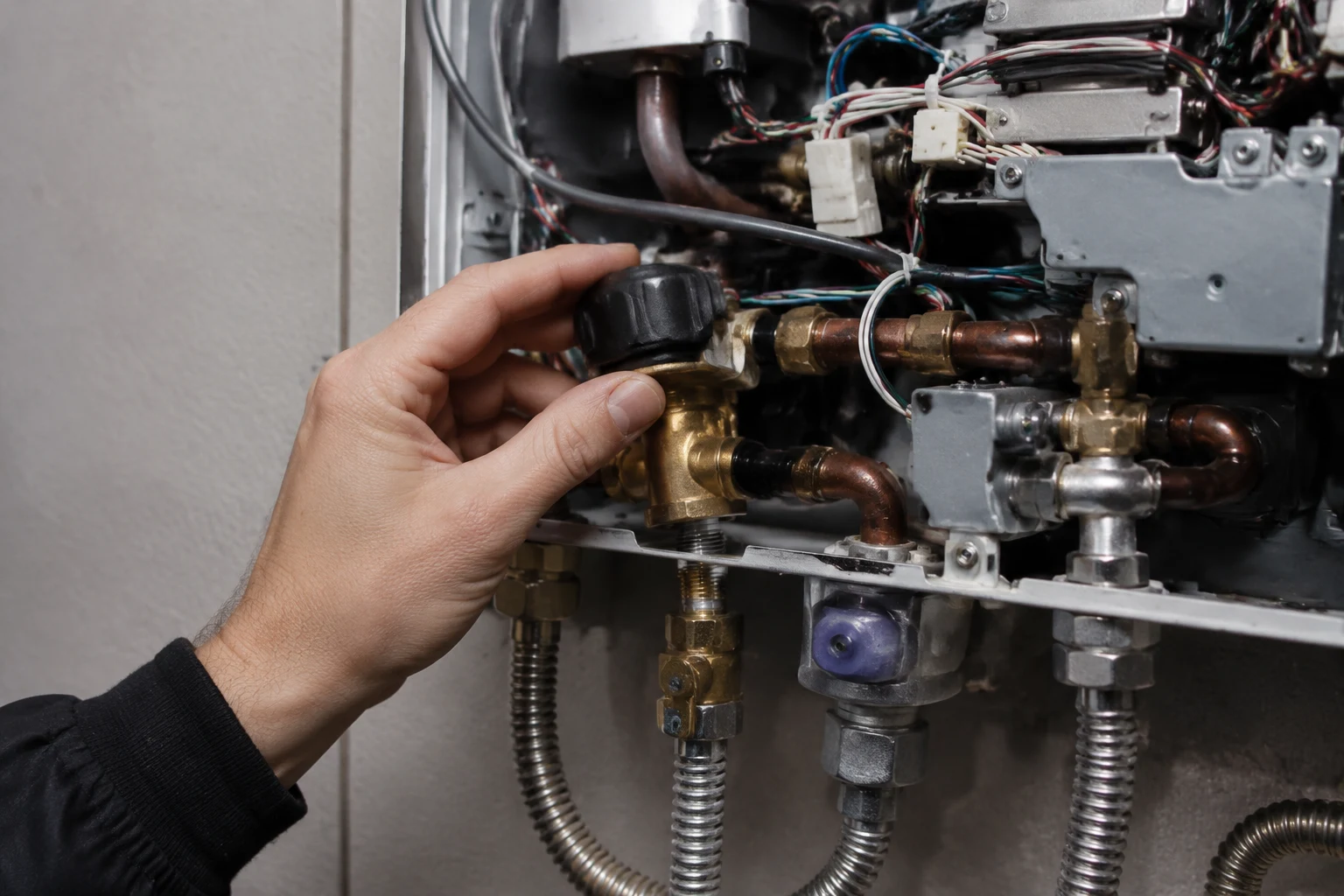
Scale and loose connectors cause most repeat 65 faults, and both are preventable. In hard-water areas, descale the unit on schedule, once a year is typical, and more often if your water is very hard, so the servo never gets a chance to seize up. Pull and rinse the cold water inlet screen filter at the same service so grit does not migrate to the valve. While the cover is off, reseat the servo connector and look for the first hint of corrosion, because catching a green pin early beats chasing an intermittent 65 on a cold morning. A softener upstream pays for itself on a tankless heater by keeping the servo, the heat exchanger, and every other wetted part clean. A unit that gets a yearly flush and a quick connector check rarely surprises you with a servo code out of nowhere.
Frequently asked
Can I reset Noritz error code 65 myself?
You can clear the display, but that is not the same as fixing it. Noritz code 65 latches, so it stays on screen until you cycle power: turn the unit off at the remote, shut the breaker or unplug the heater, wait about five minutes, then restore power. If the servo just hiccuped once, the code may not come back. If the main water servo is actually stuck, scaled, or has a bad connection, 65 returns the next time the unit tries to modulate water flow. Treat the power cycle as a test of your repair, not the repair. If it comes back within a cycle or two, the valve or its wiring still needs attention.
What is the main water servo on a Noritz?
It is a small motorized valve, often called the main water flow control valve, that sets how much water runs through the heat exchanger. A tankless heater holds your temperature two ways at once: it modulates the gas burner, and it modulates water flow. When you barely crack a hot tap, the servo pinches the flow down so the small stream still gets hot. When you open wide, it lets more through. The control board commands the servo to a position and expects feedback that it got there. Code 65 fires when that command and feedback do not agree, which usually means the servo motor, its position sensor, its wiring, or the valve itself is fouled with scale.
How much does it cost to fix Noritz code 65?
If the fix is a reseated connector or cleaning scale off the servo, it costs nothing but time. The part itself is the driver of cost. A genuine Noritz Water Servo - Main set runs about $150, and the related bypass servo (ETFD010 / SBH9490) is in the same $146 to $154 range if a tech determines that valve is the culprit. Small related parts like the bypass valve set (around $77) or the servo-to-bypass pipe (about $37) can add up. Add a licensed tankless tech's diagnosis and labor and a typical main-servo replacement lands roughly $300 to $550 installed, more in high-cost metros. Get a quote before you approve it, because on an older unit the repair can approach the cost of the parts on a newer one.
Will descaling clear Noritz code 65?
Sometimes, and it is the first thing worth trying because it is cheap. The main water servo lives in the water path, so hard-water scale can gum up the valve so it will not travel to the position the board commands. Flushing the unit with a descaling solution can free a lightly scaled servo and clear the code. But descaling will not repair a burnt connector, a broken wire, or a servo motor that has actually failed. If you descale and 65 comes right back, the valve or its electronics are the problem, not scale. Run the descale, restore power, and watch whether the code returns. If it does, stop chasing it with vinegar and get eyes on the servo.
Is Noritz code 65 the same as code 66?
No, and this trips people up. Code 65 is the main water servo, the valve that controls total flow through the exchanger. Code 66 is the bypass servo, the valve that blends a little cold water back in to fine-tune the outlet temperature. They are two different motorized valves. Some third-party guides lump 65 and 66 together as one flow-valve fault, but Noritz's own documentation and parts catalog keep them separate, and the fix targets a different valve for each. If your display shows 65, order and inspect the main servo, not the bypass. Reading the code exactly as it appears saves you buying the wrong part.
Why does Noritz code 65 keep coming back?
A code that returns after a power cycle means the underlying fault is still live. The usual repeat offenders are a servo connector that was reseated but has a corroded or backed-out pin, so the signal drops when the harness moves; a servo motor or position sensor that is failing intermittently, working when cold and faulting when hot; or scale that a single flush loosened but did not fully clear, so the valve binds again as it dries out. Hard water accelerates all of this. If the wiring checks out and the valve is clean and 65 still cycles back, the servo assembly itself is worn and a replacement is the honest fix. At that point a tech with the model service sheet is the right call.
Is Noritz error code 65 dangerous?
The code is a protective lockout, not a hazard in itself. The main water servo controls flow so the burner can hit your setpoint without scalding or running cold. If the board cannot trust the servo position, it shuts the unit down rather than heat water with an unknown flow rate, which is exactly what you want it to do. So 65 stopping your hot water is the safety system working. The one thing not to do is bypass or force the valve to keep hot water flowing, because then the heater is modulating temperature blind. The fault sits on the water and electronics side, not the gas train, so it is low risk to diagnose. If you ever smell gas or see scorching at the wiring while the cover is off, stop and call a licensed tech.