When a Noritz tankless flashes 61, the burner never even tried to light. The control board spins up the combustion fan first, watches its RPM through a pre-purge and an ignition target, and only opens the gas once the fan proves it is moving air the way the board expects. Code 61 means that proof failed. The fan either did not turn, or it turned too slow or too fast for the stage it was in, so the board stopped everything before a single BTU of gas went anywhere. Sometimes that is a dead motor. Often it is a loose plug, a wind-blocked vent, or a handful of debris on the impeller.
Is code 61 the same as a flame or ignition fault?
No. Codes like 11 or a flame-failure code mean the burner tried to light and the board never saw stable flame. Code 61 happens earlier, on the air side, before ignition. The fan has to prove its RPM first. If the fan check fails, the board never gets to the ignition step, so 61 is a fan-motor fault, not a flame fault. If you see both across a few cycles, deal with the fan first, because the ignition sequence cannot run until the fan is trusted.
What the board is actually checking
The combustion fan, sometimes called the blower or the fan motor, sets the air half of the air-fuel mix. Noritz uses a forced-draft design, so the fan pulls in combustion air and pushes exhaust out through the vent. The control board does not just switch the fan on and hope. It reads the fan's actual speed and compares it to a target for each stage of firing. During pre-purge the fan runs to clear any lingering gas from the chamber. During ignition it holds a speed that gives the right air for a clean light. During operation it modulates with the burner. At every one of those checkpoints the board expects the RPM to land in a window. If the fan is stalled, dragging, or racing, the measured RPM falls outside that window and the board latches 61 to protect the burn. That is why 61 can come from a tired motor and also from anything that loads the fan or disturbs its airflow.
The fix, cheapest first
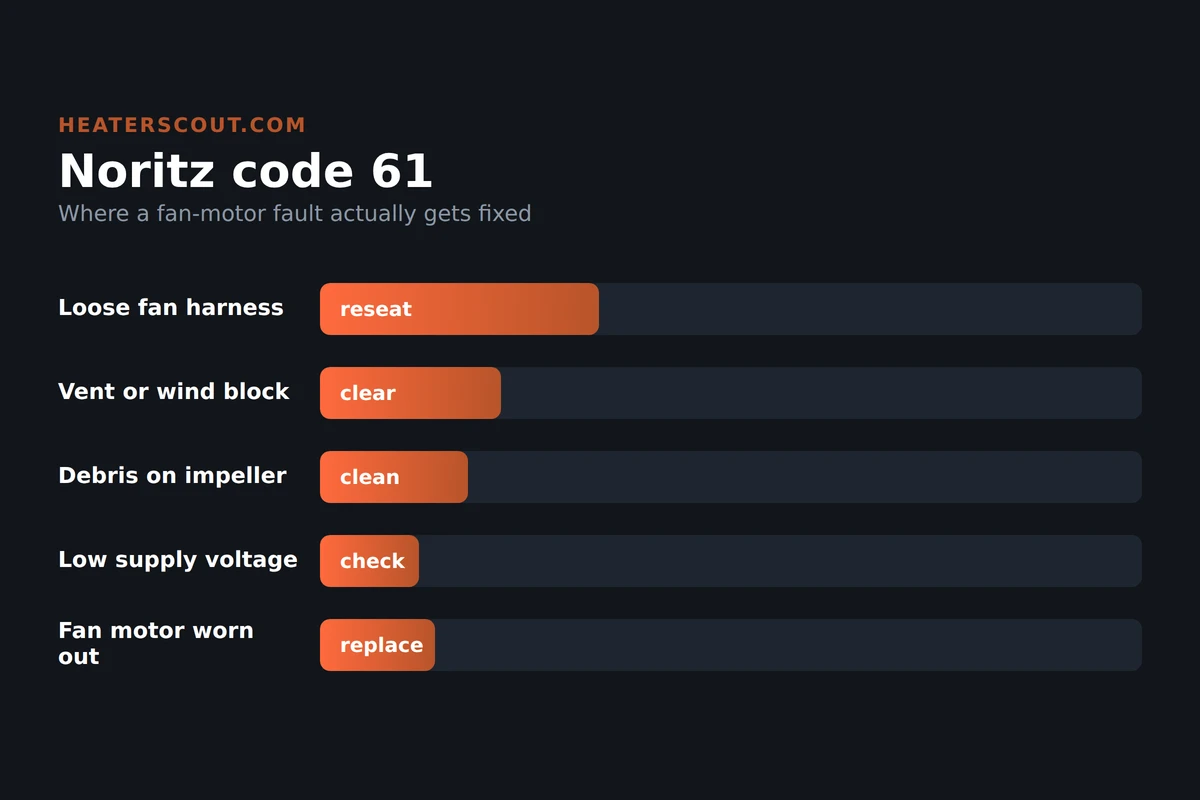
Do not order a fan because a code with the word fan in it scared you. Work from the free causes up to the expensive one. On most 61 calls the motor is fine and something around it is the problem.
Before you open the cover
Kill power and gas before you open the unit. This is a sealed combustion appliance with line voltage at the fan and gas at the burner. Turn the heater off at the controller, switch off the breaker, and close the gas shutoff. Let the heat exchanger cool before you reach in, and never run the fan test with the chamber open unless the manual for your model tells you to.
| Code meaning | Combustion fan (blower) motor abnormality |
| What trips it | Fan RPM outside the expected window, or fan not spinning |
| Stage checked | Pre-purge, ignition, and operation RPM targets |
| Most likely cause | Loose or corroded fan harness at the board |
| Other common causes | Blocked vent/intake, debris on impeller, low voltage |
| Voltage floor | Below about 108 VAC can trip 61 |
| Reset method | Power off at controller, or 30-sec breaker cycle |
| Motor test | Winding resistance with a multimeter vs. spec |
| OEM fan / blower part | About $180 to $360 on residential models |
| Pro repair range | About $350 to $650 diagnose and replace fan |
| Difficulty | DIY checks yes; fan or board swap is a pro job |
Diagnostic order when the cheap fixes do not hold
If the harness is tight, the vent is clear, the fan is clean, and the voltage is good, but 61 still returns, stop swapping guesses and start measuring. The fan either cannot reach speed or the board cannot read it, and the meter tells you which.
Verify voltage at the fan harness
With the manual's fan-test procedure, confirm the board is actually sending drive voltage to the fan connector when it commands a spin. Voltage present but no spin points at the motor. No voltage at the harness points back at the board or the wiring between them.
Measure motor winding resistance
With power off and the fan unplugged, read the motor windings with a multimeter on resistance. A reading that is open, shorted, or well outside the model's spec means the motor is failing. This is the honest test that separates a dead fan from a wiring problem.
Check for water on the motor
A heat exchanger that leaks or condenses onto the fan will corrode and kill the motor over time, and it will keep killing the replacement. If the motor is wet or rust-streaked, find and fix the water source before you fit a new fan.
Rule out the RPM feedback path
The board reads fan speed through a feedback wire or sensor in the harness. If the fan spins fine by hand and gets voltage but the board still reports a fault, the feedback signal may be the break. Inspect that conductor end to end.
Replace the fan, then suspect the board
If voltage reaches the fan, the windings read bad, or the motor is worn and drifts under load, fit a genuine Noritz combustion fan. Only after the fan, the harness, the vent, and the voltage all check out do you consider the control board, which is the last and most expensive part to touch.
Where the homeowner line sits
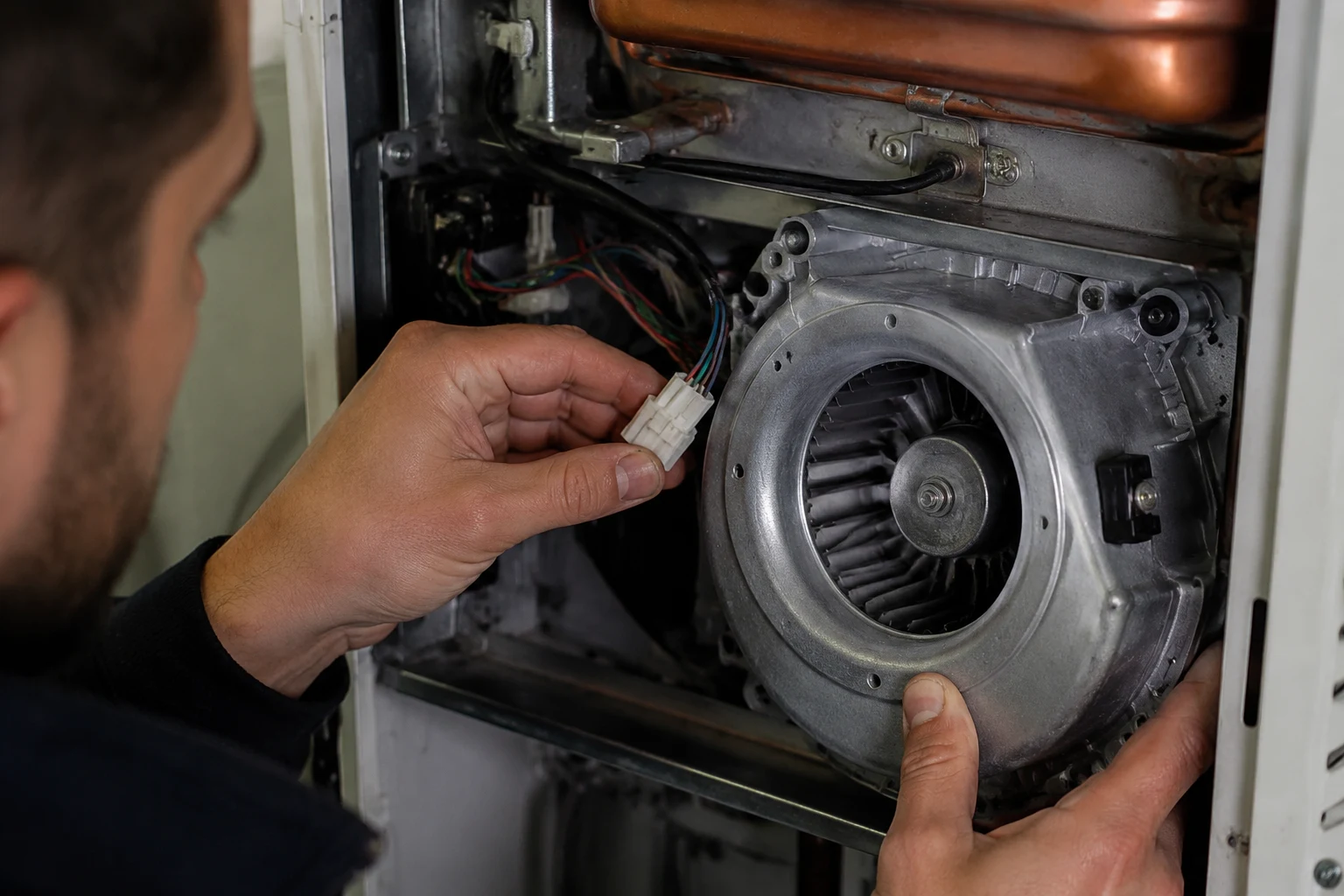
Clearing the code, reseating the fan harness, clearing the vent and intake, brushing debris off the impeller, and reading the wall voltage are all fair game for a careful homeowner who is comfortable shutting off gas and opening a sealed unit. The line you do not cross is testing under power inside the combustion chamber, measuring winding resistance if a multimeter is not your tool, and anything on the gas side. If the fan is genuinely dead or the board is misreading a good fan, both are Noritz-trained tech jobs. And never defeat the fan sensing to force the heater to run. That check exists so the burner does not light without confirmed airflow.
Keeping 61 from coming back
A combustion fan fails from debris, water, and neglect. Keep the intake filter and the vent terminations clear so the fan never fights for air, because a starved fan runs hot and drifts out of its RPM window. Have your annual service include a look at the fan: the tech should pull the cover, inspect the impeller for buildup, check the harness connectors for corrosion, and confirm there is no water dripping onto the motor from the heat exchanger. Descaling keeps the water side healthy, but the fan lives on a side of the unit a flush never reaches, so add a combustion check to the list. A heater in a windy or exposed vent location is worth an extra look, since gusts and blockage are what push a healthy fan into a 61 on the coldest morning of the year.
Frequently asked
Can I reset Noritz code 61 myself?
You can clear the latched code, but clearing it is not the same as fixing it. Noritz tankless units clear a fault when you power the heater off and back on. Press the power button on the remote controller to turn the unit off, wait several seconds, then press it again to power up. If you have no controller connected, switch the water heater breaker off for about 30 seconds and back on. That power cycle drops the 61 and keeps your temperature setting. The catch is that 61 is a fan motor fault, so the moment the board runs its pre-purge and the fan does not spin up to the expected RPM, the code returns. The reset buys you one firing attempt to stand there and listen for whether the fan actually turns. If it stays silent or the code snaps back, the problem is still physically present.
What does error code 61 mean on a Noritz tankless?
It means the control board detected a fan motor abnormality. Every time the heater goes to fire, the board runs the combustion fan through a set of RPM checks: a pre-purge to clear the chamber, a speed target during ignition, and a speed target during steady operation. The board reads the fan's actual RPM through the harness. If the fan is not spinning at all, or spinning meaningfully slower or faster than the target for that stage, the board calls it a 61 and shuts down before it lets gas flow. It is a combustion-safety interlock. The fan sets the air side of the air-fuel mix, so a fan the board cannot trust means a burn it cannot trust.
How much does it cost to fix Noritz code 61?
It depends entirely on what is wrong. If the fix is reseating a loose harness plug, clearing a wind-blocked vent, or brushing debris off the impeller, it costs nothing but your time. If the fan motor itself is dead, a genuine Noritz combustion fan or blower assembly typically runs about $180 to $360 for the part on residential models, and the labor to diagnose and swap it usually adds $150 to $300, so a professional fan replacement often lands between $350 and $650 all in. Prices climb in high-cost metros and on larger commercial units. Because the cheap causes are common, it is worth ruling out wiring, venting, and debris before anyone orders a fan.
Why does Noritz code 61 keep coming back?
A 61 that returns after a reset is telling you the real cause is still there. Common repeat offenders: a fan harness connector that is loose or corroded so the RPM signal drops in and out, a vent cap or intake that gets blocked by wind, leaves, or a nest so the fan cannot move air freely, water dripping from the heat exchanger onto the motor and slowly killing it, or supply voltage sagging below about 108 volts so the motor cannot reach its target speed. There is also honest wear: a motor with worn bearings spins ragged and drifts out of the RPM window under load. If it returns, stop resetting and start checking the harness, the vent, and the voltage in that order.
Is Noritz code 61 dangerous?
The code itself is the safety system working. The fan controls the air side of combustion, so if the board cannot confirm the fan is spinning right, it refuses to light the burner rather than risk an incomplete burn that could produce carbon monoxide or backdraft. That shutdown is protective. The danger is not the code, it is defeating it. Never jumper the fan sensing, force the unit to run, or ignore a heater that keeps throwing 61 while you keep using another hot water source. If the fan is failing and you override it, you are removing the check that keeps combustion honest. If the vent is blocked or you smell exhaust, shut it down and get a licensed gas tech on it.
Will descaling clear code 61?
No. Descaling flushes vinegar or a descaling solution through the heat exchanger to strip mineral scale off the waterways. Code 61 lives on the combustion side, in the fan motor and its wiring, and has nothing to do with water flow or scale. A flush will not touch it. Descaling is still worth doing on schedule, and a neglected unit is often neglected everywhere, so a heater that has never been descaled has probably also never had its fan or venting looked at. But if you are chasing 61, the flush is the wrong tool. The right moves are reseating the harness, clearing the vent, cleaning the fan, and checking voltage.
Can debris or a blocked vent cause code 61?
Yes, and it is one of the more common non-failure causes. The combustion fan has to move a set volume of air. If the intake filter is clogged with lint, if the exhaust vent is partly blocked by debris, ice, a nest, or a screen packed with soot, or if a strong wind gust pressurizes the vent, the fan gets loaded down or its airflow gets disturbed and its RPM drifts outside the window the board expects. The board reads that as a fan fault and throws 61. That is why the checklist starts with the vent and the intake before anyone condemns the motor. Clear the obstruction and the fan often runs clean again.
When should I call a pro for Noritz code 61?
Reseating a harness plug, clearing a vent, brushing debris off the fan, and reading the wall voltage at an outlet are all reasonable for a careful homeowner. The line you should not cross is anything inside the sealed combustion chamber under power, measuring motor winding resistance if you are not comfortable with a multimeter, or setting gas pressure. If the harness is tight, the vent is clear, the voltage is good, and 61 still returns, the fan motor or the control board is the likely culprit, and both are jobs for a Noritz-trained tech. Call sooner if you see water dripping onto the fan, smell exhaust, or the unit will not run at all.