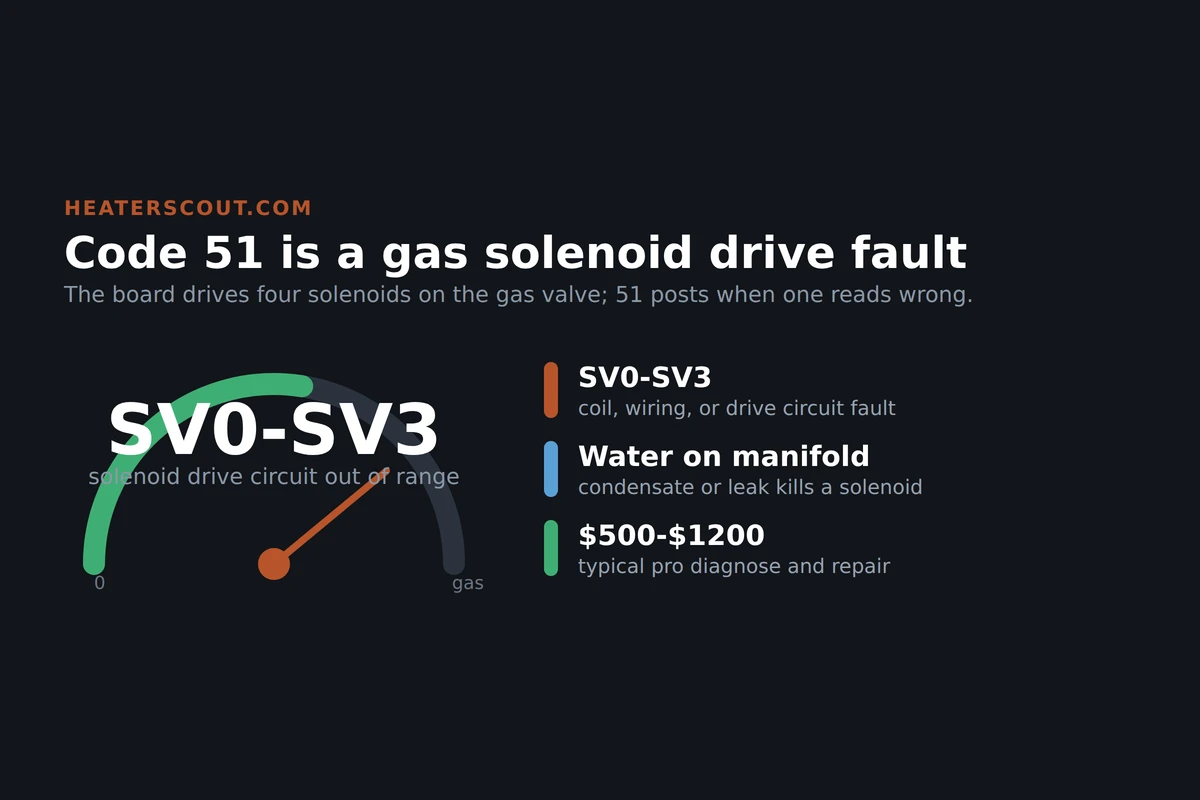
A Noritz that flashes 51 has not lost track of the water temperature or the flame. It has a problem on the gas control side. Code 51 is a gas solenoid valve drive circuit abnormality, meaning the control board cannot correctly switch one of the solenoids that meter fuel to the burner. There are four of them, SV0 through SV3, and the board watches every one. When a coil, a connector, a wire, or the drive circuit reads wrong, or when water has dripped onto the manifold, the board posts 51 and shuts the unit down. This one sits on the fuel side, so it is a licensed technician's job, not an afternoon project.
Clear the code first, then leave the gas side to a pro
Resetting only wipes the display so you can watch whether 51 returns. It changes nothing inside the gas valve. Do this much yourself, then stop.
Code 51 is on the fuel side. A power cycle clears the display, but the fix means testing solenoids on the gas valve and manifold, which is licensed work.Noritz service procedure, SV0-SV3 solenoid check
Quick answer
Noritz code 51 is a gas solenoid valve drive circuit abnormality. The control board cannot correctly drive one of the solenoids (SV0-SV3) that stage gas to the burner. Causes, most likely first: a solenoid coil out of resistance spec, a loose or corroded connector, a broken harness wire, water dripped onto the manifold, or a failed gas valve or manifold plate. Clear it with a two-minute power cycle to confirm, but the real repair is a licensed gas technician measuring each coil and replacing the gas valve (if SV0) or the manifold plate (if SV1, SV2, or SV3). Typical repair runs $500 to $1200.
What the solenoids do and why the board watches them
Understanding the part makes the code make sense. A Noritz tankless does not have a single on/off gas valve like an old tank heater. It stages gas. To match the burner output to how much hot water you are drawing, the control board switches a bank of solenoid valves, SV0 through SV3, in different combinations. Each solenoid is an electromagnet: the board sends current through a coil, the coil pulls a plunger, and gas either passes or does not. SV0 lives on the gas valve body. SV1, SV2, and SV3 live on the manifold plate downstream. The board does not just command these coils, it monitors the drive circuit that powers them. If the current it expects does not match what it sees, because a coil is open or shorted, a connector is bad, a wire is broken, or the driver on the board itself has failed, it concludes it can no longer safely control the gas and posts 51.
Causes of code 51, most likely first
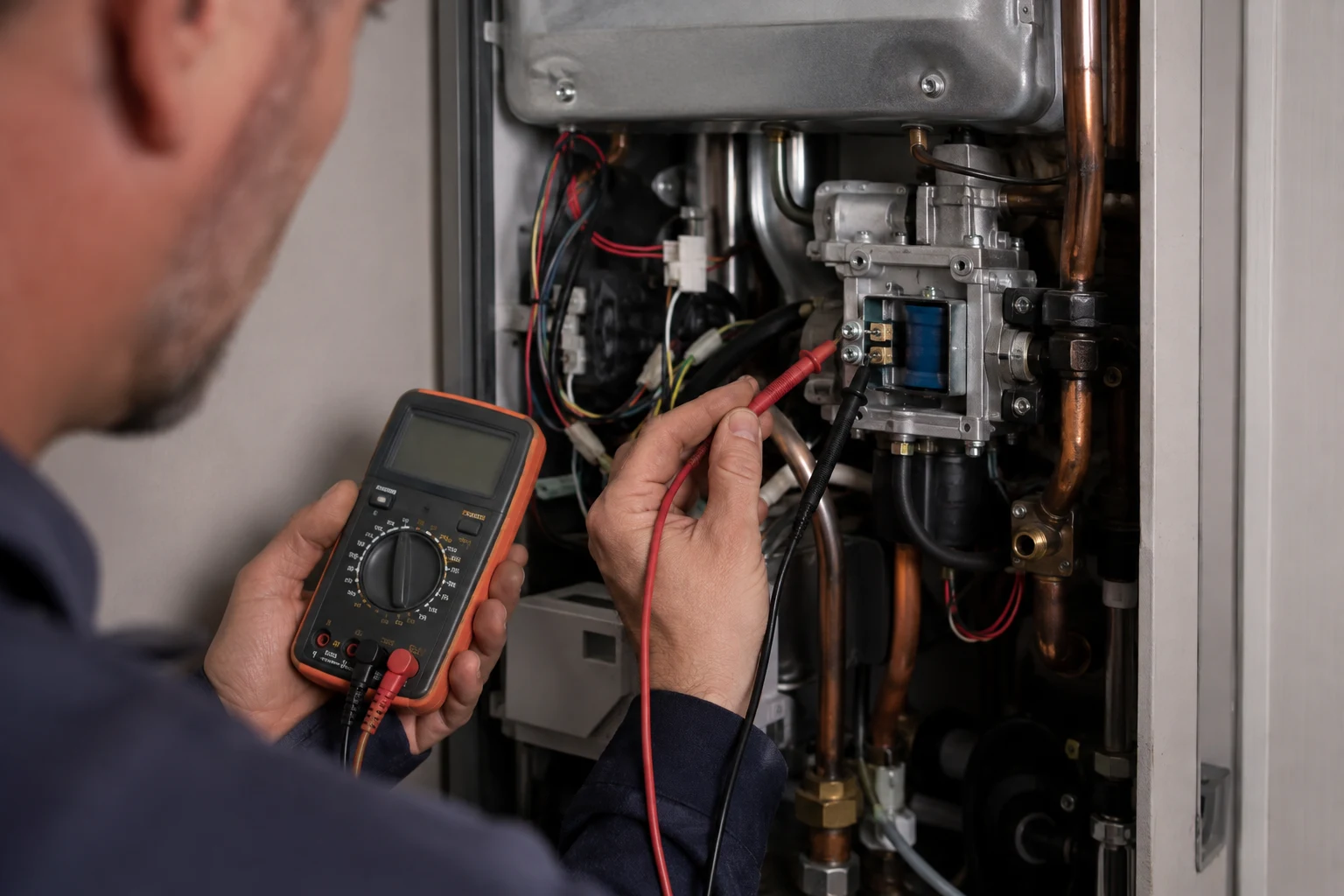
A technician works this list in order, cheapest and most common first. The tools are a multimeter and the service manual's resistance spec for your model. Everything here happens with the gas off.
Check the SV0 to SV3 connectors
With power off, the first move in every Noritz manual is to unplug and inspect each solenoid connector at the manifold and gas valve. Look for green corrosion, a backed-out pin, a burnt terminal, or a connector that was never fully seated. A bad connection alone throws 51 with perfectly good coils.
Ohm each solenoid coil
Measure the coil resistance of each solenoid against the value in your model's service manual. A reading of zero is a shorted coil, infinite is an open coil, and either one posts 51. A coil that reads well off spec is a failing solenoid. This test tells you which of the four is the problem.
Look for water on the manifold
Condensate or an internal leak dripping onto the manifold can short a solenoid or its connector. Technicians pulling a 51 cover often find water tracks or corrosion here. If water is present, the source has to be found and the affected part replaced, because drying it out rarely holds.
Trace the harness for breaks
If the coils and connectors check out, the wire from each solenoid back to the board is the next suspect. An open or intermittent wire mimics a dead coil. Wiggling the harness while watching the meter catches a break that only opens under movement.
Replace the gas valve or manifold plate
A confirmed fault at SV0 means the gas valve is replaced. A confirmed fault at SV1, SV2, or SV3 means the manifold plate is replaced. This is the honest fix for a bad solenoid and the most common cure for a hard 51 that returns on every power-up.
Suspect the control board last
Only after the coils, connectors, wiring, and manifold all check out does the drive circuit on the board come into question. A board that cannot drive a good solenoid is real but uncommon, and it is the most expensive part in the heater. Confirm everything upstream first.
Stay off the gas side
Code 51 is a gas-valve fault. Never jumper or bypass a solenoid to force the unit to fire, and do not open the gas valve yourself. Testing coil resistance with the gas off is fine, but replacing the gas valve or manifold and leak-testing the connections is licensed work. If you smell gas at any point, shut off the appliance gas valve, ventilate, and call your gas utility or a technician.
Where the homeowner line sits
This code lands on the pro side of the line, and the reason is simple: the parts at fault sit on the gas valve and the fuel manifold. A careful owner with a multimeter can safely power the unit down, inspect the solenoid connectors, and even ohm a coil with the gas shut off, which is useful information to hand a technician. What an owner should not do is open the gas valve, swap a manifold plate, or reassemble a fuel connection and put it back in service without a proper leak test. That is where a licensed gas or tankless technician earns the call. If your unit is under warranty, a 51 that will not clear is exactly the kind of internal-component failure the warranty is meant to cover, so check your coverage before paying for parts.
Keeping 51 from coming back
A solenoid fails from three things: age, a wiring connection that works loose over years of thermal cycling, and water reaching a place water should never be. You cannot stop a coil from aging, but you can keep water off the manifold, and that is where most preventable 51 faults start. Have the condensate management checked at your annual service so a loose or clogged condensate line is not weeping onto the gas valve. Any sign of an internal leak, a weeping fitting, corrosion tracks, or a heat exchanger that sweats, is worth chasing down before it shorts a solenoid. Keep the unit's connectors clean and dry, and if you live somewhere the heater sees big temperature swings, an annual look inside the cover catches a corroding connector before it becomes a no-hot-water morning. When 51 does show up on a unit that has been serviced and vents cleanly, the odds shift to a coil or the board, and that is a defined test with a defined part rather than a mystery.
Frequently asked
Can I reset Noritz error code 51 myself?
You can clear the display, but that is not a fix. Turn the unit off at the remote controller, shut the dedicated breaker or unplug the heater for a couple of minutes, then restore power. That drops the latched code so you can see whether it comes back. With code 51 it usually does. The code means the control board cannot drive one of the gas solenoid valves correctly, so unless the underlying coil, connector, wiring, or manifold has been repaired, the heater posts 51 again the next time it tries to fire. Use the reset to confirm a repair worked, not as the repair. If 51 returns right away, stop resetting and get a licensed gas technician on it, because you are dealing with the gas valve side of the appliance.
What does Noritz code 51 actually mean?
Code 51 is a gas solenoid valve drive circuit abnormality. A Noritz tankless does not have one on/off gas valve. It has a set of solenoids, labeled SV0 through SV3, that the control board switches on and off to stage how much gas reaches the burner. SV0 sits on the gas valve itself; SV1, SV2, and SV3 sit on the manifold plate. The board watches the drive circuit for each one. If a coil is open or shorted, a connector is loose or corroded, a wire is broken, or the drive circuit on the board misbehaves, the board posts 51 and locks the unit out. Noritz service manuals list the same first move for every model: check the SV0 to SV3 connectors, then measure the coil resistance of each solenoid.
Is Noritz code 51 dangerous?
The code itself is a protective lockout, so the heater refusing to run is the safe outcome. Code 51 lives on the gas control side of the appliance, and that is exactly why it is not a DIY repair. The solenoids you would be testing sit on the gas valve and manifold that meter fuel to the burner. Ohming a coil with the gas off is one thing; opening the gas valve, replacing a manifold, and confirming there are no leaks is licensed work. Never jumper or bypass a solenoid to force the unit to fire. If you smell gas at any point, shut the gas off at the appliance valve, ventilate, and call your gas utility or a technician before doing anything else.
Why does Noritz code 51 keep coming back after a reset?
Because the drive fault is still live. A power cycle clears the latched display but changes nothing physical. The common repeat offenders: a solenoid coil that has drifted out of resistance spec, a connector at SV0 to SV3 that reads intermittently from corrosion or a backed-out pin, a chafed or broken wire in the harness, or water that has dripped onto the manifold and shorted a solenoid. On some units the gas valve or manifold plate has simply failed. Until a tech measures each coil, inspects the connectors, and finds which of those it is, 51 will cycle right back. If it returns instantly on every power-up, the fault is hard, not intermittent, and needs the part replaced.
How much does it cost to fix Noritz code 51?
Plan for a real repair, not a cheap one, because this is gas-valve work. A technician's diagnostic visit to ohm the solenoids and trace the wiring commonly runs $100 to $200. From there it depends on which solenoid is bad. A fault at SV0 means replacing the gas valve; a fault at SV1, SV2, or SV3 means replacing the manifold plate. Between the part and the labor to swap it and leak-test the gas connections, total repairs on code 51 typically land in the $500 to $1200 range, and higher in expensive metros or on larger models. If the unit is out of warranty and the estimate is near the high end, it is worth comparing against the cost of a new heater.
Can water cause Noritz error code 51?
Yes, and it is one of the more common triggers people miss. If condensate or a small internal leak drips onto the manifold or into the gas valve, it can short a solenoid coil or its connector and post 51. Technicians pulling the cover on a 51 unit often find water tracks or corrosion on the manifold. When water has gotten onto the manifold, drying it out rarely holds; the affected solenoid or the manifold plate usually has to be replaced. It also means something upstream is leaking, so the source of the water, a cracked heat exchanger, a loose condensate line, or a fitting weep, has to be found and fixed or the new part will fail the same way.
Will descaling clear Noritz code 51?
No. Descaling flushes mineral scale out of the heat exchanger waterways, and it is worth doing on schedule. But code 51 is a gas solenoid drive fault on the fuel side of the heater, not a water-flow or scale problem. A descale will not touch a bad coil, a corroded connector, a broken wire, or a water-damaged manifold. Skip the descale as a fix here and put a meter on the solenoids instead, or have a technician do it. The one place water quality connects to 51 is indirectly: a unit that has never been serviced is also a unit whose condensate management and internal fittings have never been checked, and those are what let water reach the manifold in the first place.
Does code 51 mean the same thing on every Noritz model?
The core meaning is consistent across the NRC, NR, and NRCP lines: a gas solenoid valve drive circuit abnormality involving SV0 through SV3. What varies is the exact coil resistance spec, the connector layout, and which part carries which solenoid, so the repair path differs slightly by model. The service manual for your specific unit gives the resistance values and the connector map. Match anything you order to the model number on the data plate, and use the manual's SV0 to SV3 diagram to tell whether you are looking at the gas valve or the manifold plate.