A Noritz that flashes 33 is not complaining about your water being too hot or too cold. It is telling you that the sensor watching the heat exchanger outlet has stopped making sense. The board reads a thermistor, a small temperature probe whose resistance changes with heat, at the point where water leaves the burner core. When that resistance reads open, shorted, or out of range, the unit locks out on code 33 and stops heating. This is a sensor and wiring fault, not a gas or flow problem, and that distinction shapes the entire fix.
Where 33 sits in Noritz's sensor family
Noritz splits its water-temperature sensor faults into three separate codes, and they are easy to confuse because they all say thermistor. Getting the right one matters, because you do not want to chase the incoming water sensor when the fault is deep on the combustion core. Here is how the family breaks down.
| Code | Sensor | Where it sits | What it reads |
|---|---|---|---|
| 31 | Cold water inlet thermistor | At the cold-water inlet | Temperature of incoming water |
| 32 | Hot water outlet thermistor | At the hot-water outlet plumbing | Delivered water temperature |
| 33 | Heat exchanger outlet thermistor | On the combustion core, exchanger outlet | Water as it leaves the exchanger |
So if a note in your head or an old guide says 33 is the inlet sensor, that is the wrong code. Inlet is 31. Code 33 is the heat exchanger outlet thermistor, the one buried deepest, which is part of why it is less of a grab-and-swap job than the others. A handful of older Noritz lines relabel sensors slightly, so always confirm against your own unit's error list before you order a part.
What is actually failing
Before you decide who fixes this, figure out which of the usual causes you are looking at. Each one points at a different next move.
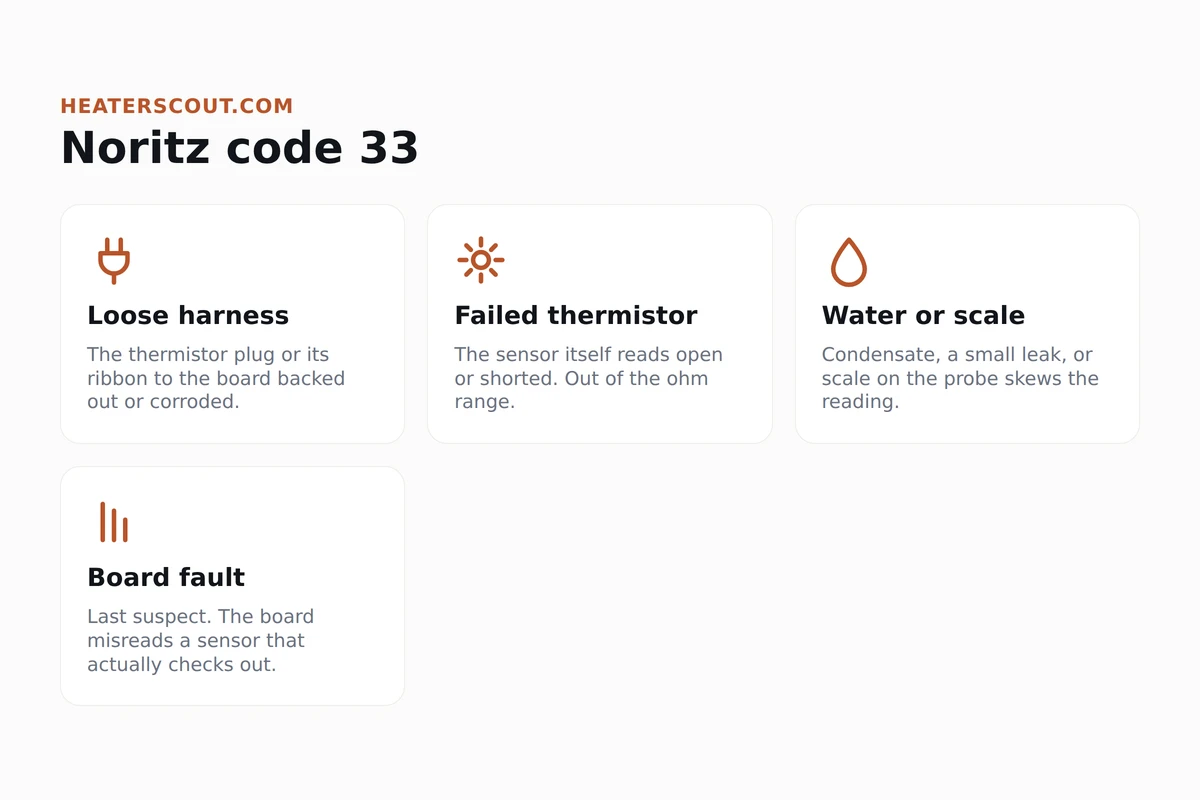
A loose or corroded connector
The thermistor plug backed out, or the harness ribbon at the board is not fully seated, or a pin has green corrosion. Reseating it clears the code. This is the cause a homeowner can actually fix.
A dead thermistor
The sensor element itself has gone open or shorted from age and heat cycling. It reads infinite or near zero on a meter. The honest fix is a new OEM thermistor, which is a pro job on the 33 sensor.
Moisture or scale on the probe
Condensate from a venting fault, a small exchanger seep, or heavy mineral scale can coat the probe and skew its resistance. Fix the water source, not just the sensor, or 33 comes back.
A control board fault
The board misreads a sensor that actually measures fine. Real but rare, and the most expensive part in the unit. You only land here after the wiring and the sensor both check out.
What you can do versus what needs a tech
Code 33 has a clean split. The safe homeowner moves are the power cycle and, if you are comfortable opening the panel, a look at the connector. Everything past that lands on the combustion side behind the board, which is where a licensed tech takes over.
Safe for a homeowner
- Power cycle: unplug or breaker off, wait a full 60 seconds, restore.
- Turn the remote controller off and back on to clear the latched code.
- With power and gas off, open the panel and check the thermistor plug and harness for a loose or corroded connector.
- Push each connector back on firmly and retest. A reseat clears a real share of 33 faults.
- Note whether the code returns instantly or after a delay, and tell the tech.
Call a licensed tech
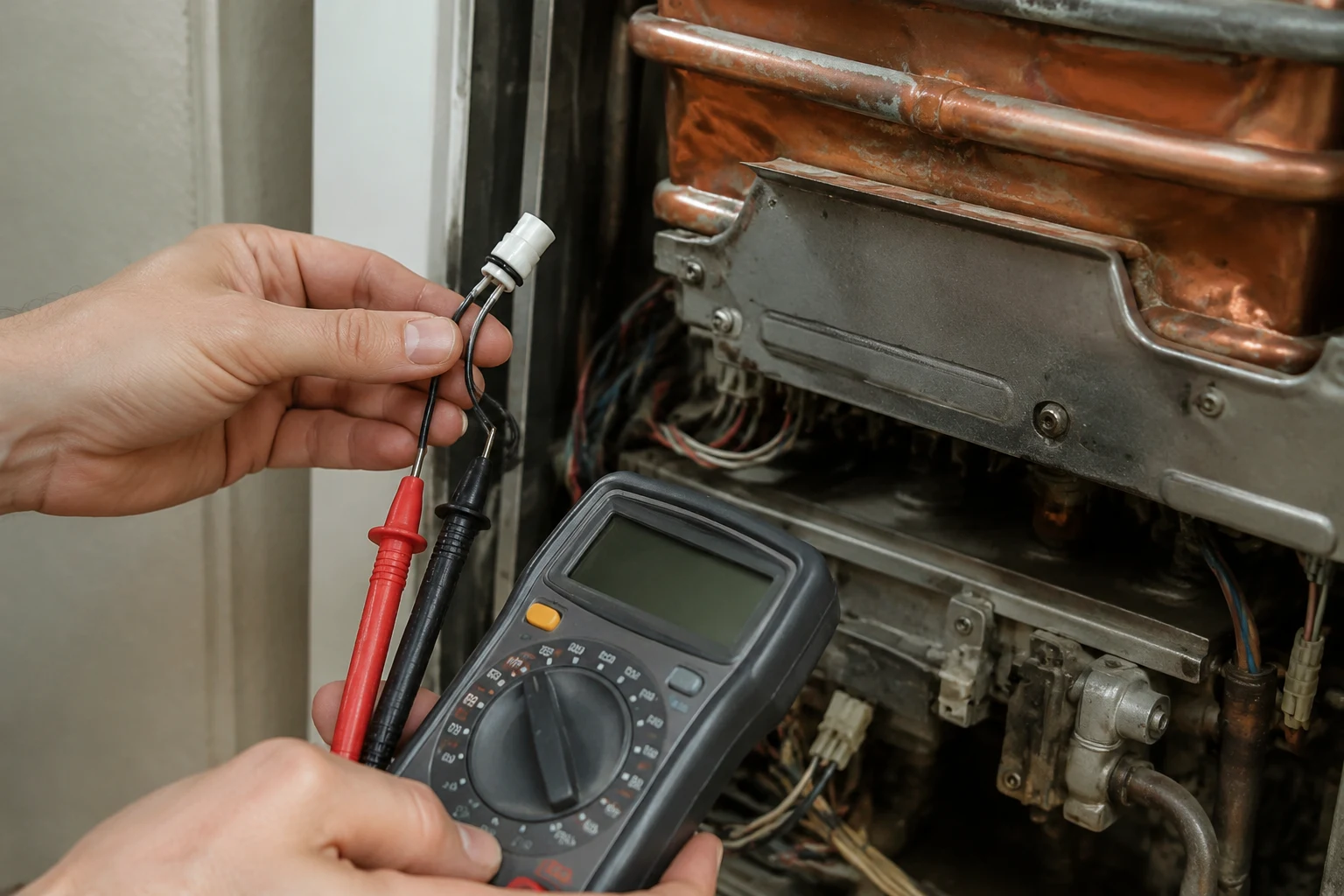
- Reading the thermistor's resistance and comparing it to the Noritz ohm spec.
- Replacing the heat exchanger outlet thermistor, which sits deep on the sealed combustion core.
- Chasing condensate, a small exchanger leak, or a venting fault that wets the sensor.
- Diagnosing a suspected control board and any work involving gas or the burner.
- Anything where 33 rides along with a smell of gas, a visible leak, or repeated lockouts.
Before you open the panel
Kill power and gas before you open the cabinet. Switch off the unit's breaker or unplug it, and close the gas shutoff. Noritz tankless heaters are sealed combustion units with a live control board and gas at the burner. Give the heat exchanger a few minutes to cool before you reach in, and never jumper or bypass a thermistor to force the unit to run. That sensor is part of how the board catches overheating.
Noritz code 33
A heat exchanger outlet thermistor abnormality. The control board reads the resistance of the thermistor mounted at the outlet of the heat exchanger to track water temperature at the burner core. When that reading goes open, shorted, or out of range, the board posts 33 and shuts the unit down. It is a sensor and wiring fault, distinct from code 31 (cold water inlet thermistor) and code 32 (hot water outlet thermistor).
Reading the thermistor the right way
When a reset does not hold and the connector looks fine, the meter settles the argument. A thermistor is a resistor that changes value with temperature, so you test it by reading ohms and comparing to the published curve. Noritz gives reference values for this sensor: roughly 11,400 to 14,000 ohms at 59 degrees Fahrenheit, and about 6,400 to 7,700 ohms at 86 degrees. The resistance falls as the sensor warms, which is normal. Read the numbers like this and you know which branch you are on.
| Meter reads | Diagnosis | Next move |
|---|---|---|
| Infinite / OL | Sensor element is open, dead | Replace the thermistor |
| Near zero | Sensor is shorted | Replace the thermistor |
| Way off the chart for the temperature | Sensor has drifted | Replace the thermistor |
| Inside the range, fault persists | Sensor is fine | Recheck wiring, then suspect the board |
That last row is the one people skip. If the sensor reads correctly for the current room temperature but 33 still shows, the thermistor is not your problem. Go back to the harness, look for a broken or pinched wire between the sensor and the board, and only after all of that is clean do you put money on the control board. Boards get blamed far more often than they fail.
Keeping 33 from coming back
Because 33 is a sensor and wiring fault, prevention is mostly about heat, moisture, and clean connections. Descaling on schedule keeps scale off the exchanger and off the probe, which is one indirect way a neglected unit invites a skewed reading. Just as important, keep water away from the sensor and the board. A venting problem that lets condensate collect, or a slow seep at the heat exchanger, will wreck a thermistor and its harness over time, so any sign of moisture inside the cabinet deserves attention before it becomes a 33 on the coldest morning. During annual service, have the tech check the thermistor connections and read the flame side and combustion for condensate. A sensor that stays dry and cleanly connected rarely throws this code twice.
Frequently asked
What does Noritz error code 33 mean?
Code 33 is a heat exchanger outlet thermistor abnormality. Noritz uses a small thermistor, a temperature sensor whose electrical resistance changes with heat, mounted at the outlet of the heat exchanger. The control board constantly reads that resistance to know how hot the water is as it leaves the burner core. When the reading goes open circuit, short circuit, or drifts outside the range the board expects, the unit posts 33 and shuts down. It is not telling you the water is too hot or too cold. It is telling you the board can no longer trust the sensor that watches that spot. That is why 33 is a sensor and wiring fault, not a gas, venting, or flow problem.
Is Noritz code 33 the inlet or the outlet thermistor?
The heat exchanger outlet thermistor. Noritz splits the sensor faults into a family, and it is easy to mix them up. Code 31 is the cold water inlet thermistor, the one that reads incoming water temperature. Code 32 is the hot water outlet thermistor, at the plumbing outlet of the unit. Code 33 is the heat exchanger outlet thermistor, which sits deeper inside on the combustion core and reads the water as it comes off the exchanger. If a guide or a memory tells you 33 is the inlet sensor, that is the wrong code. Inlet is 31. Confirm against the model's own error list, because a few older Noritz lines shuffle sensor labels.
Can I reset Noritz code 33 myself?
Yes, and it is the first thing to try. Turn off any hot taps, then power cycle the unit: unplug it or switch off its dedicated breaker, wait a full 60 seconds so the board fully drops power, and restore it. On remote-controller models you turn the controller off and back on. That clears the latched code and lets the board re-read the thermistor. If the fault was a momentary glitch or a connector that reseated when you bumped it, 33 stays gone. If it comes right back, the reset told you the fault is live and the sensor or its wiring is the real problem. A reset that does not hold is a diagnostic result, not a failure on your part.
What causes Noritz code 33?
Four things, in rough order of likelihood. First, a loose or corroded connector, the thermistor plug backed off, or the harness ribbon at the board is not seated, or a pin has green corrosion. Second, a failed thermistor, the sensor element itself has gone open or shorted from age, heat cycling, or a physical crack. Third, moisture or scale, condensate from a venting problem, a small heat exchanger seep, or mineral scale coating the probe, any of which skews the resistance. Fourth, and least common, the control board itself misreading a sensor that actually measures fine. You work that list cheap to expensive: reseat wiring, verify the thermistor's resistance with a meter, then suspect the board only after the sensor checks out.
How do I test the heat exchanger thermistor on a Noritz?
You measure its resistance with a multimeter and compare it to the Noritz spec. Kill power and gas, open the panel, unplug the thermistor, and read across its two terminals in ohms. Noritz publishes reference values: roughly 11,400 to 14,000 ohms at 59 degrees Fahrenheit, and about 6,400 to 7,700 ohms at 86 degrees. Resistance drops as the sensor warms, which is normal for this type. An infinite reading means the element is open, dead. A near-zero reading means it is shorted. A value wildly off the chart for the current temperature means it has drifted and needs replacing. A reading inside the range with the fault still present points back at wiring or the board. This is where most homeowners hand off to a tech, because the sensor sits behind the board panel on the sealed combustion side.
How much does it cost to fix Noritz code 33?
If it is a loose connector you caught yourself, the fix is free. If the thermistor is dead, a genuine Noritz heat exchanger outlet thermistor typically runs about $30 to $70 for the part, depending on model and where you buy it. A plumber or Noritz service tech to diagnose and swap it usually lands around $150 to $400 once you count the trip and labor, higher in expensive metros or if the sensor is buried and takes real disassembly. The costly branch is a control board, which can run $250 to $600 for the part alone on many Noritz models. That is exactly why you rule out the wiring and the sensor before anyone orders a board. Boards fail far less often than a cheap sensor or a corroded pin.
Is Noritz code 33 dangerous?
The code is a safety response, not the danger itself. That heat exchanger outlet thermistor is one of the sensors the board uses to keep water temperature in check and to catch overheating at the core. When the board loses a trustworthy reading from it, shutting down is the safe move, because running blind on that sensor could let the exchanger overheat undetected. So the lockout protects you. The thing you should not do is bypass or jumper the sensor to force the unit to run. If code 33 keeps returning after a reset and a reseat, leave it off and get a licensed tech on it. And if 33 shows up alongside signs of a leak, dripping at the base, or a musty smell, treat the moisture as its own problem, because water on the board is its own failure path.
Will descaling clear code 33?
Not directly, and do not expect it to. Descaling flushes vinegar or a descaling solution through the waterways to strip mineral scale off the heat exchanger. Code 33 is about the sensor reading, not water flow, so a flush by itself does not reset a bad thermistor or reseat a loose plug. There is one indirect link: heavy scale can coat the thermistor probe and skew its reading, so a unit that has never been descaled and throws 33 might improve after a flush that cleans the probe. But that is the exception. On a well maintained unit, 33 is wiring or a dead sensor, and descaling is unrelated. Keep descaling on your annual schedule for the health of the exchanger, just do not count on it to clear this specific code.