A Noritz that flashes 32 has not lost its heat or its water. It has lost trust in one small sensor: the thermistor that reads how hot the water is as it leaves the unit. The control board leans on that reading to modulate the burner and hit your setpoint, and the moment the signal stops making sense, whether the sensor opened, shorted, drifted, or just wiggled a connector loose, the board refuses to run blind and posts code 32. Nine times out of ten it is either a loose plug or a cheap sensor, but the fix lands squarely on the hot-water plumbing, which is why Noritz files this one under call a technician.
Is code 32 the same as codes 31 and 33?
No, and the distinction is the whole point. Noritz assigns each temperature sensor its own code. 31 is the cold water inlet thermistor, the one reading water coming in. 32 is the hot water outlet thermistor, reading water leaving the unit. 33 is the heat exchanger outlet thermistor, deeper inside the combustion path. They fail the same way and get diagnosed the same way, but they are three different physical sensors in three different spots. So a 32 sends you specifically to the outlet sensor on the hot side, not to the inlet and not to the heat exchanger. All three, 31, 32, and 33, share the same advice from Noritz: verify the connection, then replace the sensor, and lean on a licensed tech to do it.
What the outlet thermistor actually does
Understanding the sensor makes the code obvious. A thermistor is a temperature-sensitive resistor. The type used in tankless heaters is an NTC thermistor, meaning its resistance falls as it gets hotter and rises as it cools. The control board pushes a small reference voltage across it and reads the voltage that comes back, which tracks the sensor's resistance, which tracks temperature. On the outlet, this sensor tells the board how hot the water is right as it heads to your taps. The board uses that number every second to trim the gas valve and fan up or down so the water lands on your setpoint instead of overshooting. When the board reads a resistance that is impossibly high (an open circuit, like a broken wire), impossibly low (a short), or a value that swings in a way real water temperature never would, it declares the sensor untrustworthy and throws 32. It would rather stop than guess at how hot your water is.
What trips code 32
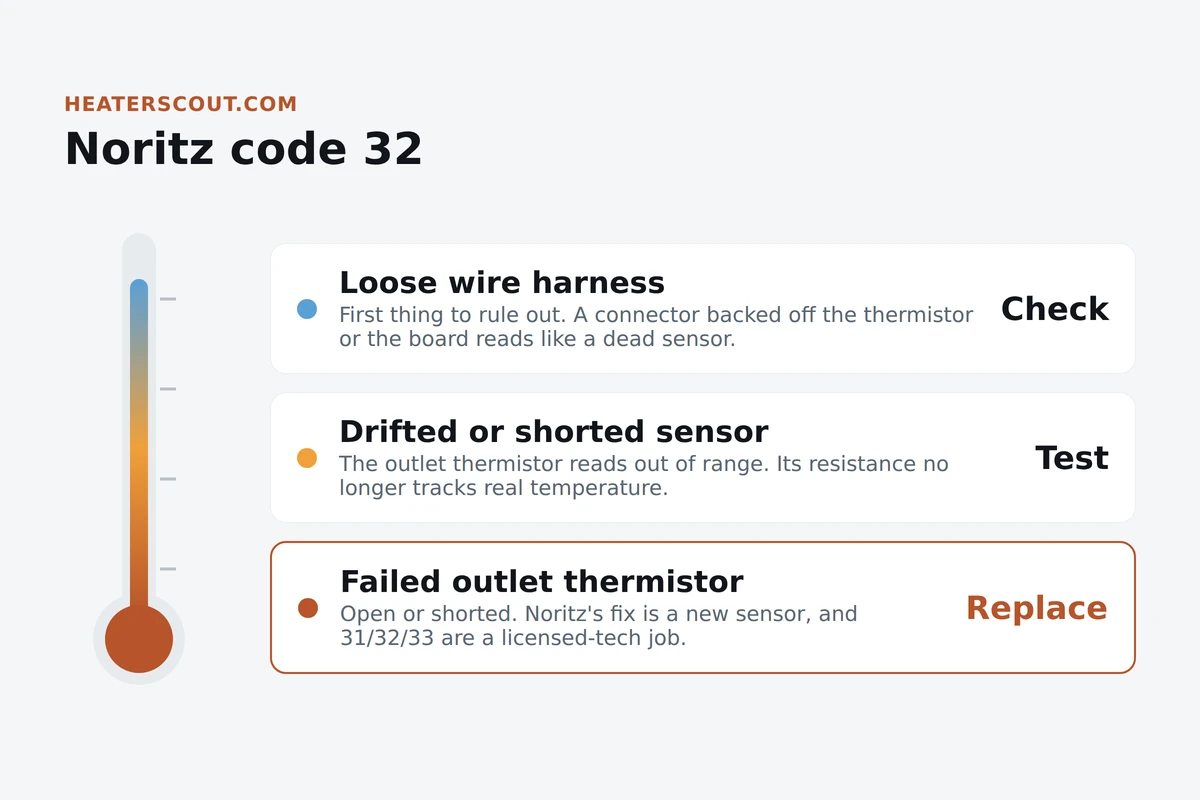
- Wire harness backed off the thermistor terminal or unplugged at the board.
- Outlet thermistor gone open circuit, an internal break reads as infinite resistance.
- Thermistor shorted, near-zero resistance the board rejects.
- Sensor drifted out of range, resistance no longer matches real temperature.
- Corroded or moisture-fouled connector on the hot-water side.
- Chafed or pinched harness wire that opens once it heats up.
What does NOT cause it
- Scale in the heat exchanger. That is a flow and descale issue, not a sensor fault.
- Low gas pressure or ignition trouble. Those throw their own codes.
- A cold inlet reading, that is code 31 on the other sensor.
- The heat exchanger outlet sensor, that is code 33.
- Air or exhaust temperature, codes 30 and 35.
- A dirty flame rod or flame-failure lockout, a different family entirely.
The fix, in order
Work from free to expensive, and stop the moment the code clears. Do not order a control board because a sensor code rattled you. The board is almost never the problem here. Power and gas off before the cover comes off, every time.
Diagnostic order when a reseat does not hold
If 32 survives a good reseat, stop guessing and start testing. A thermistor either reads a sane resistance for the temperature it is sitting at or it does not, and a meter settles the argument. This is tech territory, but it helps to know what they are checking.
Measure the thermistor resistance
With the sensor unplugged and the unit at a known temperature, a tech reads the thermistor's resistance with a meter. An NTC sensor should show a specific resistance for that temperature per the model's service chart, higher when cold, lower when hot. Infinite resistance means it is open. Near zero means it is shorted. Either one is a failed sensor.
Wiggle-test the harness and connectors
Corrosion or a chafed wire can read fine at rest and drop out once the unit heats and vibrates. A tech flexes the harness and watches the reading for dropouts, and inspects the run for a pinched or melted spot near hot surfaces. Moisture on the hot-water side is a common connector killer here.
Confirm it is the sensor, not the board
If the sensor reads correct resistance for its temperature and the wiring is solid but the board still posts 32, the control board may be misreading a good signal. That is real but rare, and it is the last and most expensive thing to suspect, not the first.
Replace the outlet thermistor
The honest fix for a sensor that tests open, shorted, or drifted is a new Noritz outlet thermistor, installed with the right seal and torqued so it does not weep. After the swap, the tech clears the code and runs the unit through a heat cycle to confirm the reading tracks temperature.
Where the homeowner line really sits
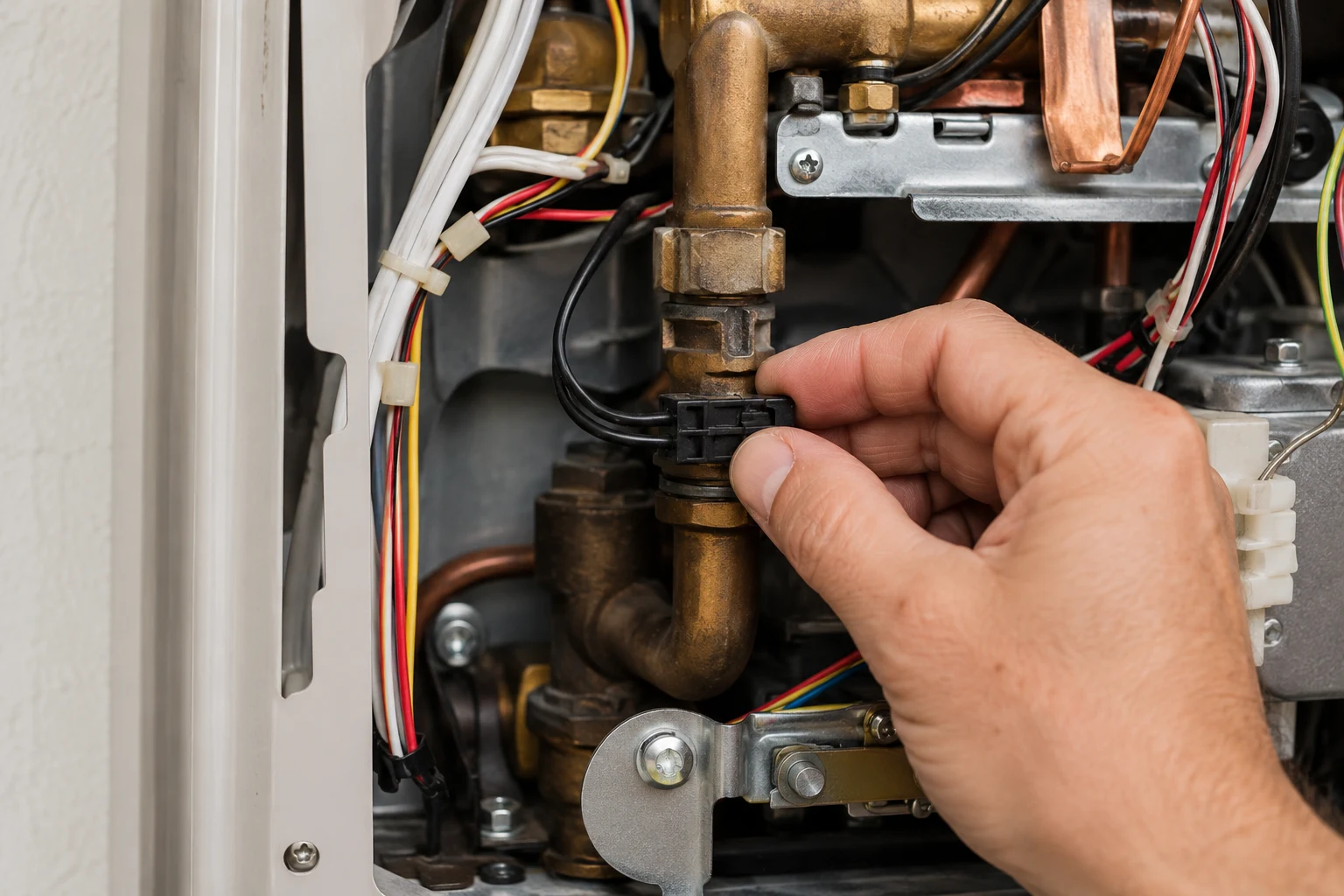
The split on code 32 is cleaner than most. The free, safe part is reseating connectors: cover off with power and gas killed, push the thermistor plug and the board plug home, look for corrosion, close it up. Any careful person can do that. The line you do not cross is the sensor swap itself, because the outlet thermistor lives on pressurized hot-water plumbing. Replacing it means draining the unit and opening a fitting, and a bad reseal turns a $30 sensor into a drip that rots the cabinet. Noritz did not put 31, 32, and 33 in the technician column by accident. Testing resistance against a temperature chart is also a meter job most homeowners are not set up for. If the reseat does not clear it, that is your cue to call, not to start draining the unit yourself.
Keeping 32 from coming back
Thermistor faults are less about wear and more about connections and moisture, so prevention looks different from a descale routine. When your tech comes for annual service, have them inspect the sensor harnesses and connectors, not just flush the heat exchanger. A dab of dielectric grease on the outlet thermistor connector fends off the corrosion that causes intermittent dropouts on the hot, humid side of the unit. Keep the cabinet dry and make sure the front cover seals, because water finding a connector is a frequent cause of phantom sensor codes. Descaling still matters for the unit overall, just know it is not what protects you from a 32. And if a thermistor has already failed once from moisture, ask the tech to route and secure the harness clear of the hottest surfaces so the next one lasts.
Frequently asked
What does Noritz error code 32 mean?
Code 32 is a Thermistor - Hot Water abnormality. In plain terms, the sensor that reads the temperature of the water leaving your Noritz, the outlet thermistor, is sending the control board a signal the board cannot trust. That happens when the sensor has gone open circuit, shorted, drifted so far off that its resistance no longer matches real temperature, or when the wire harness feeding it has worked loose. Noritz groups its temperature sensors by code: 30 is the air thermistor, 31 is the cold water inlet, 32 is the hot water outlet, 33 is the heat exchanger outlet, and 35 is the exhaust. So 32 points at one specific sensor on the hot side, not a general temperature problem. The unit shuts down because it will not modulate the burner blind, without a reliable read on how hot the water going to your taps actually is.
Can I reset Noritz code 32 myself?
You can clear the display, and it is worth doing once to confirm the fault is real and not a one-off glitch. Switch the unit off, either at the remote controller or at the dedicated breaker, leave it off for at least 30 seconds so the board fully powers down, then switch it back on. Your temperature setting stays put. If 32 clears and never comes back, a connector may have simply reseated. If 32 returns as soon as you draw hot water, the sensor or its wiring is genuinely faulty and the reset bought you nothing but confirmation. Noritz is blunt about this: if the code shows again after a power cycle, call for service. Clearing the code is not the same as fixing the sensor behind it.
Is Noritz code 32 a DIY fix or a job for a pro?
Noritz puts the inlet, outlet, and heat exchanger thermistor faults, codes 31, 32, and 33, in the call-a-technician column, and there is a good reason. The outlet thermistor sits on the plumbing after the heat exchanger, so replacing it means draining the unit, breaking into a hot-water fitting, and getting the seal right so it does not weep. Get the sensor position or the O-ring wrong and you trade an error code for a leak. A careful, mechanically confident homeowner can reasonably do the free part: pop the front cover with power and gas off and reseat the thermistor connector and the harness plug at the board. If that does not clear it, the actual sensor swap and any resistance testing are best left to a licensed Noritz tech.
How much does it cost to fix Noritz code 32?
If the only problem is a connector that backed off, the fix costs nothing but the time to open the cover and push it home. The outlet thermistor itself is an inexpensive part, commonly in the $20 to $60 range for the genuine Noritz sensor depending on model, and some come as a short pigtail assembly. What you pay for is the visit and the labor. A service call to diagnose and replace an outlet thermistor usually lands somewhere around $150 to $350 once you count the trip charge, draining the unit, and the swap, more in high-cost metro areas or if the unit is hard to reach. If the board is misreading a sensor that tests fine, a Noritz control board is the expensive outlier, often several hundred dollars for the part alone, which is exactly why you rule out the cheap causes first.
Will descaling clear Noritz code 32?
No. Descaling flushes vinegar or a descaling solution through the heat exchanger to strip mineral scale off the waterways, and it is genuinely important maintenance on a tankless unit. But code 32 is an electrical sensor fault, not a water-flow or scale problem. A descale does nothing for a thermistor that has gone open or shorted, and nothing for a loose harness plug. The one small connection is that heavy scale can insulate a sensor's tip and slow its response, but that shows up as slow or wrong readings, not the hard open/short fault that trips 32. Keep descaling on schedule for the health of the unit, just do not expect a flush to touch this code.
Why does Noritz code 32 keep coming back?
A code that returns after a reset is telling you the real fault is still there. The usual repeat offenders: the connector at the thermistor or at the board was reseated but is corroded, so the contact drops out intermittently and the board sees the sensor come and go. Or the thermistor is physically failing, its resistance drifting far enough that the board rejects the reading only under certain temperatures. Or a wire in the harness is chafed or pinched near a hot surface and opens up once things warm. Moisture is a common culprit too, since a damp or corroded connector on the hot-water side can mimic a dead sensor. If a reseat does not hold, the honest fix is to test the sensor's resistance and replace it rather than keep clearing the code.
Is Noritz code 32 dangerous?
The code is a safety response, not the danger itself. Without a trustworthy read on outlet temperature the board cannot control how hot the water gets, so rather than risk scalding water or an over-temperature run, it shuts the unit down and posts 32. That lockout is protective. The real risk is bypassing it. Never jumper or defeat a thermistor circuit to force the unit to run, because you would be asking it to heat water with no idea how hot it is getting. If the sensor reseats and 32 still returns, or you notice water running hotter than your setpoint before the shutdown, leave it off and get a licensed tech on it. And if you ever smell gas around the unit, that is a separate, immediate call to your gas utility, not a thermistor question.