A Noritz that flashes 29 is not a burner or a gas problem. It is a plumbing problem hiding inside a water heater. Code 29 shows up only on the high-efficiency condensing models, the ones that squeeze extra heat out of the exhaust and, as a side effect, produce a steady trickle of acidic water. That condensate has to drain away by gravity. When the drain line or the neutralizer that treats that water backs up, condensate rises toward the burner, and the control board shuts the unit down on purpose and posts 29. Most of the time the fix is at the drain, not inside the machine.
What the board is actually watching
Condensing tankless units run the flue gas cool enough that the water vapor in it condenses out. That water is acidic, roughly the pH of vinegar, so Noritz routes it through an internal trap and, in most installs, an external neutralizer before it reaches a floor drain or a septic line. Critically, this water has no pressure behind it. It moves only because the whole path falls downhill. When something stops that flow, water pools inside the condensate assembly. The unit senses the backup and throws 29 rather than let the burner flood. So the code is less a broken-part alarm and more a level warning: water is not leaving.
Check where the line ends
Follow the condensate line to its outlet, a floor drain, a condensate pump, or an outdoor termination. Confirm water can actually leave there. A capped, clogged, or disconnected end backs the whole line up.
Look for a frozen section
If the line runs outside and it is winter, a frozen plug is the number one cause. Thaw it with warm towels or a hair dryer on low heat. Never use an open flame on the piping.
Verify continuous downhill slope
The condensate has no pump behind it inside the standard drain path. The entire run must fall downhill. Any uphill dip, sag, or belly holds water and trips 29. Sight along the pipe for a low spot.
Remove any extra trap
The Noritz has a trap built in. If an installer added a second external p-trap, it just holds water and fights the internal one. Pull the extra trap out of the run.
Service the neutralizer
If the install uses an external neutralizer, open it. Depleted or packed-down media, or a cartridge full of debris, slows flow to a crawl. Flush it or replace the cartridge.
| Code meaning | Neutralizer / condensate drainage failure |
| Applies to | High-efficiency condensing models only |
| Most likely cause | Blocked, sagging, or frozen condensate drain line |
| Second cause | Depleted or clogged neutralizer media |
| Piping rule | Continuous downhill slope, no extra external trap |
| Condensate pH | Acidic, roughly vinegar (about pH 3 to 5) |
| Reset method | Off at controller, or 30-sec breaker cycle |
| Pro / premix extra step | Reset internal media timer at the PCB per manual |
| Neutralizer kit cost | About $30 to $90 depending on model |
| Pro repair range | About $150 to $400 to clear drain and swap neutralizer |
| Difficulty | DIY-friendly at the drain, pro for internal parts |
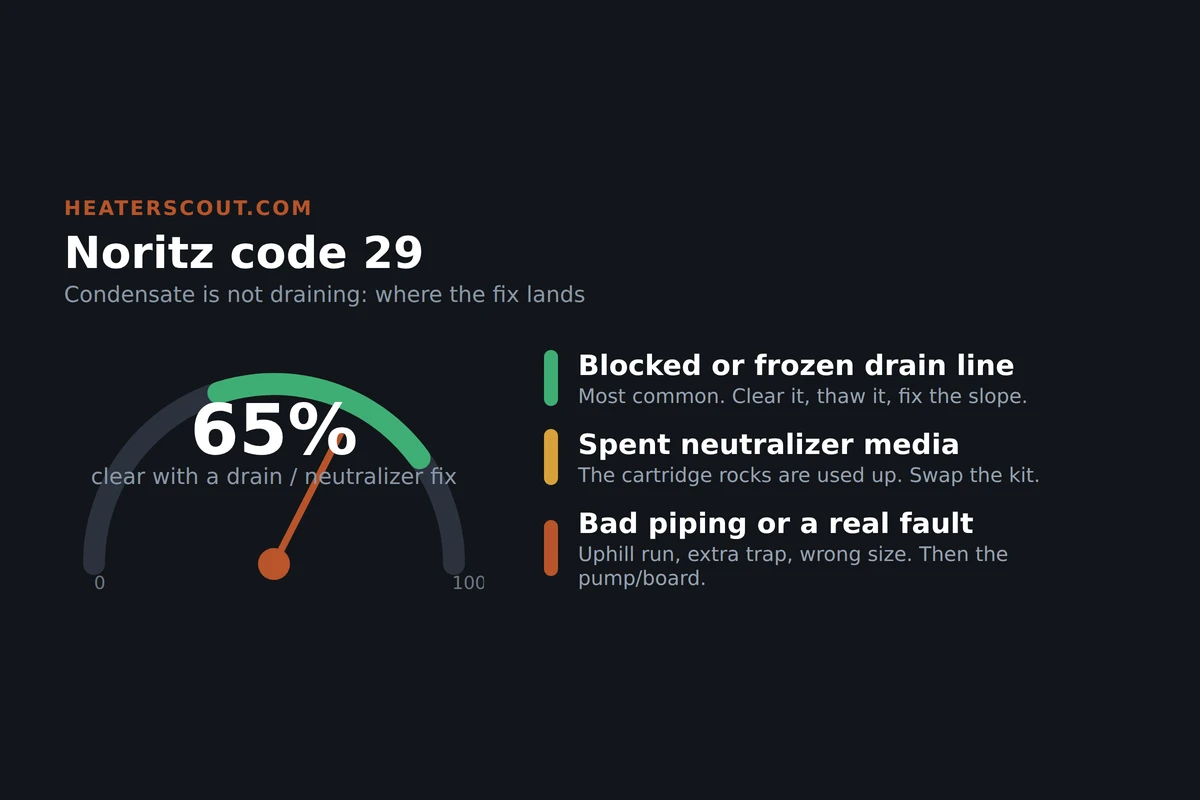
Blocked line versus spent neutralizer
Two different causes hide behind the same code, and they call for different work. Reading the pattern tells you which one you have before you start pulling things apart.
| Symptom | Blocked or frozen drain line | Depleted or clogged neutralizer |
|---|---|---|
| When it appears | Often after a cold snap, or gradually over weeks | Gradually, months to years after the last cartridge |
| What you find | Ice, sediment, a sag, or an uphill run in the line | Packed, discolored, or used-up media in the housing |
| Quick test | Pour water in the line and watch it drain | Open the neutralizer and inspect the media |
| The fix | Thaw, re-slope, remove extra trap, flush | Replace the cartridge or refill the media kit |
| Cost | Free to a few dollars of pipe | About $30 to $90 for a kit |
| Extra step | None beyond clearing the code | Reset the media timer on Pro / premix models |
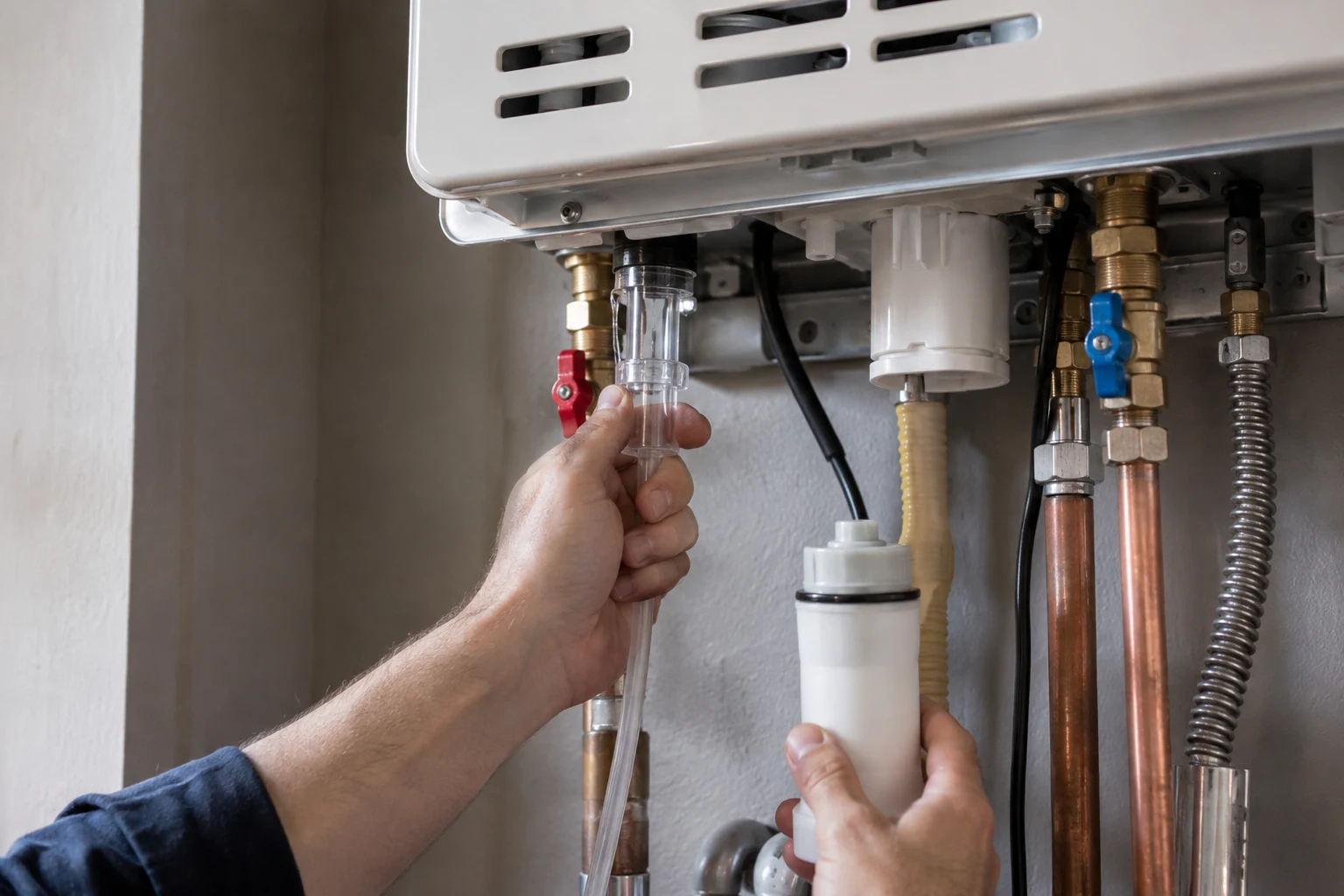
Where the homeowner line sits
Clearing the drain and servicing the neutralizer is fair game for a careful homeowner. It is a plumbing job on the outside of the unit, not a gas or combustion job. The line you do not cross is anything inside the sealed cabinet or on the control board. If the drain path checks out clean and 29 still returns, or you find corrosion and standing water inside, that points at an internal condensate assembly or a sensor, and that is a service tech's work.
Safe for a homeowner
- Clear, flush, or thaw the condensate drain line
- Fix the slope so the whole run falls downhill
- Remove an extra external trap the installer added
- Replace the neutralizer cartridge or refill the media
- Clear the code with a controller or breaker power cycle
- Confirm a condensate pump switches on when its float rises
Call a Noritz tech
- Internal condensate assembly leaking or corroded
- Standing water inside the sealed cabinet
- Code 29 returns with a proven-clear drain path
- Media-timer reset combination you cannot find or run
- Any sign of a control board or level-sensor fault
- Corrosion damage from acidic condensate on metal
Getting the piping right the first time
Most repeat 29 codes trace back to how the condensate line was run, not to a failed part. Three rules cover it. First, slope: the entire drain has to fall continuously toward the outlet, because gravity is the only thing moving the water. A single sag becomes a water trap that fills and backs up. Second, traps: the unit already has an internal trap, so do not add an external p-trap in the line. A second trap holds water and starves the flow. Third, size and route: use the pipe size the manual calls for, and keep the run out of spaces that freeze. If the condensate has to go outside in a cold climate, either route it somewhere protected or add freeze protection, because a line that freezes every January will post 29 every January.
Keeping 29 from coming back
A condensing tankless makes acidic water every time it runs, so the drainage side needs attention the same way the water side needs descaling. Put the neutralizer on a schedule. The media is not permanent; it gets consumed neutralizing acid and eventually stops working, and a depleted cartridge packs down and slows drainage. Check it during your annual service and replace it when the media is spent. On Pro Series and premix models, remember the second step after a swap: reset the internal media timer through the button combination on the control board so the unit tracks the new cartridge instead of nagging you about the old one. Keep the drain line clear of sediment and slime with a periodic flush, and in cold climates confirm the outdoor run is protected before winter. Do that, and the code that always seems to appear on the coldest morning of the year stops appearing.
Frequently asked
Can I reset Noritz code 29 myself?
You can clear the display, but clearing is not the same as fixing. On a Noritz tankless there is no dedicated red reset button. You clear a fault by turning the unit off at the remote controller or the on/off switch, or by flipping the breaker off for about 30 seconds and back on. That power cycle drops the 29 and keeps your temperature settings. The problem is that 29 is a drainage fault, so if the condensate line is still blocked or frozen, the code returns within a few minutes of the burner running, because the unit starts making condensate again with nowhere for it to go. On some Pro Series and premix models there is a second step: after you replace the neutralizer cartridge you have to reset the internal media timer through a button combination on the control board, and the manual for your exact model spells out that sequence. Clearing the code buys you a test cycle. It does not unclog a drain.
What does error code 29 mean on a Noritz tankless?
It means the unit cannot drain its condensate. Code 29 shows up only on high-efficiency condensing Noritz models, the ones that pull extra heat out of the exhaust and leave behind acidic water. That water has to run out of the unit by gravity, through the drain line, often through a neutralizer, and into a drain. When the neutralizer or the drain line backs up, condensate rises inside the unit toward the burner. The control board sees that and throws 29 to shut the burner down before it floods. So the code is not reporting a broken part most of the time. It is reporting that water is not leaving the way it should.
How do I fix the condensate drain on a Noritz code 29?
Start at the outlet and work back. Find where the condensate line ends, at a floor drain, a condensate pump, or an outdoor termination. Confirm water can actually leave there. If the line runs outside and it is winter, a frozen section is the usual culprit; thaw it with warm towels or a hair dryer on low, never an open flame. Next, check the slope. Condensate has no pressure behind it, so the whole run has to fall continuously downhill. Any uphill dip, sag, or belly holds water and trips 29. Remove any extra trap you or an installer added, because the Noritz already has a trap built in and a second one just holds water. Flush the line with water to clear sediment or slime. If the unit uses an external neutralizer, check whether the media is used up or the cartridge is clogged and replace it. Clear the code and run a hot tap to confirm it stays cleared.
How much does it cost to fix Noritz code 29?
If it is a clogged or frozen line, the fix costs you nothing but time and maybe a few dollars of PVC to re-slope a bad run. A replacement neutralizer cartridge or refill kit runs roughly $30 to $90 depending on the model and whether you buy OEM. If the acidic condensate has eaten the neutralizer housing or the line, replacing that hardware is another $30 to $150 in parts. A plumber's visit to diagnose and clear the drainage, correct piping, and swap the neutralizer usually lands around $150 to $400 once you count the trip and labor. The expensive and rare end is an internal condensate assembly or control board, which pushes a repair into the several-hundred-dollar range. Because the common causes are cheap, it pays to rule out the blocked line and the spent media before anyone talks about a board.
Will descaling clear Noritz code 29?
No. Descaling flushes vinegar or a descaling solution through the heat exchanger to strip mineral scale off the water side, the potable water that comes out of your taps. Code 29 lives on the condensate side, the acidic water that drips out of the exhaust path. They are two separate water systems inside the unit. A descale does nothing for a blocked condensate drain or a spent neutralizer. Keep descaling on schedule for the health of the heat exchanger, but do not expect it to touch 29. The moves that clear this code are clearing the drain, fixing the slope, and servicing the neutralizer.
Why does Noritz code 29 keep coming back?
A 29 that returns after you clear it is telling you the water still cannot get out. The repeat offenders: a drain line with a hidden uphill section or a sag that holds water, so it works for a few minutes then backs up again. An outdoor line that keeps refreezing every cold night. An extra trap in the line fighting the unit's internal trap. A neutralizer whose media is depleted, so it packs down and slows flow. Or a condensate pump that is not switching on when its float rises. Each of these lets condensate accumulate faster than it leaves, and the board keeps catching it. Chase the drainage path end to end rather than clearing the code again, because the code is doing exactly what it is designed to do.
Is Noritz code 29 dangerous?
The code itself is a protection, not a hazard. By shutting the burner down when condensate cannot drain, the unit keeps water from flooding the burner and the combustion chamber, which protects both the appliance and you. The thing to respect is the condensate itself. It is mildly acidic, roughly the pH of vinegar, which is why condensing units drain through a neutralizer before the water hits metal pipes or a septic system. If you are clearing a line, wear gloves and rinse anything the water touched. Do not defeat or bypass the drainage safety to force the unit to run, and do not cap a backed-up line. If the drain path checks out and 29 still returns, or you find corrosion or standing water inside the cabinet, shut it down and call a Noritz service tech.