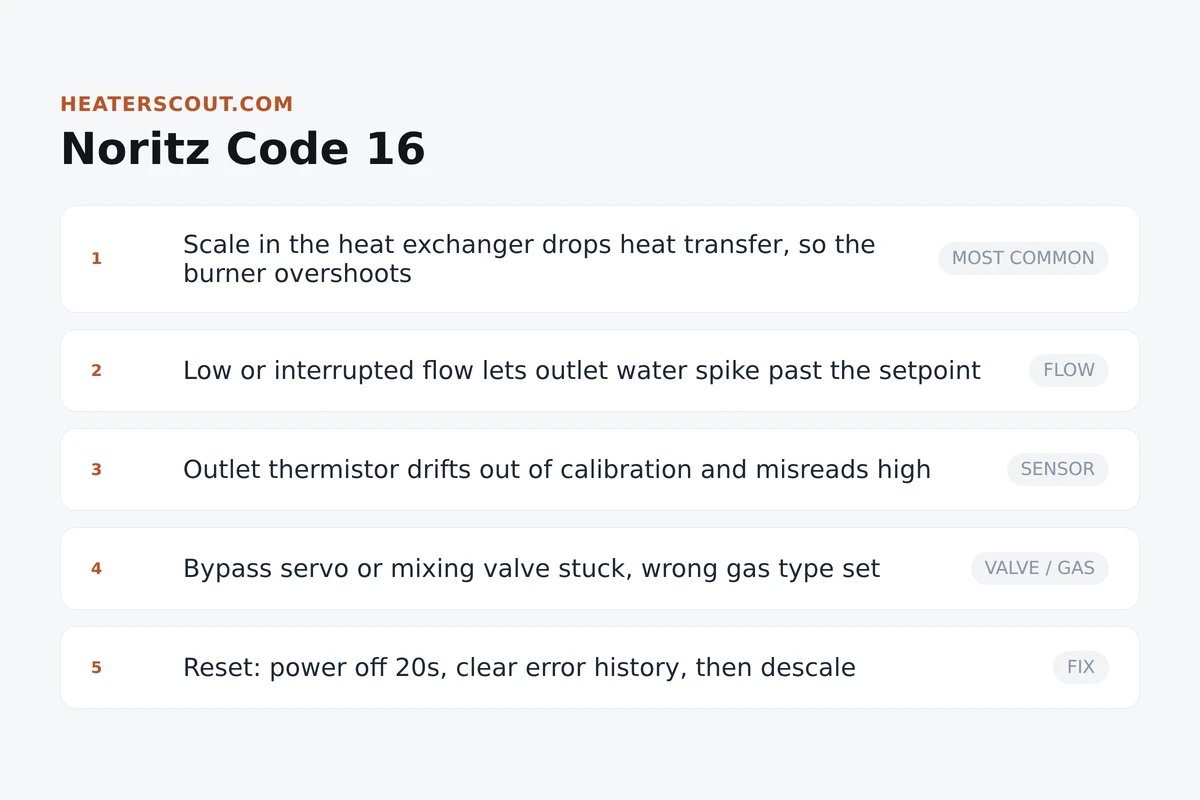
The 16 on your Noritz display is the control board saying the outlet water just got hotter than it should, so the unit clamped down on flow to protect you and itself. It is an over-temperature fault read at the hot-side thermistor, not a gas or ignition problem. Nine times out of ten the trail leads back to scale in the heat exchanger, but a couple of quieter causes fool people into replacing the wrong part. Here is how to read code 16 correctly and clear it for good.
Code 16 versus code 14: know which one you have
These two codes get mixed up constantly because both come from an overheating heat exchanger, but they are not the same fault and they do not clear the same way. Getting this straight first saves you from throwing parts at the wrong problem.
Code 16 — over-temperature warning
- Outlet thermistor read an abnormally high water temperature
- Board restricts flow as a precaution, unit keeps running
- Clears with a power cycle, no broken part required
- Root cause is usually scale, low flow, or a sensor drifting high
- You can start the diagnosis yourself
Code 14 — thermal fuse tripped
- A physical thermal fuse melted from a real overheat
- Unit shuts down hard and stays down
- Will NOT clear by cycling power, the fuse is a one-time part
- Needs a technician to replace the fuse and find the cause
- Often the end stage of ignored, repeated code 16 events
The practical takeaway: if power-cycling makes the display go clear and the unit fires again, you have code 16 and some room to work. If the code sticks no matter what you do, you are past 16 and into 14 territory, and that is a service call.
Start here: the homeowner-safe checklist
Before any tools come out, run through the checks that need nothing but your hands and a few minutes. On a healthy unit with hard water, this list alone clears most code 16 events. Do them in order.
- Turn off every hot tap, then power the unit off at the breaker for 20 seconds to reset the display.
- Confirm your hot-water setpoint on the remote is not cranked to the maximum, which leaves no headroom for a spike.
- Open a hot tap fully and check the flow. A weak trickle below the activation rate can cause the spike.
- Close the cold inlet valve and clean the inlet water filter screen, a top cause of low flow.
- Check faucet aerators and shower heads for mineral clog if flow is poor at one fixture.
- If you have a recirculation loop or crossover valve, verify it is not looping hot water back into the cold line.
- Note how many days or draws pass before code 16 returns, then read the error history if your controller stores it.
If flow was the problem, you will usually feel it right away: the trickle turns into a proper stream once the inlet screen is clean, and the code stops coming back. If flow is fine and the code still returns, scale is the next suspect.
What the code actually reports
The table below maps code 16 to the sensor and the safe values a technician checks against. Keep it handy if you call for service, since it tells you what they should be measuring rather than guessing.
| Code display | 16 |
| Meaning | Abnormally high outlet water temperature (over-temperature) |
| Sensor involved | Hot-water outlet thermistor |
| Unit response | Restricts water flow, may cut the burner briefly |
| Reset method | Power off 20s, clear error history, then fix the cause |
| Minimum inlet pressure | About 25 psi for stable output |
| Minimum activation flow | Roughly 0.5 gpm to keep the burner modulating |
| Most common root cause | Scale in the heat exchanger reducing heat transfer |
| Related but different | Code 14, a tripped one-time thermal fuse |
Why scale is the usual culprit
Scale-driven overheat
As calcium and magnesium plate the inside of the copper heat exchanger, they form an insulating crust. Heat from the burner no longer crosses into the water as fast, so the board pushes the flame harder to hit your setpoint. The coil metal and the water film against it run hotter than designed. The instant flow dips, say when a second tap opens or you throttle a faucet, that stored heat spikes the water passing the outlet thermistor, and the board throws code 16. Descaling removes the crust and lets heat transfer normally again.
This is why code 16 shows up more in hard-water regions and more on units that have gone years without a flush. Noritz recommends an annual descale in hard water, and units that get it rarely see code 16 at all. If you have never flushed the unit and the water in your area is hard, put scale at the top of your list.
The descale itself is within reach for a handy owner if the unit has isolation service valves. You close the cold inlet and hot outlet valves, connect hoses from the service ports to a bucket, and run a submersible pump to circulate white vinegar or CLR through the coil for 45 to 90 minutes. Then you rinse with clean water, reopen the valves, and restore power. No service valves means a plumber has to break into the lines to flush, which is why installers push for a service valve kit up front.
When it is not scale
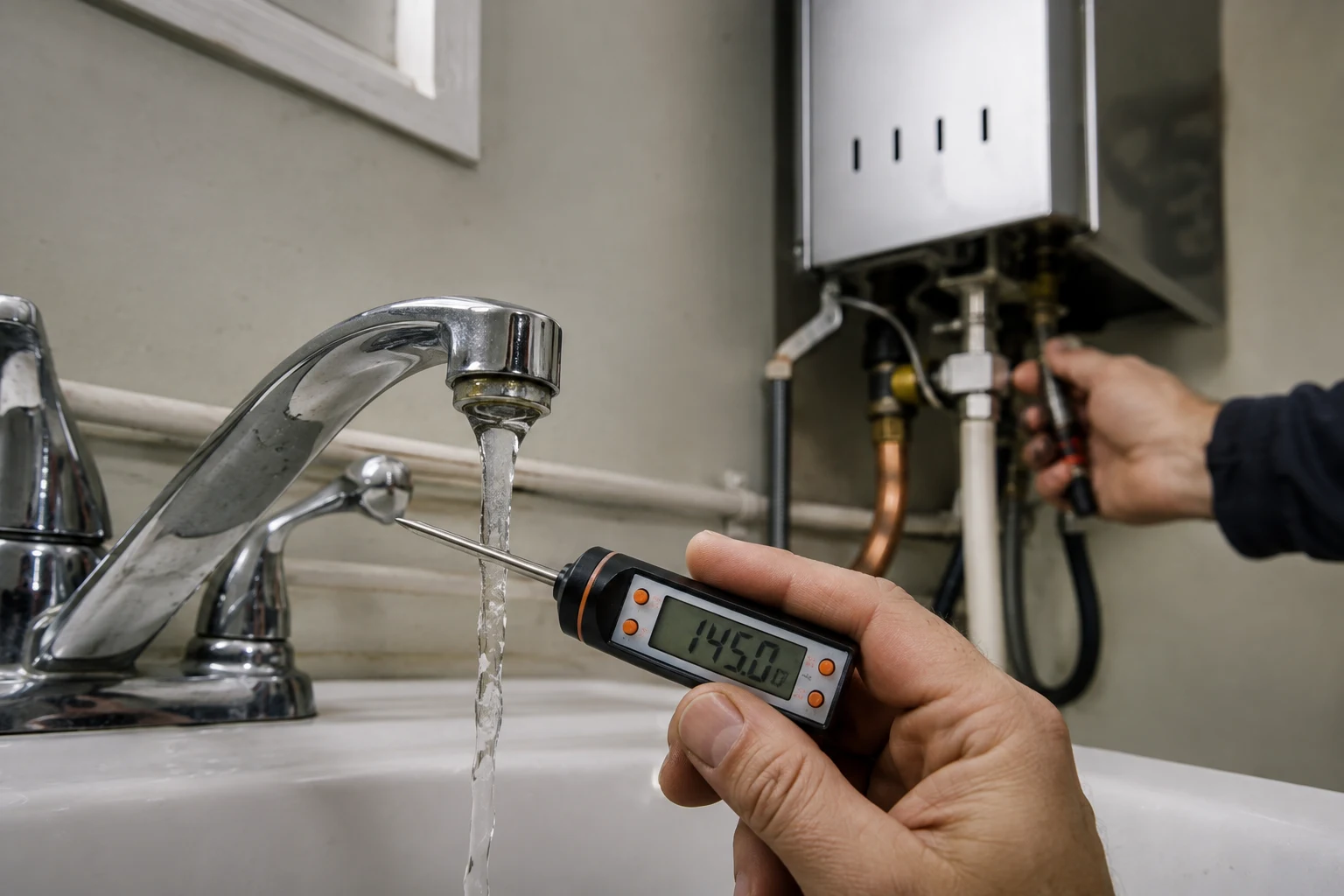
If you have flushed the unit properly and code 16 comes back within days, stop descaling and look at the parts that mimic a scale spike. This is where a licensed technician earns the fee, because these calls need a meter and, on gas settings, a combustion analyzer.
The outlet thermistor is first. These sensors drift as they age, and a drifting thermistor reports water hotter than it really is, tripping code 16 on a perfectly clean unit. A tech reads its resistance against the Noritz temperature chart and swaps it if it is off. The part is cheap; the diagnosis is the value.
Next is the bypass servo or mixing valve. Noritz units blend heated water with bypass water to hold a steady outlet temperature. If that servo sticks or will not modulate, the outlet swings hot and the thermistor catches it. Noritz service notes also list a damaged or loose heat-exchanger or thermistor connection and a malfunctioning or misadjusted gas valve among the code 16 causes.
Wrong gas type is a real one on units that were converted or installed sloppily. A unit set for the wrong fuel burns hotter than the board expects and overshoots. That is a combustion setup problem, not a homeowner fix. The control board is the last suspect, checked only after the sensor, servo, and gas side come back clean, because a bad board can misread the thermistor input.
Preventing the next code 16
Almost every repeat code 16 traces back to skipped maintenance. Descale on a schedule, once a year in hard water and every couple of years in soft water. Clean the inlet filter screen at the same time so flow never drops enough to spike the outlet. If your water is genuinely hard, a whole-house softener or a scale-inhibiting cartridge on the cold feed pays for itself by keeping the coil clean. Test your incoming water pressure and keep it at or above 25 psi so the unit gets steady flow to work with.
One more habit: do not run your setpoint pinned at the top. Leaving a few degrees of headroom means a normal transient will not immediately read as an over-temperature event. When code 16 does appear, log the date. A unit that throws it once a year after a missed flush is telling you to descale. A unit that throws it every week is telling you a thermistor or servo is failing, and that jump in frequency is your cue to call a pro before it turns into a cracked heat exchanger or a tripped code 14 fuse.
Frequently asked
Can I reset Noritz code 16 myself?
Yes. Turn off the hot water, unplug the unit or flip its dedicated breaker, wait about 20 seconds, then restore power. On models with a remote controller you can also clear the stored fault from the error history. The reset only clears the display. If the real cause is still there, code 16 comes back the next time the outlet water spikes, so treat the reset as a first step, not the fix.
What is the most common cause of code 16?
Scale inside the heat exchanger. Hard-water minerals coat the copper coil and act like insulation. Less heat crosses into the water per second, so the burner runs hotter to hit your setpoint, and the outlet temperature overshoots. When water flow then drops, the coil is already hot and the outlet thermistor sees a spike. A full descale clears this on a large share of units.
Will descaling clear Noritz code 16?
Often, yes, when scale is the cause. Noritz publishes a flush procedure: isolate the unit at the service valves, circulate a descaler such as white vinegar or CLR through the cold and hot ports with a small pump for 45 to 90 minutes, then rinse with fresh water. If the code returns within days of a proper flush, the problem is more likely a thermistor, a stuck bypass servo, or a gas setting, not scale.
How is code 16 different from code 14?
Code 16 is an over-temperature warning from the outlet thermistor: the board sees the water get too hot and restricts flow to protect the unit, and you can reset it with a power cycle. Code 14 is a physical thermal fuse that has already melted because the heat exchanger overheated. The fuse is a one-time part, so code 14 will not clear by cycling power. It needs a technician to replace the fuse and find why it tripped.
How much does it cost to fix Noritz code 16?
A DIY descale runs about $20 to $60 for solution, a bucket, hoses, and a submersible pump, or roughly $150 to $300 if a plumber does the flush. A replacement outlet thermistor is usually $30 to $90 in parts plus about an hour of labor. A bypass servo or gas valve pushes a repair into the $250 to $600 range, and a heat exchanger swap is the worst case at $400 to $1,500 or more.
Is Noritz code 16 dangerous?
The code itself is a safety response, not the hazard. The unit is telling you it saw water hotter than the target and it pulled back flow to keep from scalding you or cooking the heat exchanger. The risk is ignoring repeated code 16 events. Chronic overheating cracks heat exchangers and can trip the code 14 thermal fuse. If you feel bursts of very hot water at a tap before the code shows, stop using that fixture until it is fixed.
Why does code 16 keep coming back after I descale?
Two usual reasons. Either the flush did not fully clear the coil, common when the pump is too weak or the soak was too short, or scale was never the cause. A drifting outlet thermistor reads high even on a clean unit, and a bypass servo that will not modulate lets the outlet temperature swing. Both need a technician with a meter to test the sensor resistance and command the servo.
Can low water flow trigger code 16 by itself?
Yes. Noritz units need a minimum activation flow, generally around half a gallon per minute, and steady flow to carry heat away from the coil. A clogged inlet filter, a fouled aerator, a failing recirculation setup, or someone barely cracking a faucet can starve the exchanger. The water in the coil overheats between draws and the outlet thermistor catches the spike. Clean the inlet screen and check flow before assuming the worst.