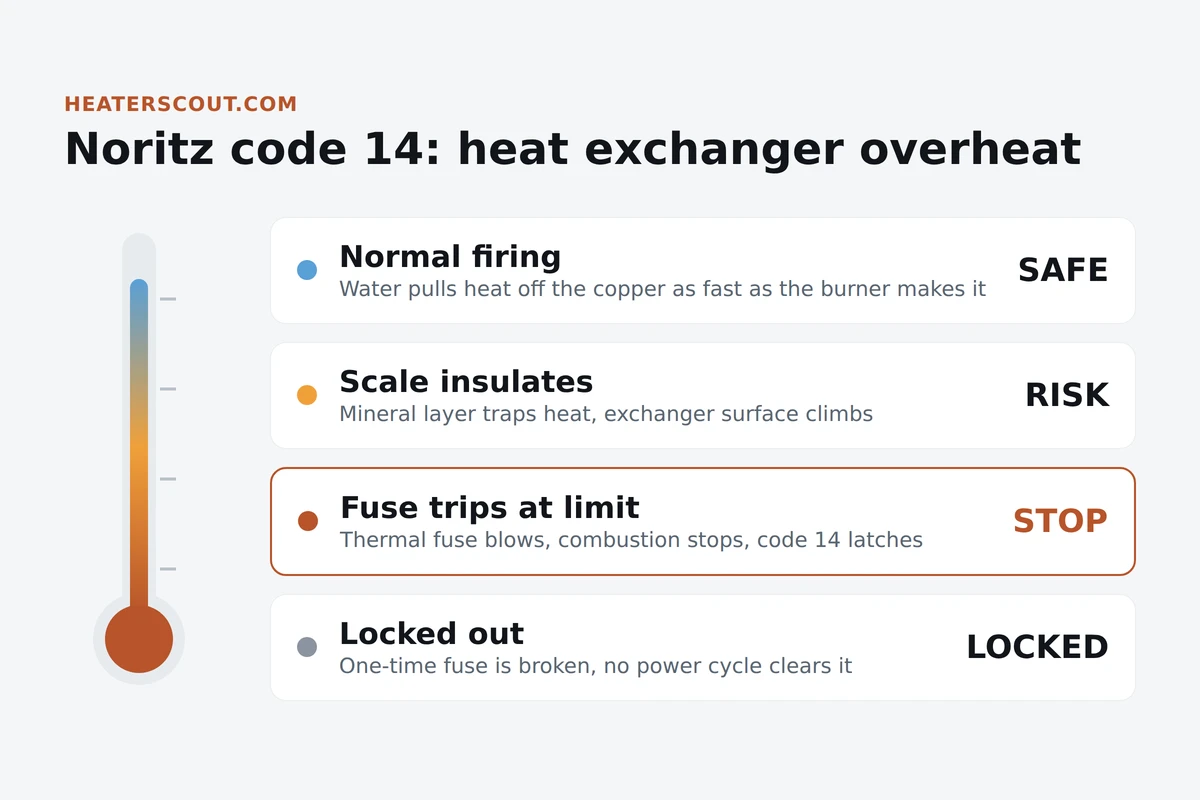
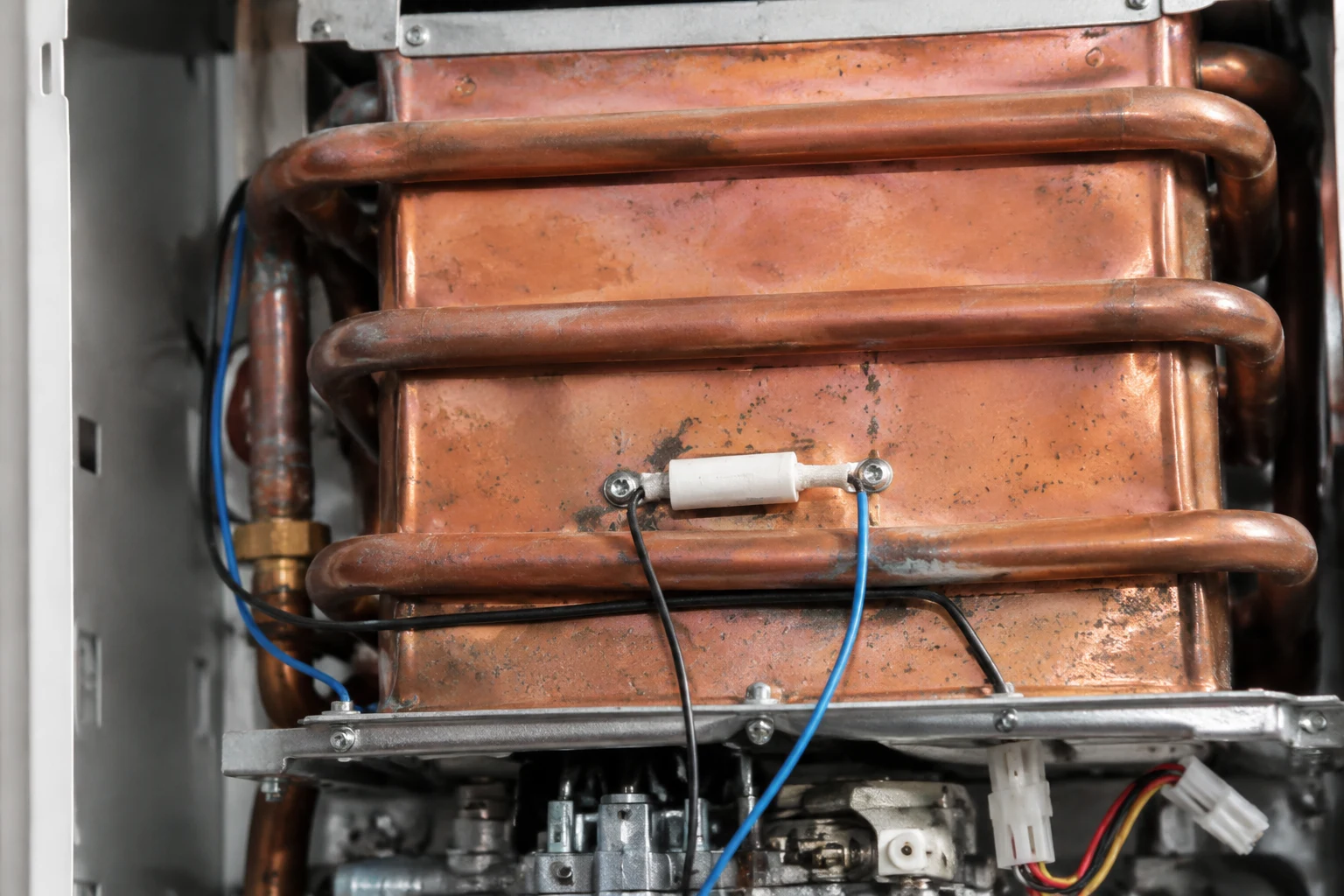
Noritz error code 14 is the heater telling you a physical fuse just melted. Not a soft glitch you can reboot away. On the copper heat exchanger models like the NRC98, NRC86, and most N-series units, code 14 means the thermal fuse wrapped around the heat exchanger got hot enough to trip and cut combustion. That fuse is a one-time part. Once it blows, no breaker flip, no unplugging, no button on the remote brings the unit back. The good news buried in that: the thing that overheated the exchanger is usually scale, and scale is something you can prevent. The blown fuse itself, though, is a job for a technician.
What you can safely do right now
Before you call anyone, there is prep worth doing, and it splits cleanly into what is safe with the covers on and what is not. Everything below happens outside the sealed cabinet. It will not clear the code, because the fuse is already spent, but it fixes the cause and can shorten the service visit. Do it in order and keep the unit powered off while you work.
Homeowner checklist before the service call
Run through this before a tech shows up. Half of these you can knock out yourself, and the rest are just notes to hand over so the visit is not spent on diagnosis you already did. The more of the cause you have pinned down, the less time on the clock.
- Confirm the exact code reads 14, and note your model number (NRC98, NRC86, N-0751M, etc.) so the right procedure gets used.
- Power the unit off at the breaker or switch and leave it off. Do not repeatedly power-cycle a latched code.
- Shut the cold water isolation valve, pull the inlet filter screen, rinse it clear, and reinstall it.
- Verify both isolation valves are fully open, lever handles inline with the pipe, not half-closed from a past repair.
- Check whether the unit has ever been descaled and when. Hard water plus no descale is the classic code-14 setup.
- Look at the exhaust and intake terminations outside for blockage, sagging pipe, or a bird nest that could restrict airflow.
- Do not bypass, jumper, or hard-wire around the thermal fuse under any circumstances. It is a safety device.
- Have your model and serial numbers ready so the tech brings the correct thermal fuse, and possibly a heat exchanger.
What you can do vs what needs a licensed tech
This is the split that saves a wasted call or a dangerous mistake. The line is simple: anything outside the sealed combustion cabinet is fair game for a careful homeowner. Anything inside it, and anything touching the fuse itself, is licensed-tech work. Code 14 is a good example of a code where the cause is DIY-adjacent but the actual clear is not.
Homeowner can do (safe)
- Clean the inlet water filter screen at the cold inlet.
- Confirm both isolation valves are fully open and flow is good.
- Run a descale flush with isolation valves, a pump, and Noritz-approved descaler.
- Inspect the exhaust and intake terminations outside for obvious blockage.
- Install a water softener or Noritz Scale Shield to stop future scale.
- Note the model number and code so the tech brings the right parts.
Licensed tech only
- Open the sealed cabinet and access the heat exchanger.
- Replace the one-time thermal fuse, which is what actually clears 14.
- Replace the heat exchanger if it is scaled or damaged.
- Test and adjust combustion, gas pressure, and the flame rod circuit.
- Diagnose a failed overheat sensor or control board if 14 returns.
- Power-cycle for 15 seconds to clear the display after the fuse is in.
Root causes, most likely first
The fuse is the symptom. Something made the exchanger run hotter than it was designed to, and that something is what your tech has to find so the replacement fuse does not blow again. Here is the order the field and the Noritz literature point to, from the overwhelming favorite down to the rare electronics failure.
1. Scale buildup in the heat exchanger
Far and away the top cause. Hard water leaves a mineral crust on the inside of the copper exchanger. That crust insulates, so heat that should transfer into the water stays in the copper. The surface climbs past its rating, and the thermal fuse trips. A code 14 in a hard water area is a near-certain sign the unit was overdue for a descale. The cure is descaling the exchanger and treating the incoming water going forward.
2. Low water flow or a clogged inlet filter
Water is what carries heat away from the exchanger. Restrict the flow and the surface temperature spikes even without scale. A screen filter packed with debris, an isolation valve left half-open, low incoming pressure, or a stalled recirculation loop all starve the flow. This is the most homeowner-fixable cause: clean the filter and confirm the valves are wide open before you assume the worst.
3. Blocked or restricted exhaust and intake
A tankless unit needs its combustion air in and exhaust out to run at the right temperature. A vent that is too long, improperly sloped, partly blocked, or terminated where it recirculates makes the burner run hot and inefficient. Check the terminations outside for nests, debris, snow, or crushed pipe.
4. Dirty burner or combustion fault
Over years the burner and combustion chamber can foul, throwing off the air-fuel mix and running the exchanger hotter than design. It needs a tech to inspect the burner, verify gas pressure, and confirm the flame rod circuit is clean.
5. Failed thermal fuse or overheat sensor
Occasionally the fuse or the high-limit overheat sensor fails or nuisance-trips without a genuine overheat. The tech replaces the fuse regardless, but if 14 returns with no scale, no flow issue, and a clean vent, a faulty overheat sensor becomes the suspect.
6. Control board (PCB)
The rarest cause. If the exchanger is clean, flow is good, venting checks out, and the fuse and sensor test fine, a control board misreading the overheat circuit can throw a false 14. It is a last-resort diagnosis after everything mechanical is ruled out, because a PCB is expensive to swap on a hunch.
Preventing the next code 14
Once you have paid for a fuse and a service call, the whole point is not to do it again. Code 14 is one of the most preventable Noritz faults because its top cause, scale, responds to routine maintenance. Descale the unit once a year, more often on very hard water, using isolation valves and Noritz-approved descaler, and clean the inlet filter screen at the same time. If your water is hard, put a softener or a Noritz Scale Shield ahead of the unit so scale never gets a foothold. Keep the vent terminations clear. Do that, and the thermal fuse spends its whole life doing nothing, which is exactly what a safety device should do.
Frequently asked
Can I reset Noritz error code 14 myself?
On most Noritz units, no, not by yourself and not with a power cycle. Code 14 on the copper heat exchanger models means a physical thermal fuse wrapped on the exchanger has heated past its limit and melted open. It is a one-time safety part. Once it blows it is broken for good, so flipping the breaker, unplugging the unit, or holding a button on the remote will not bring the heater back. Those tricks clear soft, self-recovering faults, but 14 is a hardware fault by design. What a homeowner can do is deal with the cause: shut the cold water off, rinse the inlet filter screen, confirm good water flow, and descale if it is due. That fixes the cause. It does not replace the blown fuse. For that you need a technician to open the unit and swap the part, and only after the new fuse is in does a 15-second power-off clear the display.
How much does it cost to fix Noritz code 14?
Plan on a service call of roughly $250 to $600 for a thermal fuse replacement on a straightforward install, and more if the heat exchanger has to come out or gets replaced. The fuse is a cheap part, often $20 to $60, but the labor is the money. A tech has to open the cabinet, get to the exchanger, replace the fuse, then find and fix why it overheated. Noritz and independent shops both quote two to four hours depending on how the unit is mounted. If the exchanger is heavily scaled or damaged, many techs replace it at the same time since it is nearly the same teardown, pushing the total toward $700 to well over $1,000. A descale-only visit, if that is all it needs, runs closer to $150 to $300.
Will descaling clear code 14 on my Noritz?
Descaling addresses the most common cause of code 14, but it will not clear a fault that has already latched, because the fuse is already blown. The order matters. Descale a Noritz that runs fine but is overdue, and you remove the mineral layer before it insulates the copper and trips the fuse, so descaling is prevention. If the unit already shows 14, the fuse is spent and no amount of flushing brings it back. The sequence then is: technician replaces the fuse, someone descales the exchanger so it does not overheat again, then power is cycled off for 15 seconds to clear the display. Descaling after a fuse replacement is not optional in a hard water area, because a fresh fuse in a scaled exchanger just blows again.
Is Noritz error code 14 dangerous?
The code itself is the safety system working, so seeing 14 means the heater protected itself rather than letting the exchanger cook. The thermal fuse kills combustion the moment the heat exchanger surface gets too hot, and code 14 is the record that it did its job. What would be dangerous is defeating it. Do not bypass, jumper, or hard-wire around the thermal fuse to get hot water back. That fuse is the last line between a scaled or airflow-starved exchanger and a real overheat event. Leave the unit off until it is properly repaired. If you smell exhaust or gas at any point, shut the gas off and ventilate first.
Why does Noritz code 14 keep coming back?
A repeat 14 almost always means the overheat cause was never fixed, only the fuse was. Scale is the usual culprit. If you live in a hard water area and the exchanger was never descaled, the fresh fuse sits on a copper surface that still overheats, and it blows again within weeks or months. The second suspect is water flow. A clogged inlet filter screen, a partly closed isolation valve, a failing recirculation setup, or low incoming pressure all reduce how fast water pulls heat off the exchanger, which lets the surface temperature spike. The third is combustion and venting: a restricted or improperly sloped exhaust, blocked intake, or dirty burner makes the unit run hot and inefficient. Fixing 14 for good means treating the water with a softener or a Noritz Scale Shield, keeping the filter clean, and confirming the vent is clear and correctly installed.
Does error code 14 mean the same thing on every Noritz model?
No, and this trips people up. On the older and standard copper heat exchanger models like the NRC98, NRC86, and many N-series units, code 14 is the thermal fuse tripping from heat exchanger overheat, which is the case this article covers. On the Pro Series and premix models, Noritz publishes a separate error code 14 article because those units use a different exchanger and control design, and the exact trigger and checkpoints are not identical. The overall meaning is still overheat protection, but the part involved and the service steps can differ. If your unit is a Pro Series or premix model, check the specific Noritz knowledge base article for your series and the service manual for your exact model number rather than assuming the copper-exchanger procedure applies.
Can I keep using hot water until a tech can come out?
No. When code 14 latches, the unit stops combustion and will not fire, so you get no hot water anyway, and you should not force it. Do not power-cycle it repeatedly hoping it clears, and absolutely do not bypass the fuse to get heat back. Leave the heater off, note the code, and if you can, do the homeowner-safe prep before the tech arrives: shut the cold water, rinse the inlet filter screen, and check that the isolation valves are fully open. Having the cause half-diagnosed can shorten the visit, and if the real problem is just a filthy filter plus scale, you have already pointed the tech at it.