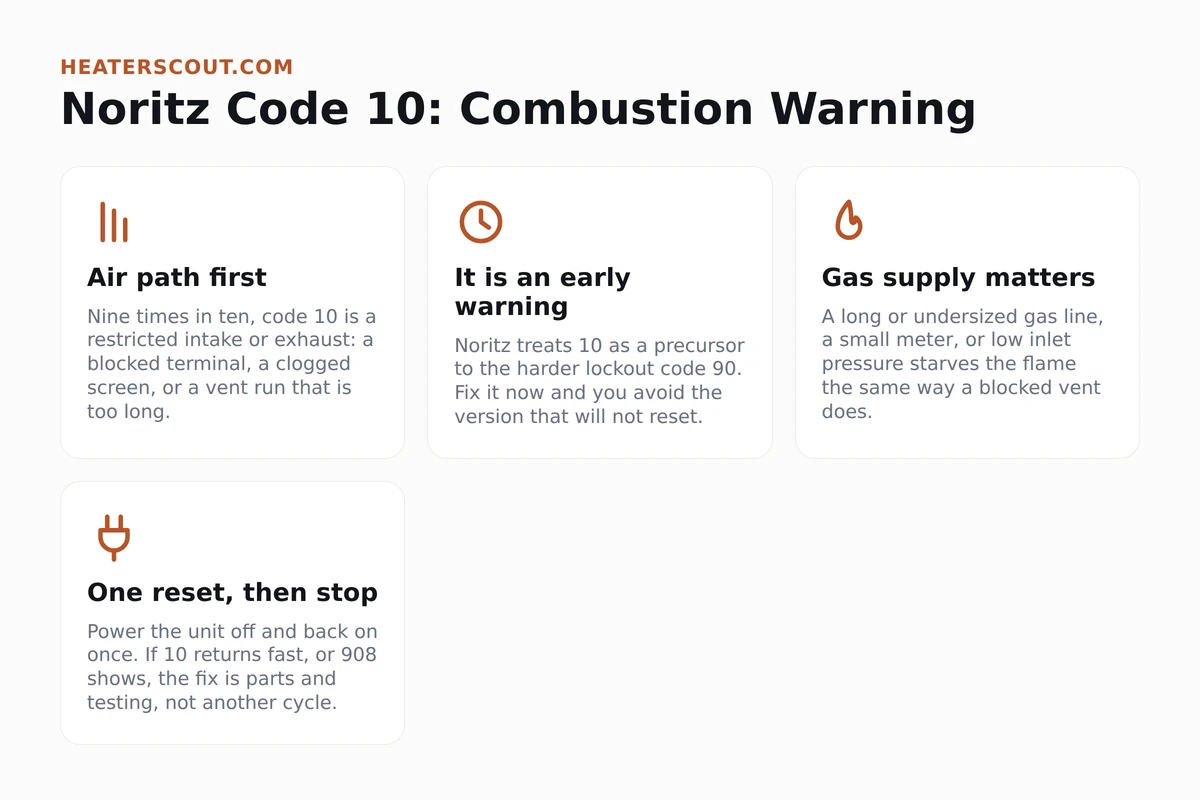
A Noritz tankless throwing code 10 is telling you something specific: the burner is not getting clean combustion, and the unit knows it. Noritz treats 10 as an early warning, an official precursor to the harder lockout code 90. The heater will often keep making hot water for a while, which is why homeowners tend to ignore a 10 until it graduates into a 90 that will not reset. Catch it now and the fix is usually cheap. Nine times out of ten it comes down to air: a blocked vent, a clogged intake, or a gas supply that cannot keep up.
Noritz code 10 (combustion abnormality)
The control board monitors the flame and the air-to-fuel balance while the burner fires. When combustion drifts outside the window the board expects, it posts a 10. Noritz documents this code as a precursor to error code 90, its full combustion lockout. Because 10 is a warning and not a hard stop, the unit frequently keeps running, so people miss it. The board is not guessing. Something is starving or unbalancing the flame, and the top suspect is a restricted air-supply or exhaust path.
The two things code 10 is really complaining about
Every cause of a Noritz 10 falls into one of two buckets: the air side or the fuel side. The burner needs a steady volume of combustion air in and a clear route for exhaust out, and it needs enough gas at the right pressure to fire cleanly. Choke either one and combustion goes ragged, and the board flags it. Knowing which bucket you are in tells you whether this is a five-minute fix at the outside wall or a call to a licensed tech with a manometer.
Air side (most common)
- Blocked vent terminal outdoors: snow, leaves, a bird nest, or a bag pressed against the cap.
- Clogged intake screen or air filter packed with lint and dust.
- Vent run too long or too many elbows for the model, choking flow.
- Condensate pooling or icing in the vent, narrowing the path.
- Dirty fan or burner from years of debris and built-up lint.
Fuel side (needs a pro)
- Gas line too long or undersized for the unit's demand.
- Undersized gas meter that cannot deliver rated flow.
- Low inlet gas pressure, especially when other appliances fire at once.
- Wrong vent-type, vent-length, or vent-size setting in the control board.
- Incorrect elevation setting for a high-altitude install.
Causes ordered by how often they cause a 10
Field experience and the Noritz troubleshooting notes line up here. Start at the top of this list, because the cheap and common causes sit above the rare and expensive ones. A homeowner can safely handle the first two or three rows. Everything below the line about gas pressure needs a licensed technician with the right instruments.
| Blocked vent terminal | The outdoor exhaust or intake cap is obstructed by snow, leaves, a nest, or debris. The single most common cause and the easiest to check. Homeowner-safe to clear. |
| Clogged intake screen or filter | The air intake screen or filter is packed with lint and dust, cutting the combustion air the burner can draw. Rinse or vacuum it clean. Homeowner-safe on most models. |
| Vent run too long or too restrictive | Too much pipe length or too many elbows for the model chokes both intake and exhaust flow. This is an install issue that a tech corrects by resizing or rerouting the vent. |
| Condensate pooling or ice in the vent | Trapped condensate or ice at the termination narrows the vent path in cold weather. Clear the ice; if it recurs, the vent slope or the condensate drain needs a tech. |
| Dirty fan or burner | Years of lint and debris on the fan wheel or burner unbalance combustion. Cleaning with an air compressor is technician work, not a DIY job on a live gas burner. |
| Wrong vent or elevation settings | Vent-type, vent-length, vent-size, common-vent, or elevation settings entered wrong at install. A tech verifies and corrects these on the board or via the EZ Start Plus app. |
| Weak or undersized gas supply | Long or undersized gas line, small meter, or low inlet pressure starves the flame. Requires a manometer to diagnose and possibly a larger line or meter. Pro only. |
Reset once, then stop and diagnose
Do not sit and cycle power on a Noritz that keeps throwing code 10. One reset is fine to clear a transient fault. But if 10 returns within minutes of firing, the combustion problem is still physically present, and repeated resets only hide a gas appliance running badly. If the controller shows 908 instead of a clean 10, an internal lock is active and you cannot reset it manually; that needs a Noritz service agent. And if you ever smell exhaust indoors or see a disconnected or sagging vent pipe, shut the unit off and call a licensed technician before doing anything else.
How to work through a code 10
Go in order. The first two steps are safe for a homeowner and clear a large share of code 10 calls at the outside wall. If the code survives those, you are into gas and vent-setting territory, which means measurement tools and a licensed tech. Do not skip ahead to guessing at parts.
1. Clear the exterior vent and intake terminations
Go outside to where the Noritz vents through the wall or roof. Look at both the exhaust and the intake caps. Pull away any snow, leaves, a bird or wasp nest, or trash that has blown against them. In a cold snap, check for ice at the termination. This is the number-one cause of code 10 and the one you can fix in five minutes with nothing but your hands and a flashlight.
2. Check and clean the intake screen or filter
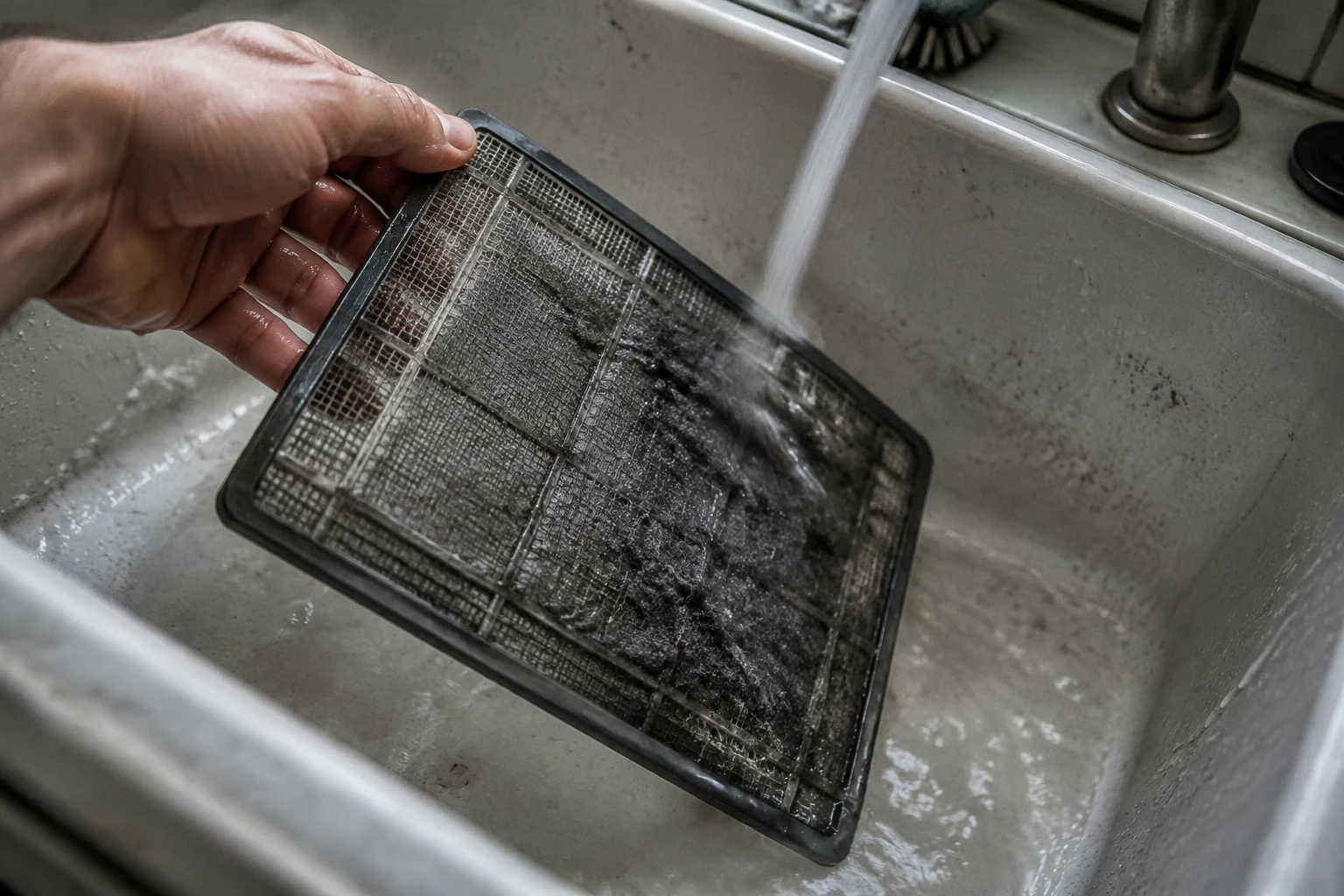
Many Noritz models have an air intake screen or filter that catches lint and dust. When it packs up, the burner cannot draw its combustion air and combustion goes ragged. Locate the intake screen per your model's manual, then rinse or vacuum it clean and reseat it. Keep it as a recurring maintenance item, because a house with a lot of dust or a nearby dryer vent will load it up again.
3. Power cycle once and watch
With the terminations clear and the screen clean, disconnect and reconnect power: switch the unit off, wait about thirty seconds, then power it back on. Run hot water and watch the controller. If the code stays gone, you found it. If 10 comes back within a few minutes, stop. The next steps are not homeowner work, and continuing to reset a bad-combustion gas unit is not the move.
4. Verify the vent configuration settings (technician)
A licensed tech confirms the vent-type, vent-length, vent-size, common-vent, and elevation settings on the control board match the actual install. These are set through the circuit-board buttons or the EZ Start Plus app over Bluetooth. A vent run that is longer or more elbowed than the settings assume will produce a 10 every time the burner ramps up, and no cleaning fixes a setting that is simply wrong.
5. Measure gas supply and pressure (technician)
If the air path is proven clear, the fault points at fuel. A tech puts a digital manometer on the gas inlet and checks that the unit gets rated pressure under all firing conditions, including when other gas appliances are running. Low inlet pressure, an undersized or overly long gas line, or an undersized meter all starve the flame. The cure may be resizing the line or upsizing the meter, which is why this end of the diagnosis is not cheap.
6. Inspect and clean the fan and burner (technician)
Last, a tech pulls the front and inspects the fan wheel and burner for lint and debris, then clears them with compressed air. A fouled fan or a dirty burner unbalances the air-fuel mix and throws combustion out of range. This is deliberately the last step because it means opening a live gas appliance, and it is only worth doing once the free and cheap causes are ruled out.
Which models show code 10 this way
The plain two-digit 10 is the Pro Series display, and the combustion-precursor meaning above is straight from Noritz's Pro Series documentation. Older and residential Noritz lines share the same combustion-fault logic and the same causes, and the troubleshooting does not change: air path first, gas supply second. If your controller shows 908 rather than 10, that is the internal lockout variant that blocks a manual reset, and it goes straight to a Noritz service agent. When a code keeps returning after one honest reset, the unit is asking for measurement and parts, not another power cycle.
Keeping code 10 from coming back
Prevention is mostly about the air path, because that is where the code lives. Keep the vent clearances the install manual calls for, and keep the outdoor terminations clear of snow drifts, leaves, and nesting birds and wasps through the seasons. Put the intake screen on your maintenance list and clean it once or twice a year, more often if the unit sits near a dryer vent or in a dusty space. Have the unit serviced annually so a tech can check combustion, clean the burner and fan before they foul, and confirm gas pressure stays in range. A code 10 that you fix and prevent is a code 90 that never happens, and the 90 is the one that leaves you with a cold shower.
Frequently asked
What does error code 10 mean on a Noritz tankless water heater?
Code 10 is a combustion abnormality. The control board watches the flame and the air-fuel balance during firing, and when combustion drifts outside the range the board expects, it posts a 10. Noritz specifically calls this out as a precursor to error code 90, the harder combustion lockout. In plain terms, the heater is telling you it is not burning cleanly, and the most common reason is that it cannot get enough combustion air in or push exhaust out. On the Pro Series models the code reads as a plain 10 on the controller. Because it is a warning rather than a hard lockout, the unit will often keep running and making hot water for a while, which is exactly why people ignore it until it turns into a 90 that will not clear.
Can I reset Noritz code 10 myself?
Yes, once. The Noritz reset for code 10 is to disconnect and reconnect power: turn the unit off at its switch or unplug it, wait about thirty seconds, then power it back on. If an obvious cause was transient, say a plastic bag blew against the outdoor vent terminal and then fell away, one power cycle clears it. What you should not do is sit there cycling power over and over. If 10 comes back within a few minutes of firing, the underlying combustion problem is still there and resetting only masks it. Note one thing: if the controller shows 908 instead of a clean 10, an internal lock is active and you cannot manually reset it. That one needs a Noritz service agent.
Is Noritz error code 10 dangerous?
It is a combustion warning on a gas appliance, so treat it seriously even though the unit may still run. Bad combustion means the burner is not getting the air it needs, and incomplete combustion of natural gas or propane produces carbon monoxide. A properly sealed direct-vent Noritz pushes its exhaust outdoors, so a single 10 with a working vent is usually not an immediate hazard. But a partially blocked or disconnected exhaust changes that math fast. If you have a carbon monoxide alarm, make sure it is working. If the vent looks disconnected, sagging, or you smell exhaust indoors, shut the unit off and call a licensed technician before you touch anything else.
Why does Noritz code 10 keep coming back after I reset it?
Because the reset does not fix the cause. Code 10 is the board reporting bad combustion, and a power cycle only clears the fault memory. If the vent terminal is still half blocked, the intake screen is still packed with lint, the gas line is undersized, or the inlet pressure sags when the burner ramps up, the next firing produces the same bad combustion and the same 10. A code that returns within minutes is Noritz telling you the problem is physical. Common repeat causes are a vent run that is too long or has too many elbows for the model, a dirty burner, or a gas meter that cannot deliver rated flow when other appliances are also running. Those need measurement, not another reset.
How much does it cost to fix Noritz code 10?
It ranges widely because code 10 has cheap causes and expensive ones. Clearing a blocked vent terminal or rinsing an intake screen costs nothing but your time. A licensed technician diagnostic visit with a manometer and combustion analyzer runs about $120 to $250 in most US markets. If the fix is correcting the vent, expect a few hundred dollars for added or resized pipe. If the gas supply is undersized, running a larger gas line or upsizing the meter is the priciest path and can reach four figures depending on the run. Parts like a fan motor or a cleaned or replaced burner assembly land in the $150 to $500 range plus labor. The good news is that many code 10 calls end at the vent, which is the cheap end.
Will descaling clear Noritz code 10?
No, and this is a common mix-up. Descaling flushes mineral scale out of the heat exchanger water side and cures flow-related and temperature-related complaints. Code 10 is about air and fuel on the combustion side, not water. Running a vinegar or descaler flush will not touch a blocked vent, a clogged intake screen, or a weak gas supply, so it will not clear a 10. Annual descaling is still worth doing for the health of the unit, but for code 10 you want to look at the vent terminals, the intake path, and the gas supply. Combustion faults and water-side scale are two separate maintenance jobs on the same appliance.
What is the difference between Noritz code 10 and code 90?
They are the same family of fault at two severity levels. Code 10 is a combustion abnormality warning; the unit noticed bad combustion but is still willing to run. Code 90 is the hard lockout that follows when the unit fails to reach the target temperature on repeated tries, and it stops the heater. Noritz states plainly that 10 is a precursor to 90, and the troubleshooting for both is nearly identical: check the vent settings, the air path, the burner cleanliness, and the gas pressure. The practical takeaway is that a 10 is your chance to fix the combustion problem while the heater still works, before it escalates into a 90 that leaves you with no hot water at all.