A Navien on the wall does not blink a mystery at you the way an old tank does. It puts a specific code on the display, and that code is the whole diagnosis if you read it right. The catch is that the field causes cluster into a short list, gas supply, water flow, scale, and venting, and most codes are just symptoms of that same handful of problems. Sort the code into one of those buckets and you know whether it is a filter you can clean or a manometer reading you need to call for.
Quick answer
Most Navien NPE and NPN faults fall into four groups. Combustion codes (E003 ignition failure, E004 false flame, E012 flame loss) point at gas supply, pressure, or the flame rod. Overheat codes (E016 heat exchanger, E030 exhaust) point at scale and low water flow. Air-path codes (E110 blockage, E109 fan) point at the vent, intake, or fan. And E515 is the control board. Read the exact code on the display, match it to your model's manual, run the safe checks, and reset only once. A code that returns after a reset means the cause is still there.
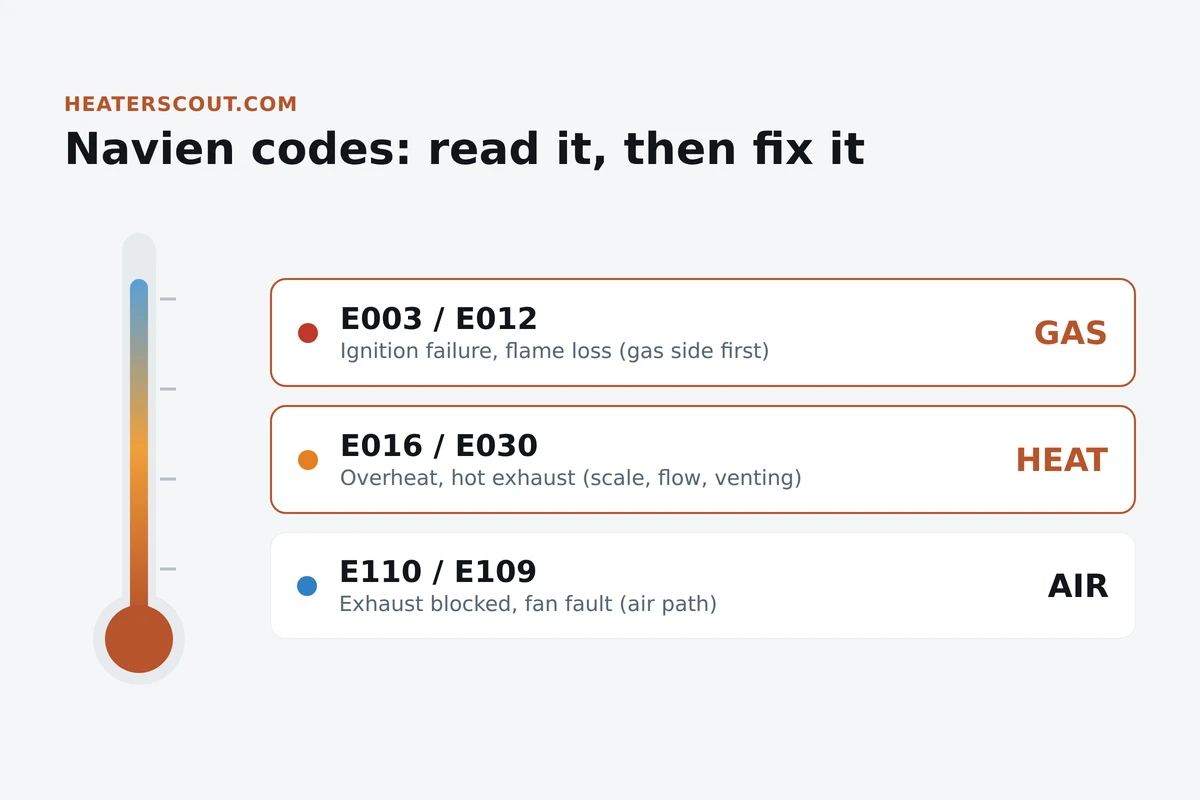
Combustion codes: E003, E004, E012
These are the ones that leave you standing in a cold shower. E003 is ignition failure. On a call for hot water the unit purges, sparks the igniter, and opens the gas valve, then the flame rod checks for an actual flame by reading the tiny current a flame conducts. If it never senses one, the board shuts everything down and posts E003 rather than release unburned gas. E012 is the near cousin: the burner did light, but the flame went out partway through the cycle. E004 is the mirror image, the control thinks it sees a flame when it should not, usually a grounding or flame-rod issue.
All three trace back to gas or air far more often than to a dead part. A gas valve that is not fully open. Pressure that reads fine at rest but sags below the minimum the second the burner pulls full load. Air drawn into the line after a propane tank ran empty and got refilled. A flame rod fouled with a thin oxide film so it misses a live flame. The unit that lights for a second and then drops out on E012 is the textbook low dynamic gas pressure story, and the fix is a correctly sized gas line, not a reset.
Confirm gas is actually reaching the unit
Test a stove or another gas appliance. On propane, make sure the tank is not empty. A whole house with no gas is not a Navien fault.
Open every valve in the path
The main gas valve handle should sit in line with the pipe. The hot and cold isolation service valves under the unit must be fully open, and the flow not reversed.
Purge air after a propane refill
When a propane tank runs dry it pulls air into the line. Cycle the unit and run another gas appliance briefly to draw fresh gas through. It can take a few ignition attempts before the flame holds.
Reset once, then stop
Press RESET, or power off five minutes and back on. If E003 or E012 returns, the remaining suspects are dynamic gas pressure, the flame rod, and the gas valve. Those need a manometer and gas certification.
Overheat and scale: E016, E030, and the flush
E016 is a heat exchanger overheat, and E030 is an abnormal exhaust temperature, the flue running hotter than it should. Different sensors, mostly the same root cause: heat that is not moving into the water the way it should. On a condensing tankless that almost always comes back to scale. Hard water lays mineral down inside the heat exchanger, the scale insulates the water from the flame, the metal runs hotter than the water coming out, and the safety trips. A clogged cold water inlet filter does the same thing from the other side by choking the flow, so less water is there to carry the heat away.
This is why descaling is the single most valuable thing you do for a Navien. Navien's own guidance is at least once a year, more often the harder your water. The procedure uses the isolation valves a proper install includes: hook a submersible pump and hoses to the service valve ports, circulate white vinegar or an approved descaling solution through the heat exchanger for at least 45 minutes, then flush with fresh water for at least ten. On NPE units with the built-in buffer tank, flush that separately afterward. If the display shows E760, that is not a breakdown, it is the flush reminder that the interval has come around.
| E003 | Ignition failure. Burner never lit. Gas off or low pressure, air in the line, LP/NG mismatch, dirty igniter, or fouled flame rod. Check gas and valves first. |
| E004 | False flame detection. Control sees flame current when it should not. Grounding, igniter, or flame-rod fault. Technician diagnosis. |
| E012 | Flame loss. Burner lit then the flame went out mid-cycle. Interrupted or low gas pressure, or a failing flame rod. Confirm gas valve open and pressure in spec. |
| E016 | Heat exchanger overheat. Scale in the exchanger or a clogged cold-water inlet filter cutting flow. Power off 30 seconds, clean the inlet filter, descale. |
| E030 | Abnormal exhaust temperature. Flue running hot, roughly past 230 F. Partial vent blockage or a scaled heat exchanger. Clear the vent, descale. |
| E047 | Exhaust thermistor fault, open or shorted. Check the thermistor connection and wiring. Technician. |
| E109 | Fan motor activity fault. Fan not spinning correctly or air pressure out of range. Clean the intake filter and fan; may need a fan replacement. |
| E110 | Exhaust or intake blockage. Obstructed vent pipe, ice, snow, leaves, or a nest. Clear the exterior termination; if it persists, a tech checks the flue. |
| E351 | Low water flow or flow-sensor fault. Flow below the activation threshold, a clogged inlet filter, or a fouled flow sensor. Clean the filter, open the valves. |
| E438 | Circulation pump abnormality on buffer-tank and recirculation models. May need the pump, flow sensor, or board checked. Technician. |
| E515 | PCB (control board) fault. The board, igniter, fan, venturi, and 3-way valve all get inspected. Technician. |
| E760 | Not a fault. Flush reminder. The unit is telling you descaling is due. |
The order to work a code in
Whatever code is showing, the sequence is the same. Bucket it, do the safe water-side and outside checks, descale if the unit is anywhere near due, then reset once and watch. Most codes clear somewhere in that walk. The ones that do not are telling you where the real fault lives.
Flame sensing rod (flame rod)
A small electrode that sits in the burner flame and proves the flame is present by conducting a tiny ionization current back to the control board. No current means no flame, so the board locks out on E003 or E012. Over time the rod fouls with an oxide film or its mount loosens, and then it misreads a live flame and throws a false code. It sits inside the sealed combustion chamber next to live gas parts, so cleaning it is a technician job, not a wipe-and-go.
Air path: E110, E109, and venting
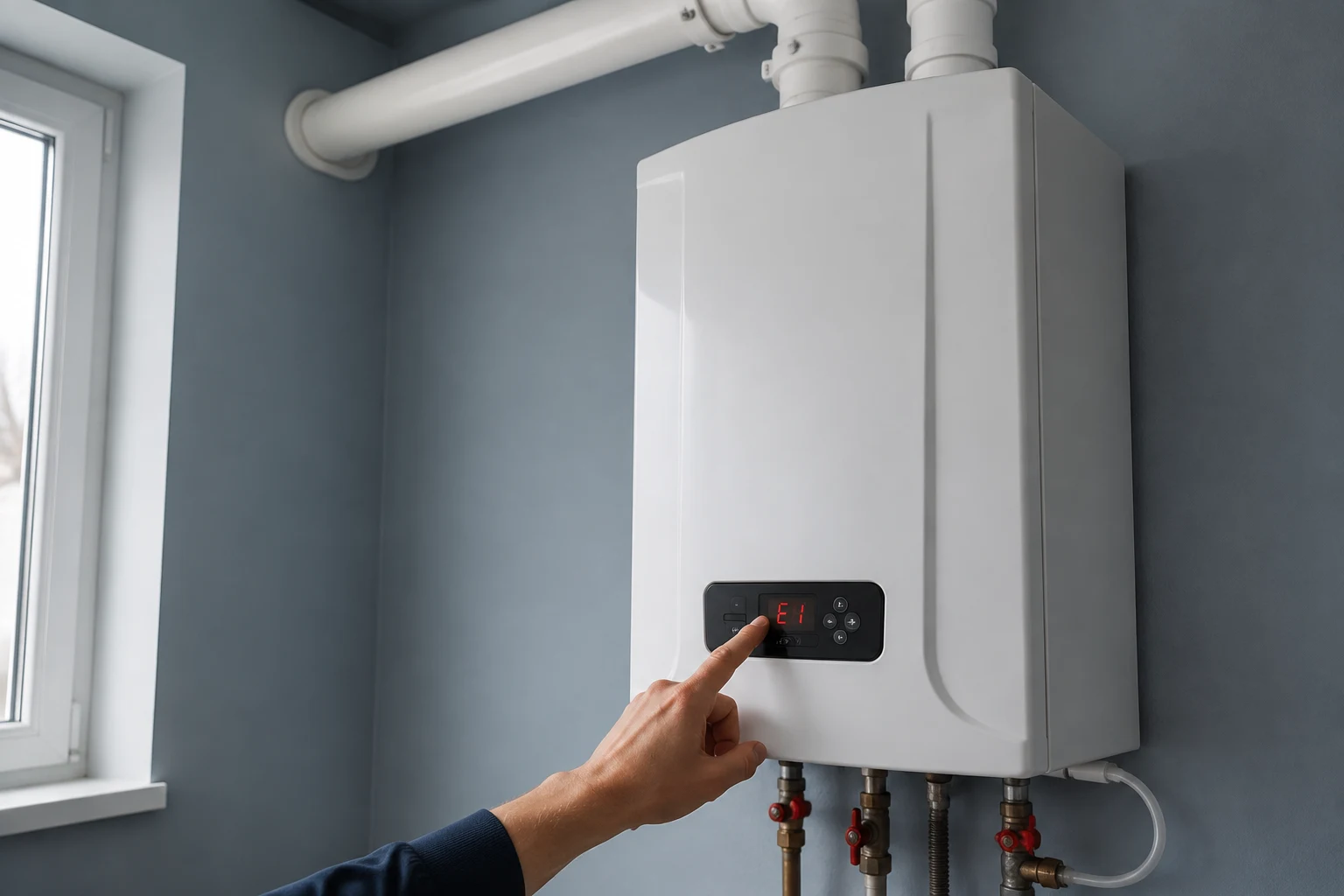
E110 is an exhaust or intake blockage and E109 is a fan motor fault, and both come down to combustion air not moving right. On these sealed condensing units the intake and exhaust run in dedicated PVC or polypropylene pipe out through a wall or roof, and the exterior termination is exposed. Leaves, snow, ice, a nest, or a termination set too close to the ground in a snow zone can all choke it. The intake filter behind the front panel also loads up with dust. You can safely inspect the outside vent and the accessible intake. What you should not do is open the sealed cabinet to reach the fan or venturi. If the terminations are clear and E109 or E110 persists, the fan or the air-pressure sensing needs a technician.
Water flow and the flow sensor: E351
A Navien needs water actually moving through it to fire. The flow sensor at the cold water inlet is a little turbine that spins with the flow and signals the board once you cross the activation threshold, around half a gallon a minute. Below that the burner will not light, by design, so a low-flow fixture or a partly closed valve can look like a dead heater. The most common real culprit is the cold water inlet filter clogged with sediment or scale, dropping flow below the threshold. E351 and the low-flow codes point right here. Clean the inlet filter and open both isolation valves before you suspect the sensor. A failed flow sensor is a part replacement, but it sits far down the list behind a dirty filter.
Freeze protection, and the reset that fixes nothing
Navien units carry built-in freeze protection, and it works whether the front panel is displaying or dark, but only while the power toggle and the cord stay energized. That is the winter trap. It runs on electricity, so a power outage during a hard freeze kills it, and water in the heat exchanger can freeze and crack the exchanger. In freezing weather leave the power and gas on. If your area loses power in storms, plan a battery backup or generator, or drain the unit if it will sit cold and unpowered. Outdoor and recessed installs take the brunt of it.
The reset button earns a warning of its own. On newer NPE and NPN units it is the return-arrow next to the power button, and a power reset is unplugging or switching off for five minutes. Either one clears the locked-out display so the unit tries again. Neither one touches the reason it locked out. A code that returns the moment you reset is telling you the fault is still live. Reset once, run the safe checks for that code's bucket, and if it comes back, stop resetting. Repeated resets on a combustion code just wear on a safety system doing its job.
Everything on the water side and the outside of the cabinet is a reasonable job for a careful owner: the inlet filter, the valves, the vent, the descale, one reset. Everything behind the sealed door is where a licensed installer or Navien service earns the call, because the failure mode there is a gas problem, not an inconvenience. The code on the display is your tie-breaker. Read yours against the manual for your specific NPE or NPN model, because the code map shifts a little between generations.
Frequently asked
What do the most common Navien error codes mean?
The ones people hit most are on the combustion side. E003 is ignition failure, the unit ran its lighting sequence but the flame rod never confirmed a flame, so it locked out. E012 is flame loss, the burner lit and then went out mid-cycle. E016 is a heat exchanger overheat, usually scale or a clogged inlet filter cutting water flow. E030 is an abnormal exhaust temperature. E110 is an exhaust or intake blockage. E109 is a fan motor fault. E515 points at the control board. E760 is not a fault at all, it is the flush reminder that the unit is due for descaling. On any of them, match the code to the manual for your exact NPE or NPN model, because the map shifts a little between generations.
Why does my Navien keep showing E003 or E012?
Both are combustion codes and both usually trace back to gas or air, not a broken board. E003 means the burner never lit, E012 means it lit and then the flame dropped out. The field-common causes overlap: a gas valve that is not fully open, low or sagging gas pressure when the burner pulls full load, air in the line after a propane tank ran empty and was refilled, or a fouled flame sensing rod that misreads a live flame. Start with what you can check without opening the unit. Confirm gas is on and another appliance works, that the service valves under the unit are open, and on propane that the tank is not empty and the line has been purged. If the code returns, the next suspects are dynamic gas pressure and the flame rod, and both need a technician with a manometer. Each reset clears the display, not the cause.
How often should I descale or flush a Navien tankless?
Navien says at least once a year, and more often when the water is harder. Their own descaling guide has you circulate white vinegar or an approved descaling solution through the heat exchanger for at least 45 minutes using a submersible pump and the isolation valves, then flush with fresh water for at least ten minutes. On NPE models with the built-in buffer tank you flush that tank separately. An E760 on the display is not a breakdown, it is the built-in reminder that the flush interval has come up. In hard-water areas, roughly 11 grains and up, once a year is a floor, and every six months is not overkill. Scale drives most of the overheat and efficiency complaints on these units, so this one job prevents more codes than any single repair fixes.
Can a Navien tankless freeze, and does it need power in winter?
Yes on both counts. Navien units have a built-in freeze protection function, but it runs on electricity, and it works whether the front panel is on or off only as long as the power toggle and the cord stay energized. That is the trap in a cold snap. If the power goes out during a hard freeze, the protection dies with it, and water in the heat exchanger can freeze and crack it. So in freezing weather keep the power and gas on, and if your area loses power in storms, plan for a battery backup or generator, or drain the unit if it will sit cold and unpowered. Outdoor and recessed installs are the most exposed. A cracked heat exchanger from a freeze is one of the few failures that is not covered and not cheap.
Why is my Navien not making hot water even though it powers on?
If it will not fire at all with the display alive, walk the water path before the gas path. Navien units need a minimum flow, roughly half a gallon a minute, to trigger the burner, and the most common thing that starves it is the cold water inlet filter clogged with debris or scale. A partly closed isolation valve does the same. If the burner fires and then the water turns lukewarm and swings hot and cold, that is the classic scale-and-flow picture, often riding alongside an E016 overheat. Clean the inlet filter, confirm the service valves are fully open, and descale if the unit is overdue. If it shows a specific code, read the code first, because E351 and its relatives point at flow rather than the burner.
How do I reset a Navien tankless water heater?
Press the RESET button on the front control panel. On newer NPE and NPN units it is marked with a return-arrow symbol next to the power button. If there is no obvious reset, or the code will not clear, do a power reset: switch the unit off or unplug it, wait a full five minutes, then restore power. Either way, understand what a reset does. It clears the locked-out display so the unit tries again, but it does nothing about why it locked out. A code that comes right back is telling you the fault is still there. Reset once, run the safe checks, and if it returns, stop resetting and diagnose the cause or call for service.
Which Navien problems can I fix myself, and which need a pro?
Homeowner-safe work is the water side and the outside of the unit: cleaning the cold water inlet filter, confirming the isolation and gas valves are open, clearing the exterior vent and intake of ice, leaves, or nests, descaling the heat exchanger with the isolation valves and a pump, and doing a single reset. The line to respect is anything that means opening the sealed cabinet or touching gas. Measuring gas pressure with a manometer, cleaning the flame sensing rod, working on the fan, the venturi, the gas valve, or the control board, and clearing a flue that is genuinely blocked are technician jobs, both because they need instruments and because a mistake around gas is dangerous. Repeated combustion codes, any E515 board fault, and any smell of gas are hard stops.