A Navien tankless does not have a tank to drain or an anode rod to swap, so it is easy to assume it runs maintenance-free. It does not. The heat exchanger that makes tankless so efficient is a tight coil of waterways, and in hard water those waterways scale up fast, choking flow and trapping heat until the unit starts throwing overheat and ignition faults. Navien's own guidance is a yearly descale, sooner if your water is hard, plus a short list of filters and traps to keep clean. This page walks the whole annual routine on an NPE unit: the flush through the isolation valves, the inlet and recirculation screens, the air intake filter, the condensate trap and neutralizer, and the flame rod, with the error codes each neglected task tends to trigger.
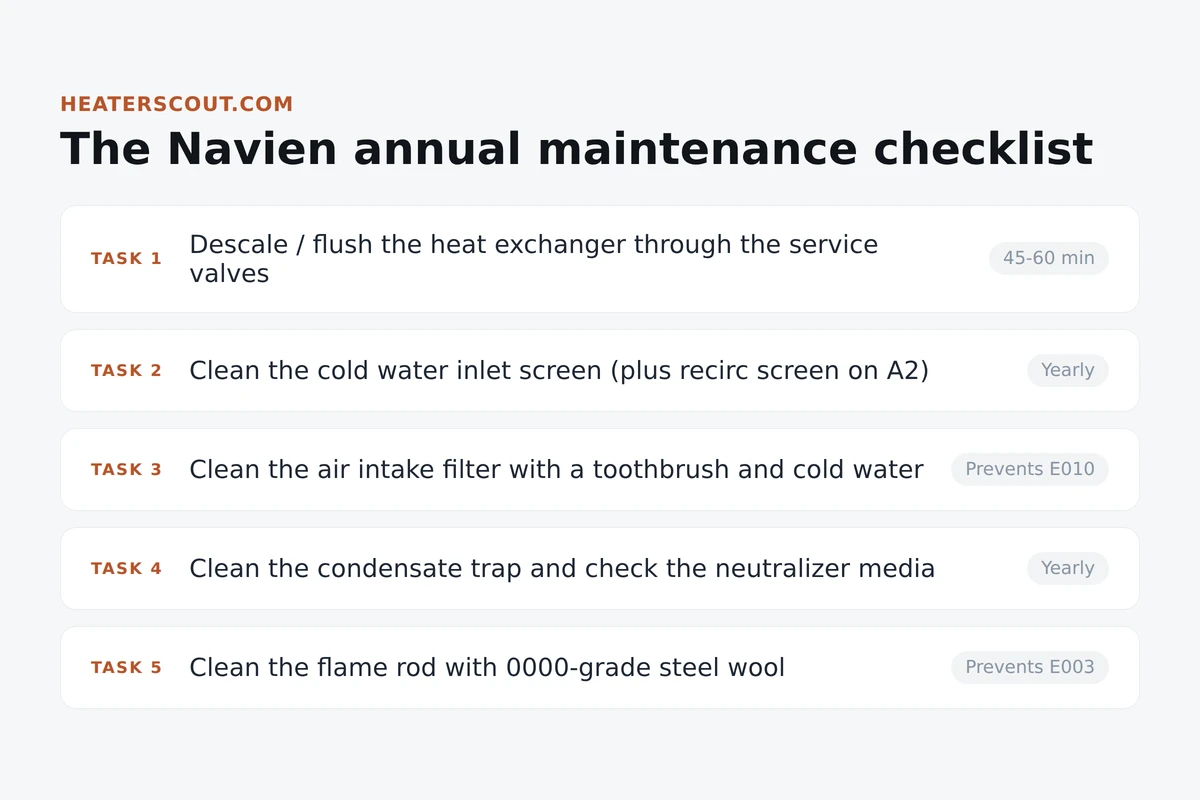
- Descale the heat exchanger once a year, or every six months on hard water
- Circulate descaler or white vinegar for 45 to 60 minutes, then rinse with fresh water at least 10 minutes
- Clean the cold water inlet screen, plus the recirculation screen on NPE-A and NPE-A2 models
- Clean the air intake filter with a toothbrush and cold water, and let it dry fully
- Clean the condensate trap and check or replace the neutralizer media
- Clean the flame rod with 0000-grade steel wool if you are comfortable pulling the front cover
The short version
Flush a Navien tankless heat exchanger at least once a year, dropping to every six months if you have hard water or heavy use. Circulate descaler or plain white vinegar through the isolation service valves for 45 to 60 minutes, then rinse with fresh water for at least 10 minutes. Around that core task, clean the cold inlet screen once a year (plus the recirculation screen on Advanced NPE-A2 units), clean the air intake filter so it does not clog and throw Error Code 10, and clean the condensate trap and neutralizer. Skip the flush and scale eventually shows up as an E016 overheat or an E030 exhaust fault.
Why a tankless needs more attention than a tank, not less
A tank water heater holds forty or fifty gallons and heats it slowly. Sediment settles to the bottom where it mostly sits harmlessly until it insulates the burner. A tankless is the opposite. It has no storage, so when you open a tap it fires the burner hard and slams cold water through a compact heat exchanger to heat it on the fly. That heat exchanger is a maze of narrow waterways running at high temperature, and high temperature plus hard water is exactly the recipe for mineral scale. The scale does not settle out of the way like tank sediment; it plates onto the inside of the waterways, narrowing them and insulating the metal from the water it is supposed to heat.
Two things happen as that scale grows. First, flow drops, because the passages are physically narrower, so the shower that used to run strong turns weak and the unit struggles to hold temperature. Second, the metal runs hotter than it should, because the scale layer keeps heat from moving into the water, and that is what eventually trips the overheat protection. On a Navien that shows up as E016, the heat exchanger overheat fault, or as E030, exhaust overheating, when the flue gas runs hotter than the board will allow. Both are the unit telling you the heat is not getting where it should. The fix for the scale is the annual descale, and doing it on schedule is the difference between a heat exchanger that reaches its fifteen year warranty and one that fails in year six.
The annual descale, step by step
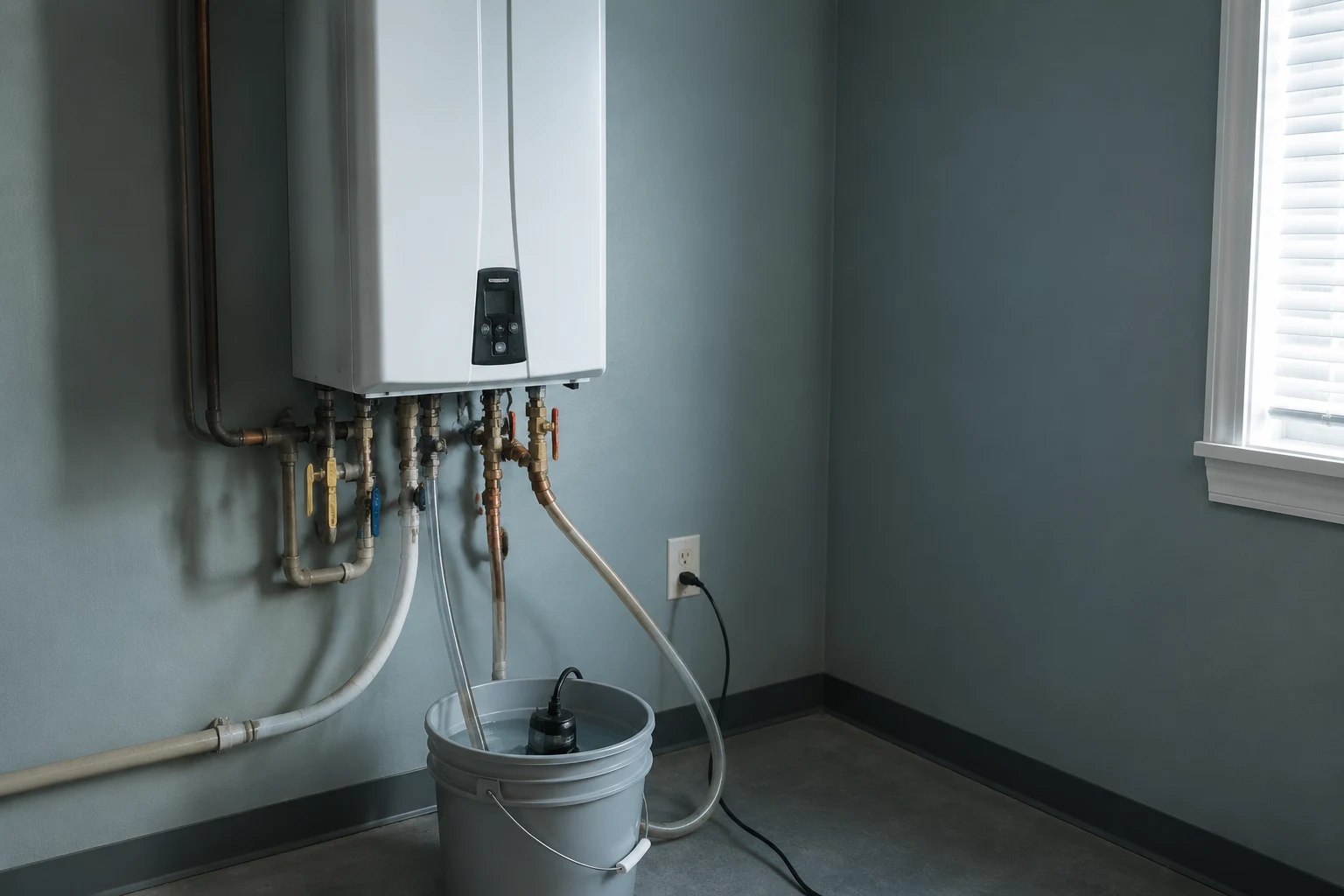
The flush is the heart of Navien maintenance, and it is a homeowner job as long as your unit was installed with an isolation valve kit. Those are the two valves with the small service ports, cold and hot, that let you close the unit off from the house plumbing and circulate cleaning solution in a loop. Navien labels the isolation valves and the drain-side service valves, and they are three-position valves: open to the house, fully closed, or open to the service port. If your install skipped the isolation kit, add it before your first flush, because flushing without it means cutting pipe.
Never skip the fresh water rinse
Rinse thoroughly after descaling. Navien calls for at least ten minutes of fresh water through the heat exchanger once the vinegar or descaler is done its work. Leftover acid sitting in the waterways keeps attacking the metal and can taint the first draws of hot water, so do not shortcut the rinse to save time.
How do I know if my Navien even has isolation valves?
Look at the water connections at the bottom of the unit. Isolation valve kits add a pair of valves, usually with a small capped service port and a handle, on the cold and hot lines right where they meet the heater. If you see plain pipe with no service ports, the kit was not installed, and adding it is a quick job for a plumber that turns every future flush into a homeowner task.
The screens: cold inlet and recirculation
Every Navien tankless has a water screen on the cold water inlet, a fine mesh that catches grit and debris before it reaches the heat exchanger. On the Advanced models, the NPE-A and the current NPE-A2, there is a second screen on the recirculation inlet, because those units carry a built-in recirculation pump and buffer tank that move water through an extra loop. The Standard NPE-S and NPE-S2 do not have the internal recirculation pump, so they have the single cold inlet screen unless an external recirculation loop was added.
Cleaning them is simple. Shut off the water, pull the screen out of its housing, rinse it under cold running water, and scrub it gently with a brush if it is fouled with sediment. A clogged inlet screen mimics a scaled heat exchanger from the user's side: weak flow, trouble holding temperature, the unit working harder than it should. Because it is so quick to check, the inlet screen is worth a look any time flow drops off, not just at the annual service. On an Advanced unit, remember the recirculation screen exists so you do not clean one and miss the other.
NPE-A2 (Advanced)
Built-in recirculation pump and buffer tank, no minimum flow rate. Clean both the cold water inlet screen and the recirculation inlet screen at the annual service, since this model has the extra loop that the Standard units do not.
NPE-S2 (Standard)
No built-in recirculation, though an external recirc loop is an option. Clean the single cold water inlet screen unless an external loop was added, and otherwise the descale and filter routine is identical to the Advanced.
Older NPE-A / NPE-S
The prior generation follows the same logic: Advanced has the recirculation screen, Standard does not, and both want the yearly descale, air filter cleaning, condensate trap, and flame rod care described here.
The air intake filter and inlet air screen
A condensing tankless breathes. It pulls combustion air through an intake, and Navien puts a filter and an inlet air screen inside the cabinet just below the air intake collar to keep dust, lint, and debris from being dragged into the blower, burner, and heat exchanger. In a dusty utility room, a garage, or a laundry closet full of dryer lint, that filter loads up faster than you would think, and a starved burner runs poorly.
The consequence of ignoring it is specific: when the air intake filter clogs badly enough, the unit stops operating and displays Error Code 10 on the front panel. That is a nuisance fault with a two minute fix, but only if you know to look. Clean the filter by keeping it free of dust and lint, brushing it with a toothbrush under cold running water, and letting it dry completely before it goes back in. No soap, no solvent, just a brush and water. Put this on the annual list and pull it forward if your unit lives somewhere dusty.
E010 is usually just a dirty air filter
If your Navien suddenly quits and shows E010, do not assume the worst. That code points straight at a clogged air intake filter. Pull it, clean it with a toothbrush and cold water, dry it, and reseat it before you call anyone. It is one of the most common self-fixable faults on the unit.
Condensate trap and neutralizer
Because the NPE is a condensing unit, it wrings extra efficiency out of the exhaust by cooling the flue gas until water vapor condenses out of it. That condensate is mildly acidic, and it drains out the bottom of the unit through a trap. The trap sits at the base of the cabinet and comes apart for cleaning: remove the metal wire clip under the bottom, pull the cup out of the trap, clean it, and when you put it back make sure the o-ring is seated correctly so it does not weep.
Many installs also route the acidic condensate through a neutralizer, a cartridge of calcium carbonate media that raises the pH before the water reaches the drain, which protects the drain line and satisfies local code. The media gets consumed over time and can pack down and restrict flow. Navien's neutralizers use a float that rises and locks in place when flow is restricted, and that locked float is your cue to open the neutralizer, clean or replace the media, and then press the float back down to reset it. Check the trap and neutralizer at the annual service and look for any leaks around them while you are there.
The flame rod
The flame rod, sometimes called the flame sensor, is a thin metal rod that sits in the burner flame and confirms to the control board that a flame is actually present. It works by passing a tiny electrical current through the flame, and anything that coats the rod, carbon, soot, or corrosion, breaks that signal. When the board cannot sense the flame it should be seeing, it treats that as a failure and locks out, which on a Navien reads as E003 ignition failure or E012 flame loss.
Cleaning the flame rod is a real fix for those faults and a good preventive task, but it goes deeper into the unit than the water-side work. Kill the power and shut the gas, then pull the front cover to reach the burner assembly. Clean the rod gently with 0000-grade steel wool until the metal shines, which removes the carbon layer without gouging the surface. If you are not comfortable working near the burner and gas, this is the one task worth handing to a technician, while you still handle the flush, the screens, and the traps yourself. Owners commonly split the routine that way, and it keeps most of the work in your hands without asking you to open the combustion side if you would rather not.
Hard water is the whole story
Nearly everything on this list traces back to water. Scale in the heat exchanger is a mineral problem, the inlet screens catch mineral grit, and the descale interval is set entirely by how hard your water is. That is why Navien frames the schedule the way it does: at least once a year, and every six months if your water is especially hard or you use a lot of hot water. If you do not know your hardness, the descale bucket tells you. Flush at twelve months and watch what comes out. If the solution stays fairly clean, yearly is fine. If it comes out cloudy and gritty, your water is scaling the unit faster than the annual cycle can keep up, and you should either shorten the interval to six months or add water treatment.
A water softener or a scale-reducing filter upstream is the long-term answer for a hard water home. It cuts the mineral load reaching the heat exchanger, which stretches the descale interval, protects the screens, and adds years to the unit. It does not let you cancel the flush entirely, because even softened water drops some mineral at tankless temperatures, but it moves you from the six month cycle to the yearly one. Keep the annual routine on the calendar, and a Navien NPE will run efficiently for the full length of its warranty rather than dying early of a problem that a bucket of vinegar and an afternoon would have prevented.
Frequently asked
How often should I flush a Navien tankless water heater?
Navien recommends descaling the heat exchanger at least once a year. If you have hard water or run a lot of hot water, drop that to every six months, because minerals build up faster than the annual schedule can keep up with. The flush is the single most important task on the list: it clears the lime scale that coats the inside of the heat exchanger, and scale is what quietly steals efficiency, chokes flow, and eventually pushes the unit into an overheat or exhaust fault. Water hardness drives the interval more than anything else, so if your area runs hard and you have no softener or scale filter, plan on the six month cycle. A quick way to gauge it is to watch your descale solution: if it comes out cloudy and gritty at twelve months, you waited too long and should shorten the interval.
What do I need to flush a Navien tankless?
You need the isolation valve kit installed on the unit, a small submersible pump, two washing-machine hoses, a five-gallon bucket, and about four gallons of descaler or plain white cleaning vinegar. The isolation valves are the part that makes this a homeowner job instead of a plumbing job: they are the cold and hot valves with the little service ports, and they let you close the unit off from the house and circulate cleaning solution in a loop without touching the plumbing. If your Navien was installed without an isolation valve kit, that is the first thing to fix, because flushing without it means cutting into pipes. Cleaning vinegar works and is cheap, but a dedicated tankless descaler is a little faster on heavy scale. Do not use anything harsher than vinegar or an approved descaler, since aggressive acids can attack the heat exchanger you are trying to save.
Which filters does a Navien tankless have and how do I clean them?
Every Navien tankless has a water screen on the cold water inlet, and the Advanced models, the NPE-A and NPE-A2, add a second screen on the recirculation inlet. To clean either one, shut the water off, pull the screen, rinse it under cold running water, and scrub it gently with a brush if it is fouled. Separately, there is an air intake filter and an inlet air screen inside the cabinet just below the air intake collar. That one catches dust and lint, and you clean it with a toothbrush and cold water, then let it dry fully before it goes back. The air filter matters more than people expect: if it clogs, the unit stops and shows Error Code 10 on the display. So a Navien has three or four screens depending on model, and all of them come clean with water and a brush, no chemicals.
What happens if I never do maintenance on my Navien tankless?
Neglect shows up as error codes and lost performance long before the unit dies outright. Scale in the heat exchanger restricts flow and traps heat, which can trigger E016, the heat exchanger overheat fault, or E030, exhaust overheating. A dirty flame rod stops sensing the flame reliably and throws E003 ignition failure or E012 flame loss, because carbon on the rod breaks the tiny current that tells the board a flame is present. A clogged air intake filter stops the unit and shows E010. Before any of those hard faults, you lose efficiency and flow: showers turn lukewarm and the gas bill creeps up. The heat exchanger carries a fifteen year warranty, but that warranty assumes the maintenance was done, so a unit killed by scale in year six is a self-inflicted wound.
Can I do Navien maintenance myself or do I need a plumber?
The flush, the filter cleanings, and the condensate trap are genuinely homeowner tasks if the isolation valve kit is already on the unit. The flush is the biggest one and it is mostly patience: hook up the pump and hoses to the service ports, circulate descaler for forty-five minutes to an hour, then rinse with fresh water for at least ten minutes. Cleaning the inlet screens and the air filter is a few minutes with a brush, and the condensate trap pulls out from the bottom after you remove a wire clip. The one task that gets closer to service territory is the flame rod, because it means killing the gas and power, pulling the front cover, and working near the burner. If you are not comfortable there, leave the flame rod to a technician and do the water-side maintenance yourself. Many owners split it exactly that way.
Do I need to clean the condensate neutralizer on a Navien?
If your Navien is a condensing unit, which the NPE series is, it produces acidic condensate as it pulls heat out of the exhaust, and many installs route that condensate through a neutralizer before it hits the drain. The neutralizer is a cartridge of calcium carbonate media that raises the pH so the acidic water does not eat your drain line or run afoul of local code. Over time the media gets used up and can pack down. Navien's neutralizers have a float that rises and locks when flow gets restricted, which is your signal to open it up, clean or replace the media, and press the float back down to reset it. While you are in there, clean the condensate trap at the bottom too: pull the wire clip, remove the cup, and make sure the o-ring seats correctly on the way back so it does not weep.
Does a water softener mean I can skip flushing my Navien?
It lengthens the interval but it does not eliminate the flush. A softener or a scale-reducing filter cuts the mineral load reaching the heat exchanger, so a home with truly soft water can often stretch to the annual descale comfortably and may find very little scale when they do it. But softened water is not distilled water, and a tankless heat exchanger runs hot enough to drop some mineral out of even good water, so the yearly flush stays on the calendar. The proof is in the bucket: if your annual descale comes out nearly clean, your water treatment is doing its job and yearly is fine; if it comes out gritty, shorten the interval or look at your softener.